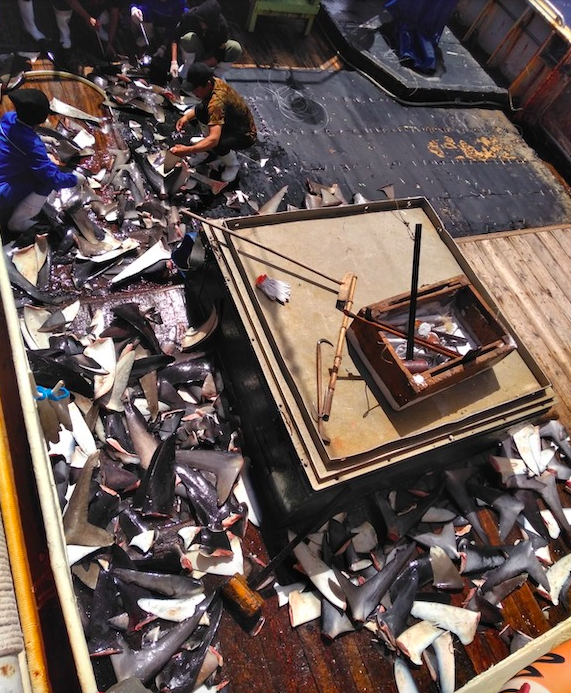
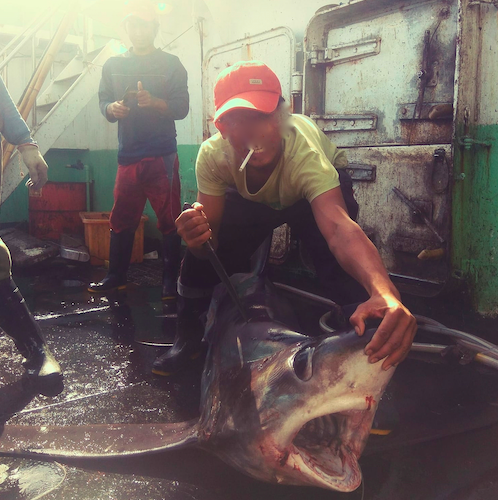
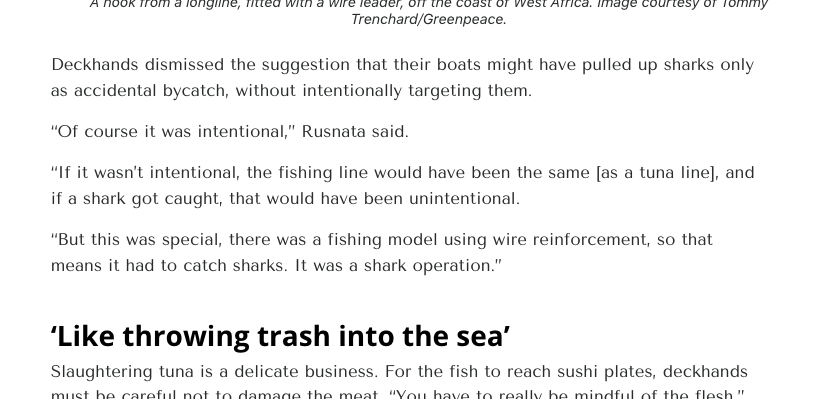
This was taken on the Long Xing 629, a DOF boat that went viral in 2020 after four Indonesian deckhands fell ill and died from nightmarish working conditions.
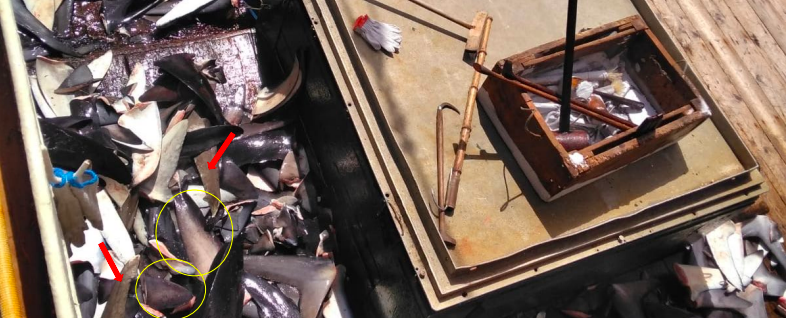
Experts who reviewed the images identified fins of endangered oceanic whitetip sharks (indicated), among other species.
Despite foremen and captains going through deckhands' phones and deleting photos of sharks and other protected species, some deckhands managed to smuggle photos off their ships.
Second point: shark finning
Our interviewees gave incredibly detailed descriptions of the entire process of catching and killing the sharks and removing, drying, packing, weighing and storing the fins.
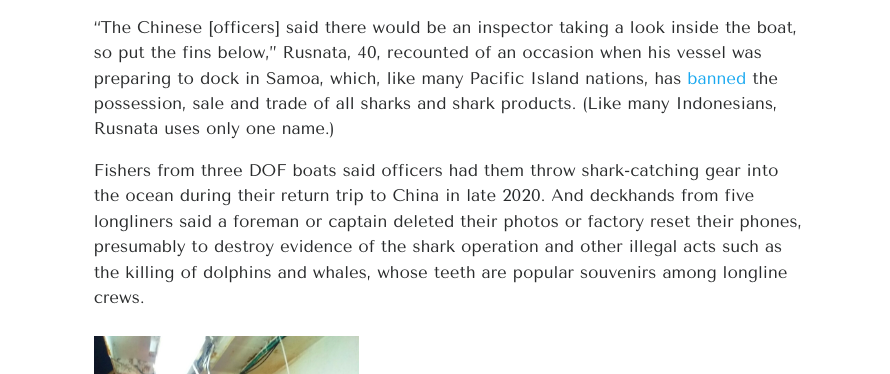
They also recounted how their bosses tried to evade law enforcement.
Longline boats tend to pull up lots of shark as unintentional bycatch, but our interviewees made clear this was something else entirely: the deliberate targeting of sharks, on an industrial scale.
Said one deckhand: “Of course it was intentional. … It was a shark operation.”
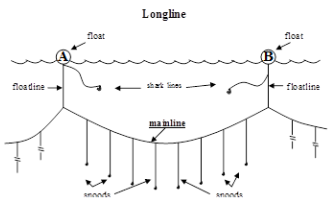
It’s illegal to use shark lines (which dangle closer to the surface) and wire leaders (which sharks can’t bite through) simultaneously in the western Pacific, DOF’s primary hunting ground.
DOF was using them simultaneously. A lot.
First point: banned gear and deliberate shark catching
DOF used what are known as shark lines and wire leaders to intentionally target shark.
The firm has always presented itself as a tuna company, claiming to be China’s largest supplier of sashimi-grade tuna to Japan.
We tracked down ~70 of DOF's former deckhands on Indonesian social media and persuaded some to go on record. We ended up interviewing 16 men from 12 DOF boats. They include Adhi Tayuh Braka, pictured below.
3. DOF did all this on such an enormous scale that it indicates China is drastically undercounting the entire country’s shark catch.
The findings are based on interviews with dozens of Indonesian men who worked on more than half of DOF's boats from 2018-2020.
Three main findings:
1. The company, Dalian Ocean Fishing, used banned gear to deliberately catch sharks in international waters.
2. DOF finned sharks, which is illegal. Finning is when you cut off the fins and throw the body overboard.
🚨New investigation🚨
This article by me and @BGokkon reveals a massive illegal shark finning operation across the fleet of a major Chinese tuna firm.
It's based on dozens of interviews with Indonesian men who worked on nearly 20 of the company’s boats. https://t.co/tVP7DANmTG
A lack of #transparency in seafood supply chains has been linked to slavery, child labour, food insecurity and the loss of livelihoods.
A toolkit to support seafood companies in sourcing seafood free of illegal fishing or abuse is now freely available: https://t.co/Bkrfu744EN
Hi friends! Excited to report that we have a new open-access paper out today in Scientific Reports: "the role and value of science in shark conservation advocacy!"
We (@NickDulvy@dr_catmac Scott Wallace and I) surveyed shark conservation advocates.
https://t.co/ZO83FV8Pd1
Read our 1st year report here https://t.co/YjRq1fnsfj
This is just the beginning, we are continuing to develop to become a better citizen science project that can support Elasmobranch conservation. Thank you for being a part of our journey so far 🤟
#Progress#CitizenScience
Paper alert! 📣 “We undertook a solution scan to identify & collate 161 possible options for reducing the risks of further epidemic disease transmission from animals to humans”. 🐓🦠🧍♀️Chuffed this is finally published & what a privilge to part of this epic inter-disiplinary team
👨🔬MEET THE RESEARCHERS 👨🔬
Today we meet Dr. Jorge Llopis (@Jorge_Geopis) , a postdoctoral researcher at Bangor University and our Research Associate here at ICCS! Jorge studies human responses to conservation interventions.
Watch the interview in the thread below ⬇️
(1/5)
Jorge talks about how interviewing the local people in Dakar, Senegal after finishing his undergraduate degree in History sparked his interest in conservation.
(2/5)
Jorge did his Masters and PhD research looking at the impact of Protected Areas on the local people in Madagascar. He is currently doing postdoctoral research on the same topic, building on the 10 years of experience he has gained in this field!
(3/5)