The last 12 hours of our Kickstarter are here! If you can, please share this with your favorite content creator, news outlet, friends, etc.
At 2:00PM EST we're having a Discord meeting to celebrate the campaign which ends at 11:59PM EST tonight!
Gamers, together we are mighty!
¡Lanzamos nuevo sorteo: el juego físico de MOUSE PI For Hire a elegir entre PS5 y Nintendo Switch 2!
Para participar:
-RT a este Tweet
-Seguir a @wakkapoficial
Finaliza el Lunes 13 de julio
SHARE IT! SIGN IT! SUPPORT IT!
This is the largest petition against Sony's attack on ownership out there at the moment: https://t.co/ZJGO46mfuU
Started by @PNPGames. If you want to support them (and us), shop games you will own here (ref link): https://t.co/DxZbeJzs6N
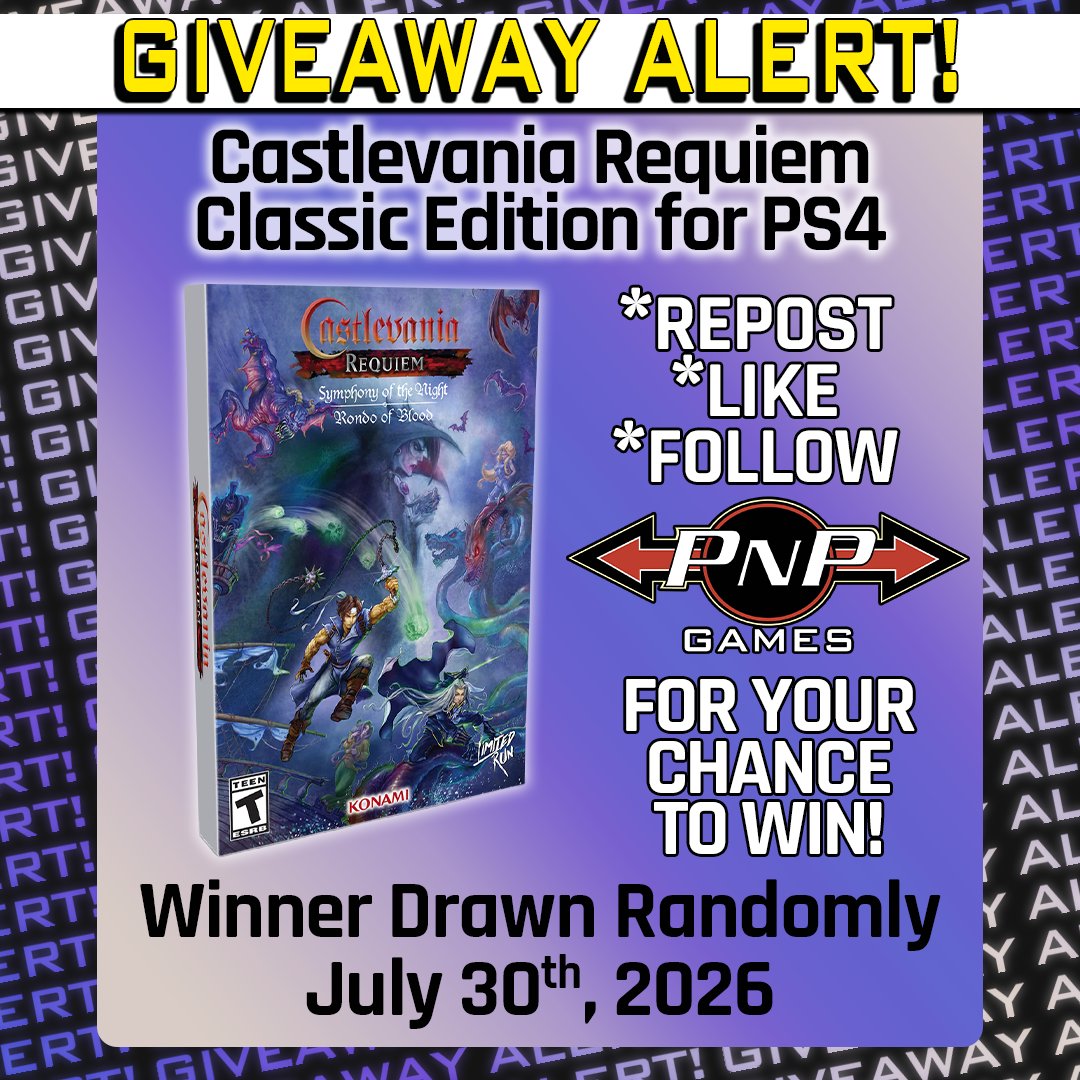
GIVEAWAY ALERT 🦇
REPOST, LIKE, AND FOLLOW PNP GAMES for your chance to WIN a Castlevania Requiem Classic Edition for PlayStation 4!
Experience two of the greatest games ever made!
#VideoGames#Canada#USA#Free#Giveaway
*No purchase necessary, a winner will be drawn at random on JULY 30TH, 2026 and contacted via a direct message from THIS official PNP Games social media account.
(Open to residents of Canada/USA/UK/AU/FR/JP and ANYWHERE PNP Games ships!)
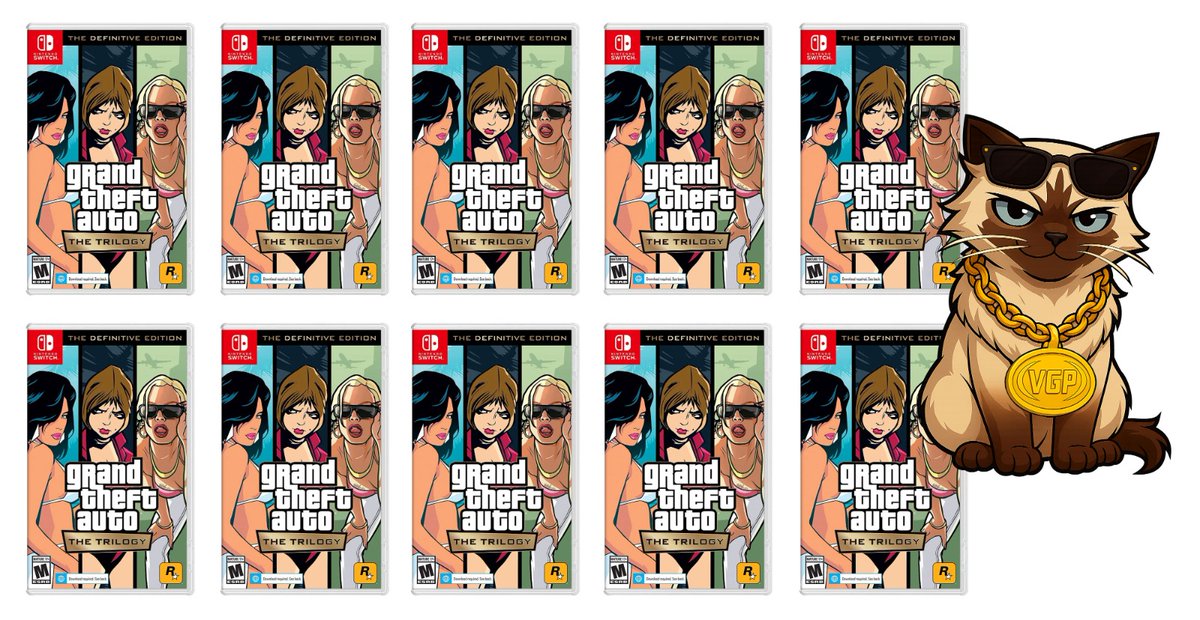
VGP Glitch Giveaway Time!
Glitch is giving away 10 copies of Grand Theft Auto: The Trilogy - The Definitive Edition Nintendo Switch to 10 lucky winners (1 copy per winner)
RT, Like and Follow VGP to enter for a chance to win!
Winners announced Thursday, July 16, 2026!
GTA 6
Te late la historia? que tal las narraciones de acontecimientos y personas más extraños, horrible y dificiles de creer? si respondiste si a las 2, esto es para ti. Proximamente en Youtube.
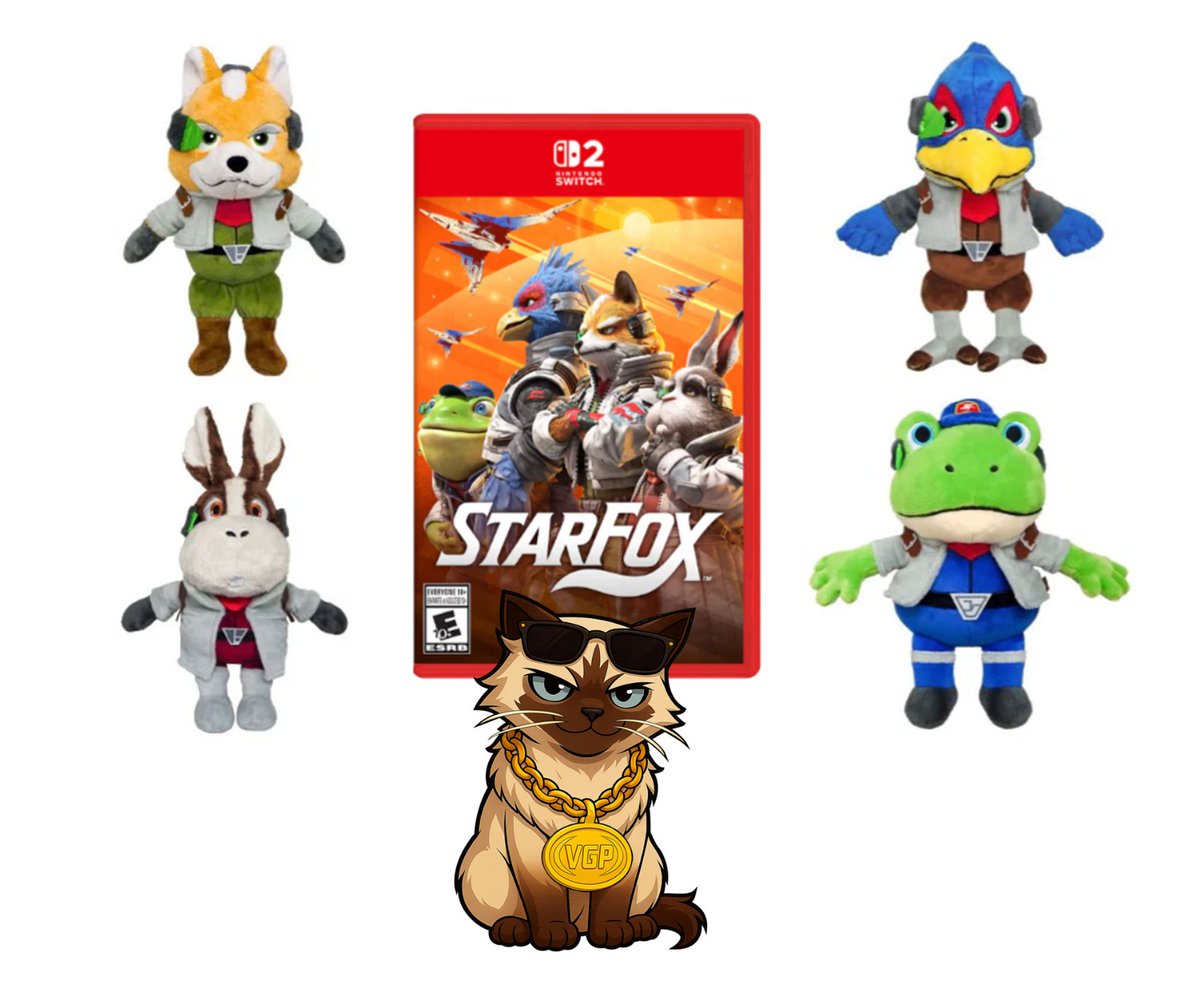
We are giving away the new Starfox Switch 2 game and plush set to celebrate the release this week.
To enter:
Follow us
Like this post
Tag a friend in the replies
The winner will be drawn live during our game stream this Thursday 6/25/2026!
Let me talk about the final subject of “poverty”—real poverty.
There is actually no such thing as “fake poverty.”
People in countries with a GDP per capita in the $30,000 range still struggle in their own way, even if clean running water is readily available.
In countries with a GDP per capita of around $60,000, such as the United States, the middle class also struggles, even if their cars are extremely large.
The standards are simply different.
There are many definitions of hardship.
In some cases, even eating cup ramen noodles can feel like a sign of wealth, while in others, life can feel extremely difficult despite outward stability.
However, there are also people who are truly poor by any global standard.
I know a wonderful Japanese person who volunteered in parts of Africa where there is no electricity or running water.
She lived there for several years and taught children in those communities.
Those children do not have smartphones, of course, which means they have almost no way to access manga at all.
(Of course, this is a simplified description. Reality is always more complex, and I hope to talk about it in more detail another time.)
I have no problem if those children were to read my manga for free.
If I could, I would even want to teach them manga myself.
But in reality, they do not need manga education in the first place—they simply have no access to it.
There are no manga readers, and no aspiring manga artists there yet.
Yeah... this is an important point when we talk about poverty and manga.
I believe that a country can begin developing a manga industry once it reaches around $2,000 in GDP per capita.
It can already become an important market, and eventually a major comics-producing nation.
Around $10,000 per capita, which was roughly South Korea’s economic level when I made my debut, a strong manhwa industry is already possible—and indeed, South Korea had already become a major manhwa-producing country by then.
Manga also has the power to help transform a developing nation into a cultural powerhouse over time.
That is one of its true strengths.
I have mentioned two key ideas about manga before:
First is diversity is one of manga’s greatest strengths.
Second is manga gives opportunity to children in poorer countries, and through them, the culture and soft power itself grows and becomes stronger.
The baseline here is roughly $2,000 GDP per capita and access to basic infrastructure such as running water.
When a country cannot even build basic infrastructure, manga cannot easily become part of daily life—because there is no access to it in the first place.
No smartphones, no internet connection, sometimes not even basic tools for reading or writing.
But I do not give up on this idea.
In fact, I have long been thinking about how manga could still reach those people as a form of hope.
Individually, manga only requires very simple tools—paper, a calendar, a pen or pencil.
But what is truly needed is a system.
Yes, a system.
There is no more affordable art form than manga when it comes to learning and education.
But it requires infrastructure.
And ideally, that system should allow children to access it for free.
This is where “poverty” and “free access” must meet in a positive way.
In the end, real poverty is exactly this kind of situation: a world without phones, without social media, without running water, and therefore without access to manga at all.
For those people, manga must move forward—not as a paid product, but as something supported by systems, education, and infrastructure.
And later, when value is created, global long-term investors and industries can recover that value in sustainable ways.
Of course—not through piracy.
To be continued...
Father’s Day is just around the corner, and we're giving away TWO controllers! 🎮
Get ready for the next game day. Two lucky winners will each receive the controller they choose!
How to Enter:
✅ Follow @GuliKitDesign
✅ Like, comment, and repost
📅 Ends: June 21
🏆 Winners Announced: June 22
🌍 Open Worldwide
Fingers crossed!🍀
#FathersDay #Giveaway #GuliKit #GameController
Now let's talk about perhaps the most difficult issue of all.
There are some arguments that say:
"Oh, we would like to buy manga too, but we simply don't have the money."
Does it sound like I'm poking a hornet's nest?
Does this sound interesting?
It may sound provocative, but this is not a hornet's nest.
This is a story about compassion.
What should we say when someone tells us:
"We want to support comics and manga creators too.
But unlike people in Japan, we, readers, don't have money.
How can we possibly spend money on manga?"
The truth is that Steve and I heard this argument many times in South Korea nearly thirty years ago.
And we spent a great deal of time thinking about it.
In this particular field, Steve and I are probably old dinosaurs.
Back then, the people who argued that "free access is a right because we're poor" were often much more aggressive than they are today.
Their attitude was often something like:
"Anyone who tells us we should pay for comics deserves to be attacked forever."
And to be honest, many of them acted exactly that way.
Still, when someone says:
"Some readers say that they would like to support manga, but feel they cannot afford it because their primary responsibility is to provide for their families."
There is a sad misunderstanding hidden beneath those words.
A story of people who do not fully understand each other's circumstances.
Let's begin with something that may sound painful to Japanese readers.
Most Japanese readers do not have much money either.
Most Japanese mangaka do not have much money.
Most aspiring manga artists do not have much money.
On the side that creates manga, and on the side that buys and enjoys manga, there are countless people surviving on instant cup-ramen noodles, cheap gyudon, and determination.
Many readers carefully save a small allowance to buy a single tankōbon volume.
They do it because they want to support creators.
They do it because they want manga to continue existing.
They do it because if nobody pays, manga cannot continue to be made.
The same is true in South Korea.
I hope people can understand that.
When someone says:
"Well, people in Japan and South Korea can pay because they're rich,"
it can be painful to hear.
But perhaps those of us in Japan and South Korea should also consider something.
For some people in the world, a life sustained by instant noodles is already a dream of prosperity.
For some people, simply having clean drinking water come from a faucet is a sign of wealth.
For many people around the world, a monthly take-home income of ¥160,000(USD 1,000) would be life-changing.
For others, earning the equivalent of ¥1,000(USD 6.25) per hour would be enough to support an entire family.
Japan is a wealthy country.
South Korea is a wealthy country.
So are countries such as the United States, France, and Luxembourg.
In some countries, even having clean drinking water from a tap can be considered a luxury.
Well... even some relatively wealthy countries do not provide drinkable tap water.
Water comes out of the faucet—but you cannot safely drink it.
And there are still many people in the world who do not even have a faucet.
When I was a child, eating instant ramen noodles at home was not an everyday meal.
It was an occasional luxury.
But it is still too early to conclude: "Oh, I’m sorry."
Please allow me to continue the story a little further.
When I was young, there were times when even cup ramen noodles felt like a luxury.
And yet, I still bought manga.
In fact, many Japanese readers did the same.
Manga did not become successful because Japan was rich.
Manga grew during the 1950s, when Japan was still a very poor country.
It grew because people chose to buy manga.
Because they valued it.
Because they believed it was worth supporting.
And this is the point I want to make.
If you live in a country where clean water comes from a faucet, then in many cases, you can afford to buy manga.
You can support your family and still occasionally purchase a volume of a series you love.
And we should think carefully about what it means to read manga through piracy and to have unlimited access to comics for free.
It usually means the following:
You have a smartphone, a computer or a laptop.
You are connected to the global internet.
You, or someone else, can afford the cost of that connection.
You have enough access to consume an unlimited amount of manga.
And when someone posts on social media saying,
"Unlike Japanese people, we're poor,"
that also means they have the time, opportunity, and technology needed to make that post.
In many cases, it may suggest that the issue is not absolute poverty.
Of course, there are exceptions.
There are always exceptions.
Some people genuinely face circumstances far more difficult than most of us can imagine.
I do not want to dismiss those realities.
But I believe that, for many readers, the issue is often more complicated than simply having no money at all.
I began my career as a poor mangaka in a country that was still poor.
I care deeply about people who struggle financially.
I am on their side.
In fact, comics and manga themselves have always been on the side of ordinary people.
What I am talking about is your potential.
I believe you are capable of buying manga that you love.
And I believe it is important to understand the enormous value that comes from supporting creators directly.
When I lived in a Korea where tap water was available but not something we wasted freely, and where cup noodles were an occasional luxury, Korea's GDP per capita was between $2,000 and $5,000.
Today, countries such as Brazil, Vietnam, and Bolivia have levels of income that are comparable to—or in some cases higher than—South Korea's during the period when its modern comics industry was rapidly growing.
A great many people in these countries can afford to buy manga.
And if they do, they can begin building great comics industries of their own.
The potential is enormous.
We should not compare ourselves to today's Japan or South Korea.
We should compare ourselves to Japan and South Korea when they were still developing countries.
When manga was being born.
When those countries were still relatively poor.
When Dragon Ball was selling tens of millions of copies, South Korea's GDP per capita was only around $5,000.
People were not wealthy.
But they still bought manga.
A favorite manga volume was often considered more valuable than fashionable shoes or many other small luxuries.
It was worth sacrificing a few comforts to own.
I suspect many Japanese readers in the 1950s felt the same way.
That is what buying manga means.
If you love manga, a collected manga volume is not something you buy after every other desire has been satisfied.
It is something you choose to buy instead of something else.
Because the people creating manga often live the same way.
Many creators sacrificed comforts in order to draw manga.
When I was a first-year university student, my lunch was often nothing more than inexpensive instant noodles.
Not cup ramen noodles—those were expensive.
I spent nearly all of my money on manga, drawing reference books, and screentones.
During that year, I produced nearly 200 pages of personal work and five one-shot stories prepared for submission.
And I eventually made my professional debut with a manga I drew during my first winter break.
Some of the screentones used in that work had been given to me as a birthday present.
If you have a smartphone and an internet connection that allow you to read unlimited manga online, then you can probably afford to buy a manga volume once in a while and keep it on your shelf.
And that small act can become part of the foundation upon which a national comics industry is built.
Because creating opportunities is often the best solution.
But in truth, the real problem is not whether people have money to buy manga.
The real problem is that many people have no practical way to buy it.
And officially licensed foreign editions are often far too expensive for readers around the world.
I believe that is a genuine problem.
And so, the story about money continues.
To be continued...
— Trevor Belmont —
A hero who once wielded the holy whip “Vampire Killer” and, alongside his allies, defeated Count Dracula.
Upon receiving a plea for help from a bishop, he sets out for Paris with his daughter, Rose Belmont.
#Castlevania#CastlevaniaBC
Castlevania: Belmont's Curse
Launching October 15, 2026 — Pre-orders available now!
Set 23 years after Castlevania Dracula's Curse –
follow Rose Belmont’s journey in an all new 2D Action-Exploration title from KONAMI, Evil Empire and Motion Twin.
#Castlevania#CastlevaniaBC
VGP Glitch Giveaway Time! Do A Barrel Roll!
Glitch is giving away a copy of Starfox Nintendo Switch 2 and the whole plush crew! Fox, Falco, Peppy, Slippy and her sticker!
RT, Like and Follow VGP to enter for a chance to win.
Winner announced June 25, 2026!
🚨Announcing: Gravity Circuit 2!🚨
🔥A new Ark has appeared, and Kernel City is in danger!🔥
Jump into action as Kai, the Gravity Circuit✊, or Cable, the Power Circuit⚡and fight the Hunter Army!
Coming in 2027, to PC, Switch and PS5!
Published by @DearVillagers.
🚨 ALERTA MÁXIMA: NOS QUEDAN MESES PARA SALVAR AL AJOLOTE 🚨
Mientras Clara Brugada dice que “estamos ajolotizando la Ciudad” y el ajolote ya está en muros, placas y hasta como mascota del Mundial... su casa real se muere.
El Santuario Ajolote CIMA A.C. advierte: Si no hay acción contundente YA en Xochimilco, Tláhuac y Chalco, el ajolote mexicano se extingue a finales de 2026.
LOS DATOS QUE DUELEN 📉
En 1998 había 6,000 ajolotes por km². Hoy quedan menos de 35. Hemos perdido al 99.5%. En 2020-2021 solo hubo 2 avistamientos en San Gregorio Atlapulco. Conanp vio 5 ajolotes en Lago Tláhuac-Xico. Eso es todo lo que queda.
¿POR QUÉ SE ESTÁ MURIENDO? 💀
75 mil alcantarillas vierten aguas negras a los canales 24/7.
Cóctel tóxico: bacterias, metales pesados, aceites, hormonas y antibióticos en el agua.
Fiestas en trajineras: Bocinas a todo volumen, alcohol y drogas contaminan y estresan su hábitat.
Mafia inmobiliaria: Compra irregular de chinampas en El Ranchito y Barrio 18, con letreros de "propiedad privada" en Laguna del Toro. Se urbaniza y se "legaliza" con complicidad de notarías.
Especies invasoras: Tilapia y carpa devoran huevos y crías.
LA HIPOCRESÍA OFICIAL 🎭
Gastaron 31 millones de pesos en el Anfibium de Chapultepec. Clara Brugada prometió otro santuario en el Parque Ecológico de Xochimilco “próximamente”... sin fecha. Mientras, cero saneamiento real en los canales donde el ajolote debería vivir.
Josefina González, 60 años viviendo en Cuemanco, recuerda: “Cuando era niña el agua estaba limpiecita. En el lodo venían los ajolotes”. Hoy esa agua mata.
CIMA A.C. ya hizo su parte: Resguarda 11 familias genéticas para reproducirlas. Pero no pueden regresarlas a los canales porque el agua es veneno.
¿QUÉ EXIGIMOS? 📢
Federales: @SEMARNATmx @conaguamx@PROFEPA_Mx@CONABIO
CDMX: @GobCDMX@SEDEMACDMX @SacmexCDMX @AlcXochimilco @AlcTlahuac @Claudiashein
Edomex: @Edomex @SEDEMAgem @GobiernoChalco
Congresos: @Congreso_CdMex @Legismex
Diputados locales: @ErikaRosalesMed@AdrianaEsMG
Mundial: @FMF@FIFAcom
Saneamiento YA: Atender las 75 mil alcantarillas y frenar descargas ilegales.
Freno a la mafia: Investigar notarías y compras irregulares en Barrio 18 y El Ranchito.
Regular trajineras: Prohibir bocinas, alcohol y fiestas que contaminan.
Presupuesto etiquetado: No más museos de 31 mdp sin salvar el hábitat real.
Vigilancia 24/7: Contra invasiones y pesca de tilapia/carpa.
El ajolote es ciencia, es cultura, es México. Si desaparece en 2026 será por omisión de este gobierno.
El gobierno que deje morir al ajolote y solo lo use y explote como ícono para el Mundial “México 2026”, será recordado por eso.
COMPARTE ESTO. Que Clara Brugada y SEMARNAT expliquen por qué hay dinero para “ajolotizar” paredes pero no para limpiar el agua donde vive.
#SOSAjolote #SalvemosAlAjolote #XochimilcoEnCrisis #AjolotizandoLaHipocresia #SEMARNATResponde #NoMasExtinciones #Mexico2026 #Barrio18 #ClaraBrugada