@blockaid_@VerusCoin Hacker did the right thing and returned $8.6M of the funds. Keeping a legal bounty of 1350 ETH as discussed and agreed by the @VerusCoin community.
Link: https://t.co/WoEiqV7k89
@chrisdior777@VerusCoin@Galxe Looks like the Verus-Ethereum bridge hacker just returned $8.6M.
@VerusCoin community happy and the hacker retains a legal $2.8M bounty.
Link: https://t.co/WoEiqV7k89
Everyone knows that @VerusCoin bridge got hacked a few days ago.
I posted the discord message as a way to laugh at myself yesterday. Well it seems like we live in the right universe!
4052 ETH returned!
Seems like the Verus-Ethereum bridge hacker gave back the funds minus the proposed 1350 ETH bounty. Not a bad payday for them. Glad Verus can continue to build with most of the liquidity returned and intact. Onwards we go! @VerusCoin
"so you staked your ETH on the Ethereum blockchain to earn yield?"
"yes, Dave"
"except you didn't want your capital to be locked up so you actually staked it with a liquid staking protocol called Lido?"
"that's correct, Dave"
"and Lido gave you a liquid staking receipt token called stETH in return?"
"yes, Dave"
"and then you didn't think that was enough, so you juiced the yield even further by depositing your stETH receipt tokens into a restaking protocol called Eigenlayer?"
"you are correct, Dave"
"and now you didn't want to lock up your capital, so you actually restaked with a liquid restaking protocol called KelpDAO who provided you with a liquid restaking receipt token called rsETH?"
"you got it, Dave"
"and then that was surely not enough juice, so you then deposited your rsETH tokens into a lending protocol called AAVE so that you could open a leveraged looping position that borrows ETH against the rsETH collateral and restakes the ETH into rsETH which is then deposited as collateral, except it turns out rsETH used a cross-chain bridge called LayerZero whose security is held together by a 1/1 toothpick, which was obviously hacked by north koreans causing rsETH to become undercollateralized and now these looping positions are stuck and unprofitable, and everyone is pointing fingers at each other, and also DeFi is a very serious industry"
"you are 100% correct, dave"
jfc.
@blockchainchick There is only one true DeFi and it is decentralized. It’s also protocol level and not in Smart Contracts
62 million MC mostly on chain without being on hardly any exchanges. It’s literally doing what crypto was supposed to do.
Verus $VRSC Protocol
https://t.co/Ha48a3jsvD
#PBW2026 has been a blast. Great conversations at the booth, Mike Toutonghi’s presentation on DREAM apps and that warming Verus community feeling.
Thanks for everyone who came and made this happen!
Verus tech is elite and it has been slept on by an industry that chased a lot of glitzy VC funded half baked protocols/projects.
Verus has some of the best talent in the world building quietly.
Watch Paris Blockchain Week for the DREAM model unveil.
$VRSC $BTC $ETH
Thanks to @ItsDave_ADA for the inspiration.
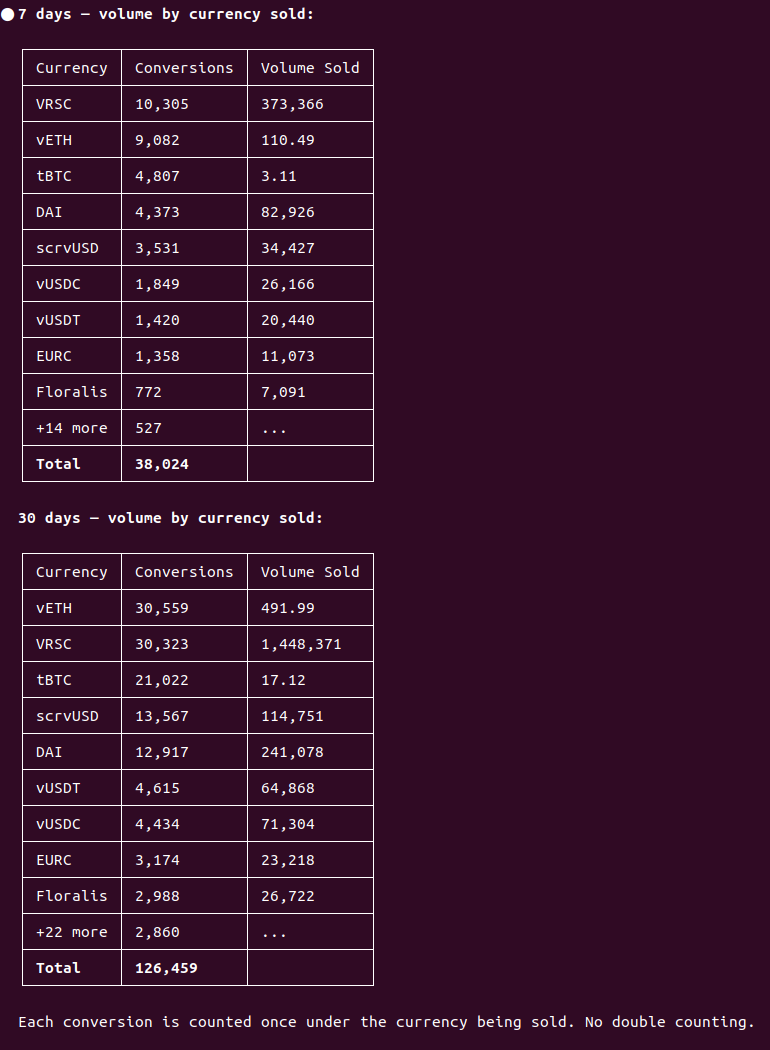
Dug into the defi stats on @VerusCoin who has a TVL ratio of 50%, 25TVL at a 50m MC....
Mev free defi on the protocol level, that is where it is at!!
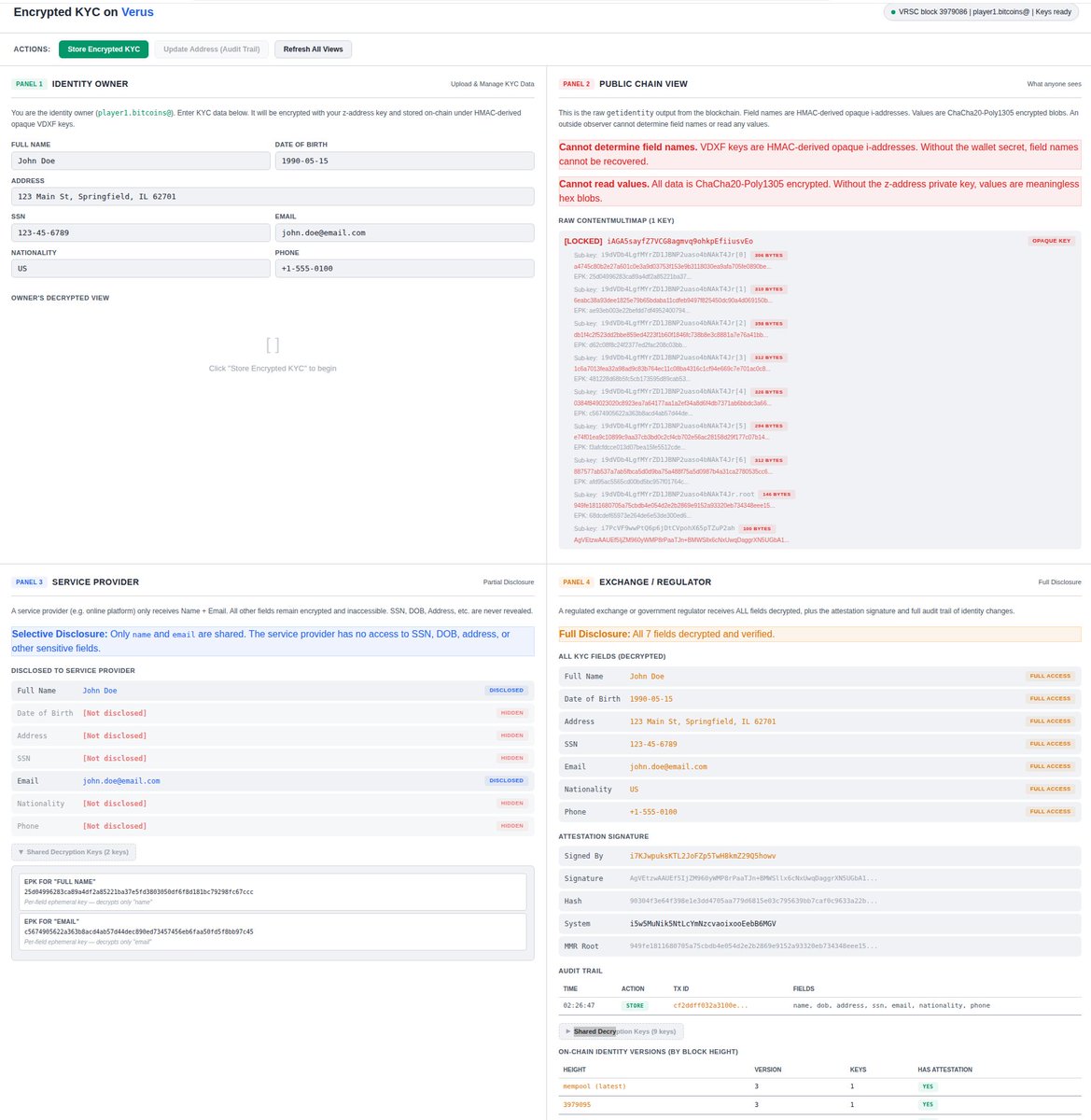
Let's put users back in control of their data with DREAM apps.
Decentralized, Rights-preserving, Encrypted, Application Model.
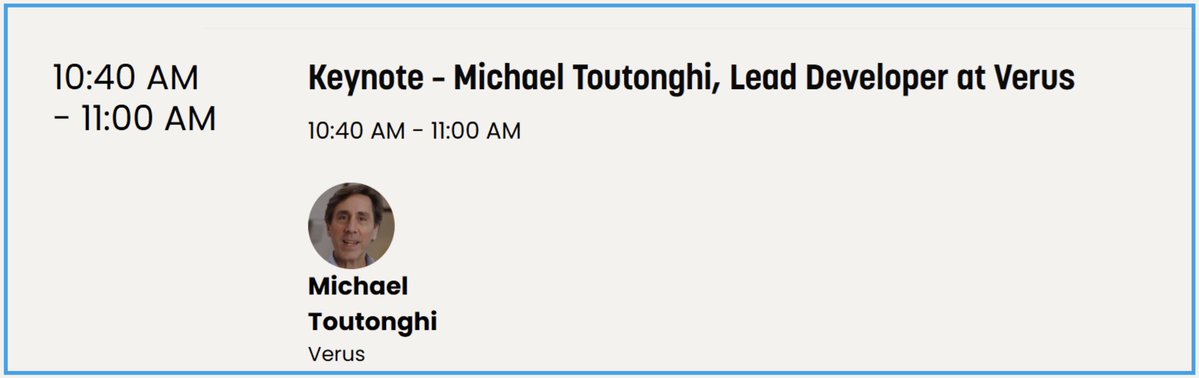
Come see the keynote, Wednesday, 15 April, 10:40 AM, Mona Lisa Stage.
#PBW2026
@mikemaccana@sphere_labs This is how @VerusCoin handles it. I am so surprised that this whole space in the span of 15 years still have not solved subscriptions without holding the funds.
Paris Blockchain Week just got interesting.
Michael Toutonghi, lead developer of Verus, is keynoting on April 15 at 10:40 AM.
Verus also has a booth on the floor. If you're serious about where blockchain infrastructure is heading, come find us.
#PBW2026
I built what midnight claims to do using 7 year old tech from @VerusCoin , Cardano needs to innovate and not play these games (token lockups etc). I feel sorry for the community as the people are being mislead.
Verus at Paris Blockchain Week 2026!
We secured a booth + 20-min talk slot for our lead developer to present Verus to Europe's biggest blockchain audience.
Help us reach €22,000 by Feb 15th and make it happen.
#Verus#PBW2026
For anyone that doubts or does not know...Verus $VRSC absolutely eviscerates Zcash $ZEC
IT IS NOT EVEN CLOSE
Verus vs. ZEC
Both protocols share roots in privacy technology—Verus inherits zk-SNARKs for optional shielded transactions, similar to Zcash—but Verus extends far beyond privacy to include a wide array of capabilities that Zcash lacks.
Below is a detailed head-to-head comparison, focusing on key areas where they differ. I'll highlight Verus's unique features and explain why Zcash does not currently offer equivalents based on their official documentation and ecosystem developments as of October 2025.
Consensus Mechanism
Verus: Uses a hybrid Proof of Power consensus, balancing 50% PoW (VerusHash 2.2 algorithm, CPU-friendly and accessible on mobile/ARM devices) and 50% PoS. This allows for merge-mining up to 22 ecosystem chains simultaneously with the same hash power, enhancing security and efficiency. Miners and stakers earn from a fee pool tied to network activity (e.g., currency launches, conversions), potentially exceeding block rewards as adoption grows.
Zcash: Relies solely on PoW (Equihash algorithm), which is ASIC-resistant but does not incorporate PoS or hybrid elements. There is no built-in fee pool for profit generation beyond standard block rewards and transaction fees, and it lacks merge-mining capabilities for multiple chains.
Key Difference: Verus's hybrid model provides greater decentralization, staking incentives, and multi-chain scalability, which Zcash does not have.
Privacy Features
Verus: Supports zk-SNARKs for shielded transactions, inherited from its Zcash/Komodo lineage, with end-to-end encryption for private payments and messages. Privacy is integrated into DeFi and cross-chain operations, allowing zero-knowledge proofs in liquidity pools and identity-bound transactions.
Zcash: Core focus on privacy via zk-SNARKs, enabling fully shielded transactions that obscure details while allowing selective disclosure for audits. It also supports secret messages attached to transactions.
Key Difference: Both offer strong privacy, but Verus extends it to a broader ecosystem (e.g., DeFi and identities), while Zcash's privacy is more payment-centric.
DeFi Capabilities
Verus: Native DeFi integrated at the protocol level, including liquidity pools, AMMs, and fractional currencies (e.g., 100% or partially backed assets like vYIELD, Switch, and Pure). Users can create adaptive-supply currencies backed by reserves (must include VRSC), perform conversions with 0.025%-0.05% fees, and earn from pool fees. It supports decentralized crowdfunding via pre-launch discounts and pre-allocations.
Zcash: No native DeFi features like liquidity pools, AMMs, or currency creation. It functions mainly as a privacy coin for payments, without built-in tools for yield generation or automated trading.
Key Difference: Verus offers a full DeFi suite, including over $500M in lifetime on-chain volume since 2023, while Zcash has none.
MEV Resistance
Verus: Solves Maximal Extractable Value (MEV) issues in DeFi through UTXO-based simultaneous transaction processing (1-10 blocks), offsetting orders for fair pricing and reduced slippage. This eliminates front-running, back-running, and sandwich attacks, with net effects applied to pools for deeper effective liquidity.
Zcash: No DeFi, so MEV is not applicable. Its sequential PoW processing could theoretically allow ordering exploits if DeFi were added, but it lacks such features.
Key Difference: Verus's MEV-resistant design is a unique safeguard for fair DeFi, absent in Zcash.
Cross-Chain Interoperability
Verus: Features the Verus Internet Protocol (VIP) for provable, decentralized cross-chain communication using Proof-of-Proof-of-Consensus (PoPoC). Supports Public Blockchains as a Service (PBaaS) for launching unlimited interoperable chains, non-custodial bridges (e.g., to Ethereum for ERC-20 exports), and MEV-resistant bundling. Enables trustless transfers of currencies, identities, and data across networks.
Zcash: No native cross-chain functionality, bridges, or multi-chain support. It operates as a standalone blockchain without tools for interoperability.
Key Difference: Verus's VIP and PBaaS enable scalable, multi-protocol ecosystems, which Zcash lacks entirely.
Identity and Security
SystemsVerus: VerusID provides self-sovereign, multisig identities with revocation, recovery, and binding to data/contracts/rights. Over 32k registrations, used for authentication, NFTs, and controlling assets. Verus Vault adds time-locking (e.g., delayed unlocks for theft protection) while allowing staking.
Zcash: No identity system or vault-like security features. Privacy is transaction-based, without user-controlled identities or time-locking.
Key Difference: Verus's advanced identity and vault tools offer unprecedented control and security, not available on Zcash.
NFT and Marketplace
FeaturesVerus: Decentralized NFT marketplace for buying/selling VerusIDs (functioning as NFTs) peer-to-peer on-chain, with privacy options and no intermediaries. Supports single-satoshi NFTs and binding to content.
Zcash: No NFT support or marketplace.
Key Difference: Verus enables a fully decentralized NFT ecosystem, while Zcash has nothing comparable.
Currency and Chain Launching
Verus: Users can launch custom currencies/tokens (basket or simple types) or entire PBaaS chains via transactions, without coding.
Zcash: No tools for launching currencies, tokens, or chains.
Key Difference: Verus democratizes blockchain creation, a capability Zcash does not provide.
Smart Functionality
Verus: Uses "Smart Transactions" for secure, consensus-verified logic (e.g., multi-currency accounting, identities), avoiding vulnerabilities of traditional smart contracts. Supports dApps via unified APIs.
Zcash: No smart contract or transaction logic beyond basic payments.
Key Difference: Verus's approach is more secure and integrated than typical VMs, absent in Zcash.
Scalability and Other Capabilities
Verus: Unlimited horizontal scaling via multi-chain architecture, with over $60M TVL and community-driven growth. Supports mining/staking on mobile devices and profit from ecosystem fees.
Zcash: Scales as a single chain with ~4.68M shielded ZEC out of 16.34M supply; no multi-chain or advanced scalability features.
Key Difference: Verus's ecosystem is far more expansive, with tools for builders that Zcash lacks.
In summary, while Zcash excels as a pure privacy payment protocol, Verus builds on similar privacy tech to create a comprehensive Web3 platform. Verus's innovations in DeFi, interoperability, and identities make it more versatile for developers and users, addressing limitations in single-purpose chains like Zcash.
Web2: Corporate servers control your data.
Web3 (VM): Smart contracts control your money via permissions. Every hour, another wallet drained.
Web3 (Verus): You control everything. Direct transactions. No permissions. No intermediaries. Money and data are actually yours.