One thing about white people, they will lie, steal, manipulate and then rewrite history as victims, survivors or saviours. Zero accountability, AfriForum is on brand
Elections will make you realise the importance of publicly owned land and buildings. Very soon the government will spend billions hiring privately owned infrastructure to execute something as important as the elections.
10 minutes into the al jazeera episode on LGE and it's very disappointingly biased. 1 commentator said the ANC has been losing votes the DA lol and that the EFF is populist!
This is not the life people should be living. 20 years of DA governance in Cape Town and this how people still live.
The DA only cares for the rich.
JHB people I will keep warning you about the DA and that Gogo. This is her legacy in Cape Town.
Helen called amaXhosa in Cape Town “economic refugees”. Said colonialism wasn’t all bad. Labelled Simphiwe Dana a “professional black” which she defined as a perpetual victim of racism. Called Mmusi, Lindiwe et al. failed experiments. She is actively against BEE. She’s a Zionist.
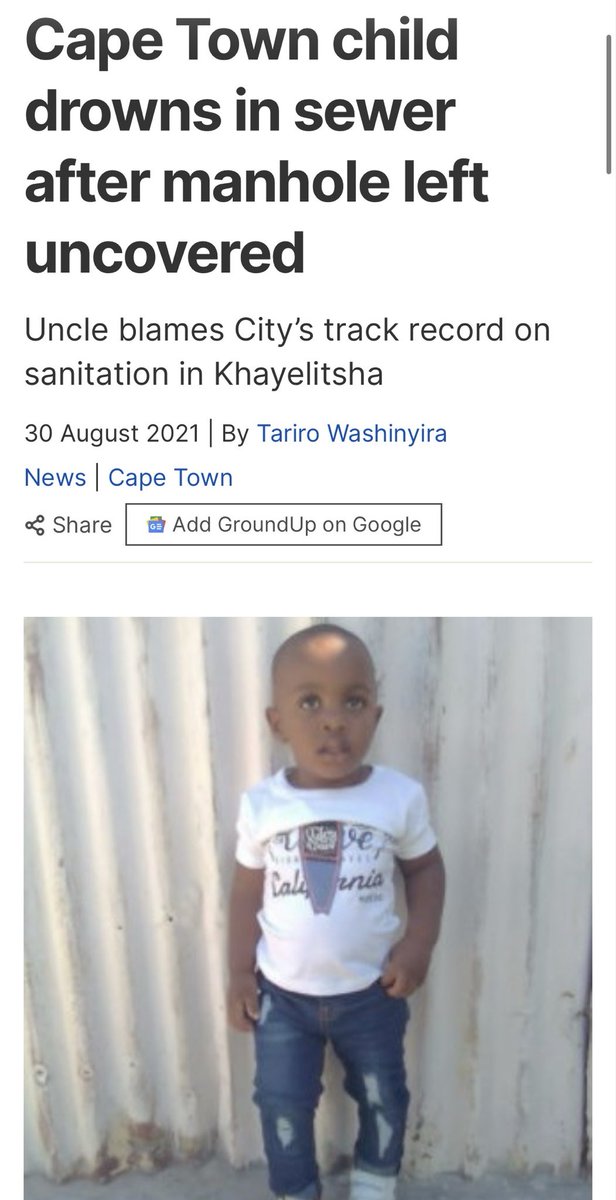
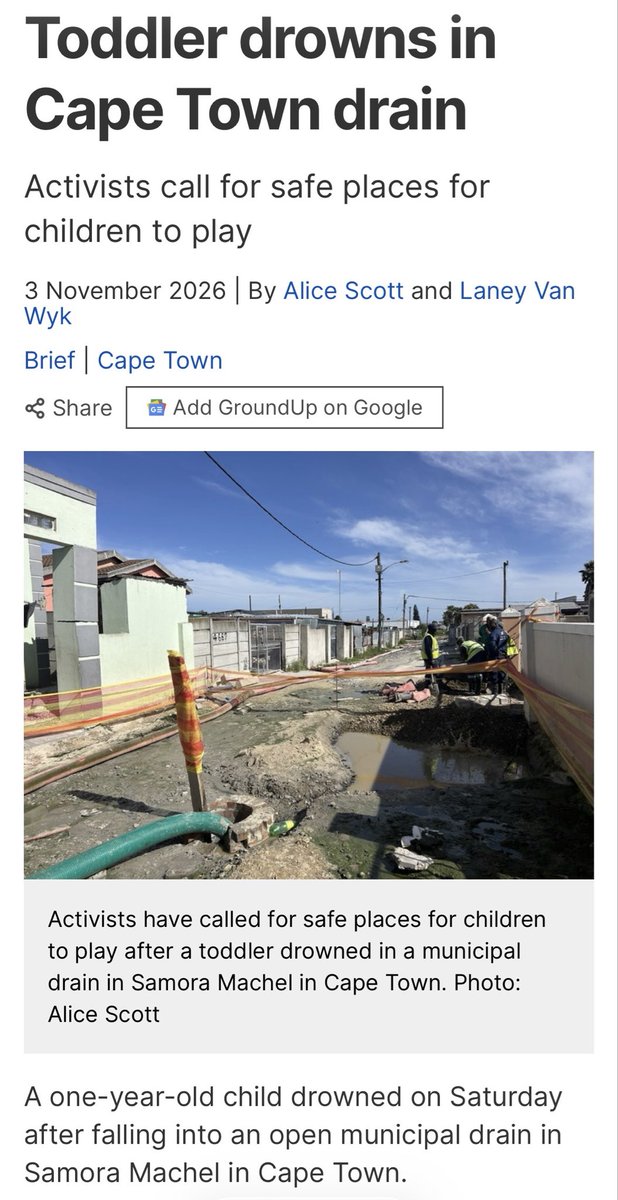
Children are dying preventable deaths in Cape Town 💔
Another child, a one year old, has died in Cape Town due to the DA’s neglect of infrastructure maintenance in townships.
5 years ago a two old died of similar circumstances.
https://t.co/sllnFLRaL4
The One-Stop Border Post Bill is currently being finalised. It’s in line with the African Agenda 2063. The BMA is getting rid of the dual-stop border system and will go into PPP once the Bill is signed off.
The Bill aims to address four critical problems:
1. Eliminate massive congestion and delays.
2. Lower the high cost of doing business across the border.
3. Combat border corruption and security risks.
4. Unlock regional trade — establish common control zones.
Interestingly, this Bill falls outside of Immigration Act and Refugees Act, however travellers will have their passports processed by both countries’ immigration officers at the same time inside a unified Common Control Zone.
This year I am lending my vote to the EFF. Last time it was Good Party. Both oppose the DA in Cape Town well.
REMEMBER: LGE aren’t winner takes all. We also vote in those who will oppose & challenge. If you are in obviously DA dominated ward, vote for & strengthens the Opposition
We sometimes use the suffering of poor communities as an argument against political opponents rather than as a reason to demand improvements for those communities
The DA governs both Sea Point and Khayelitsha for example. If Sea Point is my evidence of good governance, then I’d have Khayelitsha also form part of my assessment. Ba ibindim
SOUTH AFRICA’S GRADUATION OUT OF AGOA DOESN’T MEAN WE WON'T HAVE ACCESS TO THE U.S. MARKET. WE WILL HAVE ACCESS, BUT WITH SLIGHTLY HIGHER TARIFFS.
While we are now in a different political climate, I think it’s important to remember that aside from the issues the U.S. raised about South Africa’s eligibility to be part of AGOA, there have been some conversations for some time. For example, back in 2014, the focus, amongst other things, was on the reality that South Africa is an upper-middle-income country and should have graduated from AGOA to a full bilateral trade agreement with the U.S.
Of course, we had our own complications, both because of the Southern African Customs Union (SACU), which we can’t sign bilateral trade agreements without, and because we lobbied to keep benefiting from this unilateral approach (AGOA).
Looking back, if we had found a way to graduate out of AGOA, as we were pressured to do then, and started conversations about a trade agreement, we would be in a different climate than what we are seeing now.
Of course, this doesn’t mean countries with trade agreements are spared from drastic changes in U.S. trade policy; we see those changes affecting countries like Canada.
Beyond South Africa graduating out of AGOA, I think there is also confusion about the implications. Others frame it as a complete ban from the U.S. market, which is not the case.
Simply put, as South Africa transitions out of AGOA, the country would face an additional Most Favoured Nation tariff of around 3.4% on top of the existing tariffs the current U.S. Administration added to various countries.
Currently, some South African products enter the U.S. market at 12.5% tariffs (Liberation Day tariff). Without AGOA, these tariffs would rise to 15.9%, slightly reducing the competitiveness of some South African products in the U.S. market.
Still, one could argue that while this would be a challenging path, it would not necessarily be as catastrophic as we have faced in the past, when we faced much higher U.S. tariffs and still managed to compete.
Consider South Africa’s agriculture: in 2025, the South African farming sector faced tariffs of around 30%. Still, agricultural exports to the U.S. were strong.
South Africa’s agricultural exports to the U.S. in 2025 totalled US$504 million, down 3% from the previous year.
During the higher “Liberation Day Tariffs”, some South African agricultural exporters took advantage of the 90-day pause in the second quarter of 2025 and exported more volume than usual.
After this pause, exports cooled in the third and fourth quarters of 2025. Notably, South Africa’s agricultural exports to the U.S. fell 11% in the third quarter of 2025, compared with the same period in 2024, to US$144 million. In the last quarter, South Africa’s agricultural exports to the U.S. fell sharply by 39% to US$81 million. Still, the overall annual exports were encouraging.
Even this year, South Africa’s agricultural exports to the U.S. were strong. For example, South Africa's agricultural exports to the U.S. increased by 56% from the first quarter of 2026 to the second quarter of 2026, to US$123 million. The decline in U.S. tariffs, from 30% to 12.5%, among other factors, has been the major contributor to the increase in South Africa’s agricultural exports to the U.S.
The U.S. remains an important market for South African agriculture, accounting for about 4% of our agricultural exports. Main exports include citrus, berries, grapes, raisins, wine, fruit juices, apples, pears, apricots, and nuts.
Again, South Africa's graduation from AGOA must be viewed in context and may not mean a catastrophe. This is not to understate the impact some industries may feel as the increase in tariffs slightly reduces their competitiveness. Still, we must manage the sentiment and narrative around this issue well.
Above all, this yet again reminds us of the need to work hard to diversify South Africa’s export markets to growing regions such as Asia and the Middle East.
But export diversification must be framed correctly; it is not a replacement for the U.S., EU, UK, Africa, and other markets. These remain key, and we must work to retain our access to them.
--Wandile
Uyabuza umfokaDube there by Xubera Institute for Research and Development @xuberaird why does the Zulu Nation continue to allow itself to be used for goals and objectives that do not benefit AmaZulu or Abantu Abantsundu? Not wonke uZulu, obviously.
What about the children in Cape Town?
Must children continue to die due to no play space and infrastructure neglect in the townships?
An R87 billion budget a year and still poor, Black and Coloured communities in Cape Town are left neglect like this.
Please don’t vote DA 🙏🏾