BBC:n pomojen eroaminen, johtuen vääristellystä uutisoinnista, koskettaa ikävästi myös Suomen verorahoitteista valtamediaa.
Oma haastatteluni julkaistiin vastaavasti vääristeltynä, pomo ei myöntänyt virhettä, JSN antoi langettavan.
Salaa nauhoittamani … 1/2
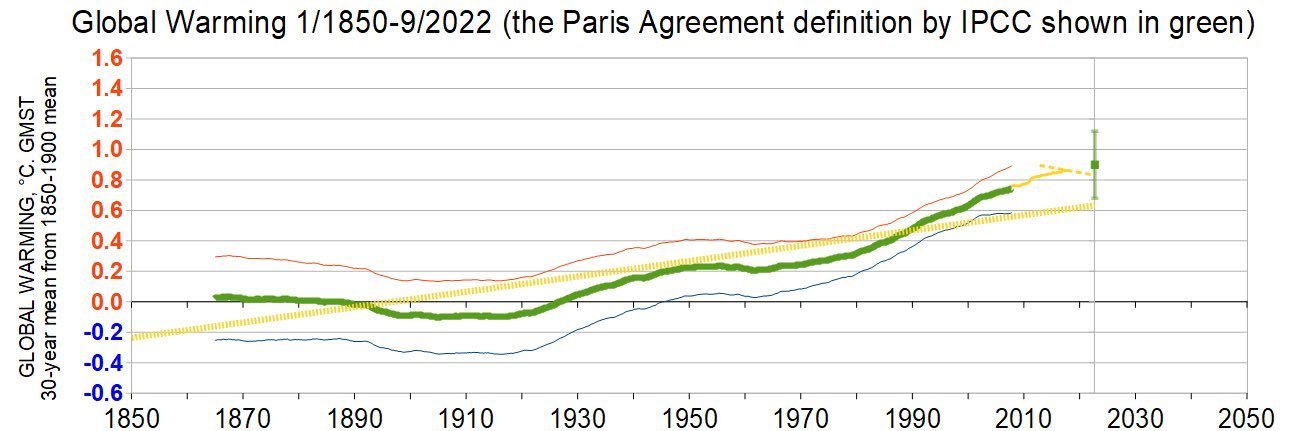
@JPee77 Juttu väittää rajan ylittyvän eri tavalla kuin miten raja voi ylittyä, jonka voit itsekin todeta vertaamalla IPCC SR15 FAQ Chapter 1 -tekstiin.
Koska puhut ”höpisemisestä”, päätän keskustelumme tähän. Hyvää jatkoa.
@Marcelh1303 Siltä näkokannalta olet oikeassa, että sopimuksen rajat ovat keksittyjä, ja jopa niiden laskutapa määriteltiin vasta sopimuksen julkaisun jälkeen. Yet… sopimus on sopimus.
@LeoVasanko@kHellstr Laskentatapa Pariisin ilmastosopimuksen rajojen saavuttamisessa on yksiselitteinen, ja löytyy IPCC SR15 FAQ Chapter 1. Keskiarvojaksoksi on päätetty nimenomaan 30v.
@JPee77 Rajaa ei lasketa siten kuin uutinen esittää. Laskutapa löytyy yksiselitteisenä IPCC SR15 FAQ Chapter 1, toimittajalta lienee jäänyt se kokonaan tarkistamatta. Saisivat oikaista uutisen.
@JPee77 Voidaan todella helposti todeta että ei tule ylittymään uutisen mukaisesti. Herää kysymys, oletko lukenut itse uutisen (en linkitä Valea). Jos luet, huomaat nopeasti ettei toimittaja ole selvillä edes laskutavasta.
The chief benefit from rising atmospheric CO₂ levels is an undeniable increase in planetary green leaf cover, now clearly visible from space.
This fresh greening covers an area twice the size of the continental United States - yet it remains ignored by the institutional forces driving a narrative of climate emergency, and largely overlooked in the mainstream media.
Data from NASA’s MODIS satellite instruments tells the real story. Rather than triggering global collapse, the rise in CO₂ sparked a massive expansion in the green canopy, stimulating agricultural yields (some cereal crops up by 280%) and natural ecosystems alike. This 'CO₂ fertilisation effect' occurs as plants perform photosynthesis more efficiently while losing less water through their stomata.
Meanwhile, the global economy has been severely disrupted by a 40-year campaign built on forecasts of environmental doom from anthropogenic CO₂. This trace gas is not a climate control knob. It is the fundamental driver of biological photosynthesis and oxygen production.
These campaigns, led by UN activism, demand a rapid, forced transition away from hydrocarbon energy. Yet wind and solar cannot supply the dense baseload power required for steel production and heavy industry. Hydrocarbon fuels still provide 82% of global primary power.
This entire transition is justified under the warning that CO₂ emissions are leading the planet to the brink of catastrophe - with the total cost of this pointless pivot estimated at a staggering $275 trillion.
Earth's geological history, paired with empirical satellite data, reveal a completely different reality: CO₂ is a powerful agent of biological enrichment. Its capacity to drive runaway global warming faces steep, immovable physical limitations.
A critical pillar of atmospheric physics is how the warming effect of CO₂ continually reduces along a sliding logarithmic curve. The first 100 ppm of CO₂ exert the greatest impact on capturing outgoing infrared radiation. But as concentrations rise, absorption bands rapidly saturate. Each subsequent doubling of CO₂ yields an ever-smaller increment of radiative warmth.
The concept of a runaway warming feedback loop loses its theoretical foundation under actual atmospheric conditions, where the 'rate of warming' diminishes progressively. Yet this debunked narrative is routinely recycled to fuel panic.
Annual COP climate summits over the past thirty years also endlessly amplify this agenda of fear, functioning largely as high-end junkets for global elites.
In geological terms, atmospheric CO₂ is in long-term decline - a fact carefully airbrushed from IPCC worst-case scenarios. During the Cambrian period, atmospheric CO₂ peaked as high as 7,000 ppm. Even with those immense concentrations, there was no global boiling; instead, it marked the greatest explosion of biological diversity in Earth's history.
During the Last Glacial Maximum (26,000 to 19,000 years ago), CO₂ levels plummeted to roughly 180 ppm - dangerously close to the 150 ppm threshold below which most C3 plant life starves and dies. From a long-term evolutionary perspective, modern levels hovering above 420 ppm represent a vital, partial recovery from a geologically recent carbon drought, rather than a precursor to apocalypse.
Today’s global average temperature sits at approximately 15°C. In the context of the history of complex life on land, this is remarkably cold. Earth’s baseline historical temperature average was closer to 24°C, characterised by ice-free poles and expansive, highly productive ecosystems. Our current global average actually reflects a colder-than-average ice age regime.
Global climates are not controlled by trace gases. They are driven by massive, slow-moving astronomical, oceanic, and tectonic forces - such as Milankovitch orbital cycles or the shifting configuration of continents blocking equatorial ocean currents.
@SariMultala Tarvitsemme sellaisia tahoja jotka pohjaavat tieteeseen, ja osaavat mm. kertoa että koko Fenno-Skandia on mittausten (Nasa) mukaan hiilinielu. Emme siis tarvitse nykyisen kaltaista Ilmastopaneelia.
@IlkkaJLeinonen Taalas kyllä tietää että globaalisti lämpenevissä vaiheissa lämpötilaerot päiväntasaajan ja napa-alueiden välillä pienenevät. Odottaako hän siis viilenevää vaihetta 2060-luvulle?
@IlkkaJLeinonen 2/2 olisi hienoa, jos ainakin osa hiilidioksidiveroista ja päästökauppatuloista käytettäisiin tämmöisten olennaisten mittaussarjojen tuottamiseen. Suomalaisella metsä- ja mittausosaamisella voisimme tuottaa tällaista dataa moneen käyttöön. Nyt resurssien virhekäyttöä.
@IlkkaJLeinonen 1/2 Puhumme siis metsätalouden mahdollisesta vaikutuksesta hillitsevänä osatekijänä lämpenemiseen ilmastollisilla tarkastelujaksoilla. Jo pelkän suunnan arvioimiseksi tarvittaisiin pitkäaikaiset vertailumittaukset hiilestä, säteilystä, pilvistä ja lämpövirroista. Joita ei ole…
@IlkkaJLeinonen Olen lukenut koko raportin, muistaisin kyllä mikäli noin olennainen asia olisi mainittu. En ole lukenut sen kaikkia viiteartikkeleita, joten mikäli asia mainitaan sellaisessa, viittaatko, kiitos.
@IlkkaJLeinonen Olen ymmärtänyt että lämpötilan kohoaminen voisi kyllä mahdollistaa tehokkaamman metsätalouden, runsaamman kasvun kautta, mutta mikä lähde esittää että metsätalous vaikuttaisi lämpötilaan? Jos jokin malliarvio, millaisilla oletuksilla?