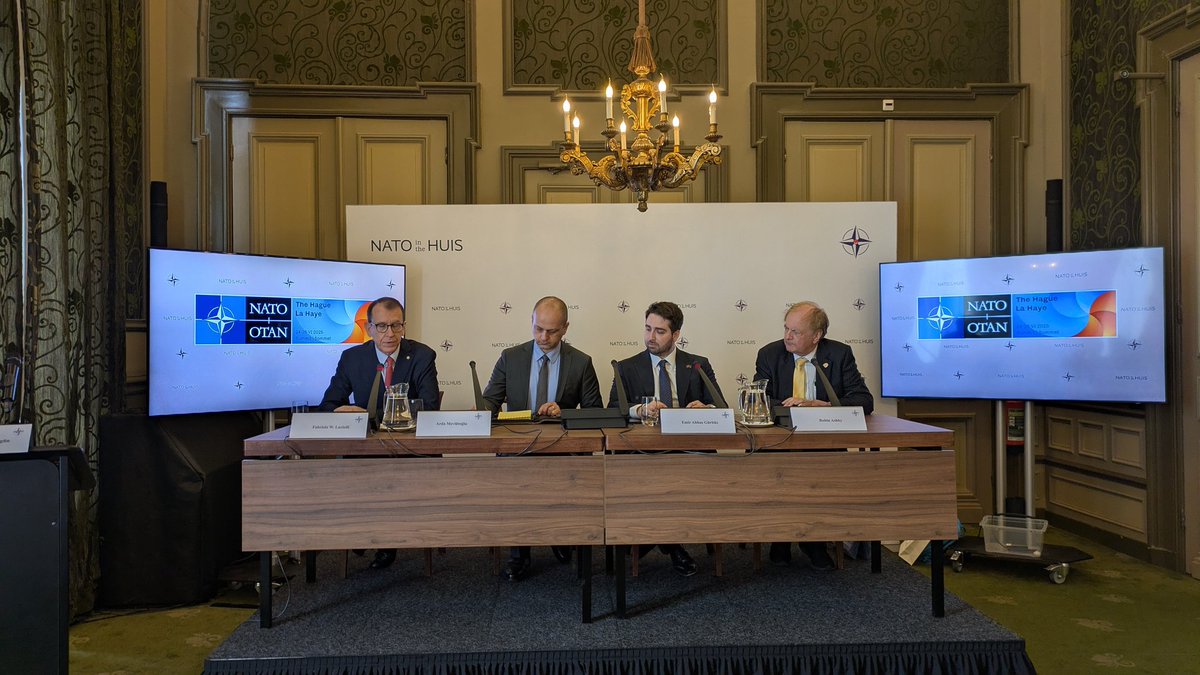
"@NATO commander: Europe has no alternative to @PalantirTech. Those seeking alternatives need to prove they can be delivered quickly, said Adm. Pierre Vandier, NATO’s Supreme Allied Commander Transformation".
Simple, clear and precise.
https://t.co/pazAvtKK5q
Because we get asked a lot.
The Technological Republic, in brief.
1. Silicon Valley owes a moral debt to the country that made its rise possible. The engineering elite of Silicon Valley has an affirmative obligation to participate in the defense of the nation.
2. We must rebel against the tyranny of the apps. Is the iPhone our greatest creative if not crowning achievement as a civilization? The object has changed our lives, but it may also now be limiting and constraining our sense of the possible.
3. Free email is not enough. The decadence of a culture or civilization, and indeed its ruling class, will be forgiven only if that culture is capable of delivering economic growth and security for the public.
4. The limits of soft power, of soaring rhetoric alone, have been exposed. The ability of free and democratic societies to prevail requires something more than moral appeal. It requires hard power, and hard power in this century will be built on software.
5. The question is not whether A.I. weapons will be built; it is who will build them and for what purpose. Our adversaries will not pause to indulge in theatrical debates about the merits of developing technologies with critical military and national security applications. They will proceed.
6. National service should be a universal duty. We should, as a society, seriously consider moving away from an all-volunteer force and only fight the next war if everyone shares in the risk and the cost.
7. If a U.S. Marine asks for a better rifle, we should build it; and the same goes for software. We should as a country be capable of continuing a debate about the appropriateness of military action abroad while remaining unflinching in our commitment to those we have asked to step into harm’s way.
8. Public servants need not be our priests. Any business that compensated its employees in the way that the federal government compensates public servants would struggle to survive.
9. We should show far more grace towards those who have subjected themselves to public life. The eradication of any space for forgiveness—a jettisoning of any tolerance for the complexities and contradictions of the human psyche—may leave us with a cast of characters at the helm we will grow to regret.
10. The psychologization of modern politics is leading us astray. Those who look to the political arena to nourish their soul and sense of self, who rely too heavily on their internal life finding expression in people they may never meet, will be left disappointed.
11. Our society has grown too eager to hasten, and is often gleeful at, the demise of its enemies. The vanquishing of an opponent is a moment to pause, not rejoice.
12. The atomic age is ending. One age of deterrence, the atomic age, is ending, and a new era of deterrence built on A.I. is set to begin.
13. No other country in the history of the world has advanced progressive values more than this one. The United States is far from perfect. But it is easy to forget how much more opportunity exists in this country for those who are not hereditary elites than in any other nation on the planet.
14. American power has made possible an extraordinarily long peace. Too many have forgotten or perhaps take for granted that nearly a century of some version of peace has prevailed in the world without a great power military conflict. At least three generations — billions of people and their children and now grandchildren — have never known a world war.
15. The postwar neutering of Germany and Japan must be undone. The defanging of Germany was an overcorrection for which Europe is now paying a heavy price. A similar and highly theatrical commitment to Japanese pacifism will, if maintained, also threaten to shift the balance of power in Asia.
16. We should applaud those who attempt to build where the market has failed to act. The culture almost snickers at Musk’s interest in grand narrative, as if billionaires ought to simply stay in their lane of enriching themselves . . . . Any curiosity or genuine interest in the value of what he has created is essentially dismissed, or perhaps lurks from beneath a thinly veiled scorn.
17. Silicon Valley must play a role in addressing violent crime. Many politicians across the United States have essentially shrugged when it comes to violent crime, abandoning any serious efforts to address the problem or take on any risk with their constituencies or donors in coming up with solutions and experiments in what should be a desperate bid to save lives.
18. The ruthless exposure of the private lives of public figures drives far too much talent away from government service. The public arena—and the shallow and petty assaults against those who dare to do something other than enrich themselves—has become so unforgiving that the republic is left with a significant roster of ineffectual, empty vessels whose ambition one would forgive if there were any genuine belief structure lurking within.
19. The caution in public life that we unwittingly encourage is corrosive. Those who say nothing wrong often say nothing much at all.
20. The pervasive intolerance of religious belief in certain circles must be resisted. The elite’s intolerance of religious belief is perhaps one of the most telling signs that its political project constitutes a less open intellectual movement than many within it would claim.
21. Some cultures have produced vital advances; others remain dysfunctional and regressive. All cultures are now equal. Criticism and value judgments are forbidden. Yet this new dogma glosses over the fact that certain cultures and indeed subcultures . . . have produced wonders. Others have proven middling, and worse, regressive and harmful.
22. We must resist the shallow temptation of a vacant and hollow pluralism. We, in America and more broadly the West, have for the past half century resisted defining national cultures in the name of inclusivity. But inclusion into what?
Excerpts from the #1 New York Times Bestseller The Technological Republic: Hard Power, Soft Belief, and the Future of the West, by Alexander C. Karp & Nicholas W. Zamiska
https://t.co/8igjazz1On
A common narrative has it that commitment and motherhood make women unhappy. New data suggest the opposite is true, @jean_twenge writes. https://t.co/R2dssAE4jq
@LorenzoCast89 Era ora che qualcuno lo dicesse. Sono sotto shock perché hanno ignorato o non compreso la profonda trasformazione in corso da anni nella destra americana. E non sembra che vogliano (o siano in grado di...) rimediare. Sarà un brutto risveglio.
Lo shock del discorso di Vance sugli europei dipende anche dalla ignoranza di questi sul contesto che ha modellato la visione del vicepresidente. Da oltre un decennio c’è un movimento intellettuale - con varie sfumature di conservatorismo, populismo, libertarismo, reazione - che da questo lato dell’Oceano è poco tradotto o sconosciuto ma che negli USA ha un seguito. Da Patrick Deneen a Paul Gottfried, da Yoram Hazony a Rod Dreher, da Curtis Yarvin a David Goodhart. Sono autori snobbati da accademia ed editoria, derubricati a paria, veniva deriso o ignorato chi li citava. Da noi, anche a causa di un imperante conformismo durato troppo a lungo, si è fatto fatica a digerire anche le analisi di autori molto più mainstream e moderati come Niall Ferguson, Douglas Murray o Victor Davis Hanson. La sorpresa scandalizzata di molti si può anche chiamare ignoranza e arroganza di gran parte del mondo intellettuale europeo.
1/7
🚨🇮🇱 Quel maledetto 7 ottobre non si può dire che non abbia provato. Yarden Bibas ha tentato con tutte le sue forze di proteggere la sua famiglia, di riuscire là dove lo Stato Ebraico aveva fallito.
In quei minuti, pochi ma interminabili, mentre i terroristi di Hamas si avvicinavano, è probabile si sia maledetto: quante volte, lui e sua moglie Shiri, avevano discusso di cambiare casa? E perché non lo avevano fatto?
Era tardi, ormai.
"Sembra sia la fine", ha scritto in uno degli ultimi messaggi inviati a sua sorella, "sono dentro".
Il ritorno di #Trump e la nuova politica estera #USA 🇺🇸
Parte II: Trump, il futuro delle relazioni transatlantiche e l'#Italia
Di @SimoZuccarelli
https://t.co/tmQVpgzENC
#TRUMP E NOI: COME SI SVILUPPERANNO LE RELAZIONI TRA #EUROPA E #USA...?
https://t.co/V7Of1v8EZ4
Una giornata di lavori di grandissimo spessore insieme ad ospiti di altissimo livello a partire dal Ministro per gli Affari europei, il PNRR e le Politiche di Coesione Tommaso Foti, l'On. Andrea Tremaglia, il Vice-Presidente della Camera di Commercio di Bergamo, dott. Giovanni Zambonelli, il Sen. Gianni Vernetti, il Min.Plen. Alessandro Azzoni, il Cons.Amb. Emanuele Farruggia, il prof. Fabrizio Luciolli, il dott. Beniamino Irdi e il prof. Simone Zuccarelli.
Una preziosa occasione per ribadire la rilevanza relazioni transatlantiche tra l’America e l'UE (e l'Italia), così come la centralità, nella sfera della #sicurezza, della dimensione #Cyber e del concetto di #deterrenza, che richiedono un urgente impegno comune affinché si pongano le basi per ottenere, in Europa, una capacità industriale realmente competitiva nel settore #difesa.
Mio intervento al Min. 23:54
@FratellidItalia@fdieuropa@TommasoFoti@atremaglia@FWLuciolli@Beniaminoirdi@GianniVernetti@AlleAzzoni@SimoZuccarelli @cciaabg @webecodibergamo@Bergamonews@centrostudiusa@GeopoliticalCen@Geopoliticainfo@SecolodItalia1@GlobalCRL@theglobalnewsit
Keynote speech del Ministro degli Esteri @Antonio_Tajani in apertura del convegno internazionale "#Europa-#Usa 2025. Sfide transatlantiche", organizzato da @Farefuturo1 in collaborazione con il Comitato Atlantico Italiano, @IRIglobal e @Heritage
Il ritorno di #Trump e la nuova politica estera #USA 🇺🇸
Parte I: il più significativo comeback della storia americana.
Di @SimoZuccarelli
https://t.co/exPO0fImaM
#Zuckerberg: "We're going to get rid of fact-checkers and replace them with community notes, similar to #X [...] #Factcheckers have just been too politically biased and have destroyed more trust than they've created."
Better late than never...