scRNAseq cell type annotation is notoriously messy. Despite so many algorithms, most researchers still rely on manual annotations using marker genes
In a new preprint accepted at ICML GenAI Bio Workshop, we ask if reasoning LLMs (DeepSeek-R1) can help with cell type annotation🧵
@SashaGusevPosts@baym can’t blame them, probably they genuinely think that’s how the world works.. and maybe that’s how the world will indeed work for them
@sinabooeshaghi i also think there’s still some AI skepticism in academic circles. it depends of the field of course, but in some less hypey & less well financed fields, people’s level of AI expertise has remained at “it makes up references”, which prevents people from exploring AI more hands-on
wtf is this way to handle mathematicians work and scientific communication
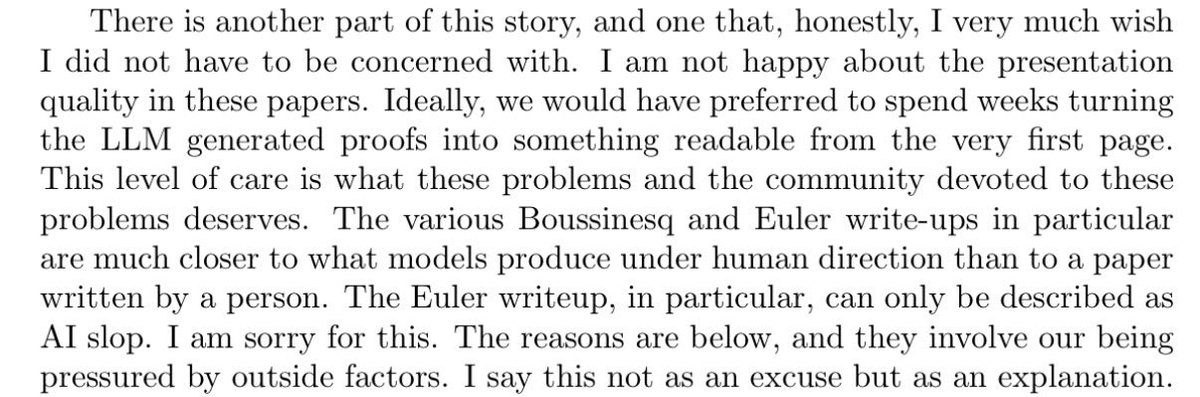
TLDR: Leven and Tristan worked over several months on one of the Millenium Prize Problems with various AIs to reach final interesting results. OpenAI apparently heard about it in the last days and prompted their latest models to work on the direction Leven and Tristan found fruitful. They then tried to push for controlling communication of the result and dropping Leven from authorship with some very bad taste social pressure.
Hope this is not a glimpse of the future we’ll get in science research with these dominating players playing marketing games hurtful for the real scientific community.
I sicced Astra on a bunch of replication packages, and it found a huge number of coding errors.
Most of these were inconsequential, but some of them overturn central results for papers in high-ranking journals.
Astra also discovered that many models weren't even run properly.
great point. the time is coming for everything & clinical trials just take years. people are quick to judge and love hype, so they imagine Claude picked the neoantigens, while missing the point that indeed without strong algorithms across the board, a personalized neoantigen vaccine is just not possible
clinical findings for sure hard to verify, that’s why clinical trials are so expensive (hard to get right and invalid if not done right, hence expensive). also that’s why clinical trial results are sometimes shocking for people close to the disease - even though mouse + organoids + cell lines suggests it should work, it turns out it does not in a trial… hence no mean effect in those population. however this still tells you little about individual effects etc.. so hard to get a true answer for a personalized question
@venkmurthy@marklewismd effect sizes do correlate with pvalues though 😄
in this case, we’re really safe to ditch the stats. best data is when nobody carea about the stats
Big progress vs cancer, folks.
The kind of event curves from randomized trials that we've not seen before for a couple of the most deadly cancers. Congrats to the oncology research community for getting these trial done. #ASCO26, @ASCO