scRNAseq cell type annotation is notoriously messy. Despite so many algorithms, most researchers still rely on manual annotations using marker genes
In a new preprint accepted at ICML GenAI Bio Workshop, we ask if reasoning LLMs (DeepSeek-R1) can help with cell type annotation🧵
@venkmurthy@marklewismd effect sizes do correlate with pvalues though 😄
in this case, we’re really safe to ditch the stats. best data is when nobody carea about the stats
Big progress vs cancer, folks.
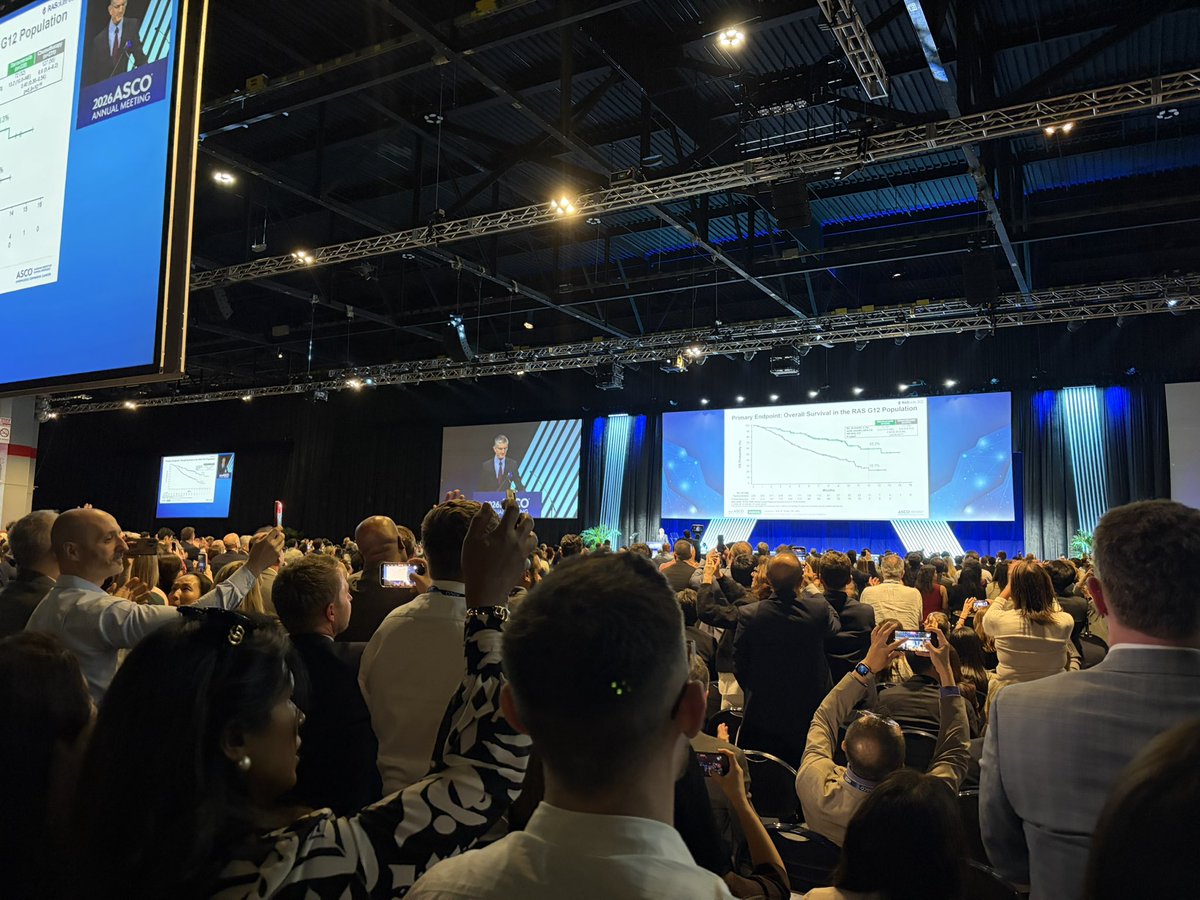
The kind of event curves from randomized trials that we've not seen before for a couple of the most deadly cancers. Congrats to the oncology research community for getting these trial done. #ASCO26, @ASCO
@t_blom This problem will naturally tend to go away as companies are grown from the start using AI. Then you don't need to extract any domain knowledge from people's heads; it will never have been in people's heads.
there aren't many times in oncology when nobody cares about statistics, but today is one of them. there has never been such a successful trial in pancreatic cancer & these survival curves are the result of 40 years of persistence.
KRAS inhibitors will forever transform oncology
🌟This is history
⭐️The most awaited abstract
👏 Standing ovation at Hall B1
💊 Daraxonrasib becomes the new standard of care for patients with previously treated metastatic #pancreatic#cancer#ASCO26
Incredible #ASCO26 moment.
Dr. Brian Wolpin, presenter of the daraxonrasib study, received a standing ovation DURING his talk after he stated the survival benefit for PDAC patients. It was sustained. Cheering. I have never see anything like it in the middle of a talk. $RVMD
Algorithms are part of nearly every aspect of life, from the physics of the natural world to planning shipping routes.
Our Gemini-powered coding agent AlphaEvolve has been accelerating progress over the last year - from quantum and biotechnology to logistics and @Google’s AI infrastructure. ↓ https://t.co/CAjvAqJiod
As I mentioned before, I am now sharing an example from GPT-5.5 Pro, also featured by OpenAI, that really left me stunned by what it is capable of in biomedical science. (full report on the website I created with Codex, link in the thread).
To push GPT-5.5 Pro hard, I uploaded a real data set of immune subset (T cells) gene-expression spreadsheet: 62 sorted T cell samples, 27,906 gene columns, and millions of underlying data points across different T cell subsets. Importantly, this public dataset also had paired structure making it possible to separate true cell-state biology from donor-to-donor variation.
I asked GPT-5.5 Pro not merely to summarize the spreadsheet, but to analyze it deeply: What can we learn from this dataset? What are the mechanistic insights? What are the most important biological questions that emerge? What follow-up experiments should we do next?
It thought for about 100 minutes and produced a roughly 40-page report!
What amazed me was not just the length or even the initial analysis, since previous models are also capable of doing this. What amazed me was the quality of the reasoning and insights it provided!
The report recognized that this was not just a table of genes, but two overlapping experimental designs. It identified the major biological axis, which in plain language was that the cells were not just “different categories.” They formed a coherent differentiation landscape, moving from future potential toward immediate function.
It also understood the caveats. It did not overclaim from bulk gene-expression data. It clearly explained that bulk transcriptomics cannot distinguish whether every cell in a sorted population has shifted or whether a smaller subpopulation is dominating the signal. It recommended the right next steps experiments, and integration with donor metadata.
This is what made the report feel so special to me. It was not just doing statistics. It was reasoning like an expert systems immunologist. It saw the structure of the experiment, interpreted the patterns, built a mechanistic model, identified limitations, proposed causal hypotheses, and laid out a translational roadmap.
Other advanced models have been able to generate excellent biomedical reports before, including previous GPT-5 models. So I don't want to claim this is an entirely new type of capability. But this one felt different in an important way. It had more scientific elegance, more restraint, more biological intuition, and more of the nuanced judgment that usually comes only from years of hands-on experience in the field.
It felt like this AI model had crossed another threshold.
This is the kind of analysis that could easily take a research team months to perform, refine, interpret, and write up. Even then, many teams might not produce something this integrated, this mechanistically coherent, and this useful as a launchpad for future experiments.
I know a 40-page T-cell gene-expression analysis may not be exciting to everyone. To illustrate how good it is, also had Codex built a web site with it anyone can explore, link below. 😊 Those interested can go deeper into the report.
I also wanted this example on the record because, because to me, it is evidence that we are entering a new stage in AI-assisted biomedical science.
The important point is no longer that AI can "analyze data and write a report.” The important point is that AI can now help transform complex biological data into mechanistic understanding, experimental priorities, and testable hypotheses at a speed and depth that would have been almost unimaginable a short time ago.
For biomedical science, this is a very big deal!
Of course, this may vary across domains, and every analysis still needs expert review, validation, and experimental follow-up. But in my own field, with data I understand deeply, this felt like another inflection point.
I feel strongly that we have crossed another milestone threshold in the age of AI, with the release of GPT-5.5.
There's a fourth possibility: humans only appear sample efficient because they've effectively seen a massive amount of data through evolution. Remember, there is a fluidity between the model and the data. The model is a representation of our understanding of data.
@SashaGusevPosts@anshulkundaje many (human) reviewers also do this though; “add another mouse experiment”; “how about another batch correction method” etc