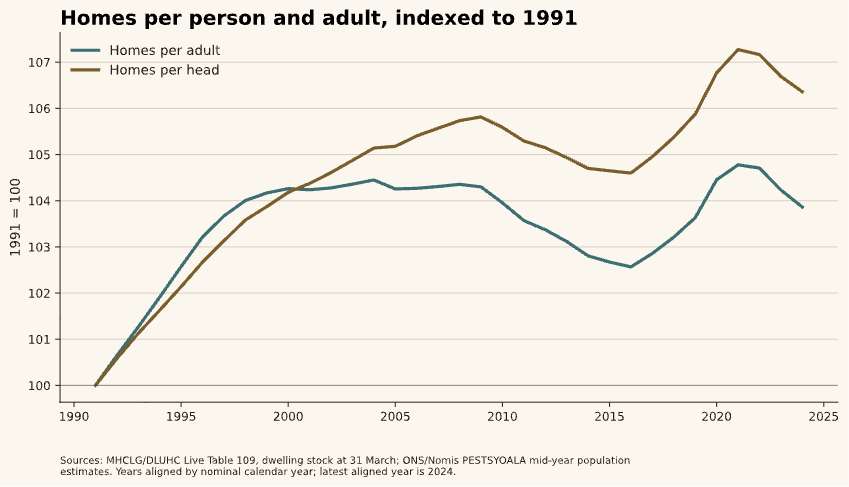
@FlyingRadical@NoJusticeMTG@IwanDoherty98 How does deregulated bank lending lead to the number of homes per person barely increasing over 30 years? If anything you'd think that would make more money available to build new homes.
@cfwinstanley@timleunig@rcolvile The most important bit is supply. The attempts to make it more complex are a combination of confusing cause and effect, and small effects that are an order of magnitude less important than supply.
@wight1984 Doesn't "equality of outcomes" in your original screenshot shown that they are willing to do some of these things? That is explicitly beyond your interpretation of "the rules should actually be fair to everyone, rather than just appearing fair".
@moving_charlie@WasOnceLoved I'm confused why you think these are the metrics that determine whether there is a shortage. Why would the number of homes for sale determine whether there is a shortage or not? Or the number of vacant homes?
@johndotwills Consider all the permissions granted (say) 25 years ago. All the ones that ended up being viable are now built out. But still not enough housing was built from the permissions granted that year. The problem is the number of permissions or post-planning viability, not the timing.
@johndotwills "why Britain has a housing crisis" is much too strong a claim - absorption rate of a development only affects when the homes are built, not how many.
A site being completed over 10 years instead of 3 still provides the same amount of housing in the end.
@AngelaH58 Not sure if you think I am suggesting forcing people out their homes, but I'm not. I am pro building much more housing so that we don't have people claiming older people should be forced out for "fairness".
In April, the BBC featured an upcoming Report claiming that London's housing crisis is not caused by a shortage. The report (from Centre For London) has now been released. The analysis arguing for a lack of shortage is fundamentally broken. 🧵 https://t.co/NtvZensnSR
@desso61 I don't know if you imagined that I said that, or if you're criticising distributional arguments that imply that should happen.
I'd much rather get housing for younger people by building huge amounts of homes rather than trying to force older people out in the name of "fairness".
@DanNeidle@HCH_Hill You have the correct definition. My point is that "owner occupiers gained floorspace" (if true) doesn't let us conclude that "rich new entrants gobble up new floorspace". We'd need to understand the age/tenure composition of the group before we could claim anything like that.
@johndotwills@Livingstone_RJ The Report is also very pro-market rate supply! The authors would almost certainly approve of the development that Southwark turned down. I can't understand how one would come away from reading it thinking that it implies applications like that should be turned down.
These errors mean one of the core conclusions of the Report is wrong. There is no counterintuitive observation to explain: Affordability and housing need have deteriorated due to an overwhelming increase in demand compared to supply, not because of a "winner takes all" dynamic.
There is no supply-side policy that can prevent older owner-occupiers continuing to live in their homes. Functional housing markets have space/homes-per-person rising over time; England and London do not.