Are you (or is someone you know) teaching AI / ML / Deep Learning this year? My forthcoming book (freely available at https://t.co/hqRA1xUPkk) will save you a lot of time. This thread will show you why.
@ilkerarslan_35 Don't worry... it's not that different and it only goes to chapter eight anyway. I'm honestly very grateful that you have ordered the hard copy. Thanks!
I'm gradually updating and improving chapters from Understanding Deep Learning and posting them to https://t.co/8zGsFiXjXd.
The latest update concerns how to measure the performance of the trained models.
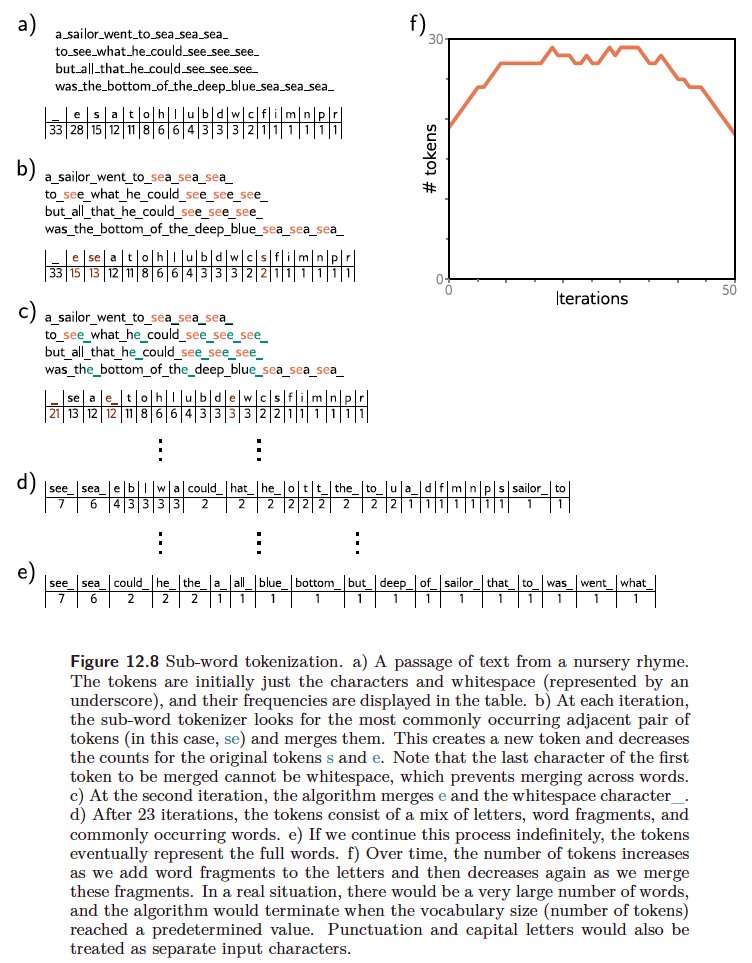
I've always really hated this illustration of byte-pair encoding from my book, but can't figure out how to make it better. Anyone out there got some design skills and want to have a crack at it? DM me if you are interested.
My latest tutorial for @RBCBorealis considers Neural ODEs. These extend residual networks to have an infinite number of layers, each of which makes an infinitesimal change to the data representation and underpin generative models like flow-matching.
📙 https://t.co/x6zFx4G1q1
I'm updating and improving chapters from Understanding Deep Learning and posting them to https://t.co/8zGsFiXjXd.
The latest unit describes a framework for loss functions from which least squares, binary cross-entropy, and multiclass cross-entropy losses can be derived.
I'm gradually updating and improving chapters from Understanding Deep Learning and posting them to https://t.co/8zGsFiXjXd .
The latest update concerns the backpropagation algorithm and network initialization. Critical info if you are teaching yourself ML!
I'm gradually updating and improving chapters from Understanding Deep Learning and posting them to https://t.co/8zGsFiXjXd .
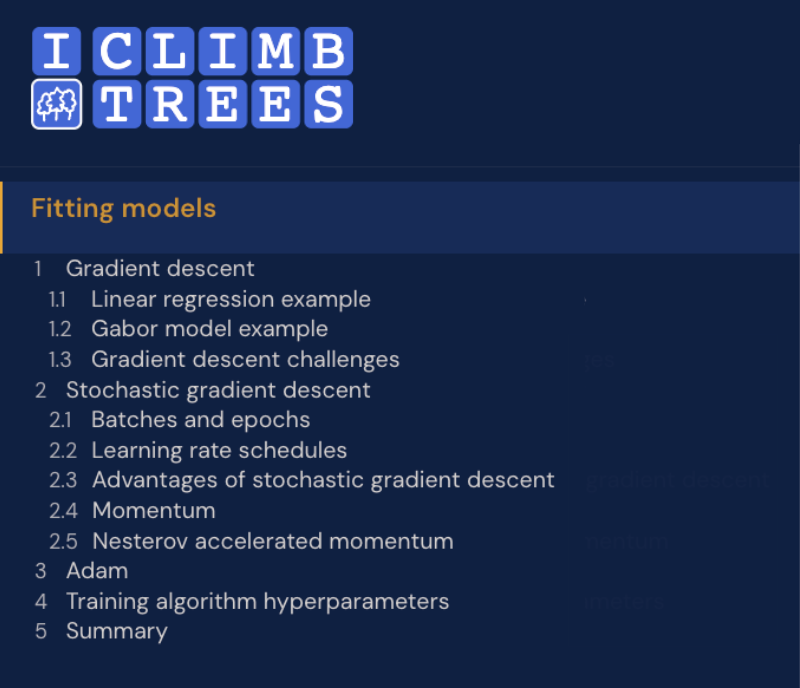
The latest addition considers how to find the parameters that minimize the loss. This process is known as training the model.
@GiorgioMantova 2. I use the full ∂L/∂φ notation just because it's the most well known and neutral. All sorts of people read my book... psychologist, economists, materials scientists, so just going for what I think will be best understood by everyone.
@GiorgioMantova 1. I use square brackets for functions and round for probability distributions. It's not standard and was intended to distinguish from "grouping brackets". I made this decision for my first book in 2012 and it was probably a mistake. Now just aiming for internal consistency.
Ever wondered why larger learning rates and smaller batches lead to better generalization?
Part XI of the ODE/SDE in ML series for @RBCBorealis, reaveals why by treating stochastic gradient descent in the infinitesimal limit as an SDE.
https://t.co/4BMPSD6FmS
Over the last year, I've written 8 blogs for @RBCBorealis that will teach you everything you need to know about ODEs and SDEs for machine learning:
https://t.co/r7J2k6j6DT
Coming soon: neural ODEs, continuous normalizing flows, diffusion models, flow matching, PINNs and more.
Part 8 of my series on ODEs and SDEs in machine learning for @RBCBorealis introduces the Fokker-Planck equation and Anderson's reverse time theorem. The former maps an SDE to a PDE over a probability distribution. The latter reverses an SDE in time.
https://t.co/h7x44cOu9U
I’ve launched 2 new course websites for my Introduction to #ComputerVision and #DeepLearning in Computer Vision courses.
🆕 Gaussian Splatting
🆕 Flow Matching
🆕 Sparse Autoencoders
🆕 Lecture Notes (work in progress)
The videos don’t include voiceovers, but that’s coming in a future revision 🤞
Share your feedback in the thread.