1/ #WorkingPaper Alert 🚨
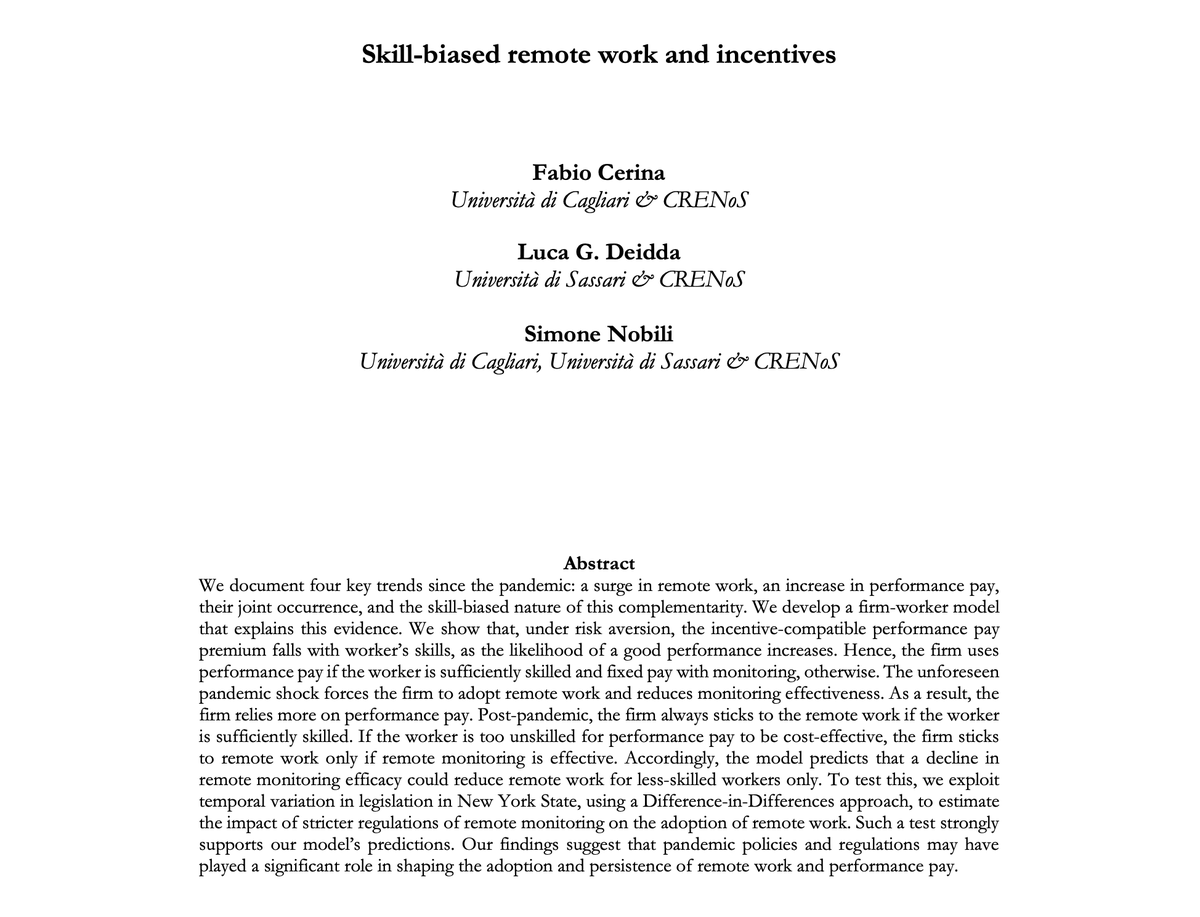
"Skill-Biased Remote Work and Incentives" – joint with @cerfaust and Luca G. Deidda.
We document:
✔ the rise in remote work & performance pay,
✔ their complementarity
✔ and skill-biased nature.
🧵👇
1/ #WorkingPaper Alert 🚨
"Skill-Biased Remote Work and Incentives" – joint with @cerfaust and Luca G. Deidda.
We document:
✔ the rise in remote work & performance pay,
✔ their complementarity
✔ and skill-biased nature.
🧵👇
@cerfaust 6/ 🔎 Our findings suggest that pandemic policies and regulations influenced the adoption and persistence of remote work and performance pay + implications for workers' health could be substantial.
@cerfaust 5/ We test such a prediction by exploiting the temporal variation in legislation in New York State, using a Difference-in-Differences approach and find strong and robust support
@cerfaust 4/ Remote work is persistent: post-pandemic, the firm always sticks to remote work for workers whose skills are so high that performance pay is the best option and switches to office only for less-skilled workers if remote monitoring is not sufficiently effective
@cerfaust 3/ Performance pay becomes more popular when the worker goes remote with the pandemic because remote monitoring is less effective than office monitoring
@cerfaust 2/ We propose a theory, based on moral hazard and information asymmetries, consistent with such evidence. Performance pay is skill-biased as, under risk aversion, the incentive-compatible premium falls with worker’s skills
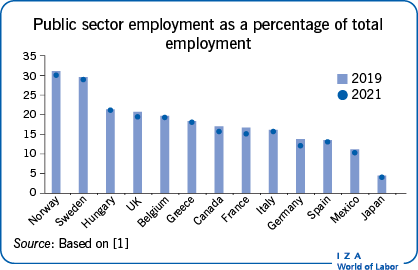
Policymakers alert: #PublicEmployment benefits disadvantaged groups and regions, reduces short-term unemployment, and stimulates private sector demand. However, beware of rigid public wage-setting: it can lead to crowding out private employment and increasing inequality.
Article Update: 'The effects of public sector employment on the economy - The size and wage level of the public sector affect overall employment volatility and the economy' by Vincenzo Caponi @UniSassari and @SimoneNobili9@univca.
https://t.co/xBGYDvU9sv
An important new paper in the Proceeding of the National Academy of Sciences. https://t.co/A82jRFPinn
This calculates the impact of WFH frequency from 0 to 5 days a week on carbon emissions. It combines commuting, non-commuting travel (e.g. driving to buy lunch if you WFH), office energy, home energy and ICT energy.
It finds moving to 2 days a week reduces carbon use by 11%, 4 days by 29% and 5 days a week by a staggering 58%. This mainly from by less commuting and closing offices. We know commuting is energy intensive, but only after reading this did I realize offices are also huge energy users.
For firms this highlights how a supportive WFH policy can deliver progress on climate objectives. Indeed, these effects are so large that WFH policies are likely to be one of the most powerful tools for companies trying to reduce their carbon footprint.
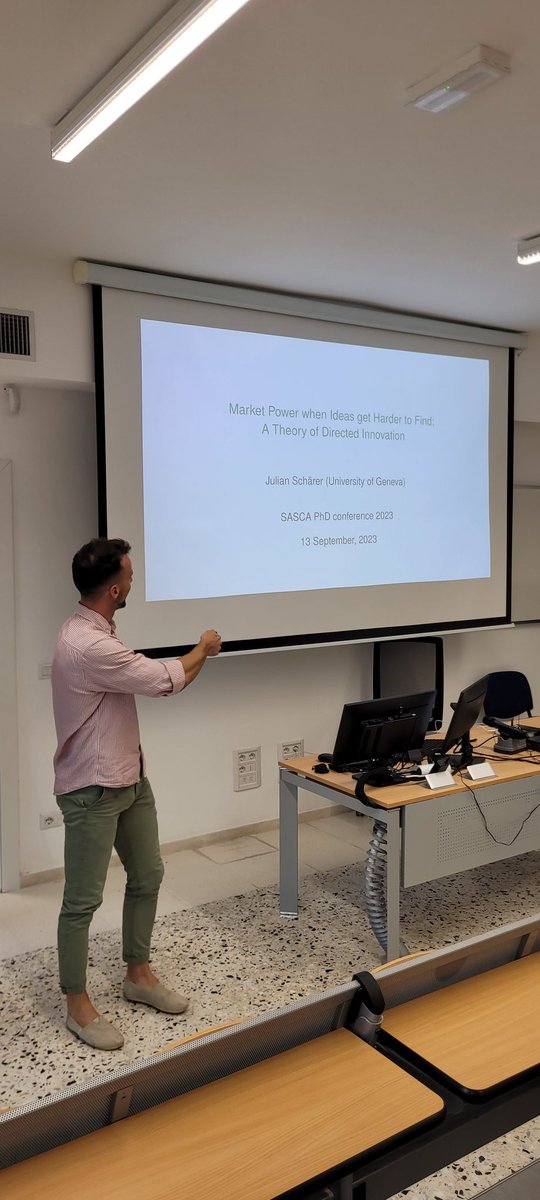
Another successful edition of the SasCa already ended @unissTweet@DipEcoUnive 💪🏼 Many thanks to you @julian_schaerer for the inspiring talk. Till next year!
Thrilled to represent the University of Geneva now! Just started my Postdoc at @unige_en and kicked off this journey with the fantastic SaSca PhD conference in Sardinia. Huge thanks to my discussant @SimoneNobili9 and the organizers @unissTweet and @CaFoscari — it was a blast! 🎓