Farmers selling vegetables, fruits, flowers play in free market, are exposed to price variability which also informs them of what to produce and what not to in time. Ex are the Krishnagiri farmers who are better off in many ways than govt dependent grain producers.
That corps have exclusive pricing power is the biggest nonsense that the vast majority including edu and rich elites end up believing.
Market forces include suppliers, vendors, land, labour, cost of capital, regulatory costs, distribution, customers, competition etc.
Amul sets its price.
McDonald's sets its price.
Pepsi sets its price.
Starbucks sets its price.
Britannia sets its price.
Parle sets its price.
Nestlé sets its price.
Cadbury sets its price.
Kurkure sets its price.
Domino's sets its price.
Maggi sets its price.
But the farmers who grow the food are expected to accept whatever price the market gives them.
No producer in the free market world sets their price independent of market forces. Farmers in India do not want to be exposed to market forces and hence mostly take the MSP as fixed by govt which also anchors their price in the market.
When representatives forget that they REPRESENT, that legislation is a duty on account of their representative powers and over look on executive is again a result of those powers.
And effective representation is indeed a function of the number of the people one represents.
An 850-member Parliament will be even more ineffective than the current 543-member House. MPs are legislators, not administrative executives. Simply adding more of them does not—and cannot—improve constituency administration, because MPs are not the administrative heads of their constituencies.
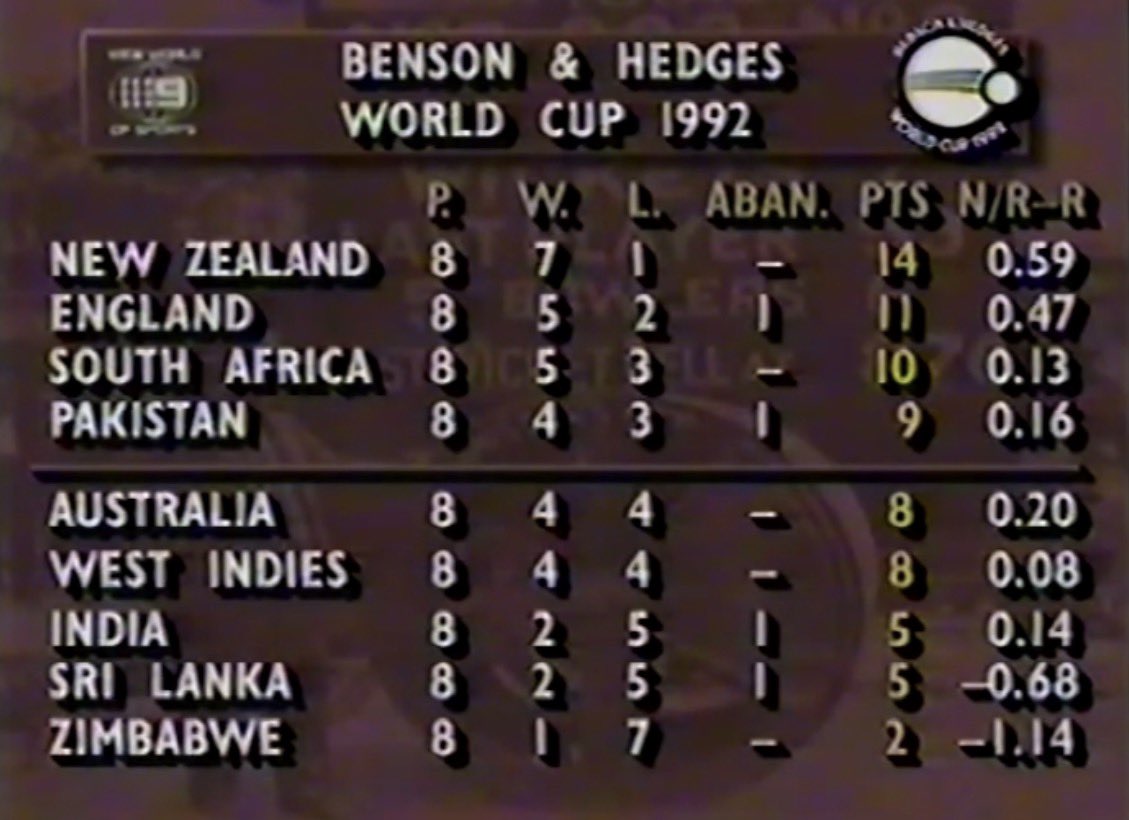
This was the first cricket world cup I followed and there were 2 disappoints apart from India's matches -
1. SA terrible loss to Eng
2. NZ was the most deserving but they could not crack Pak losing twice to them
Imagine if India had won their matches against England and Australia - they would have qualified for the semifinals. However, they weren’t good enough overall and might have still crashed out in the semis.
The team spent more than three months in Australia for five Tests and a tri-series.
The long tour, along with staying away from family for such an extended period, probably led to fatigue and affected India’s performance.
Mr. Sridhar Vembu,
It took 65 years for the Indian Rupee to slide from ₹5 to the US dollar in 1950 to around ₹63 in 2014—a long, gradual erosion across multiple governments and eras.
Yet in just the past 12 years under Narendra Modi, it has been a free fall from ₹63 in 2014 to roughly ₹92 today to the US dollar, eroding the purchasing power of every Indian family, especially the middle class and the poor who feel imported inflation the hardest.
When you choose to lecture about the 1966 devaluation—now nearly 60 years old—it feels like a convenient deflection from the crisis. It is plain dishonesty.
You turned out to be yet another closet #Chaddi trying to profiteer by sucking up to RSS-BJP-Modi.
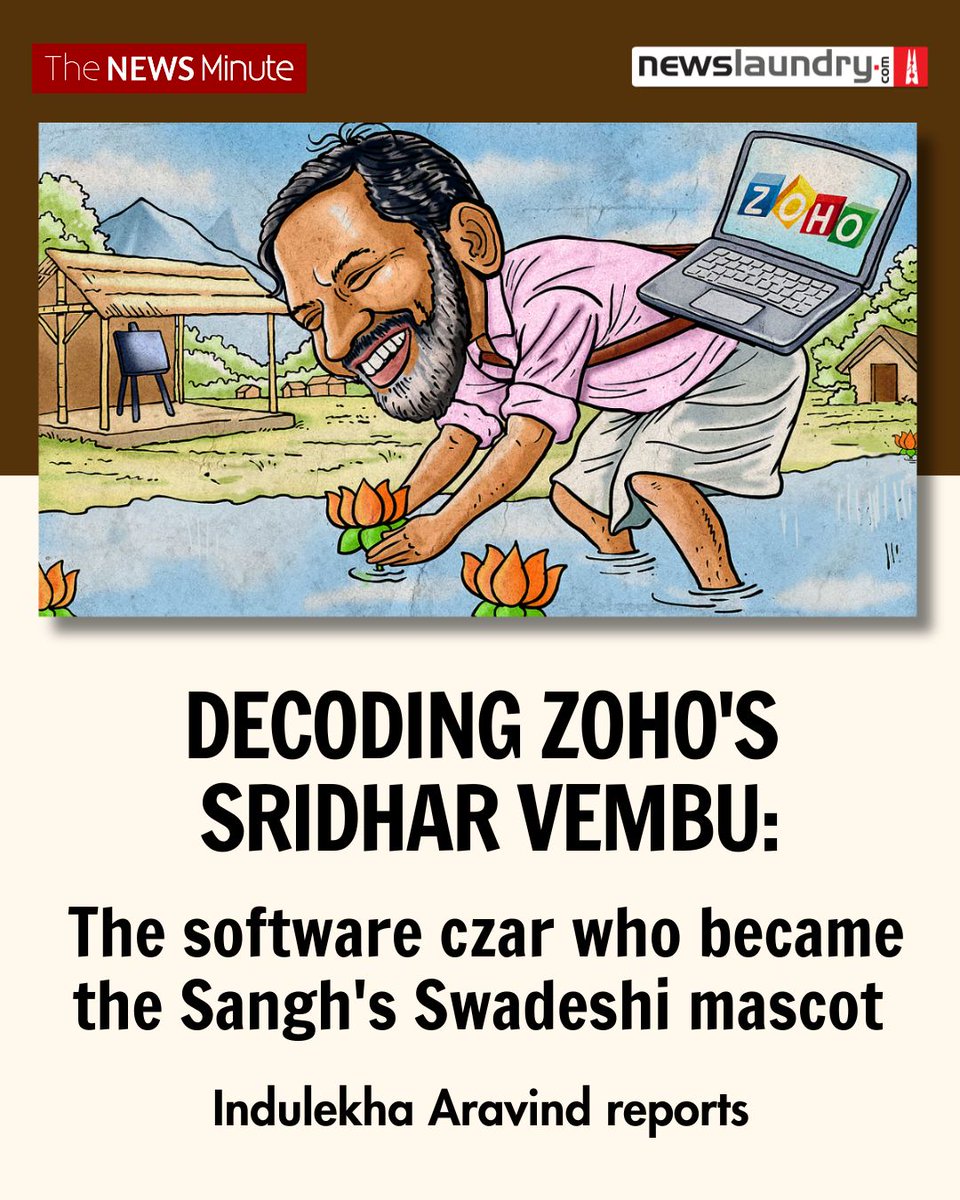
Zoho’s Sridhar Vembu is often celebrated as a tech billionaire who chose villages over Silicon Valley.
But the story isn't just that.
Here’s a closer look at power, ideology and the making of a tech empire.
🔒Profile by @Indulekha_A. https://t.co/CZFliXpxeK
https://t.co/Sox5WzV2vz
Of all the songs of the 90s, I never thought I would end listening to this song in decent freq after 25 yrs.
It's a template song - but unnimenon's melody, anuradhas folksy, jazzy arrangement just marries very nicely.
This is a common but a fairly elementary tactic. Talk about two subjects that are parallel in tandem, hoping that it forms a connect in the listeners' mind.
At an event in Bengaluru earlier today, Karnataka CM Siddaramaiah said, "The Information Technology era is now transforming into the Artificial Intelligence era. This has also raised fears of potential job losses. Our government is also working to elevate the Kannada language, heritage, and culture to a global level. As part of this, the government is committed to preparing our language for new challenges to prevent job losses from Artificial Intelligence. I call upon scholars and technical experts to come forward to make Kannada the language of new technology."
(File photo)
Over last week, have been reading a lot of commentary- many including doctors seem inclined to the idea that -
1. Human body is an input output machine
2. Medical protocols are absolutely deterministic and static
3. Evidence in evidence based medicine is same as proof.
This is exactly how evidence based medicine shouldn't work. When such events crop up, you go back to the drawing board, not give causality correlation gyaan. Risk reward for in favour of universal Covid vaccination; but that doesn't mean we disregard adverse events.
When patients came to me with logic like this, I used to agree with them and tell them a personal story. I said, I normally keep my pillow on North side of bed. One night I placed pillow on South side. That night an earthquake in Latur killed 40,000. All because of my change of pillow placement. Never kept pillow like that again. No further earthquakes. Can't understand why ppl did not believe me. Same logic.
All the scientific illiteracy that was on display during the pandemic by the "Trust the Science" folks is once again on full display now. Epistemic humility ought to be displayed not just by "tech bros" but by health researchers as well.
I owe to science. I do science. My allegiance is to science.. and such are strong indicators to not indulge in any logical, reasonable with that person.
Only valid reason to bring down age to 16 yrs for female is to protect a 18+ male in a consensual relation. When it comes to lowering with high risk of exploitation vs misuse in some cases; one should always side with the former. Misuse should be handled within that system.
You are misled. Here are the facts:
1. When two minors have sex, it goes to the Juvenile Justice Board. There is no provision to treat any child as an adult criminal. They are counseled and rehabilitated under due process. This is how POCSO already works for underage.
This has been placed before the Supreme Court, and ex-NCPCR chief @KanoongoPriyank and JJB members have explained it repeatedly.
2. Your own claim says both are immature - then why punish only the boy?
Why push legalization of risky teen sex for immature Class 10 students when it harms brain, body, and newborns, and burdens public health?
Don't let your misogyny threaten safety of our children.
Bottom line: Class 10 students should prepare for boards, not deliveries.
Underage sex is a health and brain hazard. We will not allow a legal cover that opens floodgates for predators targeting Class 10 students.
Clinical judgement and patient experience are critical components of evidence based medicine. You remove these 2 factors, you are making a dangerous assumption that the experience of the lot will translate to an individual. This is not a valid assumption for complex systems.
To understand why medicine is so complex, let's make a crude simplifying assumption that there are only 100 biomarkers that are important (in reality there are vastly more). Let's also crudely assume each market is allowed only two values. That gives us 2^100 possibilities, which is about 10^30. That is vastly more than humans that ever lived. And this is with the extremely over-simplified model. We face a practical infinity of possibilities.
In reality, no two patients are ever really alike. No statistical model can give you very high confidence on how to treat. That is why AI can never treat patients, because human doctors exercise something called "clinical judgment".
That judgment is what enables a doctor to tell us "this is not a serious issue, get good sleep" vs "this definitely needs deeper investigation". That judgment is hard. Often they cannot even explain why they arrived at this but great doctors have that intuition. The entire Big Medicine is about systematically dismantling clinical judgment and convert doctors to mere "protocol pushers". Great doctors resist this.
Now on top of the measurable biomarkers, there is the unmeasurable factor called "mental state". Every good doctor knows a positive mental state in a patient leads to far better clinical outcomes. That is why good doctors practise compassionate medicine, not just numbers based medicine. I know an outstanding skin doctor in Chennai who prescribed me medicine for my very-itchy Eczema that I had endured for months, and he also told me "try to avoid stress and it may go away, and you may not even need the medicines I prescribed". I consciously reduced my stress level and the problem went away without medicine. That is a truly great doctor.
What does it have to do with autism-vaccine connection? As my crude numerical analysis showed, we have the problem of N=1 way too often in medicine and that is even more true for autism where each kid is truly unique, and that is why statistics are mostly useless and clinical judgment is mostly all we have. We cannot have broad sweeping mandates, definitely not broad vaccine mandates. Each doctor has to exercise their judgment with their patient. And they have to listen to the patient concerns first.
What Big Medicine is about is to try to reduce medicine to be a pure statistical science and it is not. Conditions like autism do not fit that paradigm at all.
That is the battle here. At its core it is not just an autism battle, it is a philosophy of medicine battle.
I pledge to keep fighting this fight because I nearly wanted to commit suicide at one one point in my life. Just this morning, a depressed parent approached me for advice and that started my X thread today.
I urge intelligent doctors to debate this philosophy of medicine issue. I will not respond to the arrogant "stay in your lane" types.
Let's not even get into the faulty (intentional or unintentional) methods clinical research and representation. That's the next step, possible only if one can study the publications regularly.
Without getting into merits of what portfolio of vaccines is right; no more does it hold to say leave medicines to doctors alone. Many doctors are mere consumers of clinical research; with little ability to understand/critique it. So, questioning by users become imperative.
I have met Professors of Immunology in reputed medical schools in the US who _15 years ago_ had serious reservations on the aggressive vaccine schedule but would tell you it was suicidal for them to speak up.
A lot of doctors _in private_ would concur but given how much attack someone like me gets on this topic, they stay silent (I don't care about being attacked, I have been vaccinated (!) against personal attacks on me!).
So I speak up also to give a voice to those _doctors_ who prefer to remain silent.
We may need an org in India to give support to them so they can come out.
Meanwhile do not be misled by "he is not a doctor, he has no right to talk about it". I do have the absolute right and I am a reasonably informed layman.
This whole "stay in your lane" is arrogance and credentialism and I do not respect people who use that line. They are unlikely to be any good in their fields.
There is considerable debate on whether Charvakas rejected the Vedas; but what's reasonable sure is what they considered as valid source of knowledge along the 8 sources listed. Afaik nyaya accepted 4, mimamsa, all 8 and so on.
Long before Europe had its first atheists, ancient India had the Charvakas — bold thinkers who doubted everything. Emerging around 600 BCE, the Charvaka (Lokayata) school was India’s earliest materialist and rationalist philosophy. Attributed to Brihaspati, they rejected the Vedas, karma, rebirth, and any afterlife, insisting that only direct perception (pratyaksha) is a valid source of truth.
They believed the body and consciousness end together — no soul survives death. Their saying captured their worldview: “As long as you live, live happily; even borrow to drink ghee.” Pleasure wasn’t sin — it was the only certainty in an uncertain world.
Their original Bārhaspatya Sūtras are lost, but echoes survive in critics’ works like Madhavacharya’s Sarva-darśana-saṅgraha (14th century) and Jayanta Bhatta’s Nyāya Manjarī. Charvakas existed centuries before Epicurus (341 BCE) or Democritus (460 BCE), making them pioneers of empirical, secular reasoning.
Erased by orthodoxy yet impossible to silence, they remain a reminder that skepticism wasn’t imported into India — it was born here.
(Via ChatGPT + random research)