Survivor turned Architect. 📈
Building Sovereign Chain Analytics because precision shouldn’t be a luxury. Tracking institutional signals & liquidity shifts
Zero
Why “Total Market Crash Next Week”
Social Media Posts Are Usually Wrong
Urgent posts are circulating with claims that next week brings a full crash across stocks, bonds, gold, silver, and Bitcoin. They cite a Fed rate hike, the SpaceX IPO draining liquidity, China and Japan dumping U.S. Treasuries, and U.S.-Iran tensions.
Here are the actual facts as of mid-June 2026:
• Iran-related tensions have increased energy price volatility. This has affected global inflation concerns, with particular pressure on major oil-importing regions.
• SpaceX completed its record $75 billion IPO priced at $135 per share and debuted strongly on the Nasdaq, rising in initial trading. Large IPOs do redirect investor capital temporarily.
• China has reduced U.S. Treasury holdings to around $652 billion (near 18-year lows). Japan has lowered holdings to about $1.19 trillion. India sold approximately $7.6 billion in U.S. Treasuries in March 2026 as part of portfolio adjustments. These moves appear in recent monthly data across several Asian countries.
• The Federal Reserve is expected to hold interest rates steady at its June 16-17 meeting (market pricing shows near 99% probability of no change). No rate hike has been confirmed.
Broader context in Asia:
Higher energy prices from the Middle East situation have added pressure on Asian economies that rely heavily on oil imports. India, as a large importer, has seen impacts on inflation, the rupee, and current account dynamics. Indian equity indices (Sensex and Nifty) have shown mixed movements in recent sessions, trading around 23,000–23,600 levels amid global volatility.
On the predictions:
• Statements such as “insiders are all secretly reducing positions before the collapse” appear regularly in these posts but lack specific evidence. Daily buying and selling by investors is standard market activity.
• Markets do not typically decline in perfect lockstep across all assets at once. Historical data shows mixed outcomes: some assets fall while others remain stable or increase.
Social media posts often connect these points into dramatic “chain reaction” narratives because they generate higher engagement.
What data or market movements have you been tracking lately? Comments welcome.
SCA
#Markets
#Finance #CommonSense #Economy #Macroeconomics #India
What People Are Missing in India, Asia & UAE Markets Right Now
(Weekend Recap – Saturday, June 13, 2026)
Friday, June 12 delivered strong gains across the region:
• Sensex +1,695 pts to 75,528
• Nifty +461 pts to 23,623
• Dubai Index +3.84% to 5,954
• Abu Dhabi +2.72% to 9,805
• Nikkei +2.81% | Hang Seng +1.93%
Oil prices dropped sharply, boosting sentiment. But here are the important things many investors are missing:
1. Gains are built on hopes, not final agreements
US-Iran talks have progressed, but no deal is signed. Any delay or setback could quickly push oil prices higher — raising fuel costs, inflation, and pressure on Indian businesses and families.
2. Foreign investors are leaving India for deeper reasons
Tens of billions of dollars have flowed out this year. Beyond geopolitics, many see select Indian stocks as expensive and prefer other Asian markets with stronger tech exposure. Local Indian funds have supported the market well, but this cannot continue indefinitely.
3. UAE’s strength is real but still maturing
Dubai and Abu Dhabi rose on confidence in banking, real estate, tourism, and services. The UAE is targeting ~5% growth from non-oil sectors. This shift takes time — fresh oil volatility or regional issues could test it short-term.
4. Asia’s winners and losers are very different
Japan & South Korea benefit from technology growth. Oil importers like India gain from cheaper crude, while producers feel the pain. If oil rebounds, inflation may stay sticky and delay interest rate cuts.
Two extra points worth noting:
5. Expected rate cuts across Asia could be delayed if oil doesn’t stay low.
6. Many popular large-cap stocks now trade at high valuations with little margin for error.
Bottom line:
The long-term story for India and the UAE remains strong due to domestic demand and economic diversification. Short-term, however, caution is wiser than excitement. Focus on quality names — solid Indian banks, diversified UAE businesses, and Asia tech — rather than broad buying.
This weekend is a good time to review your portfolio and risk level.
What’s your biggest concern or opportunity right now?
#IndiaMarkets #UAE #Asia #Investing #StockMarket #Nifty #Sensex
Despite today’s strong relief rally, foreign investors (FIIs) have pulled out a record ~₹2 lakh crore+ from Indian stocks in 2026 so far — one of the biggest sell-offs in decades.
Local Indian investors (DIIs/mutual funds) are single-handedly holding up the market and offsetting the massive foreign exodus.
This means the rally is largely “Made in India” — but it highlights underlying caution from global funds even as oil eases and geopolitics improves. Long-term, sustained FII return will be key for broader strength.
🇯🇵 JAPAN JUST DROPPED A BOMBSHELL FOR $BTC.
The Lower House passed a bill today reclassifying crypto as a financial product.
Tax cut from 55% to 20%.
The world's 3rd largest economy is opening the door wide.
$1.4 Trillion
While tech giants talk about spending a staggering $1.4 Trillion on AI by 2027, smart money is looking at a completely different set of numbers.
Tech stocks are climbing despite hot inflation data and European rate hikes, but big-picture investors are watching where actual institutional capital is moving right now.
According to the data tracking on Sovereign Chain Analytics, big institutions aren’t just blindly buying the tech hype. They are actively managing their risk across global markets.
Here is what the Sovereign Chain Analytics Dashboard shows us behind the headlines:
Macro Liquidity Shift: While the market waits for the new SPCX launch, our daily Federal Reserve tracking shows tight net liquidity and high reverse repo numbers. The economy is tighter than the stock market looks.
On-Chain Tracking: While tech companies spend heavily on computing power, institutional transfers over $5M show that top trading desks are repositioning out of high-risk assets to shelter from inflation.
Global Cash Flow: Our platform’s data on the U.S. and regional markets shows a massive gap between the public hype around AI and the conservative way major funds are actually moving their money through the banking system.
Tech giants can dream about a trillion-dollar future, but the real data says to watch your downside. Don't trade the hype. Watch the actual flow of capital.
SCA
#Finance #ArtificialIntelligence #Investing #Economy #FinTech
Today’s Market Relief (June 12, 2026)
Global markets rose today after US President Trump shared progress on an Iran ceasefire deal. This reduced worries about oil supply problems in the Strait of Hormuz. Oil prices fell sharply — Brent around $86–89 per barrel (near two-month lows, down over 4% today) — which eases worldwide price pressures.
For India (which buys about 85% of its oil from abroad):
Lower oil costs cut import expenses, help the economy stay balanced, and keep price rises in check. This supports car makers, transport, factories, and everyday goods. The rupee strengthened to about 95.20–95.55 against the US dollar, making imports cheaper and business planning easier.
For UAE (an oil producer and business center):
Lower prices may reduce short-term earnings, but less ups and downs help other areas like finance, tourism, property, and shipping in Dubai and Abu Dhabi grow. Local markets stayed steady, showing strength.
Broader Asia and India view:
India’s young population, growing middle class, digital tools, and factory push give it steady long-term strength. Asia’s tech sectors rebounded today, and India stands as a reliable growth area.
This shows how reduced risks create clear benefits: lower costs for buyers like India and steadier planning for producers like UAE.
Key Opportunities
• Stronger energy ties between India and UAE, including oil storage deals and investments worth billions.
• Growth in banking, roads, and buildings.
• Tech and AI developments.
• India’s long-term growth potential from its people and policies.
• UAE as a global business center for travel, finance, and trade.
These offer good options for investors through funds, partnerships, or clean energy projects.
Risks to Watch
• The ceasefire could face setbacks and push oil prices back up.
��� Upcoming US inflation numbers and policy updates.
• Foreign investor money flows into India.
• Expect market swings — stay ready and follow the news.
Global groups like the IMF and World Bank expect slower world growth this year due to past tensions, but today’s moves show how events in one area quickly affect oil, stocks, and currencies everywhere. India and UAE look strong thanks to their close partnership and solid home strengths. Focus on steady, varied plans rather than daily changes.
SCA
#Finance #Investing #IndianEconomy #GlobalMarkets #UAE
India, Asia & UAE Financials Snapshot – June 11, 2026
Regional markets are holding relatively steady despite US inflation pressures (4.2% CPI) and geopolitical energy risks.
Market Performance (Latest Close / June 10-11)
• India Nifty 50: 23,215 – 23,366 range (closed around 23,215, down ~0.12% on June 10) Sensex: ~74,012 – 74,048 (+0.05% to +0.09%) Markets show selective buying with strong Domestic Institutional Investor (DII) flows offsetting Foreign Institutional Investor (FII) selling. Year-to-date performance remains positive but in a consolidation phase after earlier highs.
• Broader Asia Hang Seng (Hong Kong): ~24,100 – 24,235 (down ~0.7–1.1% recently) Nikkei 225 (Japan): ~64,217 (mildly positive to flat, showing resilience) Regional bourses are cautious, reacting to global rate and energy concerns, but supported by domestic consumption and supply chain shifts.
• UAE ADX General: ~9,538 – 9,578 (down ~0.4% recently, but stable) DFM General: ~5,758 – 5,785 (holding near recent levels) Steady volumes with focus on non-oil sectors, banking, and infrastructure-related names.
Key Economic Indicators
• India: CPI inflation projected at 4.5–4.7% for FY2026 (with some forecasts up to 4.6% amid energy pressures). Strong domestic demand, robust services sector, and healthy credit growth remain key supports. RBI maintains a balanced policy stance.
• UAE: One of the lowest inflation rates globally at ~1.8–2.0% (2025–2026 outlook). Non-oil economy expanding steadily through diversification, tourism, finance, and real estate.
• Asia: Varied picture — China and export-oriented economies face external headwinds, while domestic-led markets like India benefit from internal consumption.
What’s Coming Next (Key Triggers)
• India: WPI inflation data, bank loan growth figures, and ongoing earnings season. RBI policy signals and monsoon progress will influence sentiment. Focus remains on capex, consumption, and manufacturing themes.
• UAE: Continued push on non-oil GDP (projected 4.5–4.8% growth). Infrastructure projects and sovereign-backed initiatives provide visibility.
• Asia: China economic releases, central bank responses to global conditions, and any escalation/de-escalation in geopolitical tensions affecting energy prices.
Sovereign Chain Analytics View
India, Asia, and the UAE are demonstrating pragmatic stability in a shifting global regime. Domestic strengths and diversification are proving effective buffers, creating selective opportunities in quality names across consumption, infrastructure, tech-manufacturing, and financial services.
How are you positioning in these markets? Increasing India/UAE exposure, staying selective, or adding defensives? Share your thoughts and strategies below.
SCA
#IndiaMarkets #AsiaEconomy #UAEInvestment #Nifty50 #ADX #DFM #GlobalFlows #SovereignChainAnalytics
US Financials Snapshot – As of June 11, 2026
(Markets reacting to the first 4%+ CPI print in three years)
Market Performance (June 10 Close)
• S&P 500: 7,266.99 (–1.62%)
• Dow Jones: 49,918.78 (–1.87%)
• Nasdaq: 25,169.50 (–1.98%)
Tech and growth names led the decline as investors digested hotter inflation data and geopolitical energy risks.
Key Economic Indicators
• CPI (May 2026): +4.2% year-over-year (first 4%+ reading in three years), up from 3.8% in April. Energy costs drove much of the jump.
• Fed Funds Rate: Target range 3.50%–3.75% (effective rate ~3.62%). No change widely expected at the June 17 FOMC meeting.
• 10-Year Treasury Yield: ~4.55%.
What’s Coming Next
• Today (June 11): PPI and Initial Jobless Claims data.
• June 17: FOMC meeting — markets expect rates on hold with limited cuts priced in for 2026.
• Broader Picture: Sticky inflation, elevated energy prices, and a still-resilient but slowing labor market are shifting the regime.
Sovereign Chain Analytics View
Cross-border capital flows and on-chain positioning patterns from Asia, India, and the UAE show clear rotation toward resilience. With US inflation back above 4%, flows favor diversified real assets, regional supply chains, commodities, and high-quality opportunities less dependent on near-term Fed easing. UAE and Indian markets continue to benefit from steady domestic demand, alternative funding channels, and pragmatic diversification away from pure US rate sensitivity.
Bottom Line: The return of 4%+ inflation marks a regime shift. Defensive positioning, quality focus, and geographic diversification are gaining traction as volatility rises.
How are you adjusting your allocation in this environment? Defensive, selective opportunities, or staying the course?
Share your thoughts below.
#USMarkets #CPI #Inflation #Fed #StockMarket #GlobalFlows #SovereignChainAnalytics
SUGAR: India’s DGFT has implemented a total freeze, placing sugar into the "Prohibited" export category until Sept 30, 2026. Facing El Niño threats to future crop cycles and fertilizer supply risks, New Delhi is hoarding domestic inventory to combat food inflation.
The Shift
A massive shift is happening right now across Asia and the Middle East, rewriting how money and goods move across borders. If you are tracking global markets, supply chains, or institutional money, you need to look closely at what is happening between India, the UAE, and Singapore.
At Sovereign Chain Analytics, we have been watching the data feeds, and the numbers show a major structural change in just the last few weeks.
Here is what you need to know right now—minus the complex financial jargon.
Singapore Takes the Lead
Due to recent shipping bottlenecks and stability challenges in the Gulf—particularly around the Strait of Hormuz—global trade routes have shifted rapidly. In a historic turn, Singapore overtook the UAE to become India's second-largest export market (right behind the US).
Our data shows Indian exporters heavily rerouting their goods through Singapore to tap into its stable ports and smooth legal frameworks. In fact, India’s monthly exports to Singapore jumped a staggering 180% year-on-year, hitting $2.29 billion. Meanwhile, direct exports to the UAE dipped by 36% as companies bypassed traditional shipping choke points.
A $5 Billion Cash Injection
The UAE isn't sitting back. To balance out these trade shifts, Abu Dhabi just committed $5 billion in fresh, direct investments into India.
This is part of a massive push to deepen ties outside of just oil and gold. The money is moving straight into high-value projects: data centers, advanced technology, port engineering, and a joint sovereign AI supercomputer project. Total trade between India and the UAE crossed $101 billion, and the two countries are actively pushing to double that number to $200 billion by 2030.
India's Global Magnet Status
Despite global economic bumpy roads, India’s full-year Foreign Direct Investment (FDI)—the money foreign companies permanently invest in local businesses and factories—hit $58.85 billion. That is a solid 18% increase over the previous year.
Where is that money coming from, and where is it going?
Singapore remains India's single largest source of foreign investment capital, contributing a massive $19.8 billion to the mix.
The cash is flowing heavily into electronics, computer hardware, clean energy, and semiconductor (microchip) manufacturing.
We are no longer looking at simple, isolated trading partners. Singapore has cemented its role as the financial heart directing global capital into India, while the UAE is shifting from a simple trade hub into a massive powerhouse investor in India's technology future.
For businesses and investors, the strategy is clear: the India-Singapore-UAE triangle is where Asia’s next generation of growth and supply chain security is being built.
Data tracked and analyzed via Sovereign Chain Analytics. Not financial advice
#Macroeconomics
#GlobalTrade
#IndiaGrowth
#SingaporeFinance
#UAETec
US Financial Markets Update: June 9, 2026 (Recap of June 8 Close)
Markets Rebound on Tech Gains Amid Easing Tensions and Upcoming Inflation Data
US stocks recovered some ground on Monday, June 8. This followed big losses the previous Friday after stronger-than-expected May jobs numbers. Technology and semiconductor companies led the gains as investors returned to growth stocks. Reports of a possible ceasefire between Israel and Iran also helped calm concerns.
Key Index Closes (June 8, 2026)
• Dow Jones Industrial Average: 50,786.01 (-80.77, -0.16%)
• S&P 500: 7,405.73 (+21.99, +0.30%)
• Nasdaq Composite: 25,929.66 (+220.23, +0.86%)
• Russell 2000: ~2,855 (+0.77%)
• VIX (Volatility Index): 18.92 (-12.04%) — Market worry eased.
Sector Performance: Semiconductor stocks performed well (Nvidia +1.7%, Broadcom +2.8%, AMD +5.1%, Micron +9.9%). Tesla rose about 4.6%. The Dow lagged due to declines in some big names like Apple (-1.9%), along with insurance and materials companies.
Macro Snapshot
• Overnight Borrowing Rate (SOFR): 3.63 (stable as of recent data)
• 10-Year Treasury Yield: Around 4.55% (small changes after jobs data)
• Dollar Index (DXY): Near 100 (showing mild strength)
• Oil (WTI): Around $90–91 (gave back some gains on ceasefire news)
• Gold: Around $4,330–$4,343 (relatively steady)
What’s Ahead This Week
• Important inflation (CPI) data and more company earnings reports will be key tests.
• Reduced geopolitical worries offer some support, but ongoing inflation or jobs concerns could bring ups and downs.
• Focus remains on artificial intelligence developments, including potential new company listings and tech updates.
A positive day especially for technology investors, though not all sectors joined in. Careful risk management remains important ahead of key data releases.
Data from public market sources. Not financial advice — always do your own research as markets change quickly.
SCA
#StockMarket #USMarkets #TechStocks #FinanceUpdate #InvestmentNews
Bank of India
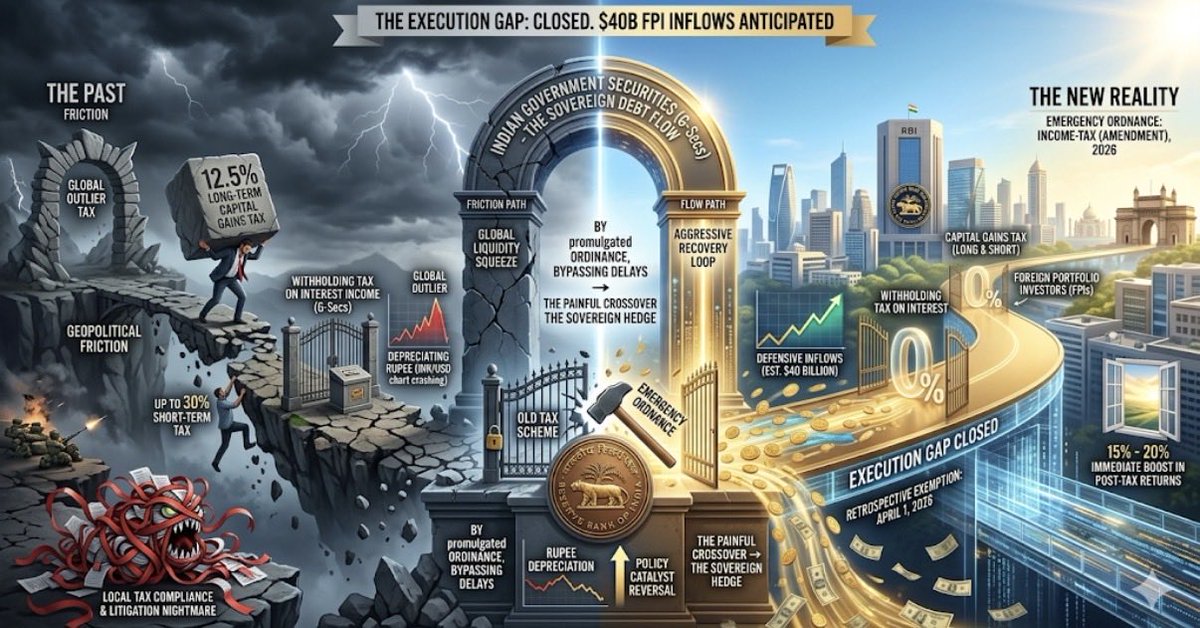
The Government of India and the Reserve Bank of India (RBI) officially bypassed standard legislative delays by promulgating the Income-tax (Amendment) Ordinance, 2026, completely exempting Foreign Portfolio Investors (FPIs) from both capital gains tax and withholding tax on interest income for government securities (G-Secs), applied retrospectively from April 1, 2026.
Here is how the "Execution Gap" was closed:
The Past Friction: Foreign allocators were previously hit with a 12.5% long-term capital gains tax, up to a 30% short-term tax, and a 20% withholding tax on interest. India was a global outlier by taxing non-residents on sovereign debt flows.
The tax rate across all three of those buckets has slashed straight to 0%.
The timing wasn't accidental; the rupee has been taking a brutal beating, depreciating significantly amidst the ongoing Middle East conflict and heavy outflows from Indian equities.
Analysts estimate these aggressive policy maneuvers could pull in roughly $40 billion in defensive inflows. By removing the local tax compliance and litigation nightmare, an investment in Indian sovereign debt just received an immediate 15% to 20% boost in post-tax returns.
🚨 NEW: US became India's largest gas supplier in May as West Asia disruptions push India to diversify energy supplies.
-> LPG imports from the US jumped 63% to 629,000 tonnes
-> LNG imports hit a record 907,000 tonnes, up 227% from April
-> Iran became India's second-largest LPG supplier, with imports rising to 144,000 tonnes in May
-> LPG imports from the UAE fell 31%, while imports from Saudi Arabia plunged 75.5%
Source: Moneycontrol
Bank of India
The Government of India and the Reserve Bank of India (RBI) officially bypassed standard legislative delays by promulgating the Income-tax (Amendment) Ordinance, 2026, completely exempting Foreign Portfolio Investors (FPIs) from both capital gains tax and withholding tax on interest income for government securities (G-Secs), applied retrospectively from April 1, 2026.
Here is how the "Execution Gap" was closed:
The Past Friction: Foreign allocators were previously hit with a 12.5% long-term capital gains tax, up to a 30% short-term tax, and a 20% withholding tax on interest. India was a global outlier by taxing non-residents on sovereign debt flows.
The tax rate across all three of those buckets has slashed straight to 0%.
The timing wasn't accidental; the rupee has been taking a brutal beating, depreciating significantly amidst the ongoing Middle East conflict and heavy outflows from Indian equities.
Analysts estimate these aggressive policy maneuvers could pull in roughly $40 billion in defensive inflows. By removing the local tax compliance and litigation nightmare, an investment in Indian sovereign debt just received an immediate 15% to 20% boost in post-tax returns.
🔵 SOVEREIGN CHAIN ANALYTICS
OUT TRON USDT INSTITUTIONAL FLOW — HTX HOT WALLET 1 CUSTODIAL
$1,000,097,820 USDT on Tron
HTX Hot Wallet 1 — Large Stablecoin Transfer
Signal Strength: 9/10 █████████░
Bias: Risk-On
CEX Outflow — Supply Lock / Accumulation
CME CONTINUOUS FLOW (Weekend) | 1:20:20 PM EST
Tronscan
German Chancellor Friedrich Merz called the EUROPEAN UNION A COMPLETE FAILURE in front of global elites:
"Germany and Europe have wasted incredible potential. We have become the world champion of over-regulation and zero growth."
What’s still under the radar is the talent and startup capital rotation happening in parallel. As money moves into stable yield and tokenized structures, we’re also seeing skilled professionals and early-stage capital from India and Singapore increasingly parking or incorporating in the UAE. This liquidity corridor is slowly becoming a human capital corridor too. Not just money moving — ecosystems are starting to connect.
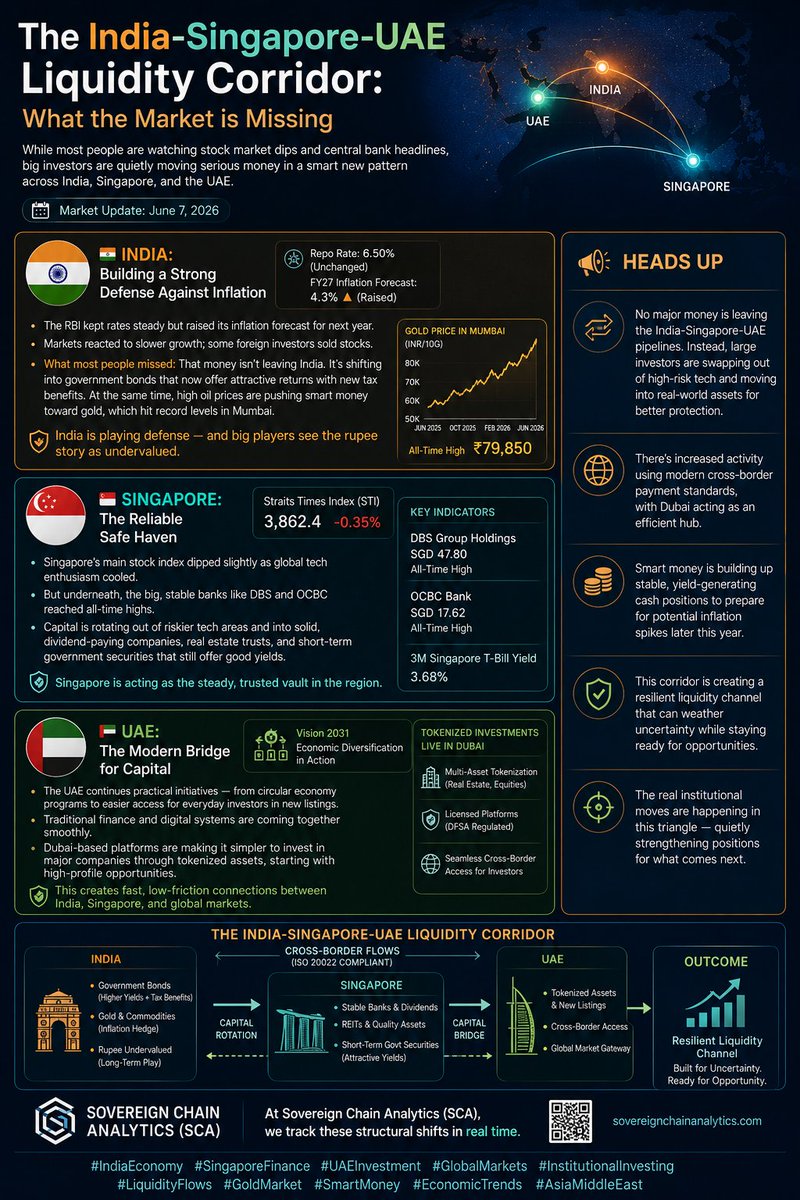
The India-Singapore-UAE Liquidity Corridor: What the Market is Missing
While most people are watching stock market dips and central bank headlines, big investors are quietly moving serious money in a smart new pattern across India, Singapore, and the UAE.
This isn't money running away from Asia and the Middle East. It's being carefully redirected into safer, higher-yield opportunities that can handle today's energy costs and global tensions. Here's what's really happening as of June 7, 2026:
🇮🇳 India: Building a Strong Defense Against Inflation
The Reserve Bank of India kept its key interest rate steady but raised its inflation forecast for next year. Markets reacted nervously to slower growth numbers, and some foreign investors sold stocks.
What most people missed: That money isn't leaving India. It's shifting into government bonds that now offer attractive returns with new tax benefits. At the same time, high oil prices are pushing smart money toward gold, which hit record levels in Mumbai.
India is playing defense — and big players see the rupee story as undervalued.
🇸🇬 Singapore: The Reliable Safe Haven
Singapore’s main stock index dipped slightly as global tech enthusiasm cooled. But something else was happening underneath: the big, stable banks like DBS and OCBC reached all-time highs.
Why? Capital is rotating out of riskier tech areas and into solid, dividend-paying companies, real estate trusts, and short-term government securities that still offer good yields. Singapore is acting as the steady, trusted vault in the region.
🇦🇪 UAE: The Modern Bridge for Capital
The UAE continues to push forward with practical initiatives — from circular economy programs to easier access for everyday investors in new listings.
The bigger story: Traditional finance and digital systems are coming together smoothly. Dubai-based platforms are making it simpler for people to invest in major companies through tokenized assets, starting with high-profile opportunities. This creates fast, low-friction connections between India, Singapore, and global markets.
Heads UP
No major money is leaving the India-Singapore-UAE pipelines. Instead, large investors are swapping out of high risk tech and moving into real-world assets for better protection.
There’s increased activity using modern cross-border payment standards, with Dubai acting as an efficient hub.
Smart money is building up stable, yield-generating cash positions to prepare for potential inflation spikes later this year.
This corridor is creating a resilient liquidity channel that can weather uncertainty while staying ready for opportunities.
The real institutional moves are happening in this triangle quietly strengthening positions for what comes next.
At Sovereign Chain Analytics (SCA), we track these structural shifts in real time.
#IndiaEconomy #SingaporeFinance #UAEInvestment #GlobalMarkets #InstitutionalInvesting #LiquidityFlows #GoldMarket #SmartMoney #EconomicTrends #AsiaMiddleEast
Test. 🔵 SOVEREIGN CHAIN ANALYTICS
OUT TRON USDT INSTITUTIONAL FLOW — HTX HOT WALLET 1 CUSTODIAL
$3,945,966,111 USDT on Tron
HTX Hot Wallet 1 — Large Stablecoin Transfer
Signal Strength: 9/10 █████████░
Bias: Risk-On
CEX Outflow — Supply Lock / Accumulation
CME CONTINUOUS FLOW (Weekend) | 3:10:43 AM EST
Tronscan
China's coast guard harasses Filipinos. Philippines documents it. China gets upset when the footage reaches the rest of the world and accuses Manila of "playing the victim."
If you don't want the reputation of a bully, stop behaving like one.
https://t.co/cyS1LBrrmR