𝗟𝗲𝘃𝗲𝗿𝗮𝗴𝗲 𝘄𝗮𝘀 𝗯𝘂𝗶𝗹𝘁 𝗳𝗼𝗿 𝘁𝗿𝗮𝗱𝗲𝗿𝘀.
𝟮𝗳𝗮𝗰𝘁𝗼𝗿 𝗜𝘀 𝗕𝘂𝗶𝗹𝘁 𝗳𝗼𝗿 𝗛𝗼𝗹𝗱𝗲𝗿𝘀.
I've held assets through enough cycles to know the tension.
You believe in something for years, and you also catch yourself wishing you had a bit more exposure, without the stress of watching a liquidation price.
Most leverage tools force a choice: be right about the destination and the exact path, or get wiped out or slowly bled dry on the way.
That's the gap https://t.co/qmraJPckLu is trying to close. It's live on Base in a capped beta, and its pitch is simple: Kelly-optimized leverage, an institutional strategy, made available to ordinary buy-and-hold investors.
➥ First, what is "Kelly" leverage?
The Kelly idea goes back to the 1950s. It asks what level of leverage makes your money compound fastest over the long run. Too little leaves growth on the table. Too much works against you, because volatility drag eats returns, and past a certain point you compound your way toward zero. The sweet spot sits in between, and the formula behind it is surprisingly clean: roughly an asset's expected return divided by the square of its volatility.
This isn't fringe thinking. For listed equities the optimal target lands around 1.5–2×, and Berkshire Hathaway has run at about 1.6× for decades. Ed Thorp, one of the founding figures of quantitative finance, built his fund around the same principle. For Bitcoin, which is far more volatile, the optimum comes out lower, at about **1.33×**.
That is the core of 2factor. It doesn't chase 3× or 5× for the thrill of it. It targets the multiple the math says should compound best.
➥ Why today's leverage fails long-term holders
Most of the world's investable capital buys and holds. 2factor estimates that about 88% of it, roughly $112 trillion, sits on horizons longer than two weeks. But nearly every leverage product is built for short-term trading. The usual options each have a problem:
Perpetual futures and margin** can liquidate you. One sharp wick and your thesis is irrelevant.
Leveraged ETFs don't liquidate you, but they reset daily, so they suffer volatility decay and hidden financing costs.
Estimates put the total cost to holders at $10B+ a year. The researchers behind the well-known path-dependence work concluded they're unsuitable for buy-and-hold investors.
Conventional multiples like 2× and 3x sit outside the productive band for Bitcoin's volatility. Over long horizons, 2× BTC tends to trail spot, and 3× gets eroded toward zero.
➥ Two forces do the damage.
Volatility drag is pure math: more volatility and more leverage mean more erosion.
Financing drag is structural: the cost of the borrowed capital behind the position, often routed through expensive hedging counterparties. If an asset's drift can outrun both, you have a "productive band" where leverage helps you. If not, it hurts.
➥ How 2factor works
2factor splits an asset's volatility into two perpetual tranches, which I find the most interesting part of the design.
cbBTC-Sr (Senior) is the yield-bearing side. It sits behind a buffer of Junior capital, so impairment would take roughly a four-sigma drawdown. Its yield comes from the premium Junior holders pay for leverage.
cbBTC-Jr (Junior) is the leveraged side, at about 1.33× cbBTC. It absorbs price movement first, and it is built to be held. It is not designed to be traded around or liquidated.
The key is where the leverage comes from. Traditional leverage is priced against the cost of shorts, which is expensive. 2factor prices it against the cost of stable yield, supplied by senior capital that wants yield. At 1.33×, Junior borrows only $0.33 of senior capital per $1 of equity, so its financing cost is by construction about one third of the senior yield. With no external hedging counterparty in the middle, that spread flows to holders instead of intermediaries.
➥How it stacks up
Buy-and-hold investors need three things from a leverage instrument: no liquidations, durability over long horizons, and capital efficiency. By 2factor's own comparison, BTC-Jr targets all three. Leveraged ETFs manage only the first. Perps and margin manage none of them reliably.
➥Who @2FactorFinance is for
Long-term holders who want more exposure without more capital. Treasuries and funds that don't want to roll futures. Risk-conscious investors who'd rather take the Senior side and earn yield with a buffer. Algorithmic funds that periodically need leveraged long exposure. Basis traders who can capture the gap between Junior's financing cost and perp funding.
Beyond Bitcoin
The ambition goes past BTC. As equities move onchain, the same mechanism could apply to any liquid asset with a reliable price feed and positive long-run drift. The site cites a median financing drag of about 18.84% in single-stock leveraged ETFs. At that cost, nothing can be held long-term. Holding a stock at 1× is already a leverage decision, and usually not the growth-maximizing one.
My take
I think the *idea* is compelling, and close to a no-brainer for the right person: someone who already holds Bitcoin for years and wants a modest, liquidation-free boost. The reasoning is that it's grounded in decades-old portfolio theory, it avoids the two things that kill most leverage (liquidations and daily-reset decay), and it targets a multiple that math supports rather than one that sells well. The cost structure is the real edge. Cheaper financing is a durable advantage, not a gimmick.
It isn't a free lunch, though. 1.33× still amplifies drawdowns, and the Kelly argument depends on Bitcoin's drift continuing to clear the volatility hurdle, a belief about the future, not a guarantee. The beta is capped, and as with any onchain protocol, smart contract risk is real. Anyone using it should read the whitepaper and size their position carefully.
Still, in a space full of products selling excitement, a project that says "the optimum is 1.33×, not 10×" is refreshingly honest. Start with the primer on https://t.co/qmraJPckLu, and use the Ask Claude tool on the site if you want to dig into the math.
Join using my referral Link https://t.co/o40UN2Maa7
Big announcements don’t turn into $CC burns overnight.
@YuvalRooz explains why Canton is chasing institutional activity, what takes time, and why he’s still excited about what comes next.
Ask most people what PancakeSwap is and they'll say it's where you swap tokens on BNB Chain. For years I used it the same way, swapping and closing the tab. The rebrand to Pancake makes sense once you look at what's on the site now.
If you trade, there's swaps, Perps for going long or short, and Stock Terminal for tokenized stocks and ETFs 24/7, weekends included. The aggregator routes each trade to the best price it can find. If you want to earn, you can stake CAKE in Syrup Pools or use Dual Investment, where you set a target price and earn yield while you wait. Builders can add custom features to pools with Infinity hooks or plug the aggregator into their own apps.
All of this runs across 11 chains, including BNB Chain, Base, Solana, Arbitrum, Robinhood Chain and Ethereum. CAKE is the same token with the same contract, so there's nothing to migrate or claim.
Which of these have you tried besides the swap? @PancakeFi@_JustxB@Disciple_tobi
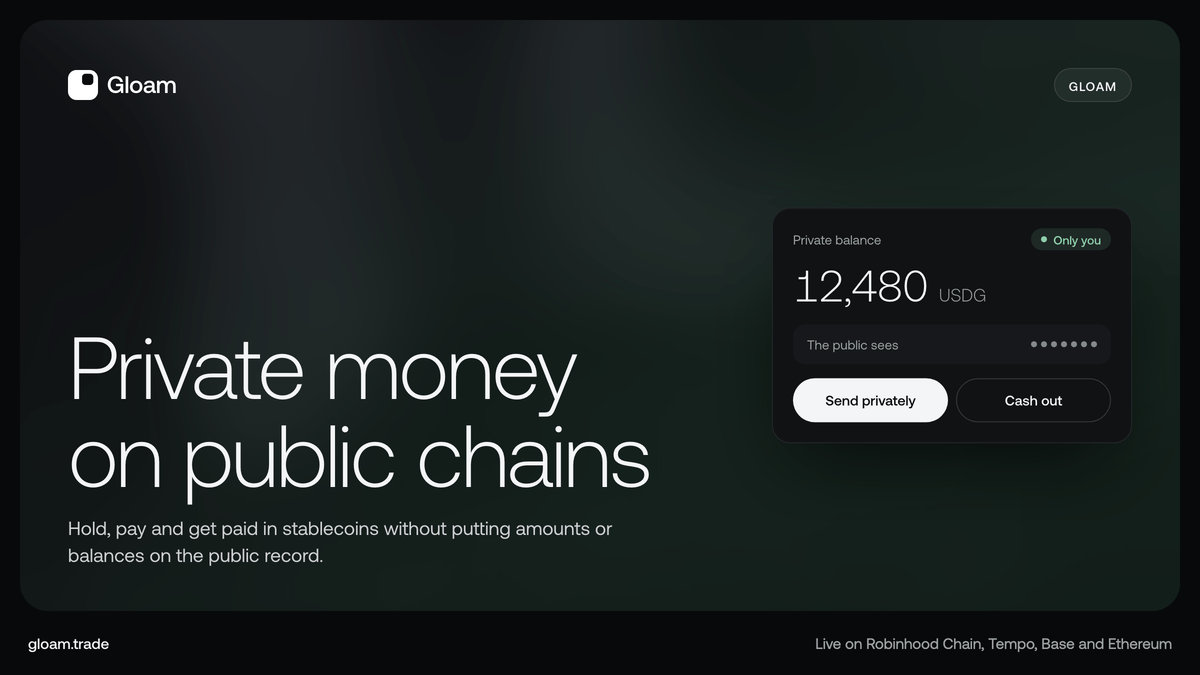
Anyone who has my wallet address can open an explorer right now and see what every project paid me this year, when the money landed and what I have left.
Most of what I earn from writing and campaigns or jobs comes in as USDT or USDC, so my wallet is basically a public income statement. The next client can check what the last one paid me.
I used to accept that as part of using crypto. Then I spent time going through how @gloamtrade works, and it changed how I think about it.
𝗟𝗲𝘃𝗲𝗿𝗮𝗴𝗲 𝘄𝗮𝘀 𝗯𝘂𝗶𝗹𝘁 𝗳𝗼𝗿 𝘁𝗿𝗮𝗱𝗲𝗿𝘀.
𝟮𝗳𝗮𝗰𝘁𝗼𝗿 𝗜𝘀 𝗕𝘂𝗶𝗹𝘁 𝗳𝗼𝗿 𝗛𝗼𝗹𝗱𝗲𝗿𝘀.
I've held assets through enough cycles to know the tension.
You believe in something for years, and you also catch yourself wishing you had a bit more exposure, without the stress of watching a liquidation price.
Most leverage tools force a choice: be right about the destination and the exact path, or get wiped out or slowly bled dry on the way.
That's the gap https://t.co/qmraJPckLu is trying to close. It's live on Base in a capped beta, and its pitch is simple: Kelly-optimized leverage, an institutional strategy, made available to ordinary buy-and-hold investors.
➥ First, what is "Kelly" leverage?
The Kelly idea goes back to the 1950s. It asks what level of leverage makes your money compound fastest over the long run. Too little leaves growth on the table. Too much works against you, because volatility drag eats returns, and past a certain point you compound your way toward zero. The sweet spot sits in between, and the formula behind it is surprisingly clean: roughly an asset's expected return divided by the square of its volatility.
This isn't fringe thinking. For listed equities the optimal target lands around 1.5–2×, and Berkshire Hathaway has run at about 1.6× for decades. Ed Thorp, one of the founding figures of quantitative finance, built his fund around the same principle. For Bitcoin, which is far more volatile, the optimum comes out lower, at about **1.33×**.
That is the core of 2factor. It doesn't chase 3× or 5× for the thrill of it. It targets the multiple the math says should compound best.
➥ Why today's leverage fails long-term holders
Most of the world's investable capital buys and holds. 2factor estimates that about 88% of it, roughly $112 trillion, sits on horizons longer than two weeks. But nearly every leverage product is built for short-term trading. The usual options each have a problem:
Perpetual futures and margin** can liquidate you. One sharp wick and your thesis is irrelevant.
Leveraged ETFs don't liquidate you, but they reset daily, so they suffer volatility decay and hidden financing costs.
Estimates put the total cost to holders at $10B+ a year. The researchers behind the well-known path-dependence work concluded they're unsuitable for buy-and-hold investors.
Conventional multiples like 2× and 3x sit outside the productive band for Bitcoin's volatility. Over long horizons, 2× BTC tends to trail spot, and 3× gets eroded toward zero.
➥ Two forces do the damage.
Volatility drag is pure math: more volatility and more leverage mean more erosion.
Financing drag is structural: the cost of the borrowed capital behind the position, often routed through expensive hedging counterparties. If an asset's drift can outrun both, you have a "productive band" where leverage helps you. If not, it hurts.
➥ How 2factor works
2factor splits an asset's volatility into two perpetual tranches, which I find the most interesting part of the design.
cbBTC-Sr (Senior) is the yield-bearing side. It sits behind a buffer of Junior capital, so impairment would take roughly a four-sigma drawdown. Its yield comes from the premium Junior holders pay for leverage.
cbBTC-Jr (Junior) is the leveraged side, at about 1.33× cbBTC. It absorbs price movement first, and it is built to be held. It is not designed to be traded around or liquidated.
The key is where the leverage comes from. Traditional leverage is priced against the cost of shorts, which is expensive. 2factor prices it against the cost of stable yield, supplied by senior capital that wants yield. At 1.33×, Junior borrows only $0.33 of senior capital per $1 of equity, so its financing cost is by construction about one third of the senior yield. With no external hedging counterparty in the middle, that spread flows to holders instead of intermediaries.
➥How it stacks up
Buy-and-hold investors need three things from a leverage instrument: no liquidations, durability over long horizons, and capital efficiency. By 2factor's own comparison, BTC-Jr targets all three. Leveraged ETFs manage only the first. Perps and margin manage none of them reliably.
➥Who @2FactorFinance is for
Long-term holders who want more exposure without more capital. Treasuries and funds that don't want to roll futures. Risk-conscious investors who'd rather take the Senior side and earn yield with a buffer. Algorithmic funds that periodically need leveraged long exposure. Basis traders who can capture the gap between Junior's financing cost and perp funding.
Beyond Bitcoin
The ambition goes past BTC. As equities move onchain, the same mechanism could apply to any liquid asset with a reliable price feed and positive long-run drift. The site cites a median financing drag of about 18.84% in single-stock leveraged ETFs. At that cost, nothing can be held long-term. Holding a stock at 1× is already a leverage decision, and usually not the growth-maximizing one.
My take
I think the *idea* is compelling, and close to a no-brainer for the right person: someone who already holds Bitcoin for years and wants a modest, liquidation-free boost. The reasoning is that it's grounded in decades-old portfolio theory, it avoids the two things that kill most leverage (liquidations and daily-reset decay), and it targets a multiple that math supports rather than one that sells well. The cost structure is the real edge. Cheaper financing is a durable advantage, not a gimmick.
It isn't a free lunch, though. 1.33× still amplifies drawdowns, and the Kelly argument depends on Bitcoin's drift continuing to clear the volatility hurdle, a belief about the future, not a guarantee. The beta is capped, and as with any onchain protocol, smart contract risk is real. Anyone using it should read the whitepaper and size their position carefully.
Still, in a space full of products selling excitement, a project that says "the optimum is 1.33×, not 10×" is refreshingly honest. Start with the primer on https://t.co/qmraJPckLu, and use the Ask Claude tool on the site if you want to dig into the math.
Join using my referral Link https://t.co/o40UN2Maa7