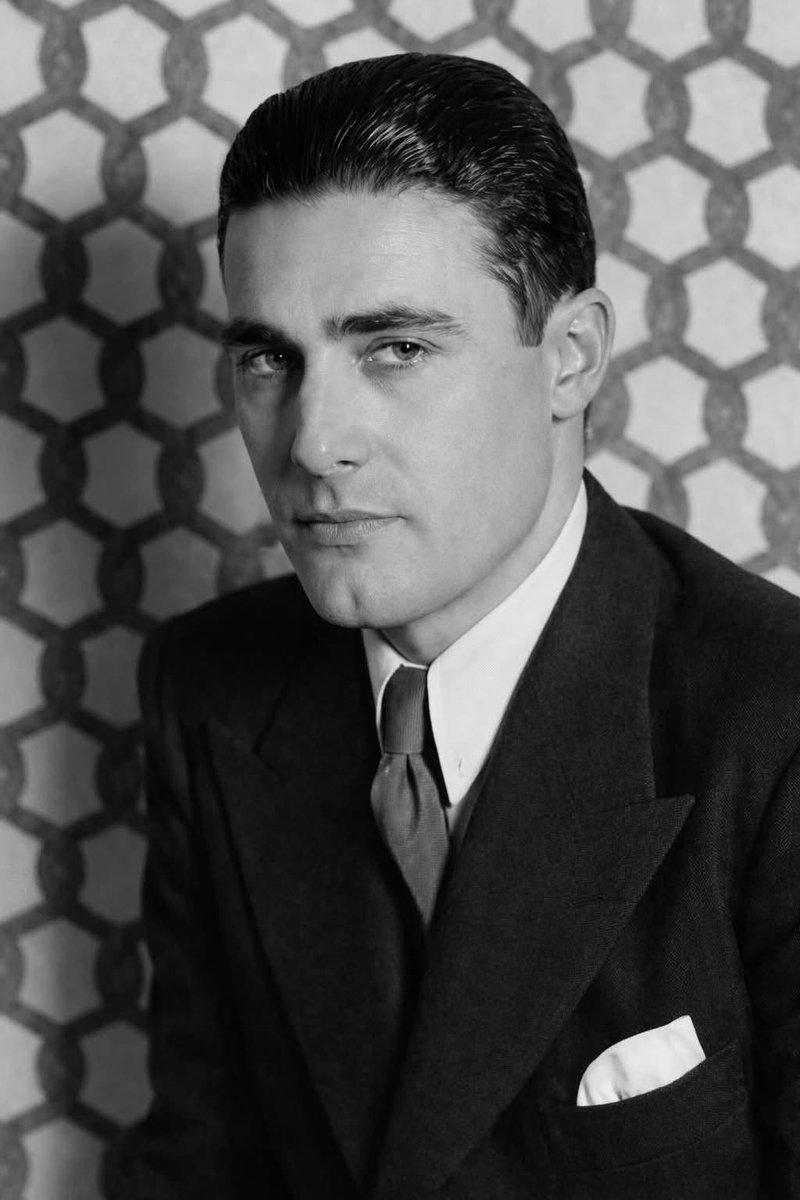
Billy Zane may have played the ruthless Cal Hockley in Titanic (1997), but behind the scenes, he was a total prankster.
After mischievously tipping a gentleman’s top hat and acting innocent, the moment became even funnier when someone suddenly started playing the Star Wars theme.
Absolute chaos.
@Rainmaker1973 I rescued a crow a few years ago that was paralyzed, I ended up taking it tk a wildlife bird rescue center but I don't think it survived 😔
While I had it, I would take it to look in the mirror and it would get so happy.
In 1978, a man put his head inside a running particle accelerator.
A beam of protons, traveling at nearly the speed of light, shot straight through his skull.
The radiation was hundreds of times more than what is normally enough to kill a person. Doctors were sure he was a dead man.
They were wrong.
His name is Anatoli Bugorski. Back then, he was a 36-year-old physicist at the Institute for High Energy Physics in Protvino, a small town south of Moscow.
He worked on the U-70, the most powerful particle accelerator in the Soviet Union. When it was built, no machine in the world could produce a stronger beam.
That day, a piece of equipment had broken down, and Bugorski went to see what was wrong. He had no idea that the safety systems had failed and the beam was still on.
He bent down for a closer look…
The beam went in through the back of his head and came out next to his nose.
There was no pain. Just a flash of light, which he later described as brighter than a thousand suns.
Over the next few days, the left side of his face swelled up like a balloon. Then the skin along the beam's path began to peel away, and the radiation kept burning through the tissue underneath.
But the beam left its mark. He lost the hearing in his left ear. The left half of his face was paralyzed. He started having seizures, and mental work tired him out much faster than before.
Still, his mind was as sharp as ever. Bugorski went back to the institute, finished his PhD and kept working as a physicist for years.
The strangest effect took years to show. While the right side of his face aged normally, the left side, paralyzed by the beam, barely aged at all.
He remains the only person known to have been hit by a particle accelerator beam and survive.
A stray mother dog went from one shop to another, carrying her little puppies and repeatedly seeking help from people.
For days, she refused to give up, approaching shopkeepers and passersby as if asking them to help her babies. Perhaps she no longer had enough milk to feed them, so she did everything she could to find people who could protect and care for her puppies.
She even hid her little ones in different places to keep them from all being lost at once, yet she remembered exactly where each one was.
At first, no one seemed to understand or respond to her plea. But eventually, some kind-hearted people realized what she was trying to communicate. They listened, rescued the entire family, and brought them somewhere safe and warm where they could receive proper care.
A mother's love is truly touching. And heartfelt thanks to the kind people who are willing to open their hearts and help stray animals. ❤️🐶
On the evening of 6 June 2013, 77-year-old Jim Walpole was walking back toward Toronto’s King Edward Hotel with his wife, Marilyn, when his foot caught near the curb. He fell toward scaffolding beside the hotel and struck his neck against a sharp piece of metal.
Within seconds Marilyn was calling for help. Walpole, visiting from Defiance, Ohio, near the end of a cross-Canada trip, remained conscious on the pavement. Two men arrived almost at once. One of them was John Malkovich, though neither Jim nor Marilyn recognized him.
Malkovich did not introduce himself. He knelt beside Walpole, applied pressure to the wound, and worked to keep him steady until paramedics arrived.
Hotel doorman Chris Mathias later recalled that Malkovich had been having a cigarette and witnessed the fall. “He placed his hand and started applying pressure to the man’s neck.” Restaurateur Ben Quinn joined them.
The two strangers stayed close while Marilyn stood nearby, shaken by how quickly an ordinary walk after dinner had become an emergency.
Jim later said, “But two gentleman, I don’t know where they came from, came to my aid. They knew exactly what to do.” Malkovich, then 59 and in Toronto for a stage performance, kept pressure on the injury and reassured him that help was coming.
When Walpole finally asked his name, the answer was simple: “My name is John and you are going to be all right.”
Paramedics took Walpole to St. Michael’s Hospital. The cut required ten stitches; he had also broken his left ring finger. A doctor later told him that if the wound had been roughly another eighth of an inch over, it could have reached a major artery.
By the time the realization came that “John” was John Malkovich, the actor had already left the scene. Jim had not recognized him in the moment and knew him mainly from one film role.
There had been no celebrity moment. Marilyn later said she had initially thought he might be a doctor because of how controlled he seemed while everyone else was frightened.
Malkovich contacted the couple’s tour leader afterward to ask how Jim was recovering and sent him a personal letter.
Walpole returned home knowing the man who had knelt beside him was famous. What he remembered first, though, was the pressure on the wound, the people who refused to leave him alone, and the two strangers who appeared at the exact moment he needed them.
For those minutes, John Malkovich was simply John.
🤩 Morning can be your favorite part of the day!
No matter if you wake up at 5am or 10am, you can make your morning productive and pleasant.
Give Fabulous a try! More than 40,000,000+ members and counting!
Try the Fabulous app today!
In 1942, a drunk German officer sat at dinner and bragged about the Jewish woman he had selected from the brothel the Nazis had forced open in town. He said her name out loud. The Tunisian Arab sitting across from him stayed calm, smiled, poured more wine, and finished the meal. Then he drove the officer home, sped through the dark streets, and knocked on a door close to midnight. That night, he hid 25 people for four months. He never spoke about it again.
His name was Khaled Abdul-Wahab. He was 31 years old, a wealthy Muslim Tunisian who had studied art and architecture in New York and spoke fluent German. Nazi officers trusted him. They invited him to their dinners.
Tunisia was the only Arab country directly occupied by Nazi Germany during the war. Jewish families were pushed from their homes. More than 5,000 Jewish men were sent to forced labor camps. Yellow stars marked every chest.
That December night in the coastal town of Mahdia, Khaled listened as the officer boasted. The woman he named belonged to a family Khaled had known all his life.
He left immediately. He drove through the night. He knocked on their door at midnight.
Pack nothing. Come now.
He gathered 25 people — mothers, fathers, cousins, and children — and drove them nearly 20 miles to his family farm, hiding them inside the olive press, stables, and storage buildings.
This was not one brave act. It was four straight months of courage.
He fed them while supplies grew scarce. He kept babies quiet. He trusted his servants to stay silent. When German soldiers arrived to count Jewish families, the hidden people pinned yellow stars onto their clothes and stood motionless. When the soldiers left, the stars came off again.
One night, a drunken soldier wandered onto the farm and discovered them. An eleven-year-old girl hiding under a bed watched him laugh and threaten to kill everyone there. Then Khaled appeared. She remembered him her entire life as a guardian angel. He calmly walked the soldier outside, took away his weapon, and sent him off the property.
Nobody on that farm died.
In May 1943, British forces liberated Tunisia. All 25 people returned home alive.
Khaled went back to a quiet life. He married, raised daughters, painted, and worked in government service.
He never told anyone what he had done. Not his wife. Not his children. No one.
He died on September 4, 1997, at the age of 86. His story was buried with him.
Ten years later, his daughter Faiza was sitting in a café in Paris reading a Sunday newspaper when she came across an interview with an American historian describing a Tunisian Arab who had hidden 25 Jews in 1942.
The historian mentioned her father by name.
She was 45 years old and had never heard the story before.
She contacted the historian. One of the children saved on the farm had left behind 83 pages of testimony before her death. Every detail matched.
“I rediscovered my father,” Faiza later said.
Khaled was nominated for Israel’s highest honor given to non-Jews who saved Jewish lives. He would have been the first Arab to receive it.
The committee declined, saying he had not risked his own life enough.
Faiza answered with a line history should never forget:
“My father opened his home to Jews. They did not open theirs to us.”
Today, the 25 people Khaled saved have hundreds of descendants living across Israel, France, America, and Tunisia. The little girl hidden beneath the bed grew up, moved to Paris, and built a family of her own. None of them would exist if Khaled had stayed silent that night.
He had everything to lose. He acted anyway. Then he spent the rest of his life saying nothing about it.
The world nearly forgot him twice. Now you know his name.
I'm 52 years old. I have terminal Stage IV esophageal cancer. And my life has become something I never could have imagined.
I have metastatic adenocarcinoma with signet-ring features. It's spread to my liver, lymph nodes, stomach and peritoneum. The surgery that was supposed to potentially save my life was aborted when they discovered it had already spread.
I've been through chemotherapy. I've had a stent shoved down my esophagus just to help me swallow. I've lived with a feeding tube. I've had to rethink something most people never give a second thought to: eating.
A cheeseburger. Pizza. A normal meal with my family. Things that used to be completely ordinary have become things I miss.
Every meal is a calculation. Calories. Protein. What can I swallow? What will hurt? What will stay down? How much can my stomach tolerate?
I deal with nausea, abdominal pain, strange sensations throughout my torso, swallowing difficulties, and the constant uncertainty of what is happening inside my body.
I monitor blood markers. I read CT scans. I research clinical trials. I look at experimental treatments and scientific papers, trying to find something, anything, that might give me more time.
And there's a particularly cruel part of terminal cancer that people don't always understand:
You can look relatively healthy. You can walk every day. You can laugh, read, have conversations, research things, and make plans. Meanwhile, you know there's an incurable disease growing inside you.
You become acutely aware that the future everyone else takes for granted is no longer guaranteed to you.
I have a wife. I have children. I have things I still want to experience, conversations I still want to have, and memories I still want to make.
I've even started leaving little handwritten messages around the house for my wife to find someday. Things I want her to know when I'm no longer here to tell her.
I'm not writing this because I want anyone's pity.
I'm writing it because terminal cancer is so much more than a diagnosis or a statistic. It's an entirely different existence. It's fighting for your life while simultaneously trying to figure out how to keep living it.
I don't know how much time I have. Neither does anyone else.
But I'm still here. Still walking. Still researching. Still looking for treatments. Still trying to eat. Still making plans.
And I'm not done fighting.
If you're healthy, don't take the ordinary things for granted. You have no idea how extraordinary they are until they become difficult or impossible.
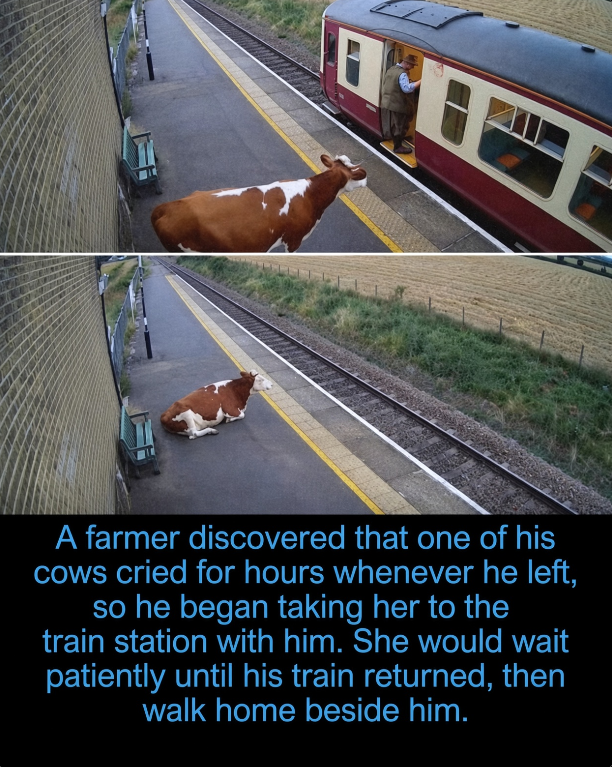
A farmer in rural Ireland noticed that one of his cows would cry for hours every time he left for the train station to pick up supplies.
Moved by her distress, he started taking her with him. To everyone’s surprise, the cow quickly learned the routine. She would calmly wait on the platform while he was away, then joyfully walk home beside him once his train returned.
The heartwarming story has captured the world’s attention, beautifully illustrating that cows are far more than livestock — they’re intelligent, emotional animals capable of forming deep bonds and meaningful routines with the people who care for them.