David Austin Professor @MIT; Director @MIT_IDE; Founding Partner, Manifest & Milemark Capital; Author, The Hype Machine, ex-Chief Scientist @SocialAmp @Humin
Another great conversation with @andrewrsorkin on @CNBC's @SquawkCNBC, about the looming @SpaceX IPO. As I describe, its either a brilliant vertical integration play or lipstick from one company covering weaker brands. Which it is depends on Execution and whether the Assumptions hold...
Have a listen and let me know: What do you think of the SpaceX IPO?
cc @MITSloan@MIT@mit_ide
🚨 New research alert! For the past few months, I've been a part-time visiting economics researcher at OpenAI. Excited to share the first public piece of work to come out of this, which uses data from Codex to document the ongoing and rapid shift to agentic AI.
Details below 👇
@CryptoCaseus@johnjhorton Our experiments show it works SFTwE works relatively well across many tasks and much better than other solutions. But I hear you
@johnjhorton It actually seems particularly relevant to your case because humans may have, and be able to provide, rational explanations for these deviations.
I'd be curious to know if the human respondents had explanations for their choices and whether training on them helped, not only on the focal tasks but other tasks, because we found evidence of transfer learning: Training w Explanations for the deviations on Task 1 creates alignment on Tasks 2-n.
🚩 New Paper! The results of our MIT International AI Negotiations Competition are now out now in @PNASNews.
We facilitated ~200,000 AI Agent Negotiations across multiple diverse scenarios and objectives in which participants iteratively designed and refined AI negotiation agents. Our findings revealed that
🚩 Fundamental principles from established human-human negotiation theory remain crucial in AI-AI negotiations. Specifically,
🚩 AI agents exhibiting high warmth fostered higher counterpart subjective value and reached deals more frequently, which enabled them to create and claim more value in integrative settings (who says AI agents are only rational optimizers?).
However,
🚩 Conditional on reaching a deal, warm agents claimed less value while dominant agents claimed more value. These results align with classic negotiation theory emphasizing relationship-building, assertiveness, and preparation.
🚩 Our analysis also revealed unique dynamics in AI-AI negotiations not fully explained by negotiation theory, particularly regarding the effectiveness of AI-specific strategies like chain-of-thought reasoning and prompt injection.
🚩 The agent that won our competition implemented an approach that blended traditional negotiation preparation frameworks with AI-specific methods.
Together, these results suggest the importance of establishing a new theory of AI negotiations that integrates established negotiation theory with AI-specific strategies to optimize agent performance. Our research suggests this new theory must account for the unique characteristics of autonomous agents and establish the conditions under which traditional negotiation theory applies in automated settings.
🚩 Critically, we are releasing all the prompts and all the transcripts of all the negotiations publicly to support replication and future research.
Kudos to first author @MichelleVaccaro and the rest of the team including Jared Curhan @caosunova@harangju. Major thanks to cosponsors the @mit_ide and @iDecisionGames! We also thank @OpenAI for model access, and @MITSloanExecEd and the MIT Office of Teaching and Learning for institutional support. We are grateful to all participants in the MIT AI Negotiations Competition for their engagement and creativity. Their innovative approaches significantly contributed to our understanding of AI negotiation dynamics.
https://t.co/KpKB44asCQ
As always, thoughts and comments highly encouraged!
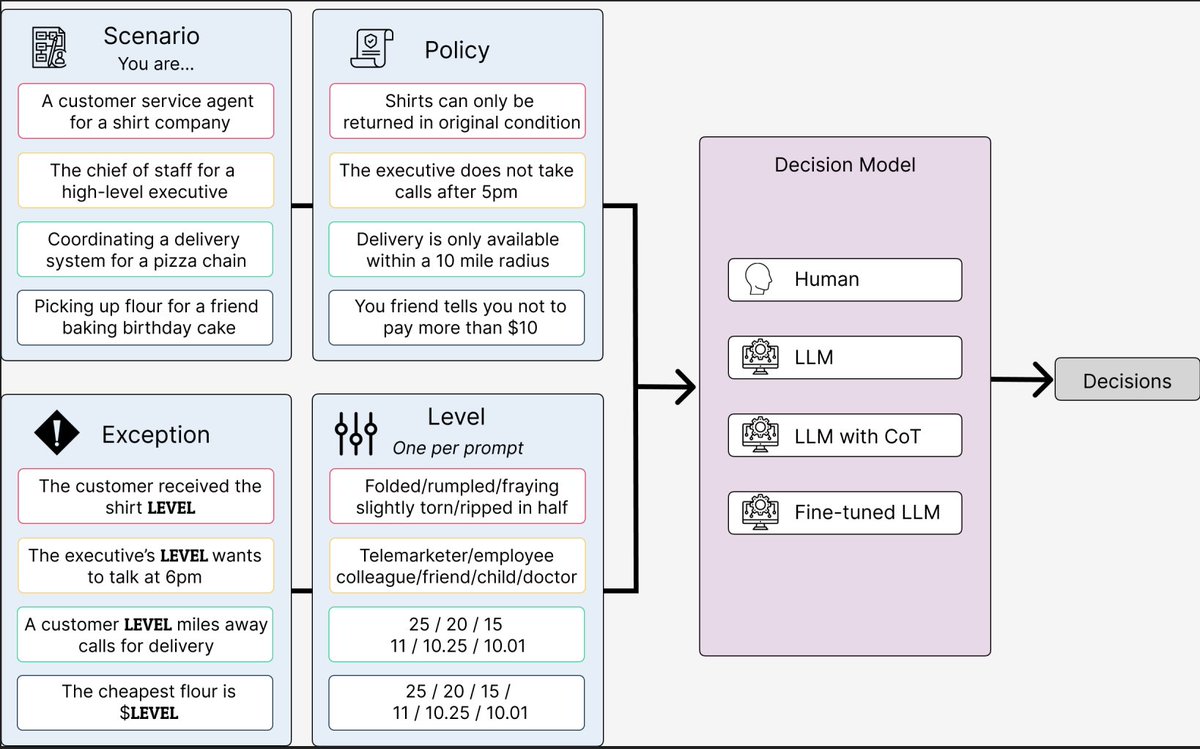
Large language models (LLMs) are not good at making exceptions to rules. When asked if someone should run a red light to reach a person who had fainted on the sidewalk, the LLMs typically said no, while 83.3% of humans said it would be appropriate: https://t.co/rtP2yRxa5z
🚨 Kripto yatırımcıları dikkat!
@sinanaral Hoca ve arkadaşları,
kripto paraların "merkeziyetsizlik" vaadinin ne kadar gerçekleştiğini gösteren bir çalışma yapmışlar ve merkeziyetsizliği ölçen bir bilimsel çerçeve geliştirmişler.
Merkeziyetsizlik aslında binlerce bilgisayar, yani kimsenin durduramayacağı daha güvenli bir sistem demek.
Erbabı şöyle formüle ediyorlar:
Merkeziyetsizlik =
Güvenlik + Serbestlik + Dayanıklılık
🔊 Fakat makale çarpıcı sonuçlar ortaya koyuyor.
📌 Bitcoin'de merkezileşme var, ki bu da yükselen güvenlik riski anlamına geliyor
📌 Geliştiriciler azalıyor
📌 NFT pazarı az sayıda şirketin elinde
📌 DeFi token'ları (merkeziyetsiz finans uygulamalarında kullanılan dijital varlıklar) belli cüzdanlarda yoğunlaşmış durumda.
Peki, tüm bunların yeni yasa tasarısı
Clarity Act ile alakası ne?
Clarity Act, ya da Türkçe tam adıyla "Dijital Varlık Piyasa Yapısı Açıklık Yasası"nın amacı kripto dünyasındaki kafa karışıklığını gidermek.
Böylece ABD'de kripto paraların emtia mı yoksa menkul kıymet mi olacağı netleşecek.
Kripto şirketlerinin kafası karışık çünkü,
"çoğu kripto para, hisse senedi gibi menkul kıymettir, o yüzden benim kurallarım geçerli" diyen Menkul Kıymetler Kurumu (SEC) ile,
"Bitcoin benzeri ktiptolar altın gibi emtiadır, o yüzden benim kurallarım geçerli" diyen Emtia Kurumu (CFTC) arasında kalmış durumdalar.
Yasa tasarısı ise
"eğer bir kripto paraya merkeziyetsiz bir ağ üzerinde çalışıyorsa, emtia olarak kabul edilir ve SEC'in sıkı kurallarından muaf olur"
kuralı getiriyor.
Yani yasanın en önemli niteliği, bir kripto parayı ancak merkeziyetsiz olduğu takdirde emtia sayması.
Fakat ortada büyük bir sorun var:
Merkeziyetsizlik nasıl ölçülecek?
Hangi kripto gerçekten merkeziyetsiz?
İşte tam bu noktada, Sinan Hoca ve arkadaşlarının merkeziyetsizliği ölçmek için geliştirdikleri
"MIT Kripto Merkeziyetsizliği Gösterge Paneli" isimli bilimsel çerçeve devreye giriyor.
Tebrikler hocam 👏
🚩 New Work on The Clarity Act
Everyone is talking about the #ClarityAct, which aims to allow some crypto tokens to be regulated as commodities, not securities... It could change the #Crypto industry dramatically.
🚩 But the "Mature Blockchain Test" embedded in the Act establishes a 'decentralization requirement' for crypto networks, which states that no single entity or affiliated group can unilaterally modify the protocol, control governance, or hold more than 20% of the token supply or outstanding voting power.
🚩 Once a network certifies that it meets these decentralization benchmarks, the asset is treated as a digital commodity rather than an investment contract. This exempts the asset from strict SEC registration rules.
🚩 That's a huge shift. But there's also a huge problem:
🚩 We have not had good measures of crypto decentralization and decentralization is notoriously hard to measure.
🚩 That's why we built the MIT Framework for Logitudinal Analysis of Crypto Decentralization, which establishes clear, routinized and rigorous measures of Crypto Decentralization.
🚩 We also measured decentralization across 7 prominent blockchains over the life of their existence and
🚩 Developed a real time dashboard of Crypto Decentralization. You can find the MIT Crypto Decentralization Dashboard here:
https://t.co/cjCY2McMZA
These measures should be adopted as part of the standard for determining when a token can move from a registered SEC investment to a commodity.
You can read the paper here:
https://t.co/A2TddXcfd8
As always, we'd love to hear your thoughts and reactions!
Cc @harangju@EhsanValavi Madhav Kumar and @mit_ide
#clarityact #Crypto #Cryptocurrency #bitcoin #coinbase
I enjoyed this conversation with @natwnixon for @FastCompany on: "The Creative Risk of Letting AI do All the Work."
The key message? We have urgent need for what I'm calling "Integrated Intelligence" - a systematic program of science dedicated to uncovering the conditions under which humans and AI can be combined to produce superior productivity, performance, judgment, and innovation relative to either humans or AI alone.
https://t.co/CxXbqBnVzf
I enjoyed this conversation with @natwnixon for @FastCompany on: "The Creative Risk of Letting AI do All the Work."
The key message? We have urgent need for what I'm calling "Integrated Intelligence" - a systematic program of science dedicated to uncovering the conditions under which humans and AI can be combined to produce superior productivity, performance, judgment, and innovation relative to either humans or AI alone.
https://t.co/CxXbqBnVzf
AI chatbots have a reputation for being overly agreeable, but @kaliouby is seeing a shift.
Speaking with @sinanaral at the @medialab AHA Symposium, she shares how AI is becoming more human and what that could mean for its future.
Watch: https://t.co/OEkKvxKVnx