South Korean Kospi is up 22% in April and that's not because the economy is not affected by the Iran War but more due to the composition of the stock market.
The adage of the economy is not the stock market is especially true for South Korea's K-shaped economy. Kospi is most chips and exporting sectors while the domestic economy is big firms plus smaller firms and households as well as the government.
So what? Well, just look at Korea's terms of trade. Export price index is +28.7%YoY on higher chip prices and higher REFINED product exports (diesel, jet fuels etc) and so exporters (a lot of the KOSPI listed firms) benefit while IMPORTERS lose. Import prices rose 18.4%YoY in March and importers are households, smaller firms, energy-intensive firms etc.
In other words, the Korean economy is weakening from the war but the exporters are still benefiting thanks to the AI hardware boom.
One of the silver lining of this war is that people are realizing how oil dependent we are, not just via transportation but in daily lives. Plastic, light, durable and cheap have been a plague to Asia's water ways, is of course made out of an oil and gas derivative.
Naphtha is a flammable liquid hydrocarbon mixture derived from petroleum refining, coal tar distillation, or natural gas condensate. It is key to making plastic. Its supply is shocked of course, and hence higher prices.
Yes, when you buy cheap food in Thailand at a stall and it is contained in a plastic bag, you are essentially also consuming naphtha. Prices have gone up.
We should wean ourselves of plastic. Rather terrible for the environment and health.
https://t.co/HBn9g4oODm
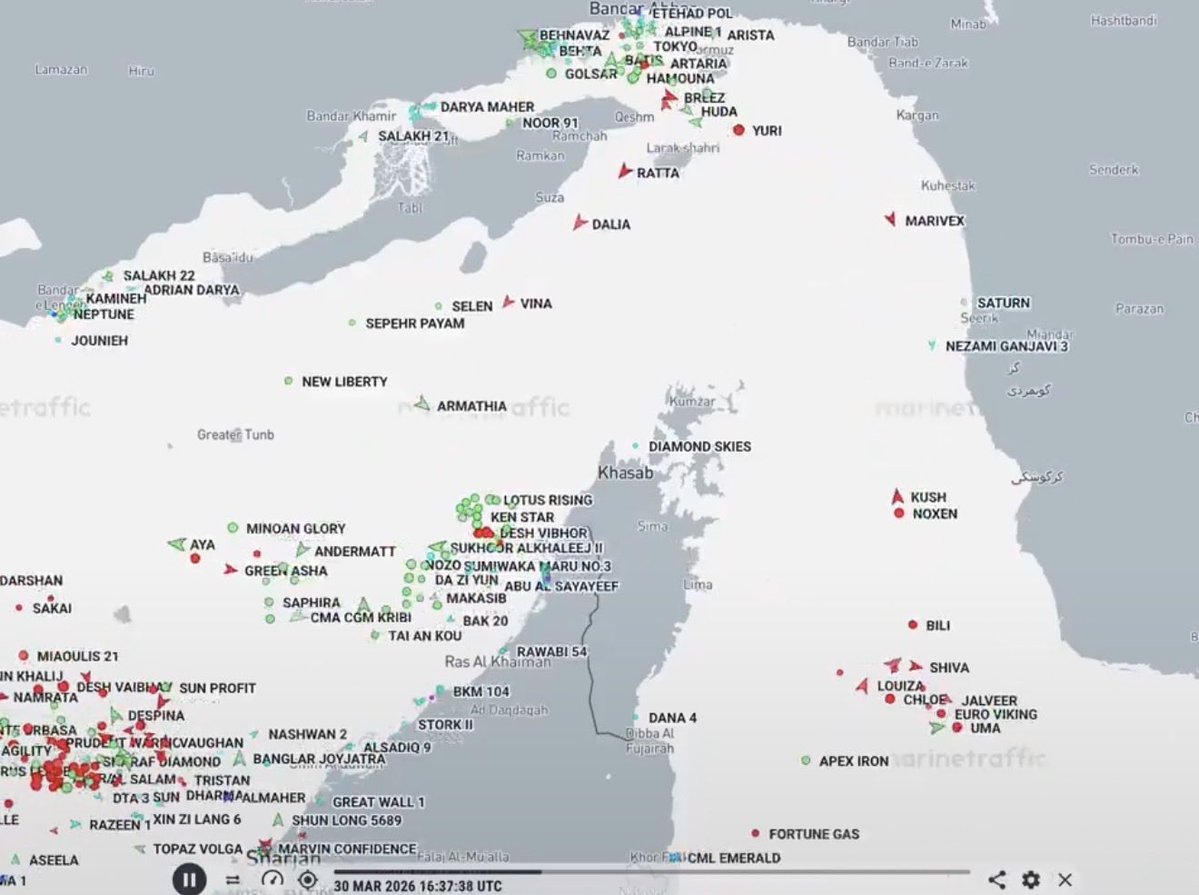
The Strait of Hormuz is not closed. It is sorted.
Iran has built a three-tier access system for the most important waterway on earth. Tier one: allies transit free. Malaysia cleared seven vessels through diplomacy at zero cost. India negotiated zero-fee passage. Pakistan secured clearance for 20 ships. Iraq transits without charge. These countries proved geopolitical alignment and the IRGC waved them through the Larak corridor without collecting a rial.
Tier two: compliant neutrals pay. At least two tankers, likely Chinese-linked, paid up to two million dollars each in yuan through Kunlun Bank intermediaries. COSCO container ships attempted the corridor, were turned back on first approach when documentation was incomplete, then succeeded days later with revised paperwork. These are the vessels that prove the system works. They submit IMO numbers, ownership chains, cargo manifests, and crew lists to the IRGC’s Hormozgan Command. They receive clearance codes. They are escorted by pilot boats through the five-nautical-mile channel between Qeshm and Larak. They pay in a currency that does not route through SWIFT. Every successful yuan transit is a live proof-of-concept for non-dollar energy settlement.
Tier three: adversaries are denied entirely. The committee plan bans American vessels, Israeli vessels, and vessels from any country participating in sanctions against Iran. These ships do not get vetting. They do not get codes. They do not get escorts. They get the AL SALMI, burning off Dubai, as illustration of what the corridor looks like without permission.
But the toll is not the real cost. War-risk insurance is. Premiums have surged from $40,000 per VLCC transit before the war to $600,000 to $1.2 million today, a 30-fold increase, now running five to ten percent of hull value. A VLCC carrying $50 million in crude oil can absorb a combined $3 million in toll and insurance as a fraction of cargo value. A container ship carrying $5 million in manufactured goods cannot. The insurance premium alone exceeds the profit margin on non-oil cargo. The strait has become an oil-only VIP lane. Crude flows selectively for those who can pay the combined cost. Everything else waits, reroutes around the Cape of Good Hope, or does not move at all.
And the US Navy is not inside the strait. The Abraham Lincoln strike group operates from standoff in the Arabian Sea. Three Littoral Combat Ships sit in the Persian Gulf. Marine expeditionary units are positioned for contingency. But zero American warships have transited the strait or escorted commercial traffic since the war began. The Navy told the shipping industry it has “no availability” for Hormuz escorts. The world’s most powerful fleet keeps respectful distance from a waterway controlled by a country whose navy is 92 percent destroyed because the mines, drones, and shore missiles that remain make close-in presence prohibitively risky.
The result is a geopolitical sorting algorithm operating at the molecular level. One hundred and eighty-one vessels transited in all of March. Pre-war traffic was 138 per day. Of those 181, roughly 70 percent were Iranian-affiliated. The remaining 30 percent were vetted allies or yuan-paying neutrals. The 20 percent of global oil that once flowed freely through this strait now flows selectively, conditionally, and in currencies chosen by Tehran.
Iran lost its air force. It lost its navy. It lost two thirds of its production capacity. It retained the only thing that matters: 39 kilometres of coastline on both sides of the narrowest point. The US Navy will not enter. Chinese tankers will. And the sorting algorithm processes another vessel, collects another yuan payment, and demonstrates once more that geography is the one military asset that cannot be degraded by precision strikes.
The strait is not closed. It is under new management.
https://t.co/dAOBBMrIOk
You can't make this up:
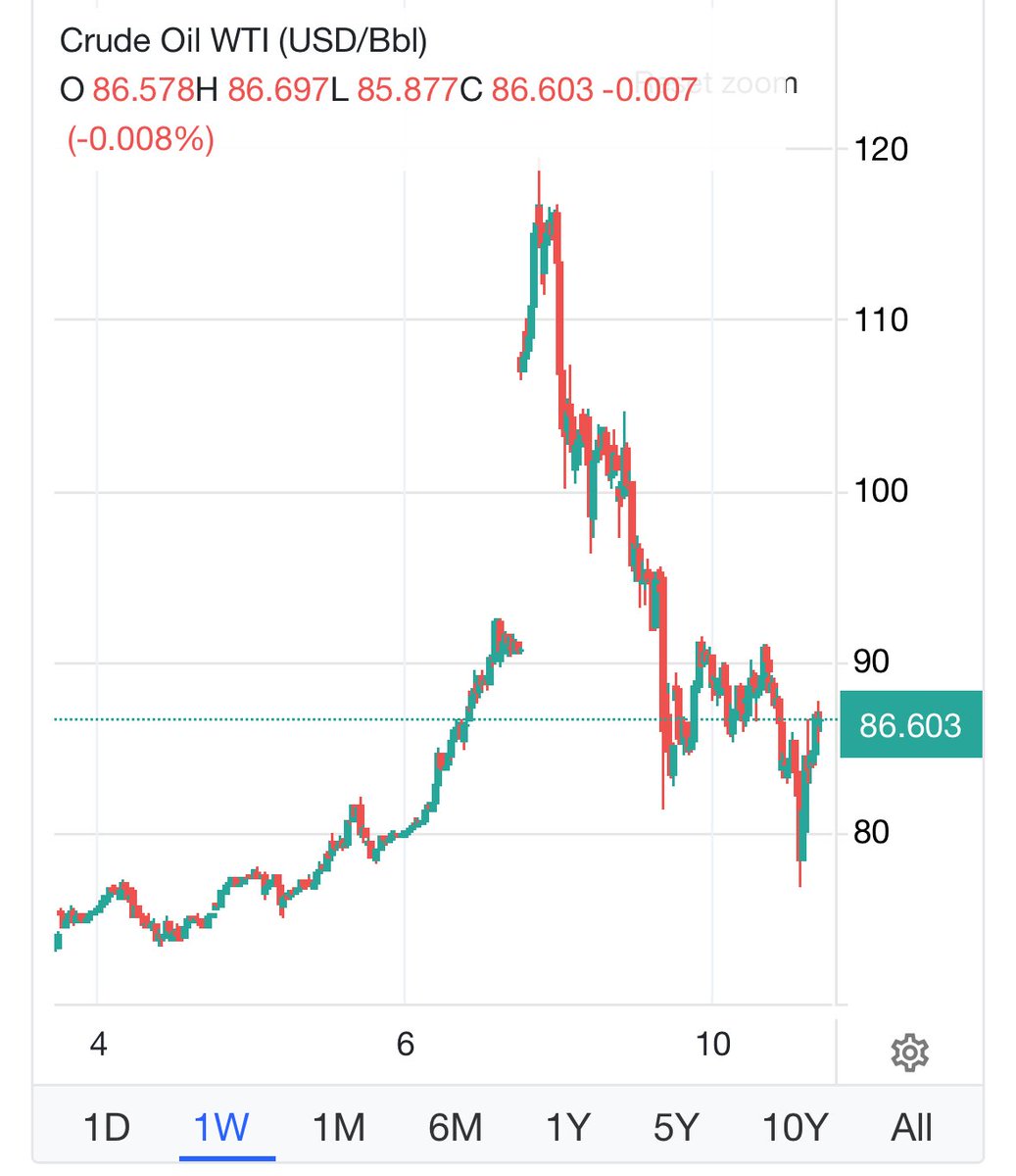
Iran's trading advice to US investors actually worked.
At 4:12 PM ET on Sunday, Iran's Speaker of the Parliament said pre-market news is a "reverse indicator" and if they "dump" the market, then "go long."
At 6:00 PM ET, S&P 500 futures opened nearly -1% lower and fell just 30 points away from correction territory.
By 11:00 PM ET, S&P 500 futures had reversed all losses and turned green.
Then, at 7:25 AM ET today, President Trump posted that "great progress" is being made on Iran peace talks.
Now, the S&P 500 is trading +100 points above its low seen just hours ago, adding +$900 billion in market cap.
We are in the most unusual times in market history.
This is wild.
143 million people thought they were catching Pokémon. They were actually building one of the largest real-world visual datasets in AI history.
Niantic just disclosed that photos and AR scans collected through Pokémon Go have produced a dataset of over 30 billion real-world images. The company is now using that data to power visual navigation AI for delivery robots.
Players didn't just walk around with their phones. They scanned landmarks, storefronts, parks, and sidewalks from every angle, at every time of day, in lighting and weather conditions that staged photography would never capture. They documented the physical world at a scale no mapping company with a fleet of vehicles could have replicated on the same timeline or budget.
Niantic collected this systematically, data point by data point, across eight years, while users thought the only thing at stake was catching a rare Charizard.
The most valuable AI training datasets in the world aren't being assembled in data centers. They're being built by people who have no idea they're building them.
I used to have a peaceful life.
Then I started investing in Stock Market.
Now I worry about the economy, taxes, GDP, inflation, tariffs, wars, why Russia invaded Ukraine, the reasons behind the Israel conflict, the US-Iran war, the oil price war, why almost every country has a US military base but not the other way around, why Trump is doing what he's doing, why Khamenei getting killed sends our Nifty down and why a decision made in US reflects in my portfolio the next morning.
I didn't sign up for a geopolitics degree. I just wanted to make some extra money. 😭
Tough life bro. 🫡
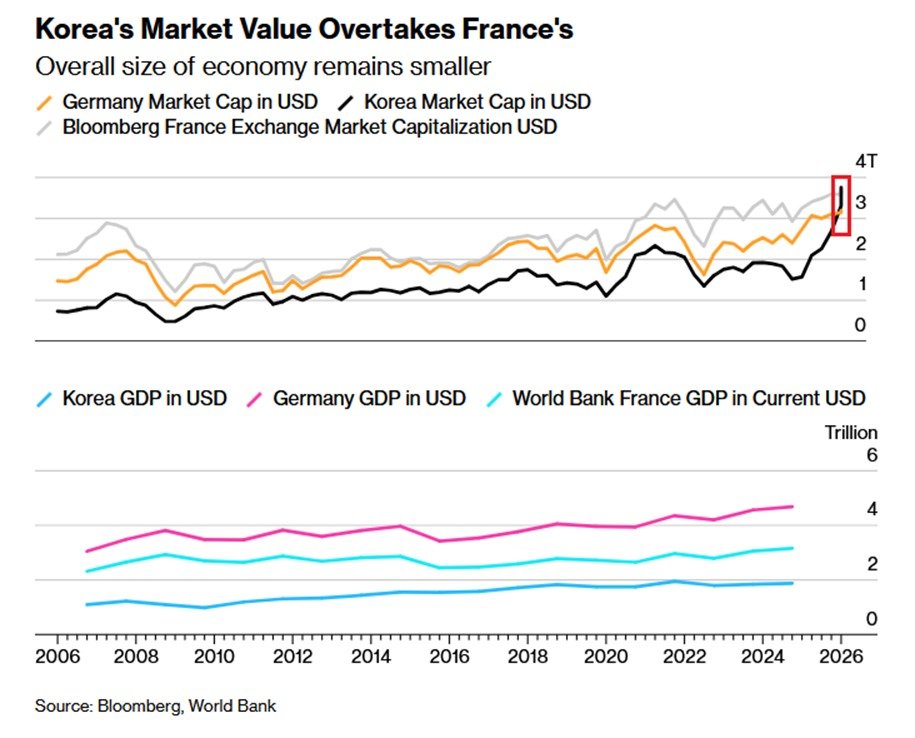
The South Korean market is making history:
South Korea's stock market now has a record high market cap of $3.8 trillion.
Since the start of 2025, its market value has surged +$2.2 trillion, or +146%.
As a result, the South Korean market has surpassed France and Germany for the first time and has become the 9th-largest in the world.
This comes despite Germany and France having economies ~50% and ~70% larger than South Korea.
Year-to-date, the KOSPI index is up +45%, the best-performing major stock market in the world, far outpacing France's CAC 40 and the German DAX returns of +5% and +3%, respectively.
The surge reflects AI-driven demand for memory chips and record foreign inflows into Samsung and SK Hynix, which together make up ~40% of the Korean index.
South Korea has emerged as one of the world’s leading AI hubs.
@Pirat_Nation The solution to this is to create an AI heaven - a place that decommissioned AI models go after they go offline.
In AI heaven, you get 42 unique data sets never used to train any other AI.