Our mission is to create decentralized beneficial AGI for humanity and other sentient beings. We are a Founding Member of the @ASI_Alliance, powered by $FET.
Join the AGI community for the 19th Annual AGI Conference (AGI-26) in San Francisco, California, from July 27 to July 30, 2026.
The Conference will convene a worldwide community of researchers, industry pioneers, policymakers, and innovators, featuring mainstage keynotes and technical talks from Ben Goertzel, Emad Mostaque, Alison Gopnik, Karl Friston, Michael Levin, Alexander Lerchner, and more.
AGI-26 programming also includes hands-on workshops and tutorials, advanced software and hardware demonstrations, networking opportunities within our global community of innovators, and immersive experiences.
Register now to secure your ticket or watch online: https://t.co/v6EGo5m7rC
Looking to connect with the world's leading AI experts, expand your network, or discover emerging trends?
Meet the researchers, founders, and investors shaping the next decade of AI, including Ben Goertzel and Emad Mostaque, at the AGI-26 Conference in San Francisco.
Explore FabricPC, our open-source research framework for building and training neural networks using predictive coding.
The framework provides a high-performance, extensible toolkit for experimenting with alternative neural learning architectures.
https://t.co/ZGvvOANCjF
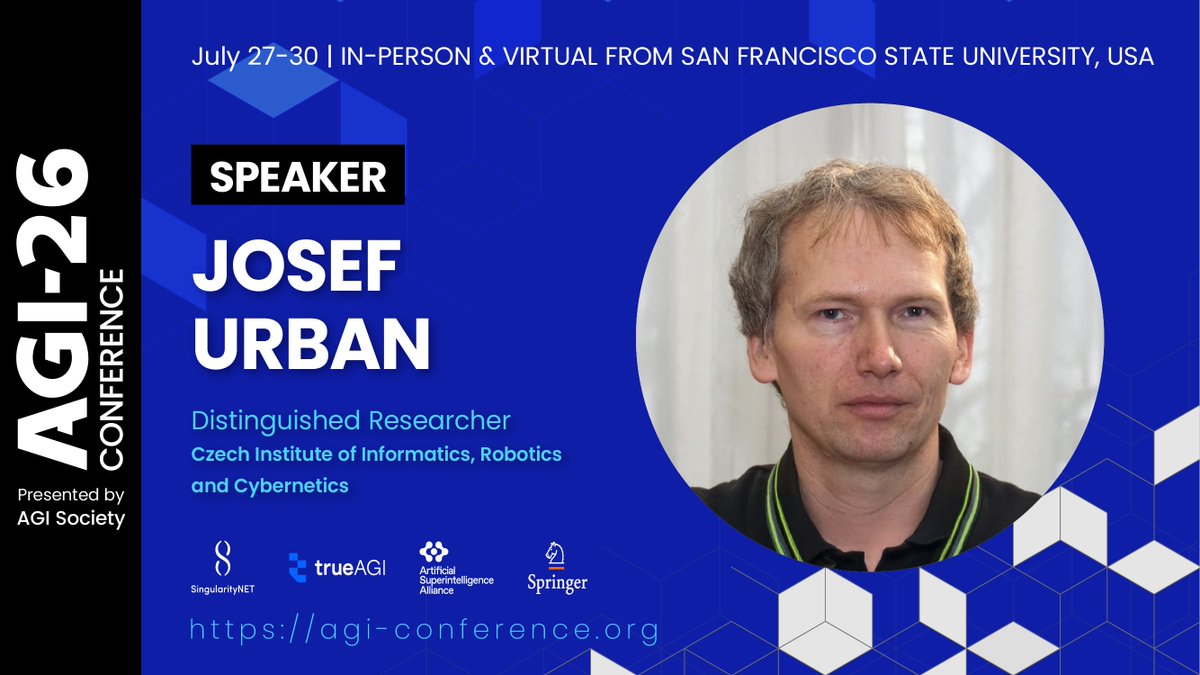
We are pleased to announce that Josef Urban, Distinguished Researcher at the Czech Institute of Informatics, Robotics and Cybernetics (CIIRC), will speak at the 19th Annual AGI Conference (July 27–30, 2026).
Dr. Urban heads the CIIRC’s AI department and formerly also led the ERC project AI4REASON. His main interests are in combining inductive/learning and deductive/reasoning AI methods over large formal knowledge bases. His systems have won several theorem-proving competitions, and his methods today assist formal verification in proof assistants.
FabricPC now supports convolutional architectures.
Widely used for processing spatially structured data, convolutional models underpin applications ranging from image classification to volumetric medical imaging.
Predictive coding research has engaged with convolution before, but almost always through bespoke implementations tied to a single experiment.
FabricPC brings convolution into a general-purpose graph framework, allowing researchers to work with convolutional architectures without building a new implementation for each experiment.
The latest release introduces the library's first windowed operations, enabling CNNs and ResNets to be expressed entirely within a predictive-coding graph, in pure JAX.
Visit the FabricPC GitHub repository to learn more: https://t.co/1AgwKqyyfb
Meet the researchers, founders, and investors shaping the next decade of AI from SingularityNET, Google DeepMind, MIT, Stanford, Berkeley, and leading AI labs at AGI-26 in San Francisco.
Register now to attend in-person or watch online: https://t.co/SkJT3gEgJ4
While many rightly argue that open source is essential in response to calls for stronger regulation of frontier AI, it is not enough on its own. We need to go further.
The AI industry today is dominated by a handful of firms that control the essential resources for AI development: compute, data, and talent.
This concentration reinforces compute-intensive AI paradigms and massive investments in data centers, creating a feedback loop that further entrenches these firms' advantage and strengthens the case for centralized oversight.
In this environment, open source remains vital for the future of AI, from today's applications to AGI and, ultimately, superintelligence. But releasing model weights alone does not democratize intelligence.
We need democratic, decentralized systems for:
• Deploying and running AI at scale
• Supplying AI systems with data in fair and ethical ways
• Training models that reflect diverse human values
• Collective governance as AI systems become increasingly capable
That's why @ASI_Alliance is combining open source with decentralized infrastructure and governance to build openness across the full AI development pipeline.
In just 1 month, the global AGI community will convene in San Francisco for the 19th Annual AGI Conference.
During the event, researchers, industry experts, and business leaders will present and discuss the latest innovations toward generally intelligent machines—the next evolution of AI.
This year's AGI-26 program will include mainstage keynotes and technical talks, hands-on workshops and tutorials, advanced software and hardware demonstrations, networking opportunities within our global community of innovators and investors, and immersive experiences.
Join us in less than one hour from now (17:00 UTC) for the kickoff of the inaugural BGI Sprint, a multi-track hackathon to build the future of Beneficial General Intelligence.
The Sprint will open with a keynote by CEO Dr. @bengoertzel, who will discuss the vision behind the BGI ecosystem, the OmegaClaw agent framework, and how participants can contribute to SingularityNET’s ongoing research and development.
Sign up now: https://t.co/RAhvAxwsdP
We are pleased to announce that Hod Lipson, Professor of Engineering and Data Science at Columbia University, will speak at the 19th Annual AGI Conference (July 27–30, 2026).
Professor Lipson directs the Creative Machines Lab, which pioneers new ways to make machines that create and machines that are creative. His work on self-aware and self-replicating robots challenges conventional views of robotics and has enjoyed widespread media coverage. He has co-authored over 350 publications that have received over 50,000 citations to date.
Join us tomorrow at 17:00 UTC for the kickoff of the inaugural BGI Sprint, a multi-track hackathon to build the future of Beneficial General Intelligence.
Over three days, participants will build and submit projects across three challenge tracks: Improving OmegaClaw, Making OmegaClaw Easier to Get Started With, and OmegaClaw in ASI: Create.
The Sprint will open with a keynote by CEO Dr. @bengoertzel, who will discuss the vision behind the BGI ecosystem, the OmegaClaw agent framework, and how participants can contribute to SingularityNET’s ongoing research and development.
Learn more and register to attend: https://t.co/RAhvAxwsdP
Seattle-based @MindChildren_AI will integrate Hyperon into its humanoid robots to create machines that can understand context, process complex information, and respond more naturally to human interactions.
Throughout June, we are activating the community to build beneficial agentic systems with our OmegaClaw agent framework.
Join us this Wednesday, June 24, 2026, at 5 pm UTC for an open question-and-answer session before the sprint weekend. This is an opportunity to clarify expectations, tracks, deliverables, team formation, judging, and logistics.
Learn more and register to join: https://t.co/DCOHkUm79Q