@Haurmeya Which, I should clarify, means your body will be screaming because she will ask you to train to the point breaking and your mouth might be screaming because the last time we had a muscle waifu in FE she had an absolutely abysmal 20% str growth and she failed to level it AGAIN.
@IGN He does have a point, but Star Citizen has been in alpha for years with no end in sight. This spin-off as well.
I'd LOVE to be proven wrong and for it to legitimately be an amazing game, but I just don't have a lot of faith in it happening.
Always remember:
Jason Schreier sat on stories of sexual harassment and abuse in ActiBlizzard (& other companies) for YEARS. He admitted this, but only when the story broke.
https://t.co/hoftqSEWzg
https://t.co/dQxkxHIqoi
You idiots are getting a lot of things confused here about #GamerGate, so let's clear this up:
1. If you say "Zoe Quinn had inappropriately intimate relations with several individual capable of giving her and her game positive press", this statement is not in dispute. One of the guys she slept with was in charge of the organization of an indie game fest where her game, "Depression Quest", ended up being featured prominently. Another, Nathan Grayson, prominently mentioned her and/or her game in three articles he wrote. While their affair allegedly began AFTER that, him saying that he'd be "willing to burn down the entire video game industry" for her at one point in January 2014 or so seems to be a rather extreme thing you'd be willing to do for someone you consider "just a friend". Never mind the fact that it's ethically questionable behavior to cover a friend you're that close to without at least making some sort of disclosure.
2. The fact that "positive press" and "inappropriately intimate relations" became distorted into "positive reviews for her game" and "sexual relations" due to a telephone game effect was something that the progressive/leftist/liberal media seized upon to discredit her critics under the dishonest pretense that, because the exact wording widely used wasn't true, then any and all accusations against her were false.
3. Her boyfriend, Eron Gjoni, didn't commit suicide. However, she made a series of extremely dubious accusations of abuse/mistreatment against video game creator Alec Holowka, which was signal boosted by Anita Sarkeesian in the hopes of starting a branch of the #MeToo movement going in the gaming industry that led to Holowka getting cancelled and committing suicide as a result. Outraged by this, a group of individuals went back and conducted an extensive dissection of her social media postings at the time, absolutely none of which corroborated her story.
@IGN The setup they used to make this cost $6000 US on just the pair of graphics cards alone.
Who is going to even afford this realistically?
Who would even WANT this?
@SecWar Piss off, Pete.
You want to give access to weapons of war to the equivalent of a gigantic computerized magic 8 ball.
How in the absolute hell underneath Satans hairy ballsack and brimstone stenched ass crack do you think that is even CLOSE to a good idea?
@_Kyou The protagonist of the ps1 Armored Core Master of Arena is very much implied to eventually become the main villain of Armored Core 2, Leos Klein. Klein is an old man at that point.
So that assumption isn't exactly correct.
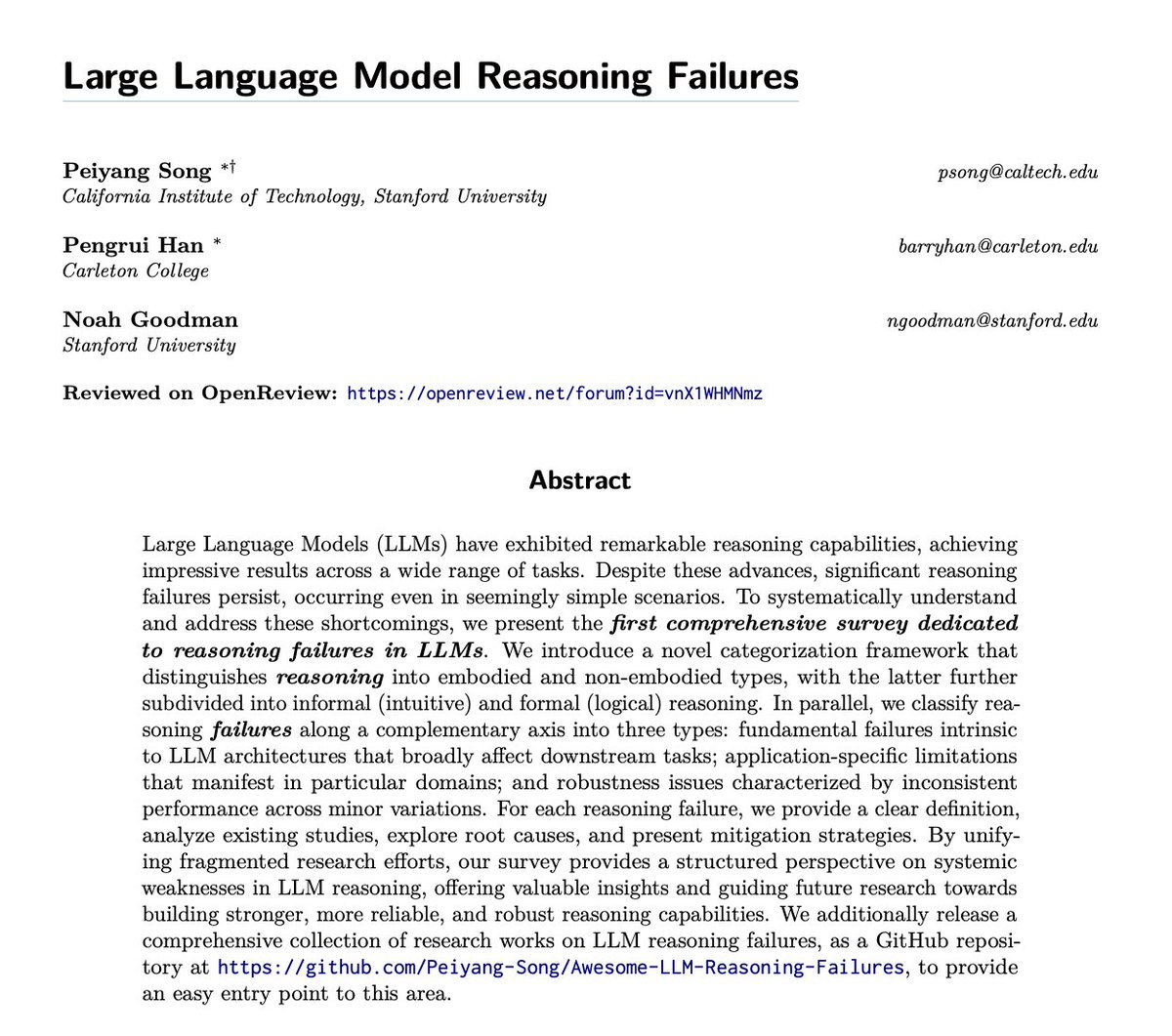
🚨 Holy shit… Stanford just published the most uncomfortable paper on LLM reasoning I’ve read in a long time.
This isn’t a flashy new model or a leaderboard win. It’s a systematic teardown of how and why large language models keep failing at reasoning even when benchmarks say they’re doing great.
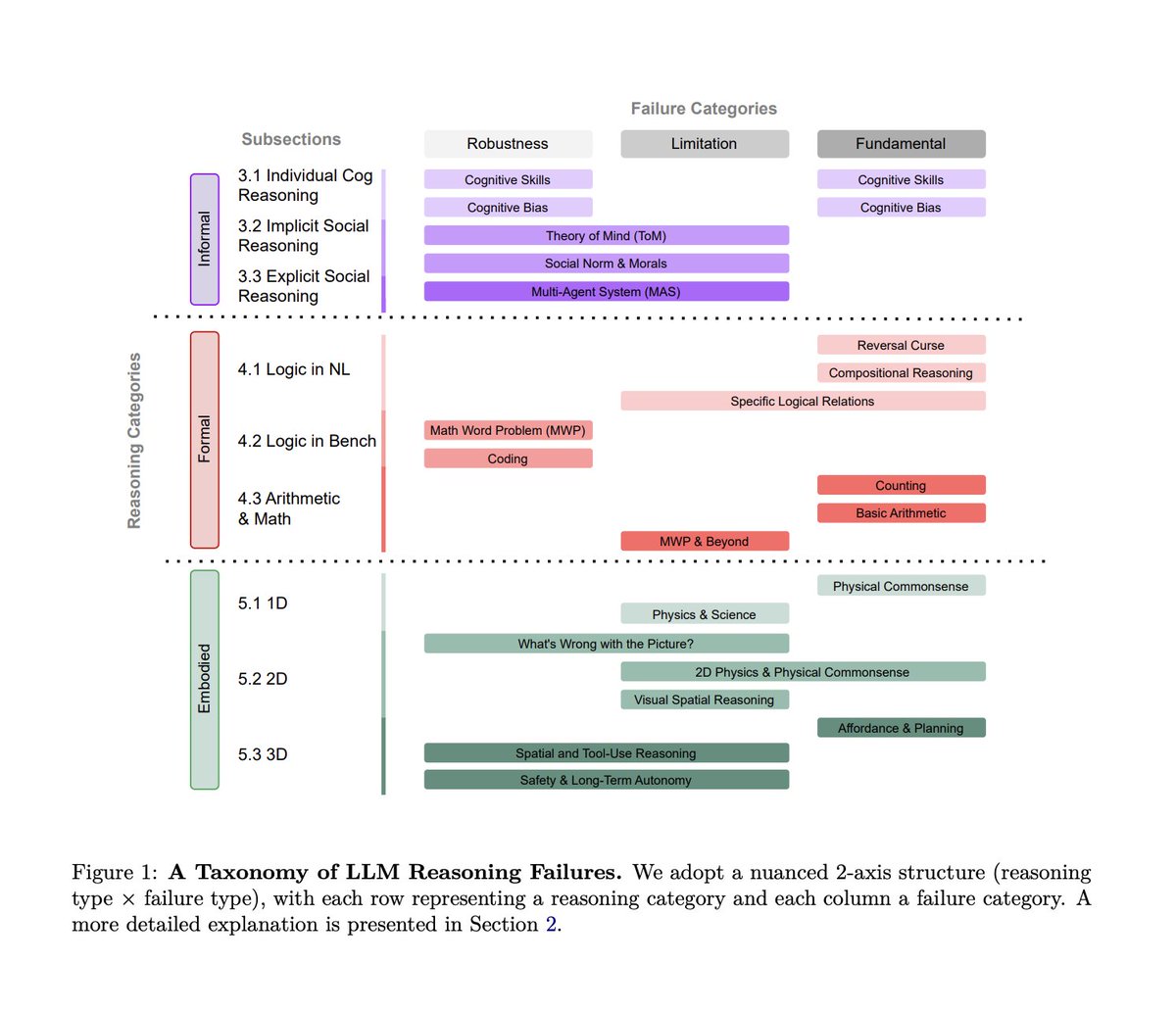
The paper does one very smart thing upfront: it introduces a clean taxonomy instead of more anecdotes. The authors split reasoning into non-embodied and embodied.
Non-embodied reasoning is what most benchmarks test and it’s further divided into informal reasoning (intuition, social judgment, commonsense heuristics) and formal reasoning (logic, math, code, symbolic manipulation).
Embodied reasoning is where models must reason about the physical world, space, causality, and action under real constraints.
Across all three, the same failure patterns keep showing up.
> First are fundamental failures baked into current architectures. Models generate answers that look coherent but collapse under light logical pressure. They shortcut, pattern-match, or hallucinate steps instead of executing a consistent reasoning process.
> Second are application-specific failures. A model that looks strong on math benchmarks can quietly fall apart in scientific reasoning, planning, or multi-step decision making. Performance does not transfer nearly as well as leaderboards imply.
> Third are robustness failures. Tiny changes in wording, ordering, or context can flip an answer entirely. The reasoning wasn’t stable to begin with; it just happened to work for that phrasing.
One of the most disturbing findings is how often models produce unfaithful reasoning. They give the correct final answer while providing explanations that are logically wrong, incomplete, or fabricated.
This is worse than being wrong, because it trains users to trust explanations that don’t correspond to the actual decision process.
Embodied reasoning is where things really fall apart. LLMs systematically fail at physical commonsense, spatial reasoning, and basic physics because they have no grounded experience.
Even in text-only settings, as soon as a task implicitly depends on real-world dynamics, failures become predictable and repeatable.
The authors don’t just criticize. They outline mitigation paths: inference-time scaling, analogical memory, external verification, and evaluations that deliberately inject known failure cases instead of optimizing for leaderboard performance.
But they’re very clear that none of these are silver bullets yet.
The takeaway isn’t that LLMs can’t reason.
It’s more uncomfortable than that.
LLMs reason just enough to sound convincing, but not enough to be reliable.
And unless we start measuring how models fail not just how often they succeed we’ll keep deploying systems that pass benchmarks, fail silently in production, and explain themselves with total confidence while doing the wrong thing.
That’s the real warning shot in this paper.
Paper: Large Language Model Reasoning Failures
The whole Yamato debate should have ended when she started calling someone else's children her children. Yamato identifies as a specific person, who had their own life and family, that's a mental health crisis. It'd be like a woman in America today saying she's Elvis Presley, the rock star himself and everyone having to pretend that's being trans, right as she starts climbing the gate and approaching his surviving family members and trying to give them a hug. Then you hear about her traumatic upbringing and it all clicks into place why she became like that. Yamato doesn't need the Oden delusion validating, she needs a therapist.
Its funny people are like "respect what Yamato wants to be called" yet whilst they're quick to call her a man, none of them call her Oden.
If you've ever wondered why Indians have such poor, incomprehensible English despite being a former British colony, this is probably why. Indians have a bizarre pedantry where they enjoy misusing ten-dollar words despite not grasping the basics of English grammar.
Years ago, when I was running Terror House Press, some Indian tried to sell me on publishing his novel, a blatant and extremely creepy rape fantasy. His pitch consisted of bizarre statements such as "Why does a man want to make love to a corpse". I looked through the manuscript and not only was it typo-ridden, he kept using antiquated terms like he thought he was David Foster Wallace. For example, in the first chapter, he described a woman as "cachinnating." I don't know what that means, YOU don't know what that means, so I looked it up. It means "laughing."
There are certain peculiarities when non-English speakers learn English, enough so that you can clock a non-native person's ethnicity based on the typos they make and the language they use. For example, North Koreans clearly learn English from decades-old Cold War phrasebooks, which is why their official communications use terms like "dotard" that no American uses in casual conversation. They also make constant malaprops; if you recall Otto Warmbier's forced confession, written for him by his captors, he described North Korean's justice system as "fair and square" and claims he is "look[ing] to the heavens" for repentance. The Chinese also do this to a certain extent; see the phenomenon of Chinese giving themselves antiquated Anglo names (or naming their kids) like "Mildred" or "Dolores."
But Indians are by far the worst. Chinese, Koreans, Europeans, even Africans at least TRY to speak English correctly. Indians don't bother. Why do Indians speak English so poorly? I don't think it's IQ. Is it izzat? Do they internalize ten-dollar words so they can sound smart and no one around them has the courage to tell them they sound retarded because they can't spell "sir"? I've met waitresses in ex-Soviet states who speak better English than the average Indian.
DEI: Deport Every Indian.