Early adopters are going to have their own agentic software factory that curates to their own exact needs soon. The incentive to build customizable all providing platforms will diminish because they just won’t do what you need.
Whoever wrote the "How you’ll know you're failing in 60 days" in this JD actually knows how to spot a `cracked` software engineer @unltdindustries
https://t.co/5VjTnDQnzc
Using this new agent in ClickUp you can totally leapfrog the IDE, Cursor, Claude Code...
Codegen is now available in ClickUp.
"Hey @codegen, fix this bug" - me
"PR submitted & ready for review!" - Codegen
"Sweet, ship it" - me
We've always believed that the future of AI value will be realized in horizontal software - today is a huge realization of this vision.
Real example: This week our customer support reps started fixing features in real time. Product managers are now prototyping features themselves.
You can mention @Codegen or assign a task, and all of the optimized context is passed to the Agent to solve bugs and ship improvements with one shot.
Available for everyone today.
Nick Lane’s theory of how the first cells evolved:
His main argument here is that life is continuous with the planet’s geochemistry.
Aka a lot of the main characteristics of cells - membranes, enzymes, energy via proton gradients - descend from spontaneous processes in the Earth.
But you can’t have these characteristics evolve piecemeal in different locations. You need one location that houses all the processes which could then give rise to the first cell.
Important context, by the way, is that all life descends from a single common ancestor - LUCA (last universal common ancestor).
Okay, so what candidate environment could give rise to LUCA? It needs two main characteristics:
- There’s a continuous flux of carbon and energy (in some sense, all life is a flux of carbon and energy, but you need some geochemistry to maintain this disequilibrium before the first cells can co-opt it).
- Something which concentrates and catalyzes the reactions which lead to organics (aka inorganic equivalents of cells and enzymes).
This rules out a lot of old theories: a warm pond with ammonia and salts and the odd lightning bolt doesn’t drive continuous flux, nor concentrate early organics in a cell-like volume to drive forward reactions.
Nick thinks alkaline sea vents are a unique fit to this challenge, and also help explain a lot of the contingent biochemistry that all life ended up using because of our shared inheritance.
Okay, let’s dig in: and for context, basically Nick here is trying to explain how you end up with an early version of the reverse Krebs cycle spontaneously. Reverse Krebs cycle takes in H2 and CO2 and makes organic molecules that are the precursors of fatty acids, proteins, and sugars.
Another important bit of context: All life runs on proton gradients. Burning food with oxygen (or other oxidants in anaerobic respiration) pumps H+ ions across a membrane, like filling a dam. These ions flow back through ATP synthase—a molecular turbine—which harnesses the flow to attach phosphate to ADP, creating ATP. Your body contains just 60 grams of ATP, but the ATP→ADP→ATP cycle is so rapid you process your body weight in ATP daily.
Sidenote: If a solution is acidic, it means there’s a lot of H+ ions in it. And if it’s basic (aka alkaline), it means there’s a lot of OH- ions in it.
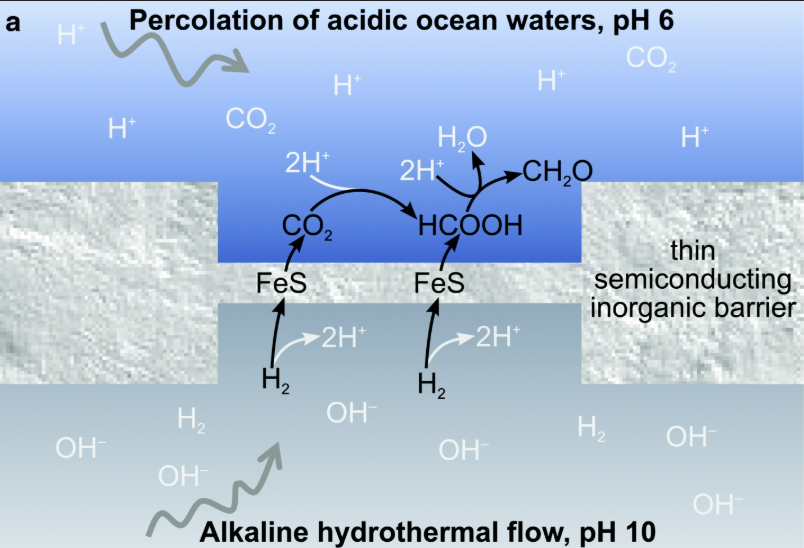
Okay so what was happening in these alkaline hydrothermal vents? There’s 3 sides to this picture: the inside of the vent, the vent wall, and the ocean side of the vent.
On the inside of the vent, you’ve got iron rich rock basically rusting, which lets out H2 and OH- into the stream of water piping through (aka making the water basic/alkaline).
The wall is made up of catalytic minerals like FeS, and also has a ton of tiny pores which connect the inside to the outside.
And the ocean side has a bunch of dissolved CO2 - early Earth was basically a giant ocean, but also had a lot of volcanoes that let out lots of CO2. And the oceans are quite acidic too, because CO2 becomes carbonic acid when dissolved in water.
Within the tiny pores inside these vents, you have H2 reacting with CO2 to form simple organics like formaldehyde (CH2O) and methanol (CH3OH), instigated by the FeS in the walls, which acts as a catalyst for this reaction.
Remedial chemistry: feel free to skip this para - I’m just going to include it since it took me some effort to relearn the high school chemistry involved. And it was quite satisfying to understand. Why do you need the H2 side inside to be basic? And why do you need the CO2 side outside to be acidic? My understanding is that in an alkaline solution, H2 -> H+ is favored, since the OH- (which definitionally makes the solution alkaline) really wants to react with H+ to make H2O. But now you’ve got some intermediate H+ lying around to be involved in other reactions. On the ocean side, the more acidic the water, the less likely that the marginal CO2 added will be turned into carbonic acid (since there’s so much of it around already) and will instead be available to react with.
Now that you’ve got these early organics building up inside these tiny pores, you can kick off this positive feedback loop where these early organics act as precursors or enzymes to make more and more of the molecules life uses. You build amino acids (which become enzymes for other reactions), and fatty acids (which spontaneously form membranes because they have hydrophobic heads and hydrophilic tails), and sugars, and peptides, and eventually DNA and RNA. Claude illustrates:
The fact that this early proto cell doesn’t have to generate proton gradients itself, and can just take advantage of the geochemical disequilibrium, is a huge boon:
“Methanogens spend practically 98% of their energy budget on generating proton gradients by methanogenesis, and little more than 2% producing new organic matter. With natural proton gradients and leaky membranes, none of that excessive energy spend is needed. The power available is exactly the same but the overheads are cut by at least 40-fold, a very substantial advantage.”
In addition to the H+ gradient, which exists spontaneously in these vents, some protocells also started to extrude Na+ ions. And since there's no natural gradient for these, this creates an incentive for developing non-porous membranes (and for proteins on that membrane to pump protons out). Once you develop such a membrane, you can exit this wall cavity and float around like a real cell.
Is the implication that inheritance only got kicked off at this point? Because beforehand, I guess you have selection amongst the pores, but you have no way to pass down traits. This buildup of organics and metabolism is happening independently across all the pores.
Yet you already had DNA and RNA by this point. So what was this genetic information doing before inheritance? I guess just organizing information to facilitate buildup of more organics?
Does this imply that there were millions of protocells with no shared lineage between them, each developing their own unique versions of all the basic biochemistry of life? LUCA just happened to be one that had DNA, RNA, and ATP synthase, but all 3 of those could have been wildly different based on which proto cells made it out of the nook first?
Yet the fact that these three building blocks are considered across all life suggests that they are uniquely well-engineered? Or maybe it means that evolution can't effectively improve upon its foundations. The same way that backprop can find the best network to map a function, but can’t rewire the GPU you’re training it on at the same time. Anyways, once you have this proto cell, it can ‘infect’ contiguous vent systems all across the ocean floor.
Contingent biochemistry explained by this theory:
- Why all life is powered by proton gradients
- Why all carbon fixation pathways, whether they’re in bacteria, archaea, or eukaryotes, use acetyl-CoA as the entry point. It forms spontaneously at these vents when catalyzed by the FeS in the walls. And basically all life still uses this molecule to store energy and build other molecules.
- Why a lot of the enzymes involved in energy metabolism (and the Krebs cycle specifically) still use FeS minerals as their backbone
- Why Archaea and Bacteria (the two different kingdoms of eukaryotes) split up - apparently it has something to do with how they create proton gradients, but honestly the relevant biochemistry went over my head. Though this bifurcation is supposed to explain why all life shares DNA, RNA, and ATP synthase, but nothing else: not the cell membrane, nor the DNA replication enzymes, nor the pumps for excretion. Apparently all of these things were implicated in the different choice that archaea and bacteria made during this bifurcating event.
Questions for Nick:
- I guess this theory is incompatible with panspermia, right?
- Does this Alkaline vents theory suggest that life might be very rare or very abundant in the universe? In some sense, it suggests it should be rare. It's just a very specific type of hydrothermal vent with the right pH gradient and pore size and durability. But in another sense, it’s just a random fucking vent. There could theoretically be thousands of similar geological structures across the universe that could also drive the flux of carbon and energy across tiny membranes.
- Isn’t ATP synthase super complicated? How did the first protocells have ATP synthase but almost nothing else nearly as complex?
- How did all this complexity build up before evolution with heredity? All these pores are just independently building up their own microcosm of unique organics? I guess it’s possible that these early building blocks are floating from hole to hole without a fully formed membrane? DNA plus enzymes float from one pore to another, and kick off more reactions? Does Nick Lane think this is likely? If not, does it suggest that there were many other equally viable alternatives for the building blocks once LUCA was able to break out?
Thanks to my fellow book club members for very useful and fun discussions: @vinayramasesh, @shae_mcl, @coen_armstrong, @Oskarlso, @_sholtodouglas
We recently started using @codegen to go straight from a PR in @linear to production in @AgreeHQ — it's one of the most incredible things to watch live.
We started by seeing if we could knock-off one of our longest outstanding low-hanging feature requests, "Login with Microsoft 360" ... and, it did it in under 45-seconds!
Introducing:
Agent Interaction Guidelines (AIG)
Principles and practices for designing agent interactions that integrate more naturally into human workflows.
→ https://t.co/TeRR6HbWfd
What the heck, shirts I got from @billabong1973@quicksilver@hurley O’Neil have lasted decades, meanwhile the crap that costs $20 today lasts less than a year
New today: @linear is now the most advanced agent-native UX on the planet.
Shipping first-class support for:
🔥 Real-time agent logs streaming
🔵 Agent lifecycle visibility
✅ Human-agent delegation
And more. They cooked.
Now officially GA in @codegen ⚡️
The goto template for launching new AI products these days:
Introducing XYZ - the world's first AI tool that lets you do ABC. On internal benchmarks, XYZ performs [insert number]x times better than any other tool.
The consistency is too funny
Video to PR in minutes
@Codegen now supports video!
- Attach a video in Slack or Linear
- @codegen uses @GeminiApp to extract insights from the video
- @codegen crushes UI bugs on your behalf
Cheers