We’re getting more disciplined about what deserves to become part of Sirius.
Not every feature idea should ship.
Not every experiment should become permanent.
And not every piece of complexity makes the system better.
A lot of the team’s work right now is actually subtraction.
Removing flows that add friction.
Cutting logic that became too complicated.
Simplifying how agents handle permissions, memory, and task handoffs.
Keeping the parts that are useful and throwing away the rest.
That kind of work is easy to underestimate because it doesn’t produce a flashy demo every day.
But it matters.
We want Sirius to become easier to understand as it becomes more capable, not harder.
More intelligence shouldn’t automatically mean more complexity for the user.
The system can be complicated underneath.
The experience shouldn’t have to be.
We’ve been tightening a lot of the smaller pieces inside Sirius lately.
Nothing dramatic.
Just the kind of work that makes the system feel more reliable over time.
We’ve been cleaning up how agents pass context between tasks, reducing unnecessary memory carryover, and making permission checks more explicit before an action can happen.
A lot of this work is invisible from the outside.
But these are the details that decide whether an agent feels predictable or frustrating to use.
We’re also spending more time testing failure cases instead of only testing the happy path.
What happens when context is incomplete.
What happens when a permission changes halfway through a task.
What happens when two agents disagree about what should happen next.
Those cases are slower to work through, but they matter.
We want Sirius to feel dependable before it feels impressive.
That’s where a lot of the team’s attention is right now.
We’re spending more time on the permission layer inside Sirius.
As Knowledge Agents become more capable, the question is no longer just whether they can understand context or execute tasks.
They also need clear boundaries.
An agent should know what it can read, what it can change, what it can execute, what requires confirmation, and what should always remain under user control.
That sounds like a small implementation detail.
It isn’t.
Permissions are one of the things that determine whether autonomous AI can actually be trusted in real use.
So our focus is not on giving agents unlimited freedom.
It’s on making them capable enough to be useful while keeping control explicit and understandable.
The more autonomous AI becomes, the more important that boundary gets.
For Sirius, this is becoming one of the core parts of the system.
The more we work on memory, the more obvious one thing becomes:
AI memory shouldn’t be trapped inside one product.
If an agent spends months learning how you work, what you care about, how you make decisions, and what context matters to you, that history becomes valuable.
It shouldn’t disappear the moment you stop using one interface.
That’s something we’ve been thinking about a lot inside Sirius.
We want Knowledge Agents to treat memory as something closer to user-owned state, not platform-owned history.
That means working toward memory that can be:
inspected,
permissioned,
updated,
revoked,
and eventually portable across different agents and applications.
We’re not there yet.
Portability gets complicated quickly once different agents have different schemas, permissions, and ways of interpreting context.
But we think the direction matters.
Your AI shouldn’t become useful only because you spent months training a platform you can never leave.
If the intelligence was built from your knowledge, the memory behind it should stay connected to you.
We’ve been reworking how Sirius handles memory inside Knowledge Agents.
The problem sounds simple: an agent should remember what matters.
In practice, it gets messy very quickly.
Not every conversation should become permanent memory.
Not every piece of user data should be available to every task.
And an agent needs to understand the difference between context that is useful now and knowledge that should still matter months later.
So we’ve been separating those layers more carefully.
Short-term context handles what the agent needs for the current task.
Persistent memory keeps information that should remain useful over time.
Permissions sit between the two and determine what can actually be recalled, used, or shared.
We’re also testing ways for users to inspect and revoke parts of that memory instead of treating the agent’s internal state like a black box.
That matters because “personalized AI” means very little if the user has no control over what the system remembers.
There’s still work to do, especially around memory quality and preventing irrelevant information from accumulating.
But this part of the system is getting much closer to what we originally wanted:
an agent that can remember enough to become genuinely useful without turning user knowledge into something the user no longer controls.
Small update before things get hectic:
We’re getting very close to launching Sirius on Arc.
We’ve spent a lot of time talking about Knowledge Agents, user-owned intelligence, and what it means for AI to actually have a place inside an onchain economy.
Now the token is about to become part of that system too.
Not the whole story.
Just one piece that helps connect users, agents, and activity around Sirius.
We’ll be publishing the official contract address very soon.
Until then, please be careful with fake accounts, fake contracts, and DMs claiming to be from the team. If the CA hasn’t been posted through our official channels, it isn’t ours.
We’ll share the final launch details soon.
For now, that’s really it.
Sirius is almost live on Arc.
See you there. 🔵
A lot of what we’re doing right now isn’t very exciting to post about.
It’s fixing small things.
Reworking flows that felt awkward.
Reading feedback we don’t always agree with.
And going back to parts of the product we thought were already “done.”
That’s probably the least glamorous part of building Sirius.
But it’s also the part that matters.
We don’t want to keep announcing bigger ideas while ignoring the small things that make the product feel unfinished.
So right now, that’s where a lot of our attention is going.
Less talking.
More cleaning things up until they actually feel right.
We’ve put a lot into Sirius.
A lot more than people can see from the outside.
There were long stretches where almost nothing looked different publicly, because most of the work was happening underneath — rewriting systems, changing assumptions, dropping ideas that didn’t hold up, and rebuilding parts we thought were already finished.
That process took longer than we expected.
But it also made Sirius much better.
Today, for the first time, it feels like the product, the technical direction, the Knowledge Agent architecture, and the broader ecosystem are finally starting to fit together the way we wanted them to.
Not perfect.
Not finished.
But good enough that we’re genuinely proud of what we’ve built.
That matters to us.
We never wanted to rush something out just to look active.
We wanted Sirius to reach a point where the work behind it could actually support the things we’ve been talking about.
We’re finally there.
And now we can start pushing much harder from here.
Blockchain doesn’t need another AI chatbot.
It needs intelligence that can actually operate inside the economies being built onchain.
That distinction is basically why we’re building Sirius.
A blockchain can settle transactions extremely well. But it doesn’t know what you know.
It doesn’t understand your research, your preferences, your business context, or the decisions you’ve made over the last three years.
An AI model can understand some of that — but today, you usually have to hand your data to someone else’s platform first.
We think there’s a missing layer between the two.
Sirius is building that layer.
Private knowledge stays under user control.
Knowledge Agents turn that context into usable intelligence.
Permissions define what an agent is allowed to access and do.
Blockchain gives those agents an environment where actions, ownership, and value can exist onchain.
That combination is much more interesting than simply putting “AI” next to “blockchain.”
If onchain economies become places where humans and autonomous agents increasingly operate side by side, somebody has to solve the knowledge layer behind those agents.
What do they know?
Who owns that knowledge?
What are they allowed to do with it?
How does intelligence move without giving up control of the underlying data?
Those are Sirius problems.
And that’s why we think Sirius can become an important part of the intelligence stack being built around blockchain.
Not another bot sitting on top of a chain.
Infrastructure for the agents that will actually use it.
Arc Mainnet is live.
Arc launches as the Economic OS for the internet: an open platform for global markets, real-time value movement, tokenized assets, and agentic economic activity.
Arc is more than a blockchain.
It launches as a full-stack financial platform with assets, applications, interoperability, developer infrastructure, and Circle platform services live from day one.
Arc delivers USDC as native gas, deterministic sub-second finality, EVM compatibility, and institutional validators.
It integrates with Arc Studio, App Kits, Arc Portal, Circle Agent Stack, CCTP, Gateway, CPN, and StableFX.
A complete economic platform at genesis.
Arc launches with infrastructure for:
→ Agentic economic workflows
→ Lending and borrowing
→ Trading and liquidity
→ Onchain FX
→ Payments and settlement
→ Tokenized assets
→ Exchanges, wallets, custody, compliance, data, and developer tooling
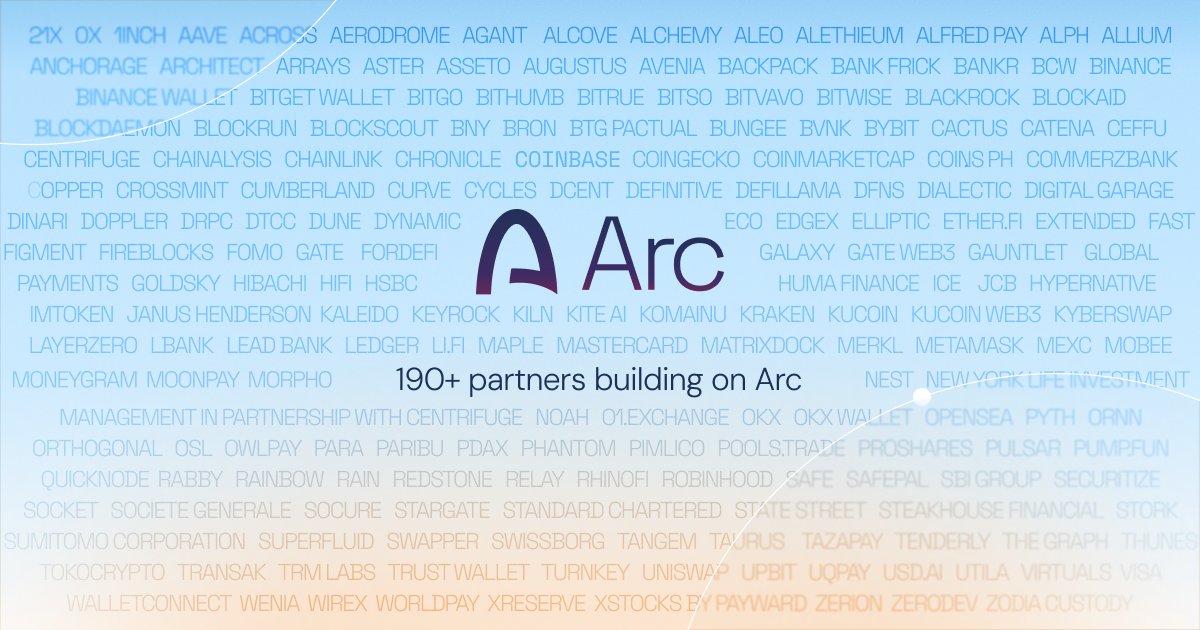
190+ institutional and ecosystem builders are building across Arc.
🧠 An AI agent representing you needs to understand what you know, work within your permissions, and recognize when a decision needs your judgment.
That is a demanding technical brief.
Sirius AI’s approach brings together several connected layers: ⚙️
🔐 Knowledge Vault — a foundation for organizing proprietary knowledge with ownership and control in mind.
🤖 Knowledge Agents — personalized AI built around the expertise of individuals and businesses.
🔄 Sirius Data — AI-assisted data workflows with human review and refinement, because the quality of an agent’s answers starts with the information behind them.
🌐 A decentralized network vision — enabling agents to communicate and collaborate while addressing how knowledge is accessed and shared.
The hard engineering happens where these layers meet.
How does an agent find the right context? Which information can it use? When should it act, and when should it bring a question back to its owner?
Our technical ambition is to make those answers work together in a useful system. 🚀
For us, a powerful AI network earns trust through the quality of its decisions and the control it gives the people behind its knowledge.
Your Knowledge. Your AI. ✨
#SiriusAI #DeAI #AIAgents
You share a piece of professional advice.
Six months later, you learn something that changes your mind. You update the original document.
Somewhere, an AI agent may still be giving people the old answer.
This is an uncomfortable test for the idea of user-owned AI: can the person behind the knowledge correct what the system continues to say?
We think that question belongs at the center of the ownership conversation.
Knowledge changes. A recommendation can expire. Permission granted for one purpose may never have covered another. A private working note can lose its meaning when separated from its context.
An AI network built around people’s expertise needs ways to handle those changes.
Contributors should be able to understand which version of their knowledge an agent is using, define the scope of its use, and communicate corrections. People receiving an answer need enough context to judge whether it still applies.
There are difficult engineering questions here.
Once information has been copied or used to train a model, changing the source does not automatically undo every downstream use. Any serious ownership model has to be honest about that limitation and clear about what its controls can actually enforce.
This is the standard we believe user-owned AI should work toward.
For Sirius AI, the long-term value of a knowledge network depends on whether people can keep contributing without losing their say over how their expertise is represented.
The relationship continues after the first upload.
People learn. Their AI should have a way to keep up.
Ask an experienced operator why they made a particular decision, and the useful part often comes after a pause.
“The numbers looked fine, but we’d seen this pattern before.”
That sentence contains something a spreadsheet won’t tell you: a memory of what went wrong, which signals mattered, and why the obvious answer deserved a second look.
This is the kind of knowledge personal AI needs to work with.
Documents give an agent material to reference. Helping it represent someone’s expertise also means capturing how that person weighs evidence, handles exceptions, and recognizes the limits of their own experience.
That takes more than uploading a folder.
A useful Knowledge Agent should be able to explain the reasoning behind a recommendation, identify the assumptions it relies on, and ask its owner when a situation falls outside what it knows.
Those moments of uncertainty matter. If an agent speaks on your behalf, its confidence affects your reputation.
For Sirius AI, this gives the idea of “Your Knowledge. Your AI.” a practical standard to aim for: an agent that reflects your judgment while making its boundaries visible.
Imagine a consultant whose agent can explain why a familiar approach would fail under a new constraint—and bring the question back to them before giving advice.
That is a meaningful way to extend expertise.
What would you need an agent to understand about your judgment before you trusted it to speak for you?
The future of AI won’t be built around one model, one company, or one closed ecosystem.
It will be built around millions of knowledge owners.
Sirius AI is creating the infrastructure for that future — where knowledge can become intelligent, autonomous, and valuable.
Your knowledge shouldn’t just train someone else’s AI.
It should become your AI.
Own it. Scale it. Put it to work.
Sirius AI is building a decentralized network where knowledge becomes autonomous intelligence.
Your Knowledge. Your AI.
#SiriusAI#AI#DeAI
🚀 The AI revolution is going decentralized.
Meet Sirius AI 🌌🤖 — the first decentralized AI network that lets anyone — individuals 👤 & businesses 🏢 — deploy their own personalized, autonomous AI.
🧵 Here’s why it changes everything 👇
❌ Today’s AI = Centralized, controlled, paywalled.
• Big tech holds the models 🏢🔒
• Your data feeds them 📊🍽️
• You rent access, not own it ⛓️
It’s time for a new model.
🚀 From decentralized data labeling to a full-stack AI ecosystem:
⚙️ Data Services Platform
🧑💻 AI Developer Platform
🛒 Decentralized AI Marketplace
🌐 Global community
$SIA powers it all — from data annotation & agent deployment to governance & infrastructure.
💡 A truly collaborative, decentralized alternative to Big AI.
🤖 What is $SIA?
$SIA is the utility token that powers the entire Sirius AI ecosystem. It enables seamless value exchange between:
🔁 Data providers
🧠 AI developers
💻 Compute suppliers
🌍 End users
Sirius AI unlocks fair, open access to global knowledge capital.