Indian Spacetech Startup revolutionising Earth Observation with the world's highest resolution L & P Band, led by Dr. Tapan Misra, Former Director of ISRO.
From forests to floods, glaciers to growing cities—every change matters.
At Sisir Radar we enable a smarter, more sustainable planet. 🌍
#EarthDay#SisirRadar
After a number of trials, we at Sisir Radar measured the 3.6 m x 3.6 m prototype of 9 panel planar reflect array antenna of our first spaceborne SAR mission. Sometimes, just numbers do not register the size of the antenna in our visualisation. You may think of 4 double beds are spread side by side in a square arrangement – that is the size of the antenna. This is the largest reflect array and probably the only one built in India. We are very satisfied with the antenna performance and smooth operation of our NF test facility.
The measurement was faced with a number of puzzling results, spread over almost two weeks. We analysed all these results to improve our understanding of the NF interactions of the probe antenna with the reflect array feed structure elements. We never anticipated this issue to challenge us. We satisfactorily resolved the issue, as evident in the final results.
As we move towards the realisation of our ambitious goal of launching our L band SAR satellite, we are reminded of the wisdom of Mark Twain: If you hold a cat by the tail, you learn things you cannot learn any other way.
#sisirradar #Lband #SAR
An engaging discussion with Kolkata Calling, where our Founder, Dr. @TapanMisra, spoke on the role of Artificial Intelligence in modern systems.
The possibilities are vast and truly transformative.
#SisirRadar#KolkataCalling#AI
On this National Science Day, we celebrate the power of science to drive innovation.
At @SisirRadar, we are revolutionising Earth observation with unmatched radar imaging—transforming data into real-world impact.
#NationalScienceDay#DeepTech#SisirRadar#Radar
Our Founder, Dr @TapanMisra1, shares his perspectives on Kolkata’s innovation landscape.
Episode out this Sunday, 22nd February at 11:00 AM on LinkedIn & YouTube.
Join us live. 🎙️
https://t.co/XxjcUKJx7c
Sisir Radar shares an interesting collage of P and L band signatures of a forest and adjoining crop land, captured by our Dual Band Drone SAR. The SAR illumination is from the lower to the upper side. The image segments are captured from 60 deg to 75 deg incidence angle. Both images are decomposed with m-chi and co-cross decomposition techniques.
The L band has lesser foliage penetration because of the larger foliage observed in a very high incidence angle. But the P band has still significant foliage penetration, and dominant scattering is from tree trunks. Because of the high incidence angle, most scatterings from tree trunks are single bounce, and double bounce scattering is inhibited because of the dense forest environment. In co-cross decomposition, the single bounce targets are mostly represented by VV returns. This observation is expected as VV returns are sustained by vertical structures of tree trunks. This interesting observation points to the fact that single bounce scattering need not be from planar surfaces; it can be from vertical structures also, especially at high incidence angles.
#SisirRadar #Pband #Lband #remotesensing
Watch Dr. @TapanMisra1, Founder of @SisirRadar and former ISRO Director, in conversation with Onkar Bangla, highlighting how Sisir Radar is shaping the development of indigenous radar and drone-based SAR technologies across the country.
Watch the full conversation: https://t.co/jlp7qBzElW
#SAR #SisirRadar #Onkarbangla #interview
Small changes on the Earth’s surface are not always obvious.
@SisirRadar, our SAR interferometry helps spot small movements in the ground, making these changes easy to understand even when visibility is poor.
#SAR#SisirRadar#radar#interferometry
The L and P band Drone SAR from @SisirRadar provide hybrid polarimetric data. The signal is transmitted in circular polarisation, and the return signal is received in two linear (H and V) polarisations. The SAR image is decomposed in two different ways. The standard decomposition is m-chi, in which the image is decomposed into single bounce, double bounce and depolarised returns. We have also recently implemented a new decomposition method where the signal in each linear channel is decomposed as polarised (HH, VV) and depolarised (HV) proportions. What we observe is that the m-chi decomposed image is influenced with incidence angle and azimuthal pointing variation. Surprisingly, the (VV, HV, HH) decomposed image is not affected by incidence angle and azimuth pointing variations. The work is in the initial stage. Probably, our users can find out a novel method of combining these two decomposed images for better classification. As we collect more and more data, we will get more insights into these two decomposition schemes.
#SisirrRadar #SAR #Lband #Pband
@SisirRadar, we make sure nothing goes unnoticed, day or night, 24/7.
Our SAR polarimetry enables precise change detection, target classification, infrastructure monitoring, and deformation analysis, reliably operating through clouds and darkness.
#SAR#SisirRadar #PolarimetricSAR
“In the middle of difficulty lies opportunity."
- Albert Einstein
2025 ended with a lucky note for future course Sisir Radar. Sisir Radar culminated Series A round, led by 360 ONE and Shastra VC. It has been a pleasure to work with Abhishek Nag and his team at 360 ONE as well as with Vasant Rao, Avijeet Alagathi, Ashis Nayak and the entire Shastra team. The successful finalisation of Series A round, not only demonstrated confidence of our investors on the technical capability of Team Sisir, but also demonstration of risk taking capability of Indian VCs on literally game changing path, undertaken by Sisir Radar and confidence on Sisir Radar to ensure business viability with deep tech.
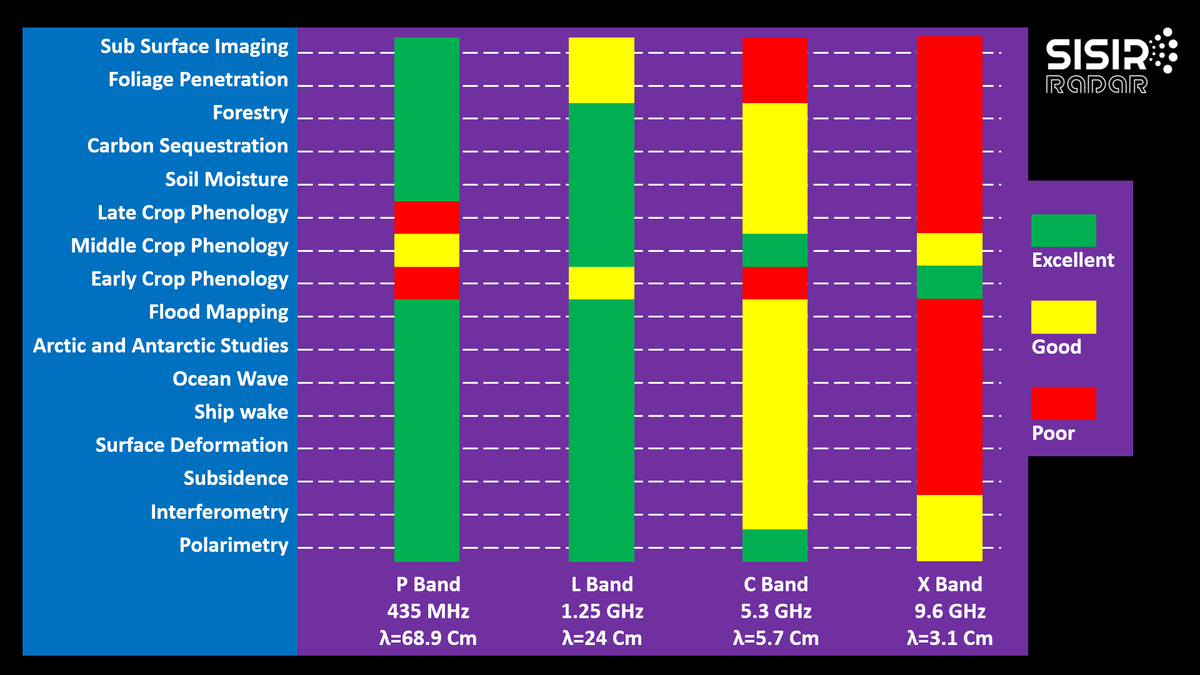
When Sisir Radar was in gestation period, we debated "Quo Vadis" when obvious and easy choice was to swim along the flow to build X band SAR. We addressed the business feasibility of SAR operating band in terms of the fundamentals of the sheer variety of applications it should address for a wider market of SAR data. The satellite and airborne SAR market has reached John Nash equilibrium of unusually high concentration in X band - less risk, wider acceptibility and a very competitive business environment with hardly any differentiators. But application wise X band was the least suitable. The largest applications were best covered in P and L band but surprisingly, hardly any takers for those bands in SAR business.
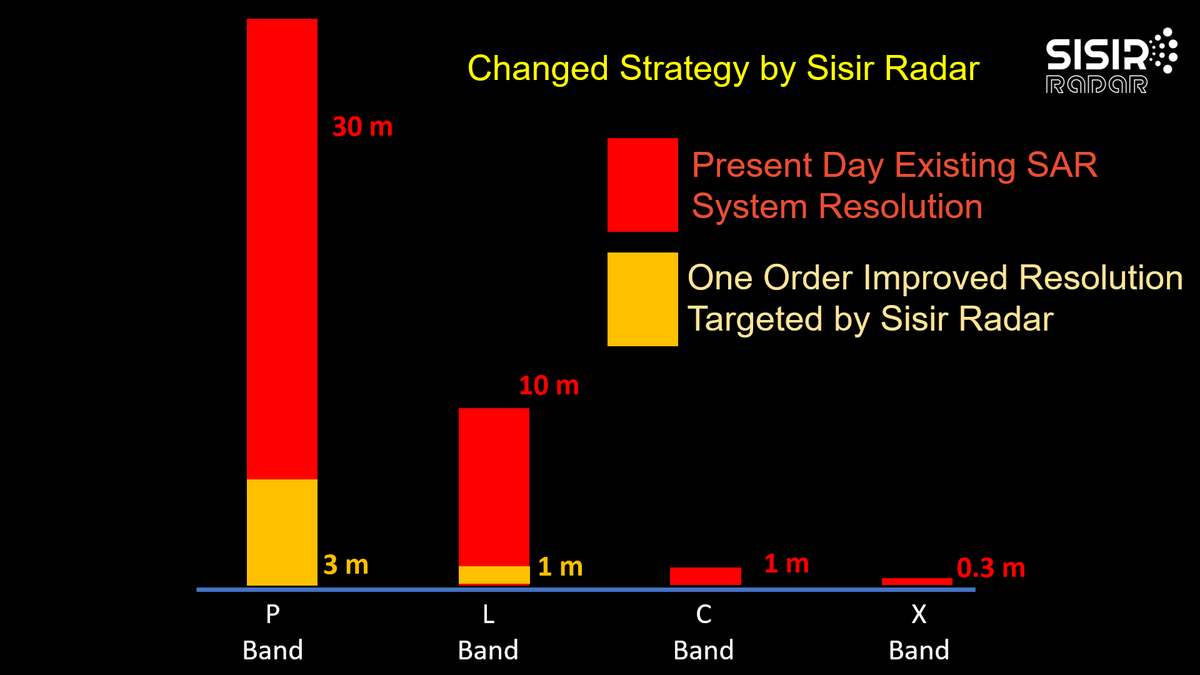
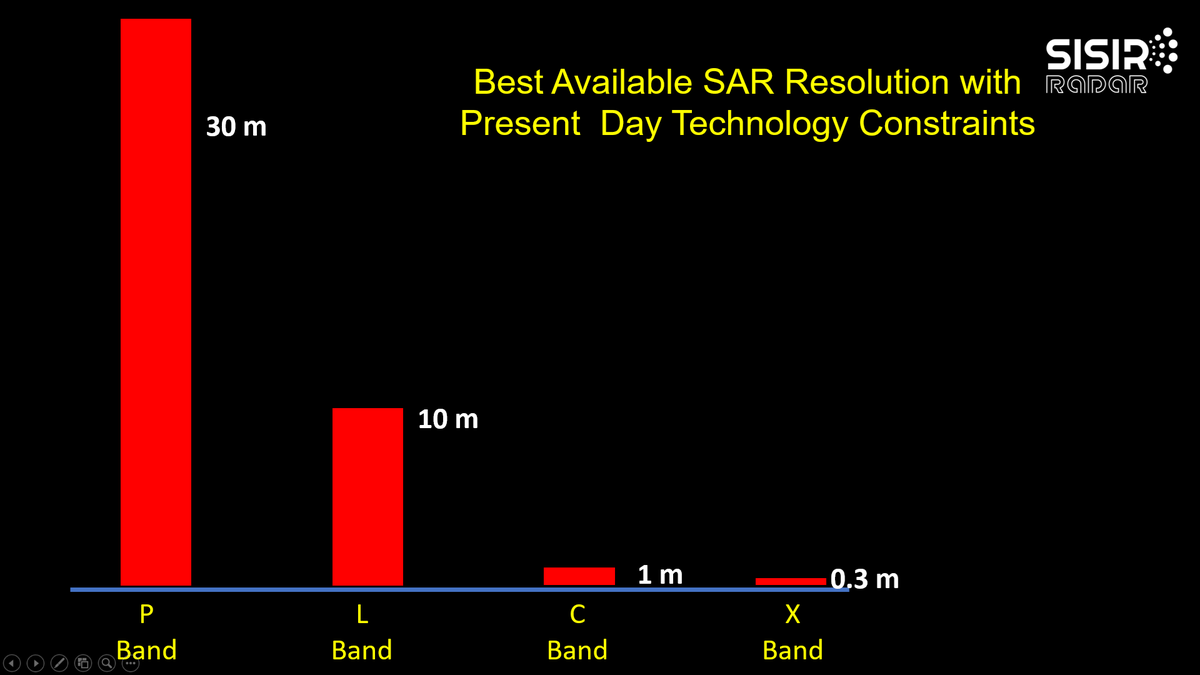
Every SAR startup was jostling to get a foothold in X band where everybody was aware of the limitations of its application potential. But X band provides opportunity of lighter hardware, better resolution and a smaller platform simply because of its short wavelength. Also, users, especially military users, long exposed to X band since WWII days, have developed ennui of experimenting with more useful L and P bands. Their reluctance was ostensibly justified in terms of poorer resolution, by almost an order or two in L and P bands, vis-à-vis in X band.
We decided to break the jinx. We innovated in SAR technology itself to improve the resolution by an order to similar level that of X band. We demonstrated technical feasibility of our innovation with world's highest resolution L and P band SAR on drone platform, a path breaking product itself. Our innovation was recognised by IDEX award. Our drone borne high resolution L and P band foliage penetration SAR has established a firm footing by convincing the users that science scores better than preconceived notions. Our Series A round funding will enable us to launch a new business arm of high resolution L band SAR satellites latest by early 2027. They will be followed by high resolution L and P band SAR satellites, imaging simultaneously mother Earth. We are confident to build a constellation of L and P band SAR satellites, which will usher in a new era in imaging the whole globe.
We will have two products: a wide proliferation of Drone borne SAR for tactical applications with quick revisits by less than an hour, and strategic applications with spaceborne SAR constellation for daily revisit. We demonstrated that the best way to escape from Nash Equilibrium is to change the rules of the game itself. Before another equilibrium is reached, Sisir Radar will definitely be the frontrunner in the game. We are grateful to our investors who trusted our convictions, demonstrated with our products and decided to undertake the journey along with us by charting a novel path.
#space #sar #satellites #makeinindia