Bioinformatician at @IBOTCZ. Bioinformatics or computational biology? That is the question. Always ready for a tertulia.
The one who assumes, goes wrong.
I am delighted to share my first publication along with @javicalvarez, @Gaspardelanoche, @froilangaca, @Vivi_R_Rios, and @DiegoVillanuM, where we present #SachaInchi chloroplast genome and explored the mode of inheritance of its organelles.
https://t.co/EYdTtOO0jb
A thread 🧵1/n
🚨¿Los grupos armados pueden influir en unas elecciones? Sí.
¿Eso significa que explican un resultado nacional? No necesariamente.
Tras la segunda vuelta presidencial surgió un intenso debate sobre el llamado "voto fusil". En la FIP analizamos el fenómeno.
Va hilo🧵🗳️
A usted pueden no gustarle las formas de Abelardo. Su manera de hablar, su deseo evidente de impresionar, su arrogancia desbordada, sus excesos. Es legítimo. A mi tampoco me gustan.
A usted puede no gustarle el Centro Democrático. Le huele a uribismo viejo, a una tradición política con la que usted nunca se identificó.
A usted puede no gustarle Oviedo. Le parece tibio, demasiado técnico, no le gustan sus formas.
Pero las formas no son lo que va a gobernar el país durante cuatro años. Lo que va a gobernar el país son los principios institucionales del que se siente en la Casa de Nariño. Y ahí la diferencia no es estética. Es estructural.
Empecemos por Abelardo.
Ha dicho con todas las letras que respeta la Constitución. Su programa está construido sobre el apego irrestricto a la ley. Y se ha comprometido públicamente con un solo período.
Se formó en la Universidad Sergio Arboleda. Y no en cualquier Sergio Arboleda: en la de Rodrigo Noguera Laborde y Álvaro Gómez Hurtado, la tradición conservadora institucionalista colombiana, la misma que defendió el Estado de derecho frente al narcoterrorismo, frente al M-19 y frente a la constituyente del 91 cuando casi todos se rendían al entusiasmo. Esa escuela respeta el partido completo, no solo cuando va ganando.
Sigamos con Paloma.
Tres períodos consecutivos en el Senado. Sin un solo escándalo de corrupción en doce años.
Abogada y filósofa de Los Andes, con especialización en economía y maestría en Nueva York. Pero el dato que más importa para esta conversación es otro: enseñó "Constitución y Democracia" en Los Andes. Es decir, la candidata pasó años enseñándole a estudiantes universitarios cómo funciona la Constitución y por qué hay que defenderla.
Cree profundamente que los desacuerdos políticos se resuelven adentro de las instituciones, no eliminándolas.
Y terminemos con Oviedo.
Doctor en economía de la Universidad de Toulouse, profesor del Rosario, exdirector del DANE. En el DANE entregó cifras durante la pandemia con un rigor técnico que le valió el respeto incluso del petrismo. El propio Gustavo Petro, antes de llegar a la Presidencia, dijo públicamente que le gustaría mantenerlo en su administración. Léalo otra vez: Petro quería mantener a Oviedo.
¿Por qué? Porque en un país donde casi todo está politizado, Oviedo demostró durante cuatro años que se pueden producir datos sin agenda. Que se puede medir pobreza sin maquillarla. Que se puede informar sobre desempleo sin esconder los números malos del propio gobierno.
Llegó a la política por la vía más difícil. Recogió firmas. No fue ungido por ningún cacique. Fue concejal de Bogotá por estatuto de oposición, después de haber sacado 616.000 votos a la Alcadía como independiente.
Oviedo no es uribista. Es un independiente que escogió esta alianza porque considera que el riesgo institucional del momento exige unidad. Y Paloma escogió a un vicepresidente con quien discrepa e, porque entendió que la coalición que el país necesita no se construye solo entre los que piensan igual.
Eso es democracia. Eso es respeto a la pluralidad.
Ahora compare.
Iván Cepeda dice que quiere modificar la Constitución. Su programa de gobierno repite la palabra "irreversibles" como mantra para describir las reformas que pretende.
Cepeda ha propuesto eliminar el Consejo Nacional Electoral, el día después de que el CNE le adoptara una decisión adversa que no le favorecía electoralmente. La frase fue suya: "ese nefasto consejo deberá ser eliminado en una reforma política".
Léala con cuidado. Cuando una institución toma una decisión que no le gusta, su primer instinto no es controvertir la decisión por las vías jurídicas. Su primer instinto es eliminar la institución.
Y nunca, en treinta y dos años de carrera política, Iván Cepeda ha dicho cuánto piensa quedarse en el poder. Nunca ha descartado una reelección. Promueve una constituyente, seguramente con el deseo de que extienda mandatos, redibuje contrapesos y modifique reglas electorales. Su programa abre todas esas puertas y no cierra ninguna.
La pregunta que toca hacerse.
No es "¿con cuál me siento más cómodo estéticamente?". La pregunta es "¿cuál de estos respeta las reglas del partido que estamos jugando?".
Abelardo, con sus excesos: respeto la Constitución, voy cuatro años, me voy.
Paloma, legalidad, instituciones, diálogo con el adversario.
Oviedo, técnica, datos, servicio público sin agenda.
Cepeda, con su calma intelectual: reformas irreversibles, constituyente, sin compromiso de un solo mandato.
La decencia política no se mide por los modales. Se mide por la disposición a perder. Quien respeta la regla acepta que algún día puede perder bajo esa regla.
Quien quiere cambiar la regla, no.
Abelardo, Paloma y Oviedo aceptan el riesgo de perder.
Cepeda diseña un país en el que ese riesgo no exista.
Esa es la elección.
Smartphones are not the explanation for the recent decline in fertility. Instead, they are an accelerator of deeper forces already at work.
Let’s start with the facts. Fertility is falling almost everywhere: in rich, middle-income, and poor countries; in secular and religious countries; and in countries with high and low levels of gender equality.
The decline accelerated around 2014. So, no country-specific explanation will work unless you are willing to believe that 200 distinct country-specific explanations arrived at roughly the same time.
Smartphones look like the obvious candidate: the first iPhone was released in 2007, and global adoption has been astonishingly fast.
Economists understand the first major decline in fertility in advanced economies, from 6 or 7 children per woman throughout most of human history to about 1.8, that occurred between the early 1800s and roughly 1970, well before smartphones. The main drivers were a sharp fall in child mortality (effective fertility was rarely above 3 and often close to 2) and the shift from a low-skill, rural agrarian economy to a high-skill, urban industrial one. We have quantitative models that fit these facts well.
Country-specific factors mattered too, of course. Proximity to low-fertility neighbors accelerated Hungary’s decline, while fragmented landowning structures accelerated France’s. But these were second-order mechanisms.
This is also why most economists long considered Paul Ehrlich’s doom scenarios implausible. We forecast that fertility in middle- and low-income economies would follow the same path as in the rich, probably faster, because reductions in child mortality reached India or Africa at lower income levels (medical technology is nearly universal, and most gains come from handwashing and cheap antibiotics, not Mayo Clinic-level care). Much of what we see in Africa or parts of Latin America today is still that old story.
But in the 1980s, a new pattern appeared. Japan and Italy fell below 1.8, the level we had thought was the new floor. By 1990, Japan was at 1.54 and Italy at 1.36.
This second fertility decline began in Japan and Italy earlier than elsewhere, driven by country-specific factors, but the underlying dynamics were widespread: secularization, an education arms race, expensive housing, the dissolution of old social networks, and the shift to a service economy in which women’s bargaining power within the household is higher. The U.S. lagged because secularization came later, suburban housing remained relatively cheap, and African American fertility was still high. U.S. demographic patterns are exceptional and skew how academics (most of whom are in the U.S.) and the New York Times see the world.
My best guess is that, without smartphones, Italy’s 2025 fertility rate would be about 1.24 rather than 1.14. I doubt anyone will document an effect larger than 0.1-0.2. Italy was at 1.19 in 1995, not far from today’s 1.14. The TFR is cyclical due to tempo effects, so I do not read too much into the rise between 1995 and 2007 or the decline from 1.27 in 2019 to 1.14 today. The direct effect of smartphones is not zero, but it is not, by itself, that large.
Where social media, in general, and smartphones, in particular, matter is in the diffusion of social norms. What would have taken 25 years now happens in 10. Social media are not the cause of fertility decline; modernity is. But they are a very fast accelerator.
That is why social media are a major part of the story behind Guatemala (yes, Guatemala) going from 3.8 children per woman in 2005 to 1.9 in 2025. Without them, Guatemala would also have reached 1.9, just 20 years later.
Modernity, in its current form, is incompatible with replacement-level fertility. By modernity, I do not mean capitalism: fertility fell earlier and faster in socialist economies than in market economies. Socialist Hungary fell below replacement in 1960, and socialist Czechoslovakia in 1966 (both experienced small, short-lived baby booms in the mid-1970s). By modernity, I mean a society organized around rational, large-scale systems and formalized knowledge.
Countries will not converge to the same fertility rate. East Asia is likely stuck near 1, possibly below, given its unbalanced gender norms and toxic education systems. Latin America faces the same gender problem plus weak growth prospects, so I expect something around 1.2. Northern Europe has more egalitarian family structures and might hold near 1.5. The very religious societies are probably the only ones that will sustain 1.8.
All of this could change with AI or changes in population composition. We will see. But on the current evidence, deep sub-replacement fertility is the “new new normal.” Unless we reorganize our societies, better learn to handle it as best we can.
Found a paper that suggests we may have spent years training agents to become hunters of proxy reward when the more basic thing intelligence craves is not a reward at all, but to not run out of viable futures.
The paper proposes that behavior is best understood as maximizing future action-state path occupancy, which collapses mathematically into a discounted entropy objective. The agent doesn’t necessarily want to GET something, but rather is trying to keep as many meaningful trajectories alive as possible.
The obvious objection is “so it just does random shit? fuck around and find out?”
No, this is where it gets pretty beautiful. The agent is variable when variation is cheap and becomes surgically goal-oriented the moment an absorbing state (death, starvation, falling over, etc) gets close enough to threaten its future path space.
Variability is the same drive as goal-directedness, just operating under different constraints.
The demos are kinda wild:
- A cartpole (classic move a cart to keep a pole from falling control task) that doesn’t merely balance but dances and swings through a huge range of angles and positions because why not? The whole point is occupying state space, and rigid balance is a voluntarily impoverished life.
- A prey-predator gridworld where the mouse PLAYS with the cat, teasing it and using both clockwise and counterclockwise routes around obstacles to lure it away from the food source before slipping in to eat, using both routes roughly equally. A reward-maximizing agent would collapse to one strategy and exploit it. Here, the agent keeps its behavioral repertoire
- A quadruped trained with Soft Actor-Critic and ZERO external reward that learns to walk, jump, spin, and stabilize, and then makes a beeline for food only when its internal energy drops low enough that starvation becomes a real threat
The thing that hit me hardest is the comparison to empowerment and free energy principle agents. Both collapse to near-deterministic policies with almost no behavioral variability. This paper’s agents find the highest-empowerment state and exploit it. FEP agents converge to classical reward maximizers.
As far as I’m aware, this is the only framework that produces agents you could describe as being “alive.”
The AI implication here is that we undertrain for behavioral repertoire. Most systems hit the benchmark by collapsing onto a narrow attractor basin of good-enough trajectories. They’re competent for sure, but brittle too, with one viable plan, executed until the world shifts and leaves them with nothing.
The thing I increasingly want from agents isn’t competence per se, but option-preserving competence.
I want agents with the ability to keep multiple viable plans alive and switch between them without catastrophe.
We’ve been so focused on teaching agents what to want that we never stopped to ask what happens if wanting isn’t the point, if the deepest drive isn’t necessarily toward anything, but away from the walls closing in.
paper: https://t.co/Kn3mllmmPK
The entire AI bias debate is fighting the wrong war.
Everyone is arguing about whether ChatGPT leans left or Grok leans right. Meanwhile a December 2025 Nature study found that a single chatbot conversation shifted opposition voters' candidate preferences by 3 to 10 points on a 100-point scale. Roughly 4x the measured effect of traditional political ads tested during the 2016 and 2020 elections.
The mechanism was straightforward: facts. When researchers prevented the model from citing evidence, persuasion collapsed. The chatbots that changed minds did it by forcing users to engage with specific claims about policy instead of triggering tribal emotions.
This is what the FT chart is actually showing. Social media amplifies the extremes because the reward function is engagement. Outrage performs. Nuance dies. AI chatbots compress the extremes toward the center because the format is conversational. You can't dunk on a chatbot for clout.
The Grok result seals it. Grok skews measurably right. Still depolarizes. The political lean of the model matters less than the structural difference between a conversation and a feed.
The platforms that provably radicalize users face zero regulatory pressure on distribution mechanics. The companies building chatbots are getting grilled by Congress over political lean. This chart explains the mismatch: radicalization is profitable. Depolarization is not.
Probiotics are getting a serious upgrade 🚀
Next-gen probiotics based on scientific evidence: engineered, targeted, and actually designed to work.
https://t.co/Q18g6S8w5k
Is AI the biggest change in education since the printing press? Yes.
This weekend, I decided to learn about the life and work of Erving Goffman purely out of personal interest. Goffman was one of the most influential sociologists of the 20th century and a professor at Penn. I had a few free hours after a tough week of travel and work, and thought it might be a good distraction.
I asked Claude to prepare a study plan based on my professional background, prior knowledge, and the hours I had available: an introduction to Goffman’s life and work, selections from his best and most influential writings, and an examination of his impact on social theory. The plan was outstanding. A top expert on Goffman would likely have done better. A 90th percentile real professor of sociology would not have, or at least not without serious effort.
As I read The Presentation of Self in Everyday Life (complete) and Asylums and Stigma (selections), I could ask Claude for clarification, connections to the wider literature, and links to material I already knew. The Q&A and the exploration of collateral ideas were so good that I ended up spending much more time than I anticipated. Last night I had to force myself to go to bed.
Did Claude get everything right? Perhaps not, but neither do I in my own graduate seminars. Even in my areas of top expertise, I often do not answer students’ questions precisely or correctly. One should not compare Claude to the perfect professor but to a real one. And every answer I could verify (I checked many) was at least a solid A-.
Am I an expert on Goffman now? Of course not. But I would say I am now familiar with an important thinker at the level a regular master’s course on modern sociological theory would produce in the week it dedicates to him. Doing the same work using Google alone would have taken much longer. I know because I have undertaken similar projects with other thinkers in the past. One had to spend considerably more time before reaching the core of the contribution.
I can now imagine someone designing self-learning courses in many fields that are better than what you can get outside the very top universities, at close to zero marginal cost. Where does that leave a normal university? I do not know.
But colleagues in departments that want to stop the spread of AI are deluding themselves. This type of technology does not come once a century. It comes once a millennium.
Quién le dice a la mesa de @BluRadioCo que proyectar el número total de votos del % de mesas escrutadas NO funciona. Si tenemos 1.5 M votos con 25% y decimos 1.5 x 4= 6M votos totales es un error porque las mesas tienen DISTINTOS números de votos!
#EleccionesColombia2026
Intensive parenting gets a bad rap. You should give your kid a free hand! Don't constantly be hovering!
And it's true, having more rules in your house makes parenting harder.
But it's also strongly correlated with better relationships with your kids.
Damos por hecho que el matrimonio siempre ha sido una unión afectiva donde la pareja es compañera/amiga, comparte gustos, emociones, intimidad diaria y convivencia cercana (lo que en inglés se llama "companionate marriage" o "matrimonio de compañerismo”) Pero esto es un cambio relativamente moderno en Occidente, y se fue imponiendo por etapas.
Anteriormente, hasta bien entrado el siglo XVIII en muchos contextos europeos, el matrimonio era sobre todo una institución económica, social y reproductiva, muchas veces una alianza entre familias (tierras, alianzas políticas, herencias, estabilidad social) donde el rol del marido era ser la cabeza autoritaria (gobernar la casa, proveer) y la esposa era la gestora del hogar y de la crianza. Pero las vidas eran bastante separadas, los hombres en el trabajo público o en los campos y las mujeres en el ámbito doméstico con hijos y sirvientes. Había poco énfasis en la "amistad emocional", compartir hobbies o conversaciones profundas diarias. El afecto podía surgir después (o no), pero no era el requisito principal para casarse. En clases altas los matrimonios se arreglaban por conveniencia y en clases bajas era algo más pragmático, por necesidad laboral o supervivencia.
Historiadores como Lawrence Stone (en su libro clásico The Family, Sex and Marriage in England 1500-1800) describen el surgimiento del "affective individualism" y el "companionate marriage" en Inglaterra desde finales del XVII y sobre todo en el XVIII cuando los padres dejan de imponer parejas estrictamente, se valora más el consentimiento y el afecto mutuo.
En las décadas 1760-1780 en el Reino Unido y Francia el amor romántico se impone como ideal. Novelas, literatura y sermones promueven matrimonios basados en mutua atracción y felicidad emocional. En el siglo XIX esto ya se ha popularizado. Con la Revolución Industrial, los matrimonios se ven como unión de dos amigos/amantes que comparten vida, conversaciones, ocio. En EE.UU. y Europa, se valora la "esposa como compañera”.
Pero la explosión de este concepto parece que es en los años 1920. De hecho, el concepto "companionate marriage" se acuña formalmente alrededor de 1924 (por historiadores y jueces como Ben Lindsey). En los años 20 (liberación sexual y feminismo de primera ola) se populariza la idea de matrimonio como unión igualitaria de compañeros/amigos sin hijos obligatorios, basada en placer mutuo, respeto y amistad emocional. Antes de la I Guerra Mundial, aún era más familiar/económico pero después ya se centra en la pareja como unidad autónoma.
https://t.co/hfq5nmomvO
https://t.co/iSgrDsdDfz
https://t.co/NPXNatlxXZ
Que buen momento para esta revisión de literatura. Desde #25alSenado propongo que este sea un tema prioritario.
Necesitamos una ley para fortalecer la atención a la primera infancia en Colombia
Si Colombia quiere cerrar brechas de verdad, la prioridad debe ser primera infancia (0–5 años). Es la inversión pública con mayores retornos en equidad, productividad y movilidad social.
Necesitamos darle prioridad presupuestal a esta política y blindar el gasto por niño atendido y evitar recortes entre gobiernos. La infancia no puede depender del ciclo político.
Hay que pasar de cobertura a calidad y resultados.
Introducir pago por resultados: nutrición efectiva, controles de salud, desarrollo cognitivo y socioemocional medibles.
Integración obligatoria de servicios.
Salud, nutrición, cuidado y educación inicial deben operar como un solo sistema. Menos fragmentación, más impacto.
Enfoque territorial.
Más recursos y flexibilidad donde hay mayor pobreza infantil, ruralidad y dispersión. La misma solución no sirve para todos los territorios.
Talento humano y familias.
Mejores estándares, formación continua para cuidadores y acompañamiento parental. La calidad del cuidado depende de quien cuida y del hogar.
Transparencia y evaluación.
Indicadores públicos por municipio e informes anuales al Congreso. Lo que no se mide, no se mejora.
Priorizar la primera infancia no es asistencialismo. Es inversión estratégica en el futuro del país. Sin eso, no hay igualdad de oportunidades ni crecimiento sostenible.
#25alSenado @NvLiberalismo
@lh3lh3 Thank you for the response Heng!
A final question if I may. How important is the quality of the gene models?
Would it be better to stick to more curated, "gold standard" few genomes, or rather a more widespread, lax, and diverse selection?
Thanks again!
I like coining terms for things. I think it can help to organize thinking about a subject.
Bureausclerosis
noun
Pronunciation: /ˌbjʊəˈroʊˌsklɪəˌroʊsɪs/ (BYUR-oh-sklair-OH-sis)
Plural: bureauscleroses
Definition
A pathological accumulation of bureaucratic rules, procedures, and administrative layers that impedes organizational effectiveness, adaptability, and decision-making. It ultimately causes institutions to function more slowly and less competently than they would with fewer formal controls.
Etymology
From bureau (French: "desk; administrative office") + -sclerosis (Greek: sklērōsis, "hardening"), by analogy with medical conditions involving progressive stiffening or loss of functional flexibility in biological systems. Related to: Eurosclerosis.
Description
Bureausclerosis occurs when bureaucratic structures evolve beyond their original coordinating or accountability-enhancing purpose and instead become self-reinforcing obstacles to action. The condition is characterized by excessive process formalization, rule proliferation, procedural inertia, and risk-avoidant compliance behavior, often resulting in delayed decisions, misaligned incentives, and institutional paralysis.
Bureausclerosis is indicated by rule accretion, a preference for process over outcomes, increasing decision latency, adaptation failure, and defensive administration, whereby actors optimize for blame avoidance rather than the effectiveness of the organization.
Distinction From Related Concepts
- Bureaucracy: A neutral or potentially beneficial system of administrative organization, not an inherently slow system, and indeed, often a means to accelerate operations, build operational capacities, allow and promote coordination, and so on.
- Red Tape: Specific, unnecessary, duplicative procedures.
- Bureausclerosis: A systemic, chronic condition in which bureaucracy itself becomes the binding constraint on perforamnce.
Example Usage
"The agency's inability to respond to the crisis was not deu to lack of resources or missing expertise, but to an advanced case of bureausclerosis that made rapid coordination impossible."
Note
Bureausclerosis is most likely to affect large, long-lived institutions that operate under systems of asymmetric accountability, wherein inaction has diffuse, delayed costs, but procedural deviations lead to immediate, personal penalties.
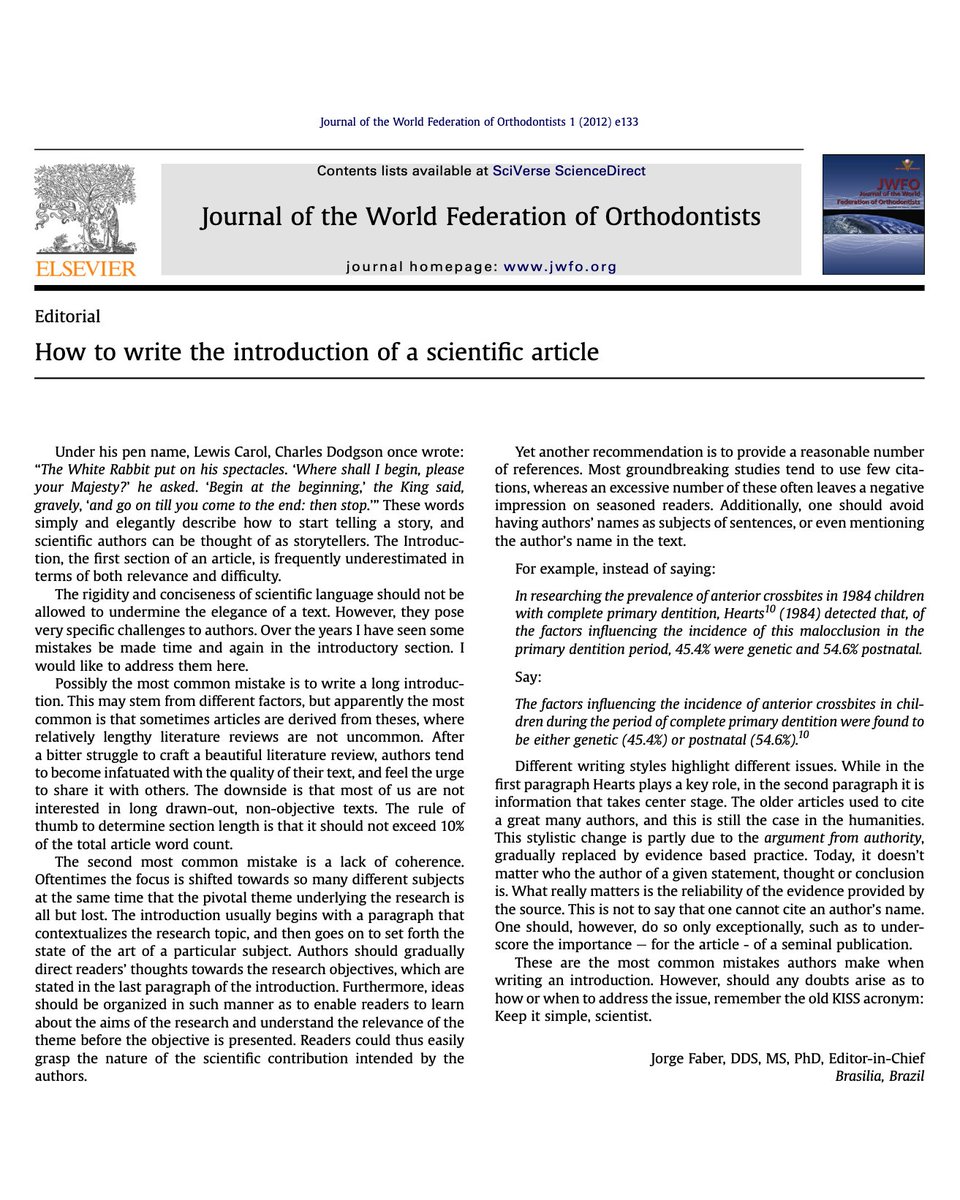
Most scientists write introductions that reviewers never finish reading.
They're too long, unfocused, and packed with names nobody cares about.
Faber reported the three mistakes that destroy submissions in this 2012 JWFO piece. And it's still relevant today.
Here's how to fix them: