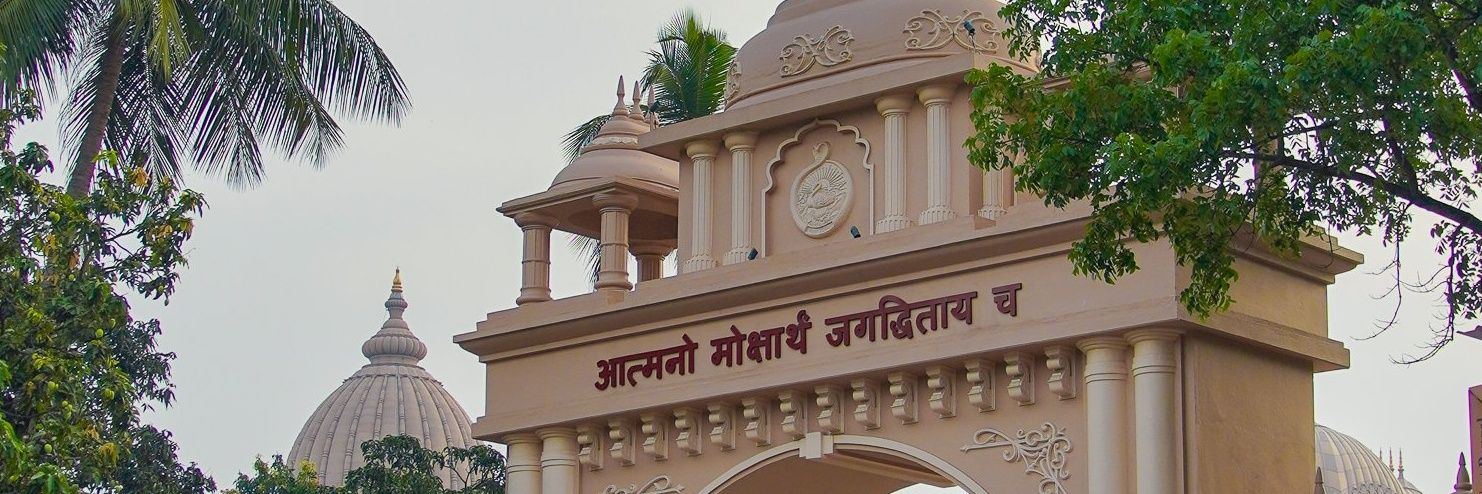
Whatever you tell yourself, that you become. Almost the first words the great Buddha uttered were: “What you think, that you are; what you will think, that you will be.”
- Swami Vivekananda
{CWSV-3 : Lectures From Colombo to Almora : The Vedanta}
#VivekanandaKendra #Spirituality
The rains have blessed Puri, and Jagannath Dham looks more divine than ever.
As preparations for the grand Rath Yatra continue, every drop of rain feels like a celestial offering at the feet of Mahaprabhu.
Jai Jagannath 🙌
Have you ever thought about what our Kolkata was like? Those of us born in this era never saw the royal grandeur of Kolkata. Whenever we look at old pictures, it feels like the city was once something entirely different — not just in its architecture, but in its way of life, transportation, culture, and everything else.
Dawn would break at the ghats of the Ganges. Life would begin from Bagbazar to Babughat even before sunrise. And on the city streets, buses would start plying. At one time, buses were the real backbone of Kolkata’s transportation system. Red government buses, double-decker buses, and later minibuses — together they carried office-goers, students, workers, and businessmen. Everyone’s day began with the bus. Trams were the city’s identity, but it was the buses that kept the city running every single day.
Think of Kolkata in 1990. At that time, Bengaluru or Hyderabad had not yet gained the recognition they have today. Kolkata was one of the most important metropolises in the country. Its significance as a center of ports, banking, commerce, education, culture, publishing, and railways was extraordinary.
The path for Bengal after independence was not easy. The 1947 Partition displaced millions of people. Families from East Bengal came as refugees and began new lives in this Bengal. Then, during the 1971 Bangladesh Liberation War, another wave of refugees arrived. That history is still deeply intertwined with the society and economy of West Bengal.
Before independence, this Bengal was one of the major centers of revolutionary movements. Figures like Subhas Chandra Bose, Khudiram Bose, Bagha Jatin, Pritilata Waddedar, and Surya Sen wrote history through their struggle against British rule.
And what about the Bengali aristocratic society of that time? The old traditional houses of North Kolkata were centers of culture, literature, music, and education. With their vast courtyards, libraries, musical gatherings, theater, Durga Puja, and everything else, they created a unique environment.
In the history of transportation too, Kolkata was a pioneer. The tram was a matter of pride, and India’s first metro rail started here. But the largest network was that of the buses. From Dharmatala to Shyambazar, Garia, Howrah, Barasat, Barrackpore — everywhere, buses carried the economy and daily life of the city.
Today, when we look at pictures of old Kolkata, one question repeatedly comes to mind: Must we erase the past in the name of development?
Cities like Paris, Prague, Vienna, Budapest, Florence, and Edinburgh have preserved their centuries-old heritage. They have built modern cities while keeping their history alive.
Why can’t Kolkata do the same?
Let modern development happen in New Town, Rajarhat, or the suburbs. But is it impossible to thoughtfully restore the historic areas like Burrabazar, College Street, Bagbazar, Chitpur, Bowbazar, Dalhousie, Esplanade, and Kumortuli? Because Kolkata is not just a city. It is a living memory.
In that memory lies the ghats of the Ganges, the smell of books on College Street, the trading history of Burrabazar, the ringing of tram bells, the first journey of the metro, and the daily bus rides of millions of people.
We never saw that royal Kolkata. We never sat on the upper deck of a double-decker bus and watched Chowringhee, never saw the old hustle and bustle of Dharmatala, nor witnessed the golden era of aristocratic Kolkata.
But that Kolkata has not completely disappeared yet. It still lives on in the old streets, historic architecture, the breeze from the Ganges, the balconies of heritage homes, and the sound of bus wheels that carry the city every single day.
There is only one question: Will we forget that Kolkata, or will we revive it once again for the coming generations?
Kolkata Bus-o-pedia ✍️
🌻 Sri Ramakrishna, Holy Mother Sri Sarada Devi, Swami Vivekananda, and Swami Brahmananda at Belur Math on 8th June 2026. 🪷 Bhajan: https://t.co/oVRuxenzCn
— Website : https://t.co/yGkG5S2Rfm
Donations : https://t.co/VONXJAsF0Y
Facebook : https://t.co/O5wKHV00E6
PM Modi is all set to return and take part in West Bengal Foundation Day celebrations on upcoming June 20th. That was the day Dr. Syamaprasad Mookerjee saved our State from going to Pakistan. Hindu Bengalis were saved solely because of him.