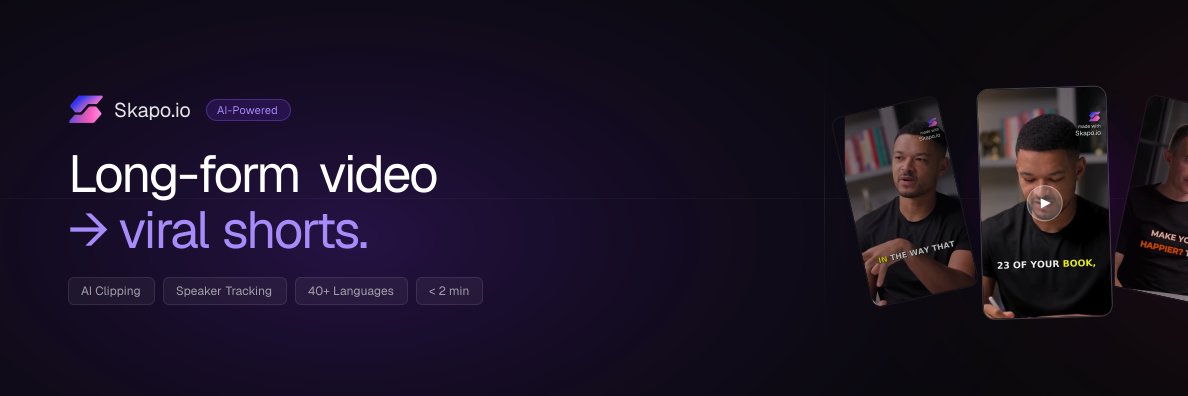
The goal isn't to replace every video editor.
It's to stop skilled editors from spending their day on repetitive tasks that software can handle.
Let automation do the first pass. Let humans make the creative decisions that matter.
We're looking to speak with podcast agencies and content repurposing teams.
How do you currently turn long-form recordings into short-form content?
What takes the most time: finding moments, editing, captions, or client revisions?
We're building Skapo around real workflows.
One client podcast is manageable.
Ten client podcasts every week is an operations problem.
Agencies need repeatable workflows, consistent output, and fewer manual steps.
That's why we're building Skapo for more than one-off clipping.
If your agency repurposes podcasts for clients, your bottleneck isn't a lack of content.
It's the labour required to turn that content into dozens of publishable assets.
Skapo is built to automate more of that pipeline, so your team can focus on quality and clients.
Building an AI SaaS is humbling.
You can spend months building something, launch it, and discover that getting people to care is harder than building the product.
That’s where we’re at with Skapo.
Now the focus is simple: talk to users, improve the output, and earn our first customers.
One of our biggest lessons building Skapo:
Generating more clips doesn't automatically create more value.
The next level is improving how many clips make it from AI output to actual publication.
That's the problem we're working on.
A generated clip isn't finished just because the export succeeded.
Does the hook make sense?
Is the context intact?
Are the captions readable?
Is the framing correct?
That's the difference between a rendering pipeline and a useful content workflow.
Building AI video software taught us something:
The model is only one part of the product.
You still need ingestion, clip selection, timing, framing, captions, rendering, and delivery to work together.
The workflow is the product.
We ran a 1h43m video through Skapo.
The result: 35 unique shorts in about 12 minutes.
The interesting part isn't just the number of clips.
It's turning a long recording into a library of content without manually reviewing every minute.
The AI video market doesn't need another button that says “Generate clips.”
It needs better clip selection, less manual correction, and workflows that scale beyond one creator.
That's where we're focused at Skapo.
Unpopular opinion: a podcast clip with perfect captions and terrible storytelling is still a terrible clip.
Editing polish can't fix a moment that doesn't make sense.
Agree or disagree?
AI didn't eliminate video editing.
It moved the bottleneck.
Now the challenge is less about cutting footage and more about finding the right moments, preserving context, and getting the output ready to publish.
That's the problem worth solving.
@RonnyBruknapp We have heard nothing but positive feedback with regards to output clips quality.
It's motivational to keep on building a podcast clipper that actually generates engageable clips!
Most AI clippers optimize for one metric: how many clips can they generate?
We think the better question is: how many would you actually publish?
Volume is easy to measure. Usability is what matters.
Our goal with Skapo isn’t to generate the most clips possible.
It’s to generate clips that require less fixing before they’re ready to publish.
More usable output.
Less manual correction.
A better workflow for creators and agencies.
That’s the metric that matters to us.
One thing we’re learning while building Skapo:
Generating a clip is easy to demonstrate.
Generating a clip someone would actually publish is a much higher bar.
We’re focused on the gap between the two.
That’s where the real product is.
A long podcast can contain dozens of moments worth sharing.
The problem is finding them.
Then cutting them.
Then adding captions.
Then exporting everything.
Skapo automates the journey from long-form video to short-form content.
One workflow. Less busywork.
We built Skapo to answer a simple question:
Can AI turn long-form content into short-form videos without losing the story?
We’re working on making that process faster, more coherent, and less manual.
The best way to improve it? Real videos. Real feedback. Real use cases.