A Giant Squid in the Flying Bat
If so, the truly giant Squid Nebula would physically be nearly 50 light-years across.
Image Credit: Steve Cannistra ( StarryWonders )
#Astronomy
NGC 4372 and the Dark Doodad
Of course NGC 4372 roams the halo of our Milky Way Galaxy, a background object some 20,000 light-years away and only by chance along our line-of-sight to the Dark Doodad.
Image Credit: Marco Lorenzi
#Astronomy
NGC 1316: After Galaxies Collide
Most elliptical galaxies have more and brighter globular clusters than NGC 1316.
Image Credit: Damian Peach / SEN
#Astronomy
Meteor shower update:
Leonids (Class I) meteor shower in Leo constellation, Peak rate (ZHR) of 15 per hour, traveling at a velocity of 71km/sec, from parent object 55P/Tempel-Tuttle, prediction status: published maximum, 7 days to peak
#MeteorShower#Astronomy
Distorted Green Flash Sunset over Italy
Different colors of the Sun may also become deflected by significantly different amounts, so that the uppermost superior image may appear momentarily green -- a phenomenon known as a green flash.
Image Credit: Paolo Lazzarotti
#Astronomy
Milky Way with Airglow Australis
Above a sea of clouds and flanking the celestial Milky Way, the airglow seems to ripple and flow across the northern horizon in atmospheric waves.
Image Credit: Yuri Beletsky ( Carnegie Las Campanas Observatory )
#Astronomy
Arp 159 and NGC 4725
Also known as NGC 4747, the smaller distorted galaxy at left is the 159th entry in the Arp Atlas of Peculiar Galaxies, with extensive tidal tails indicative of strong gravitational interactions in its past.
Image Credit: Stephen Leshin
#Astronomy
The Flare and the Galaxy
No. Despite appearances, this person is actually pointing in the direction of a bright Iridium flare, a momentary reflection of sunlight off of a communications satellite in orbit around the Earth.
Image Credit: Martin Mark
#Astronomy
Distant Neutrinos Detected Below Antarctic Ice
Pictured here is IceCube's Antarctic lab accompanied by a cartoon depicting long strands of detectors frozen into the crystal clear ice below.
Image Credit: IceCube Collaboration, U. Wisconsin, NSF
#Astronomy
Pluto in Enhanced Color
The featured enhanced color image is not only esthetically pretty but scientifically useful, making surface regions of differing chemical composition visually distinct.
Image Credit: NASA, Johns Hopkins Univ./APL, Southwest Research Inst.
#Astronomy
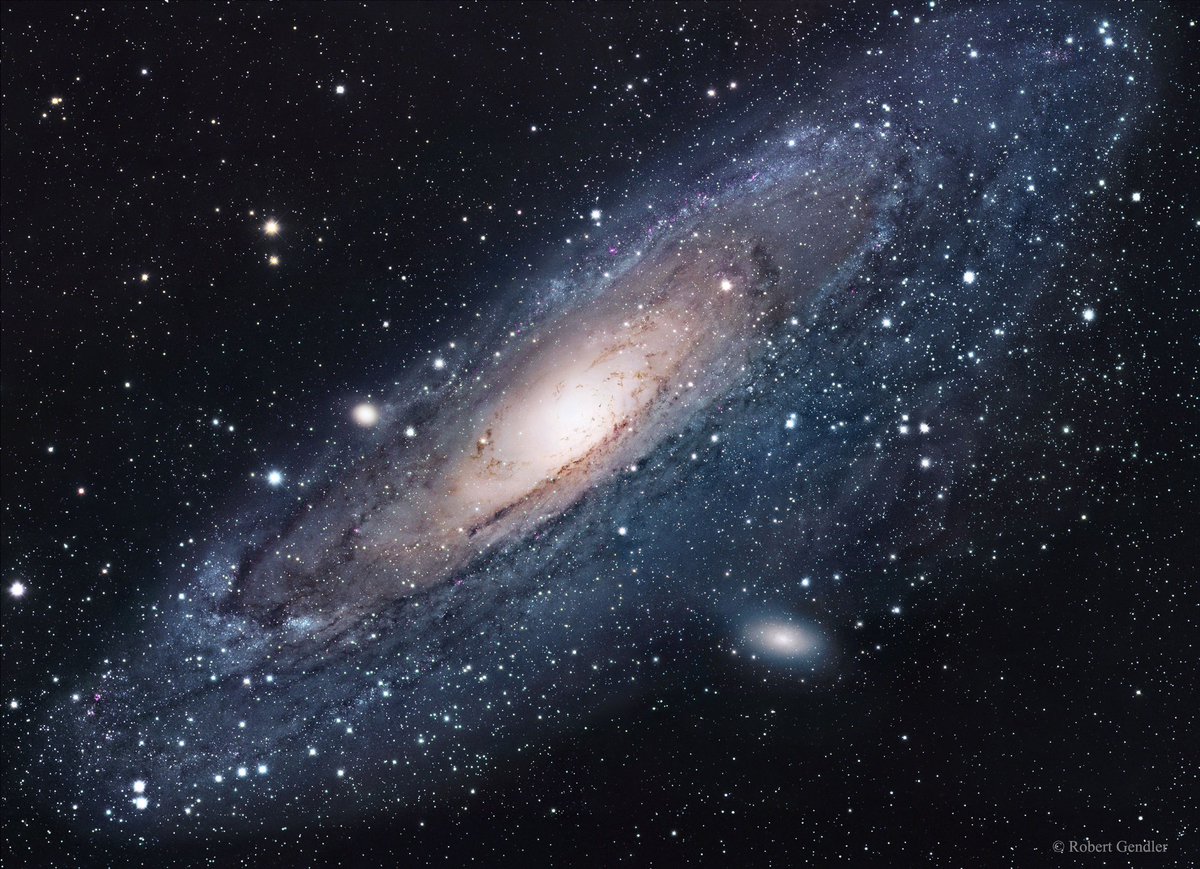
M31: The Andromeda Galaxy
The several distinct stars that surround Andromeda 's image are actually stars in our Galaxy that are well in front of the background object.
Image Credit: Robert Gendler
#Astronomy