Chandrayaan-3 Mission:
'India🇮🇳,
I reached my destination
and you too!'
: Chandrayaan-3
Chandrayaan-3 has successfully
soft-landed on the moon 🌖!.
Congratulations, India🇮🇳!
#Chandrayaan_3#Ch3
As depicted in the film Oppenheimer, one of Albert Einstein's best friends in his later years was mathematician Kurt Gödel. Gödel found a strange solution to Einstein's general theory of relativity that modelled a rotating universe allowing for backward time travel.
Gödel presented the rotating solution to Einstein on his birthday. Note that the idea was purely hypothetical, and hasn't been shown to have any connection with physical reality. Still, it has inspired other hypothetical schemes for backward time travel.
The infatuation of @elonmusk with the name https://t.co/92gi3zsHin goes way back. Here are some excerpts from my upcoming book, https://t.co/JaeIDTq8FO
"When his cousin Peter Rive visited in early 1999, he found Musk poring over books about the banking system. “I’m trying to think about what to start next,” he explained. His experience at Scotiabank had convinced him that the industry was ripe for disruption. So in March 1999, he founded https://t.co/92gi3zsHin.
His concept for https://t.co/92gi3zsHin was grand. It would be a one-stop everything-store for all financial needs: banking, digital purchases, checking, credit cards, investments, and loans. Transactions would be handled instantly, with no waiting for payments to clear. His insight was that money is simply an entry into a database, and he wanted to devise a way that all transactions were securely recorded in real time. “If you fix all the reasons why a consumer would take money out of the system,” he says, “then it will be the place where all the money is, and that would make it a multitrillion-dollar company.”
Musk was able to entice the influential head of Sequoia Capital, Michael Moritz, to make a major investment in https://t.co/92gi3zsHin. Moritz then facilitated a deal with Barclay’s Bank and a community bank in Colorado to become partners, so that https://t.co/92gi3zsHin could offer mutual funds, have a bank charter, and be FDIC-insured.
One of Musk’s management tactics, then as later, was to set an insane deadline and drive colleagues to meet it. He did that in the fall of 1999 by announcing, in what one engineer called “a dick move,” that https://t.co/92gi3zsHin would launch to the public on Thanksgiving weekend. In the weeks leading up to that, Musk prowled the office each day, including Thanksgiving, in a nervous and nervous-making frenzy, and slept under his desk most nights. One of the engineers who went home at 2 a.m. Thanksgiving morning got a call from Musk at 11 a.m. asking him to come back in because another engineer had worked all night and was “not running on full thrusters anymore.” Such behavior produced drama and resentments, but also success. When the product went live that weekend, all the employees marched to a nearby ATM, where Musk inserted an https://t.co/92gi3zsHin debit card. Cash whirred out and the team celebrated.
One driver of growth was a feature that they originally thought was no big deal: the ability to send money by email. That became wildly popular, especially on the auction site eBay, where users were looking for an easy way to pay strangers for purchases.
[After a merger, with a company cofounded by Peter Thiel and Max Levchin, the company became known as PayPal.] "Musk insisted that the company’s name should be https://t.co/92gi3zsHin, with PayPal as merely one of its subsidiary brands. He even tried to rebrand the payment system X-PayPal. There was a lot of pushback, especially from Levchin. PayPal had become a trusted brand name, like a good pal who is helping you get paid. Focus groups showed that the name https://t.co/92gi3zsHin, on the contrary, conjured up visions of a seedy site you would not talk about in polite company. But Musk was unwavering, and remains so to this day. “If you want to just be a niche payment system, PayPal is better,” he said. “But if you want to take over the world’s financial system, then X is the better name.”
Levchin and Musk soon clashed on an issue that sounded technical but was also theological: whether to use Microsoft Windows or Unix as the main operating system. Musk admired Bill Gates, loved Windows NT, and thought Microsoft would be a more reliable partner. Levchin and his team were appalled, feeling that Windows NT was insecure, buggy, and uncool. They preferred using various flavors of Unix-like operating systems, including Solaris and the open-source Linux.
One night well after midnight, Levchin was working alone in a conference room when Musk walked in primed to continue the argument. “Eventually you will see it my way,” Musk said. “I know how this movie ends.”
“No, you’re wrong,” Levchin replied in his flat monotone. “It just isn’t going to work in Microsoft.”
“You know what,” said Musk. “I will arm-wrestle you for it.”
Levchin thought, correctly, that this was the stupidest imaginable way to settle a software-coding disagreement. Plus, Musk was almost twice his size. But he was loopy from working late hours and agreed to arm-wrestle. He put all his weight into it and promptly lost. “Just to be clear,” Levchin told him, “I’m not going to use your physical weight as any sort of a technical decision input.”
Musk laughed and said, “Yeah, I get it.” But he prevailed.
[Musk told me, even before he took control of Twitter, that he planned to rebrand it https://t.co/92gi3zsHin and to try to make it a platform that would fulfill his original vision from 1999. A passage from later in the book:]
In the days leading up to his takeover of Twitter at the end of October 2022, Musk’s moods fluctuated wildly. “I am very excited about finally implementing https://t.co/92gi3zsHin as it should have been done, using Twitter as an accelerant!” he texted me out of the blue at 3:30 one morning. “And, hopefully, helping democracy and civil discourse while doing so.” He said that he would turn it into the combination of financial platform and social network he had envisioned twenty-four years earlier for https://t.co/92gi3zsHin, and he added that he planned to rebrand it with that name, which he loved. A few days later, he was more somber. “I will need to live at Twitter HQ. This is a super tough situation. Really bumming me out :( Sleep is difficult.”
Here is Musk with Peter Thiel and the https://t.co/92gi3zsHin card in 1999, and celebrating with Pappy van Winkle, @pappyvanwinkle , the world's best Bourbon, on the day he bought Twitter:
𝕏 — The Origin Story
It all started exactly two years ago, in July 2021.
I was spending a lot of time on Clubhouse and the idea of creating a club had been on my mind for a while. However, Clubhouse content was ephemeral: those who weren’t present in the room to hear the conversations missed out. I was willing to dedicate time and effort to organize discussions around topics I was passionate about but I also wanted to generate content that others could enjoy long after the room had closed.
Then @DavidSacks launched the private beta of @getcallin, a social podcasting app: it was exactly what I was looking for as it provided everything that was missing in Clubhouse.
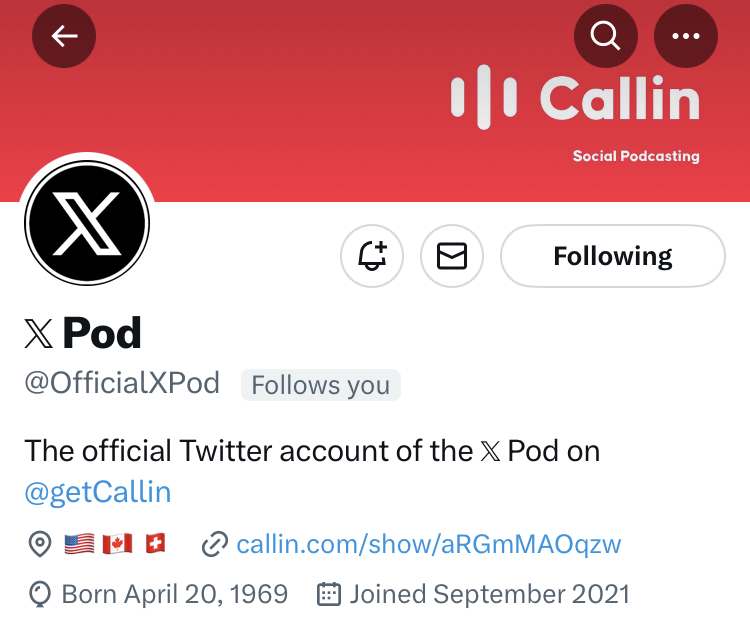
I created my Callin profile and on September 4, I created the 𝕏 show.
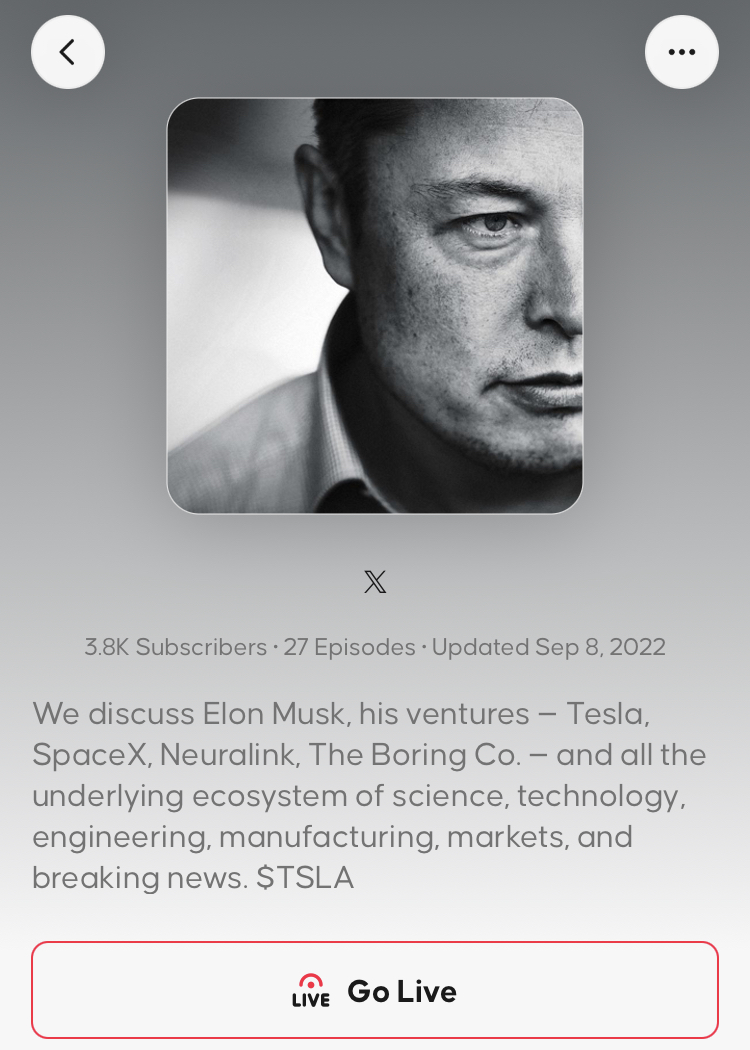
The Show would discuss @elonmusk and his ventures (Tesla, SpaceX, Neuralink, and The Boring Co.)
The Name of the show wasn’t easy to come up with. Naming it the ‘Elon Musk Show’ or the ‘Boring Neuralink SpaceX Tesla Show’ was obviously out of the question lol. It was well-known that Elon owned the one-character domain name https://t.co/A2b6GggMky which was not being used and, at the time, people on Twitter were toying with the idea that he could create X Corp, an umbrella parent corporation for all his ventures. Also, the letter 'x' is often used as a variable, which was perfect given the variety of topics the show would encompass and tackle from one episode to the next.
The Hosts of the show would discuss these topics through different lenses according to their knowledge and expertise: engineering, technology, innovation, finance, stock market, breaking news, etc. I initially approached @meckimac with the idea and she immediately jumped on board. Together we invited @AdamBerg4680, @SawyerMerritt, and @wholemars to join the team.
The Branding of the show was somewhat challenging. Using the standard letter 'X' would be boring and uninspired. We needed an edgy typeface that could be used in Callin and Twitter as text, as well as a large distinctive logo. I chose the Unicode character 𝕏 (U+1D54F) for use in the display name of the show. Based on that character, I made a slightly more refined and pronounced graphic logo for use as the profile photo. I also picked a striking B&W photograph of Elon for use as the show’s banner and episode thumbnails. Jessica searched for an available handle on Twitter and created the @OfficialXPod account. Jessica also created and managed our Slack channel.
On September 11, we had our 𝕏 Pod Launch Party episode.
Later on, inspired by @ks_kulk’s fantastic math rooms, we did a few 'Show & Tell' episodes which were simultaneously held on Callin and @MiroHQ. After the episode, Sawyer would painstakingly merge and sync the Callin audio recording and the Miro whiteboard screen recording into a single video file that he uploaded on our 𝕏 Pod channel on YouTube. Sawyer also created small teaser excerpts of episodes in video format with audio waveform renderings for Twitter, as well as a stunning promo video.
We discontinued 𝕏 Pod in February 2022 after our beloved Jessica passed away.
Eight months later, Elon acquired Twitter.
Nine months after that, Elon replaces the with 𝕏, signalling the dawn of the Everything App.
Even if 𝕏 is only an interim logo that will be refined by a professional graphic artist, I’m nevertheless happy and proud to see it be chosen by a man I deeply admire and respect, to be used by the platform I love, the platform that saved freedom of speech.
The 𝕏 was inspired by Elon and so, it must have been fate for Elon to be inspired by the 𝕏


![WalterIsaacson's tweet photo. The infatuation of @elonmusk with the name https://t.co/92gi3zsHin goes way back. Here are some excerpts from my upcoming book, https://t.co/JaeIDTq8FO
"When his cousin Peter Rive visited in early 1999, he found Musk poring over books about the banking system. “I’m trying to think about what to start next,” he explained. His experience at Scotiabank had convinced him that the industry was ripe for disruption. So in March 1999, he founded https://t.co/92gi3zsHin.
His concept for https://t.co/92gi3zsHin was grand. It would be a one-stop everything-store for all financial needs: banking, digital purchases, checking, credit cards, investments, and loans. Transactions would be handled instantly, with no waiting for payments to clear. His insight was that money is simply an entry into a database, and he wanted to devise a way that all transactions were securely recorded in real time. “If you fix all the reasons why a consumer would take money out of the system,” he says, “then it will be the place where all the money is, and that would make it a multitrillion-dollar company.”
Musk was able to entice the influential head of Sequoia Capital, Michael Moritz, to make a major investment in https://t.co/92gi3zsHin. Moritz then facilitated a deal with Barclay’s Bank and a community bank in Colorado to become partners, so that https://t.co/92gi3zsHin could offer mutual funds, have a bank charter, and be FDIC-insured.
One of Musk’s management tactics, then as later, was to set an insane deadline and drive colleagues to meet it. He did that in the fall of 1999 by announcing, in what one engineer called “a dick move,” that https://t.co/92gi3zsHin would launch to the public on Thanksgiving weekend. In the weeks leading up to that, Musk prowled the office each day, including Thanksgiving, in a nervous and nervous-making frenzy, and slept under his desk most nights. One of the engineers who went home at 2 a.m. Thanksgiving morning got a call from Musk at 11 a.m. asking him to come back in because another engineer had worked all night and was “not running on full thrusters anymore.” Such behavior produced drama and resentments, but also success. When the product went live that weekend, all the employees marched to a nearby ATM, where Musk inserted an https://t.co/92gi3zsHin debit card. Cash whirred out and the team celebrated.
One driver of growth was a feature that they originally thought was no big deal: the ability to send money by email. That became wildly popular, especially on the auction site eBay, where users were looking for an easy way to pay strangers for purchases.
[After a merger, with a company cofounded by Peter Thiel and Max Levchin, the company became known as PayPal.] "Musk insisted that the company’s name should be https://t.co/92gi3zsHin, with PayPal as merely one of its subsidiary brands. He even tried to rebrand the payment system X-PayPal. There was a lot of pushback, especially from Levchin. PayPal had become a trusted brand name, like a good pal who is helping you get paid. Focus groups showed that the name https://t.co/92gi3zsHin, on the contrary, conjured up visions of a seedy site you would not talk about in polite company. But Musk was unwavering, and remains so to this day. “If you want to just be a niche payment system, PayPal is better,” he said. “But if you want to take over the world’s financial system, then X is the better name.”
Levchin and Musk soon clashed on an issue that sounded technical but was also theological: whether to use Microsoft Windows or Unix as the main operating system. Musk admired Bill Gates, loved Windows NT, and thought Microsoft would be a more reliable partner. Levchin and his team were appalled, feeling that Windows NT was insecure, buggy, and uncool. They preferred using various flavors of Unix-like operating systems, including Solaris and the open-source Linux.
One night well after midnight, Levchin was working alone in a conference room when Musk walked in primed to continue the argument. “Eventually you will see it my way,” Musk said. “I know how this movie ends.”
“No, you’re wrong,” Levchin replied in his flat monotone. “It just isn’t going to work in Microsoft.”
“You know what,” said Musk. “I will arm-wrestle you for it.”
Levchin thought, correctly, that this was the stupidest imaginable way to settle a software-coding disagreement. Plus, Musk was almost twice his size. But he was loopy from working late hours and agreed to arm-wrestle. He put all his weight into it and promptly lost. “Just to be clear,” Levchin told him, “I’m not going to use your physical weight as any sort of a technical decision input.”
Musk laughed and said, “Yeah, I get it.” But he prevailed.
[Musk told me, even before he took control of Twitter, that he planned to rebrand it https://t.co/92gi3zsHin and to try to make it a platform that would fulfill his original vision from 1999. A passage from later in the book:]
In the days leading up to his takeover of Twitter at the end of October 2022, Musk’s moods fluctuated wildly. “I am very excited about finally implementing https://t.co/92gi3zsHin as it should have been done, using Twitter as an accelerant!” he texted me out of the blue at 3:30 one morning. “And, hopefully, helping democracy and civil discourse while doing so.” He said that he would turn it into the combination of financial platform and social network he had envisioned twenty-four years earlier for https://t.co/92gi3zsHin, and he added that he planned to rebrand it with that name, which he loved. A few days later, he was more somber. “I will need to live at Twitter HQ. This is a super tough situation. Really bumming me out :( Sleep is difficult.”
Here is Musk with Peter Thiel and the https://t.co/92gi3zsHin card in 1999, and celebrating with Pappy van Winkle, @pappyvanwinkle , the world's best Bourbon, on the day he bought Twitter:](https://pbs.twimg.com/media/F1wDN2LXwAAFE3k.jpg)





![WalterIsaacson's tweet photo. The infatuation of @elonmusk with the name https://t.co/92gi3zsHin goes way back. Here are some excerpts from my upcoming book, https://t.co/JaeIDTq8FO
"When his cousin Peter Rive visited in early 1999, he found Musk poring over books about the banking system. “I’m trying to think about what to start next,” he explained. His experience at Scotiabank had convinced him that the industry was ripe for disruption. So in March 1999, he founded https://t.co/92gi3zsHin.
His concept for https://t.co/92gi3zsHin was grand. It would be a one-stop everything-store for all financial needs: banking, digital purchases, checking, credit cards, investments, and loans. Transactions would be handled instantly, with no waiting for payments to clear. His insight was that money is simply an entry into a database, and he wanted to devise a way that all transactions were securely recorded in real time. “If you fix all the reasons why a consumer would take money out of the system,” he says, “then it will be the place where all the money is, and that would make it a multitrillion-dollar company.”
Musk was able to entice the influential head of Sequoia Capital, Michael Moritz, to make a major investment in https://t.co/92gi3zsHin. Moritz then facilitated a deal with Barclay’s Bank and a community bank in Colorado to become partners, so that https://t.co/92gi3zsHin could offer mutual funds, have a bank charter, and be FDIC-insured.
One of Musk’s management tactics, then as later, was to set an insane deadline and drive colleagues to meet it. He did that in the fall of 1999 by announcing, in what one engineer called “a dick move,” that https://t.co/92gi3zsHin would launch to the public on Thanksgiving weekend. In the weeks leading up to that, Musk prowled the office each day, including Thanksgiving, in a nervous and nervous-making frenzy, and slept under his desk most nights. One of the engineers who went home at 2 a.m. Thanksgiving morning got a call from Musk at 11 a.m. asking him to come back in because another engineer had worked all night and was “not running on full thrusters anymore.” Such behavior produced drama and resentments, but also success. When the product went live that weekend, all the employees marched to a nearby ATM, where Musk inserted an https://t.co/92gi3zsHin debit card. Cash whirred out and the team celebrated.
One driver of growth was a feature that they originally thought was no big deal: the ability to send money by email. That became wildly popular, especially on the auction site eBay, where users were looking for an easy way to pay strangers for purchases.
[After a merger, with a company cofounded by Peter Thiel and Max Levchin, the company became known as PayPal.] "Musk insisted that the company’s name should be https://t.co/92gi3zsHin, with PayPal as merely one of its subsidiary brands. He even tried to rebrand the payment system X-PayPal. There was a lot of pushback, especially from Levchin. PayPal had become a trusted brand name, like a good pal who is helping you get paid. Focus groups showed that the name https://t.co/92gi3zsHin, on the contrary, conjured up visions of a seedy site you would not talk about in polite company. But Musk was unwavering, and remains so to this day. “If you want to just be a niche payment system, PayPal is better,” he said. “But if you want to take over the world’s financial system, then X is the better name.”
Levchin and Musk soon clashed on an issue that sounded technical but was also theological: whether to use Microsoft Windows or Unix as the main operating system. Musk admired Bill Gates, loved Windows NT, and thought Microsoft would be a more reliable partner. Levchin and his team were appalled, feeling that Windows NT was insecure, buggy, and uncool. They preferred using various flavors of Unix-like operating systems, including Solaris and the open-source Linux.
One night well after midnight, Levchin was working alone in a conference room when Musk walked in primed to continue the argument. “Eventually you will see it my way,” Musk said. “I know how this movie ends.”
“No, you’re wrong,” Levchin replied in his flat monotone. “It just isn’t going to work in Microsoft.”
“You know what,” said Musk. “I will arm-wrestle you for it.”
Levchin thought, correctly, that this was the stupidest imaginable way to settle a software-coding disagreement. Plus, Musk was almost twice his size. But he was loopy from working late hours and agreed to arm-wrestle. He put all his weight into it and promptly lost. “Just to be clear,” Levchin told him, “I’m not going to use your physical weight as any sort of a technical decision input.”
Musk laughed and said, “Yeah, I get it.” But he prevailed.
[Musk told me, even before he took control of Twitter, that he planned to rebrand it https://t.co/92gi3zsHin and to try to make it a platform that would fulfill his original vision from 1999. A passage from later in the book:]
In the days leading up to his takeover of Twitter at the end of October 2022, Musk’s moods fluctuated wildly. “I am very excited about finally implementing https://t.co/92gi3zsHin as it should have been done, using Twitter as an accelerant!” he texted me out of the blue at 3:30 one morning. “And, hopefully, helping democracy and civil discourse while doing so.” He said that he would turn it into the combination of financial platform and social network he had envisioned twenty-four years earlier for https://t.co/92gi3zsHin, and he added that he planned to rebrand it with that name, which he loved. A few days later, he was more somber. “I will need to live at Twitter HQ. This is a super tough situation. Really bumming me out :( Sleep is difficult.”
Here is Musk with Peter Thiel and the https://t.co/92gi3zsHin card in 1999, and celebrating with Pappy van Winkle, @pappyvanwinkle , the world's best Bourbon, on the day he bought Twitter:](https://pbs.twimg.com/media/F1wDN2oWwAAZX_5.jpg)