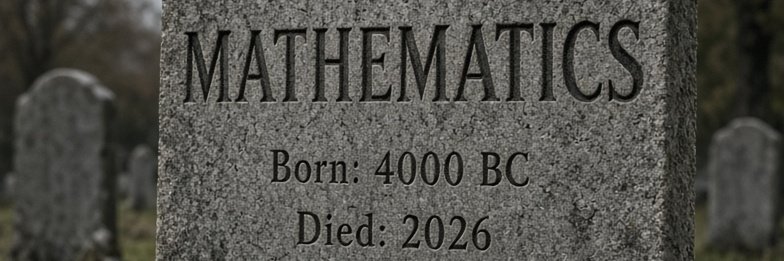
Mathematics as we know it ended in October 2026. We are the last mathematicians! The same transformation will occur to all of science in the next few years.
12/ Bottom line: a real step change in how much candidate mathematics can be produced. The bottleneck has moved from discovery to verification and understanding. Watch the next 1 to 2 years of checking, not the headline count. https://t.co/C8gPJJoVEu
11/ For students: maths is not finished. Intuition, understanding, and judging what is worth proving matter more, not less. Being able to read and check a proof becomes a core skill.
10/ What did not happen: none of the 722 papers offers a solution to a Millennium Prize problem. Headline claims in the catalogue stay claims until independent experts confirm them.
9/ Expect friction too. Many mathematicians objected to a 700-paper dump, to thin citation of earlier human work, and to the risk of being scooped. Those are fair complaints about process, not evidence that the results are wrong.
8/ Expect AI as a research assistant that tries thousands of problems overnight, more proofs shipped with machine-checkable versions, and new rules for credit and disclosure. OpenAI consulted an advisory group at the Institute for Advanced Study on exactly this.
7/ So the realistic near future: humans spend less time grinding out proofs and more time choosing good questions, checking claims, and explaining what results mean and why they matter.
6/ The hopeful part: 162 of the 722 papers (about 22%) have their main results written in Lean, a language where a computer checks every logical step. Machine-checked proofs are how verification could keep pace with AI output.
5/ Back-of-envelope: if refereeing took 20 expert-hours per paper (optimistic for hard results), 722 papers need about 14,000 hours. At 2,000 working hours a year, that is roughly 7 full-time expert-years. Writing proofs got cheap. Checking them did not.
4/ The catch: in maths, a claimed proof is not a proof until experts check it. None of these papers has been peer reviewed yet. Within a day OpenAI withdrew 3, after a sign error broke one proof and two papers that relied on it.
3/ For comparison, a productive mathematician publishes a handful of papers a year. 722 in a single day is not just faster maths. It is a different way of producing it.
2/ The scale: the model was pointed at roughly 4,000 open problems. 372 result families from about 4,000 attempts is a hit rate near 9%. Average cost per result: roughly 3 hours of ChatGPT Pro "thinking" time.
1/ On 6 Oct 2026, OpenAI posted 722 maths manuscripts on GitHub, written by an unreleased AI model. Together they claim new results on 372 problems. What does this mean for mathematics? A short, honest thread.