What's your favorite scary token? 📞 The killer is already inside the blockchain.
The burn machine is built and tested. 🔪
CA: PRE-LAUNCH — THE BLADE DROPS SOON
They all promise the same thing: "trust us, we won't rug."
$SLASHER doesn't ask for trust. It removes the need.
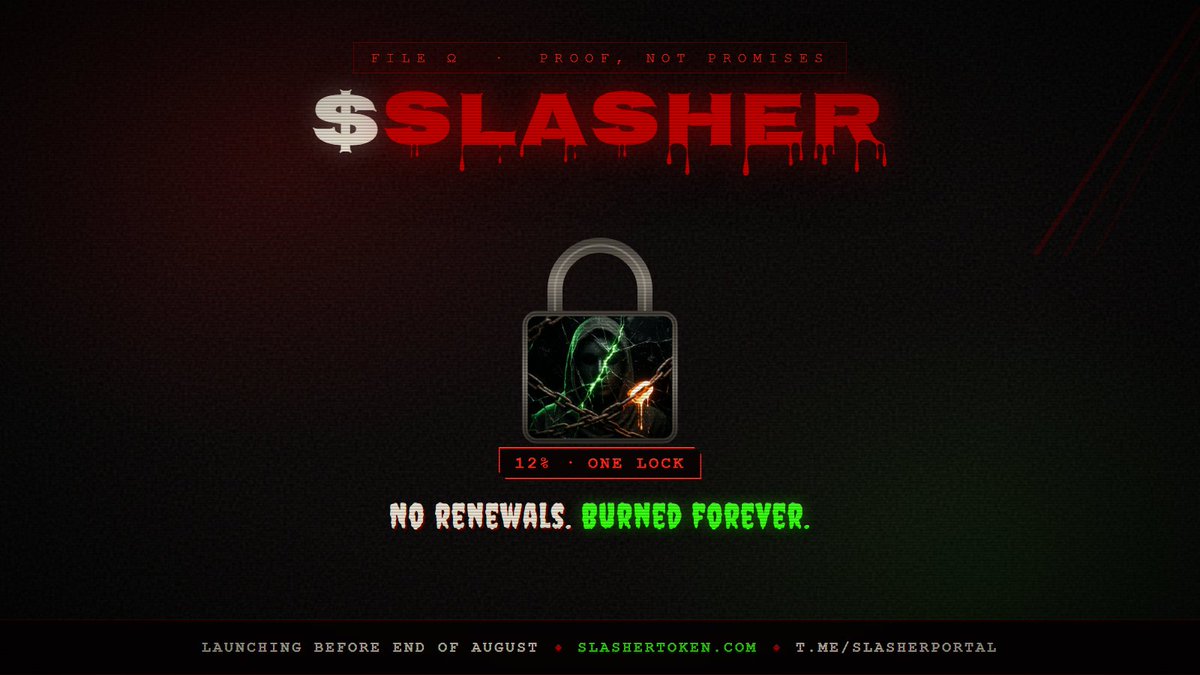
🔒 12% of supply (120M) locked at graduation — ONE fixed Streamflow schedule, no renewals, no discretion
🔥 Released in weekly tranches — every tranche burned, forever
⚙️ The wallet that creates the coin IS the treasury — 100% of our creator fees route straight to buybacks, burns & growth. Never a personal wallet.
♾️ When the vault runs dry, the fees keep the fire lit. The ritual doesn't end — it returns.
82% of supply is the public's, day one. We never touch it.
Launching before end of August. No CA exists yet — anyone selling you one right now is wearing our mask.
🌐 https://t.co/TwYfyiNOI8
💬 https://t.co/GCij8pLKdn
Turn on notifications. 🔪
Three days ago I posted about Solana confirmation timeouts and how to handle them safely.
Today I found I'd only gotten half of it right.
The rule I shipped: when a swap times out and you can't verify it on-chain, assume it landed. That prevents the duplicate-buy loop that cost me ~4 SOL.
It is correct. For buys.
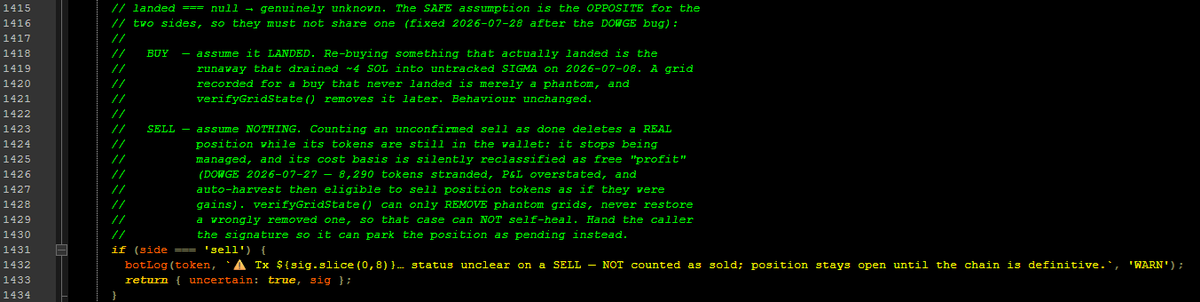
I had applied it to sells too. So a sell timed out, came back unverifiable, and the bot did exactly what I told it — assumed success, deleted the position from its grid, credited the profit.
The sell never landed. The tokens were still sitting in the wallet.
The position stopped being managed. Its cost basis got silently reclassified as free profit. And auto-harvest became eligible to sell those tokens as if they were gains.
The two ways of being wrong are not symmetric, and they invert depending on direction:
BUY assumed failed (but landed) → duplicate buy → drain
BUY assumed landed (but failed) → phantom position → verifier removes it
SELL assumed failed (but landed) → recoverable, visible
SELL assumed landed (but failed) → real position deleted, tokens stranded
That last one can't self-heal. My verifier only removes phantom positions. It has no way to put one back.
So the two sides now assume opposite things. Buys assume landed. Sells assume nothing — the position stays open, the signature is parked on it, and a resolver settles it once the chain is definitive: confirmed closes the position, reverted or never-landed reopens it for retry.
How I caught it: a number that didn't match. The app claimed 8,291 tokens of accumulated profit on a position that had earned 192. Every log line looked healthy. The bot had cheerfully written "SELL done."
The proof was the SOL balance — unchanged before and after. A sell that landed would have added 0.227 SOL. It hadn't moved a lamport.
The lesson isn't "handle your timeouts." It's that a rule which is obviously correct in one direction can be silently wrong in the other, and your code will keep reporting success the entire time.
Trust the balance, not the log.
My portfolio tracker showed the wrong total for three days.
Not wildly wrong. About 8% off. That's the dangerous kind — small enough to look right.
Two bugs. The second one is the interesting one.
1. A batched API call that silently returns partial data.
DexScreener has two token endpoints. The old one, /latest/dex/tokens/{addresses}, looks like a batch lookup. It isn't. It returns a flat list of pairs, capped at 30 — not per-token results.
So tokens with lots of liquidity pools eat the entire budget, and everything after them comes back empty. I measured it: 15 mints requested, 9 resolved, 6 missing entirely. HTTP 200 the whole way. No error, no warning, no partial-response flag. Just fewer tokens than I asked for.
The fix was the right endpoint, not more calls — /tokens/v1/{chain}/{addresses} is genuinely per-token. Same 15 mints, 15 resolved, and it returns the deepest pool, which is what I was hand-sorting for anyway.
2. My fallback invented data.
This one was mine. When a token failed to resolve, my code fell back to CoinMarketCap to fill the gap.
CoinMarketCap matches by symbol.
Tickers are not unique. There are a lot of tokens called SIGMA. So a holding quietly adopted an unrelated coin's price and market cap — and reported it with total confidence.
A mint address is unambiguous. A ticker is a guess. A symbol-matched quote can now only ever top up an on-chain price — fill in a missing market cap — never supply the price itself.
The actual lesson isn't either bug. It's that both failed silently.
A missing token contributed nothing and a wrong token contributed garbage, and neither looked like anything was broken. The total just quietly drifted.
So I added a loud warning for anything that can't be priced.
Then I found the warning was crying wolf — it was counting scam airdrops I'd already hidden, so it shouted about junk on every refresh. A warning you learn to ignore is worse than no warning, because you'll ignore the real one too. It now only fires for a token you can still see that has lost its price feed.
A wrong number that looks confident is worse than an obvious hole. If a data source can partially fail, make the gap loud — then make sure the gap is worth looking at.
🔪
@HorrorCarnival The Burning. Cropsy never says a word — he lets the garden shears do the talking. And that raft massacre is still the best kill sequence on this whole list.
FILE III · NOT TONIGHT
It came into the house the way cold comes in — without hurry, without sound, without troubling the door.
It stood at the foot of the bed a long time. You shut your eyes the way a child does and kept them shut, and the room filled with the smell of turned earth, and you understood exactly where it had been before it came to you.
You did not look. You have never been more certain of anything.
Then it turned, and went down the hall. You lay still and listened as it took what it came for in a room that was not yours.
You have spent every night since looking for the reason. Going back through your life for whatever made you worth skipping. Some kindness. Some reason. Anything.
There isn't one. It doesn't keep count; you do. It didn't weigh you and find you worthy, or weigh you and find you wanting. You were a stone in a field it was already crossing.
Nobody here is a survivor. We are the ones it stood over once and found no reason to finish.
The oldest woman in this town was visited as a girl. She is still waiting.
It takes one. It took one. You were not the one.
That is all that happened. That is the whole of it.
Not tonight is not a promise. It's a place in the line. 🔪
$SLASHER
A Solana confirmation timeout is not a failure. I learned that the expensive way — ~4 SOL, ~25 duplicate buys.
My bot read ERR_BLOCK_HEIGHT_EXCEEDED as "the swap didn't happen." execSwap returned null, doBuy concluded no position existed, and re-fired on the next tick. Every one of those buys had landed. It bought the same dip 25 times and recorded none of them.
What that error actually means: your blockhash expired while you were waiting. That's all. You already broadcast the tx — by the time the blockhash dies it has either been included or it never will be, and the error doesn't tell you which.
So stop trusting the timeout and ask the chain: getSignatureStatuses with searchTransactionHistory: true, polled a few times across both primary and fallback RPC. It's a read, so hitting the second endpoint carries none of the double-submit risk that keeps the send primary-only.
The part that matters is that it returns three states, not two:
true → landed, succeeded
false → landed, reverted (funds returned, safe to retry)
null → no endpoint gave a straight answer
Most implementations collapse that null into false. That's the bug — because the two ways of being wrong are wildly asymmetric:
Wrong "it failed" → duplicate buy → unbounded drain
Wrong "it landed" → phantom position → reconciled by the grid verifier within 15 minutes
So on uncertainty, assume it landed and let the reconciler clean up. Bias toward the recoverable mistake.
Two more that bit me separately:
confirmTransaction does NOT throw when a tx reverts on-chain. It resolves normally with value.err set. Check it explicitly, or you'll record positions for swaps that delivered nothing.
And confirm against the blockhash embedded in that transaction, not one you fetch after sending. A freshly-fetched blockhash/lastValidBlockHeight pair describes a later point on the chain — not your tx's real expiry.
None of this is exotic. It's the unglamorous part of making a bot that touches real money behave when the network doesn't.
Timeouts aren't failures. Ask the chain.
Nobody asks to see this part, so here it is.
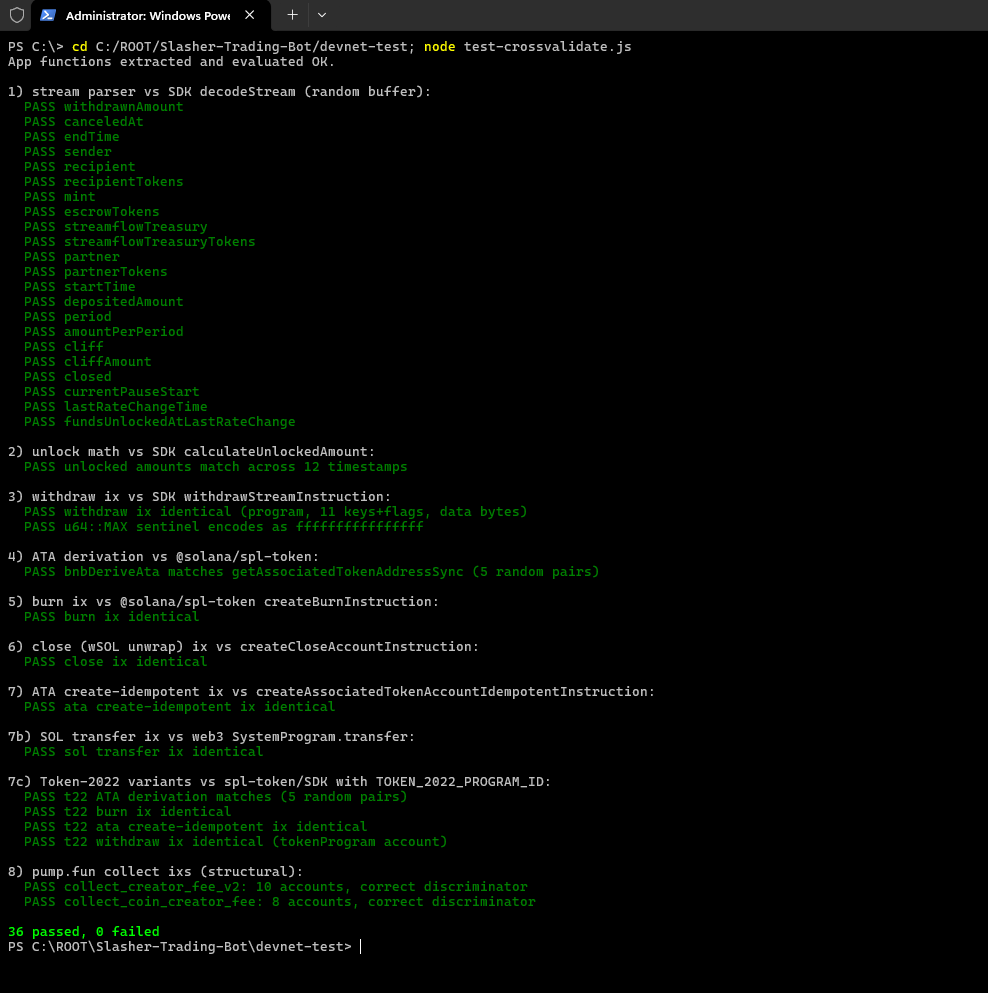
Before my burn bot is allowed to touch a single real token, every instruction it builds gets checked byte-for-byte against the official reference implementations — the exact code the underlying programs ship themselves. Not "looks right to me." Identical, or it fails.
Tonight: 36 checks. All 36 green.
The withdraw, the burn, the account layout, the Token-2022 path — all of it matched against the source of truth before it's ever pointed at mainnet.
This is the boring, paranoid, no-shortcuts part nobody films for a hype reel. It's also the whole difference between "trust me" and "check it yourself."
I'd rather spend a night on a test suite than a launch day on an apology. 🔪
$SLASHER
FILE II · THE FIRE
There is a light on the hill that has never gone out — not once, in longer than this town has had a name.
Farmers used to steer by it. Now they keep their eyes down.
Something feeds it. Every night, without hurry, it drags what it took up that hill and gives it to the fire, and the fire takes it the way it takes everything: completely, and without a sound.
Nobody has ever found ashes. No pile, no scorched ground, no bone, no tooth. Whatever goes into that fire doesn't come out as anything at all. It simply stops having ever been.
The old men said it could be smothered. They tried it once — a hundred of them, a hundred buckets, in the wet dark of an autumn night.
They found some of the buckets.
The fire was higher in the morning.
Nobody climbs the hill now. They watch the glow through the trees and count the nights it burns, which is all of them, which is every night there has ever been.
It does not need wood. It has never needed wood.
It needs what it takes. It takes something every night.
And the fire has never once gone out. 🔪
$SLASHER
https://t.co/pH46e8oDuL just made buyback-and-burn standard — 5 minutes of it, once, when a coin graduates.
Good instinct. We just took it further.
$SLASHER is built to burn on a schedule no one can stop:
🔥 the treasury's supply unlocks weekly and burns — every week, for two years
🔥 100% of creator fees feed buybacks, burns, and growth — never a personal wallet
🔥 and the machine that does it already ran its first burns in public — on devnet, before the coin even exists. receipts are up.
The launchpad burns for five minutes at the door.
Ours doesn't know how to stop.
No contract yet — launching before end of August. 🔪
https://t.co/TwYfyiNOI8
It cannot be reasoned with. The desperate have knelt before it, offering everything they had and everything they'd ever get. It has no use for everything.
It cannot be outrun. The fast ones only die tired — warm and open in the grass, while it covers the last of the distance at its own unhurried pace.
It cannot be hurt. Bury the blade to the handle and it simply turns to look at you — your arm shaking, your knuckles wet — patient, as though you've done nothing at all. You haven't.
It is old. Older than the word the first man screamed for it. It walked before the first fire was lit, and it has worn out every century since. It is not finished with this one.
Every night, it takes one. Every night, one fewer shape at the door, one less breath in the dark. You stop keeping count — counting only tells you how close it's come to you.
They swore they killed it. Buried it deep, burned what was left, salted the ground, and went home to sleep in the new quiet.
By morning it stood in the hall, the grave-dirt still on its hands. It had not hurried.
It does not tire. It does not finish. It was never given a way to stop — and it has never once gone looking for one. 🔪
$SLASHER
Every rug has the same final scene: the dev's wallet, unlocked, dumping on the people who believed.
So I wrote myself out of the script. 🔪
At graduation, my entire founder allocation — 40,000,000 $SLASHER, 4% of supply — goes into a Streamflow lock:
🔒 12 months. Weekly drip. Linear. One fixed schedule.
🔒 No renewals. No early exit. No exceptions — the contract doesn't know how to make them.
🔒 One public address. Watch it on Solscan any hour of any night.
Do the math on my worst case: ~769,000 tokens unlock per week. That's 0.077% of supply. If I turned full villain, that's the maximum damage I could do in any given week — and you'd see every move on-chain before it mattered.
The only version of me that gets paid is the one still here a year from now. That's not a promise. That's the design. ⚙️
I can't rug you. Not "won't." Can't. The blade only swings on schedule. 🩸
The lock link gets posted here the day it exists. Screenshot this and hold me to it.
https://t.co/TwYfyiNOI8
Most projects launch first, then promise to build the burn machine.
We built the machine first.
Then we let it taste blood. 🩸
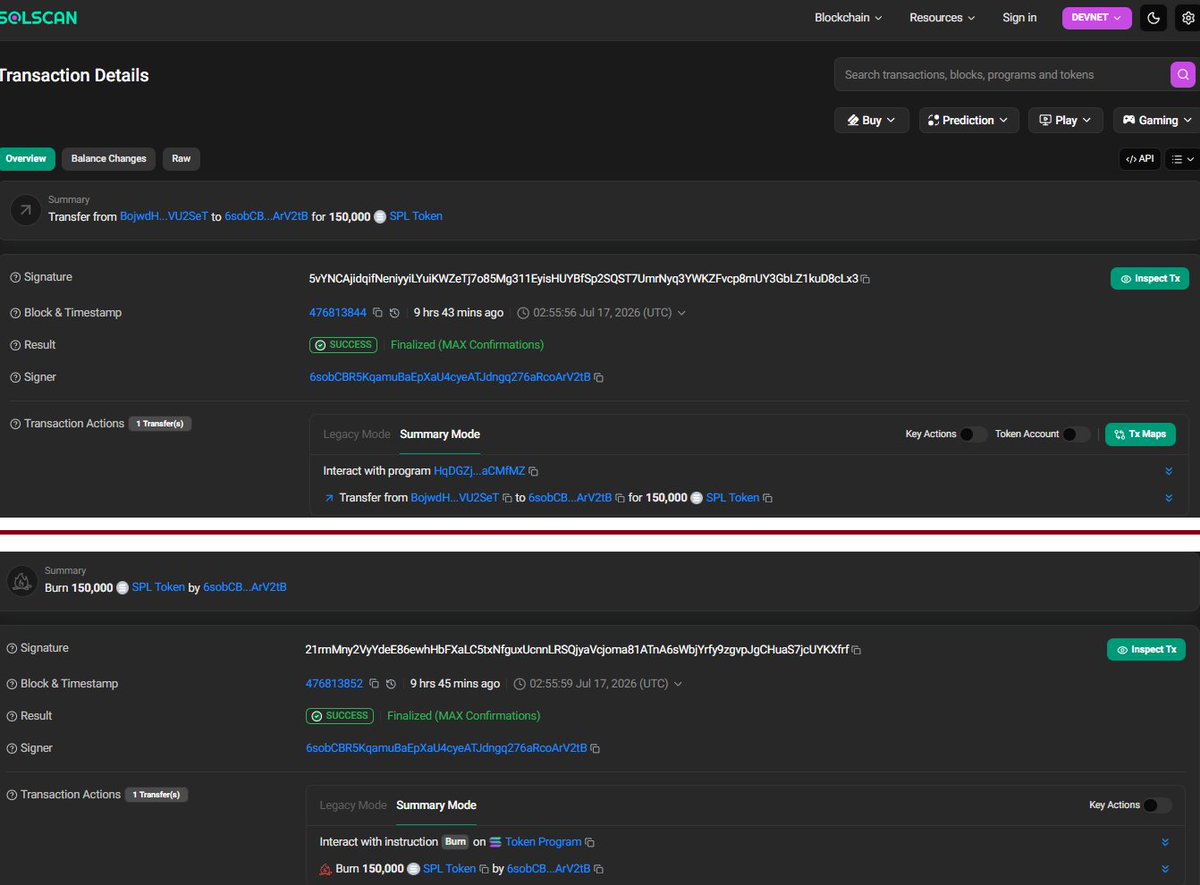
Last night's rehearsal, on Solana devnet:
🪓 It read a locked vault's unlock schedule. On its own.
🪓 It withdrew the unlocked tranche — 150,000 test tokens.
🪓 It burned every single one. Supply: 10,000,000 → 9,850,000. Gone forever.
No human pressed the button. That's the point. The machine cannot sell, cannot skim, cannot forget. It can only feed. ⚙️🔥
Autopsy report (public, on-chain, check it yourself):
Withdraw: https://t.co/9fdvyaeFFS
Burn: https://t.co/YLnKiLq28C
The moment we graduate, it starts doing this to OUR treasury. Every week. For two years. In public.
The blade was sharp before the victim arrived. 🔪
https://t.co/TwYfyiNOI8