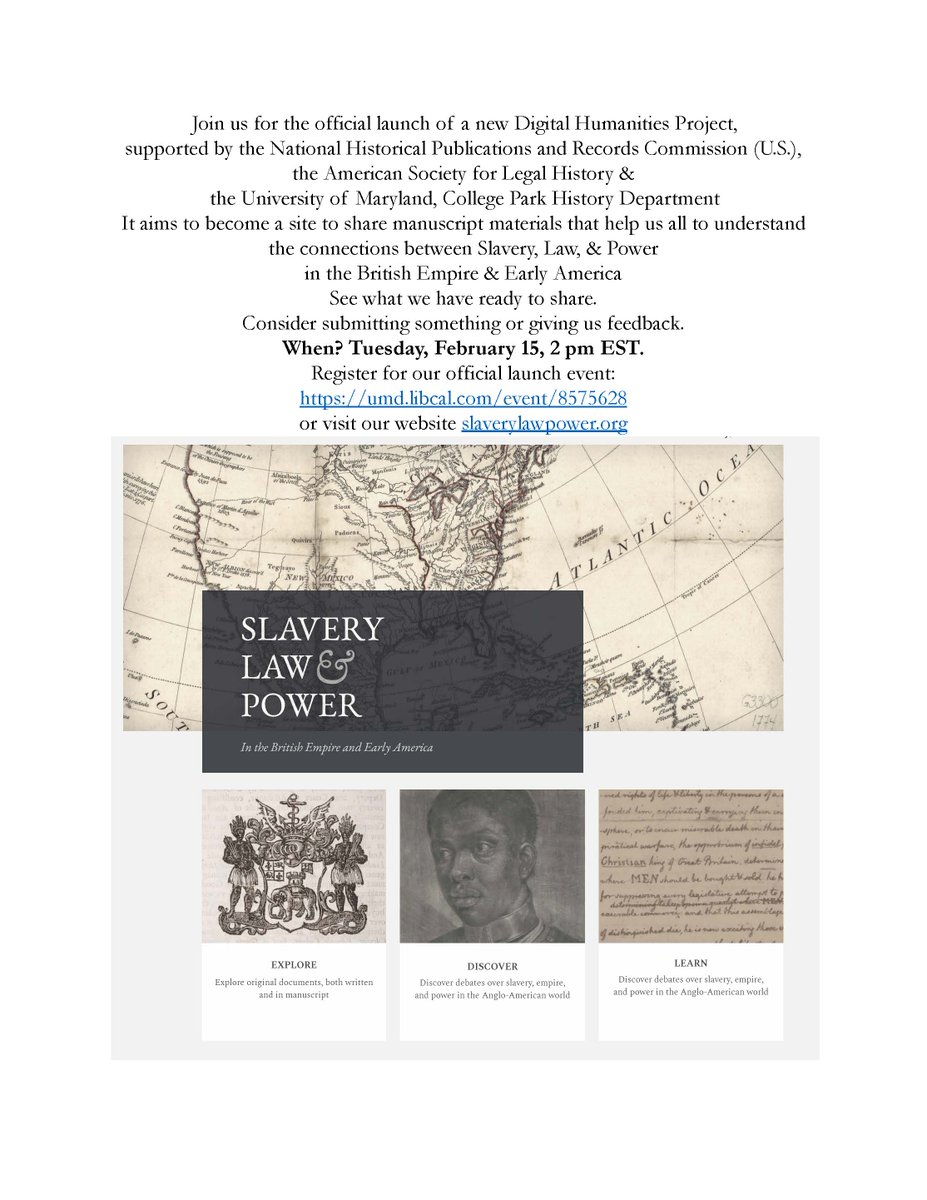
Join us for our official launch! Next Tuesday, Feb. 15th at 2pm EST. Learn about our project and how you can be a part of it! Register here: https://t.co/pIj6FIcFfs
Even as North American colonists fought for their independence, George III exchanged letters with his prime minister Lord North about a potential attack to seize the French slave-trading fort at Gorée. https://t.co/38QA1iTDwg
Historians? Do you have an interesting primary source document that speaks to debates over slavery, law, and imperial power? We’d love your suggestions on what to include as we continue to build our site:
https://t.co/Ke7rjWVWjH
A project like ours depends on a full and capable team. Learn more about the incredible folks who work with the Slavery, Law & Power project here: https://t.co/vcnnJpbHxy
Thomas Corwin’s proposed amendment was a last ditch effort to fend off the US Civil War. It would have barred Congress from interfering or abolishing “the domestic institutions” of the states - code words for slavery. https://t.co/Y7tcxjZoSU
State-granted monopolies, not just the free market, were key to England’s early dominance in the slave trade. Queen Anne granted the Spanish Asiento, a right to supply the Spanish empire with slaves, to her favorite monopoly, the new South Sea Company. https://t.co/2d9KohdRXL
In the aftermath of the Glorious Revolution, many Restoration era legal precedents received new scrutiny. In 1696, Chamberlain v. Harvey overturned the legalization of slavery in England… although its duration was short lived. https://t.co/g6AuO4Efsq
After the Duke of Monmouth’s rebellion against the Crown failed, Chief Justice Lord Jeffereys exercised swift, severe, and arbitrary judgment against them at James II’s orders. https://t.co/CrsfoPA8Ox
The English Bill of Rights underscore Parliament’s remaining worries about arbitrary and absolute monarchical rule after the Glorious Revolution. https://t.co/l2YwUUC2pD
On trial for treason after the Rye House Plot, Algernon Sidney’s unpublished manuscript served as key evidence against him. His Discourses criticized absolute monarchy & slavery. https://t.co/uNMA7nO7MY
Sir Thomas Grantham’s letters, describing his response to Bacon’s Rebellion as a member of the Royal Navy, remind us of the long reach of imperial power over colonial discontent and revolt. https://t.co/9pCiNpeUKg
Under Charles II, political prisoners increasingly faced lengthy imprisonment and denial of due process. The 1679 Habeas Corpus act emerged as Parliament’s response, to enshrine the habeas corpus. https://t.co/luD5Iw2yXp
King Charles II’s Council on Foreign Plantations regularly wrote colonial officials to gather information. What do their 1671 questions to Virginia Gov Berkeley - and his responses - tell us about their concerns? https://t.co/g0w8wUjbLF
Jamaica’s 1664 slave code, like Barbados’s 1661 code, came at a time where the restored monarchy and its supporters aimed to craft a colonial labor & economic system that would increase royal power & coffers. https://t.co/dlPUd2ZqtC
In March 1649, about 3 months after the execution of Charles I, Parliament abolished the kingly office, claiming it had been used to “oppress and impoverish and enslave the subject.” https://t.co/Z0oEoxAm94
Robert Heath led Star Chamber prosecutions against many who challenged Charles I’s authority. As a reward, he received this charter, stretching from what’s now N & S Carolina and Georgia east to the Pacific Ocean. https://t.co/fcXKNLvV2I
Explore and learn from the historical debate over slavery, law, and power on our website https://t.co/ED4fgpQQPK. View scholarly introductions, original transcriptions, and interactive timelines from the 17th and and 18th centuries.
St. George Tucker set out to gradually abolish slavery in Virginia in the decades after the American Revolution. While this act failed to pass, the fact that the act was debated in Virginia’s House of Delegates in 1796... (cont.)