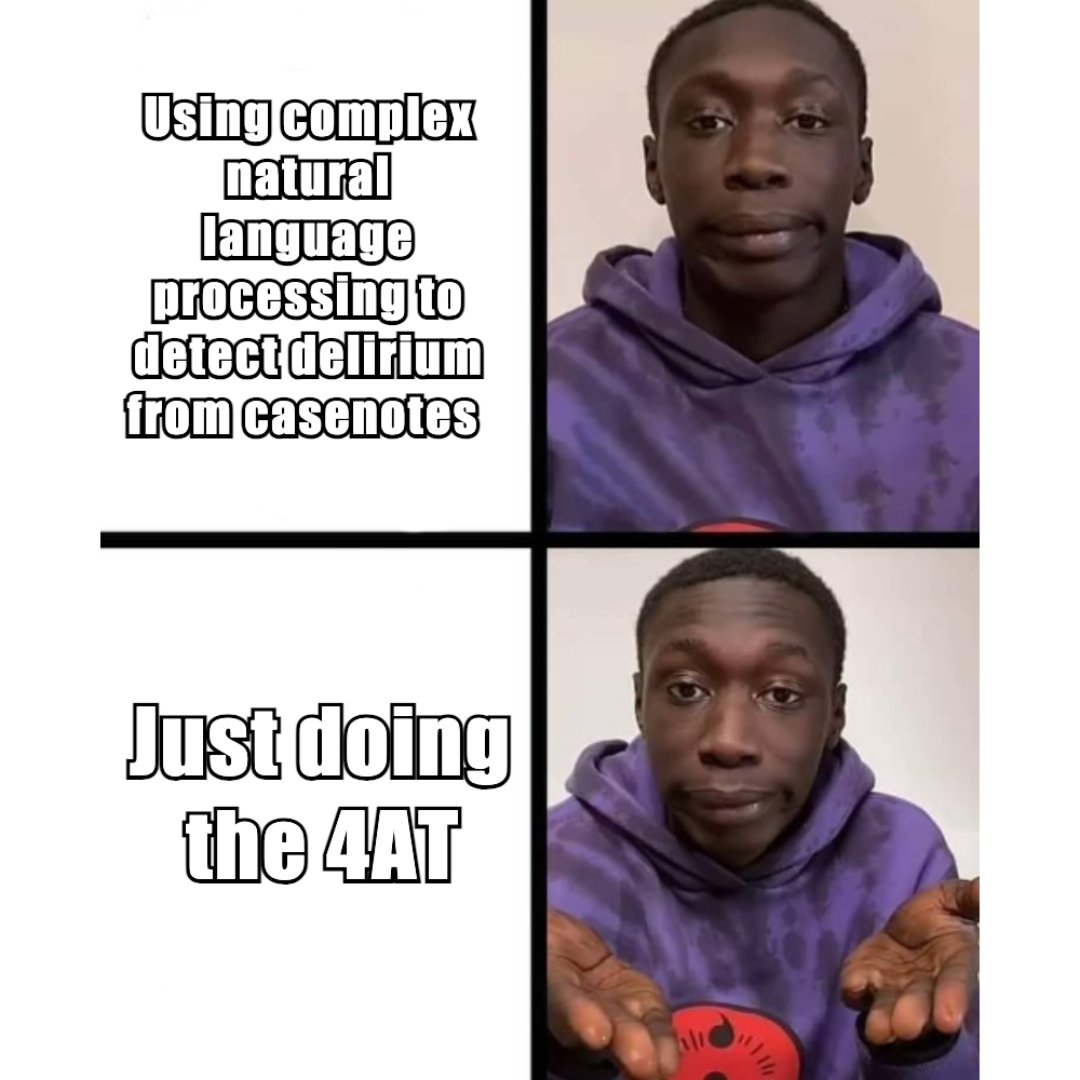
Why are we building complex AI systems to detect delirium from casenotes when we could just... do a 2-minute bedside test?
The 4AT exists.
It's well-validated (33 studies).
It's free.
Sometimes clinical medicine doesn't need machine learning.
#delirium
📣 Rare diseases affect 300–400M people globally, yet 95% lack treatments.
Our new publication calls for urgent global action and a Rare Disease Preparedness Roadmap inspired by COVID-19 lessons.
🖇️Read more: https://t.co/pkDsktlB0B
#RareDiseases
"Functioning needs to be incorporated as a health metric alongside survival and morbidity." 🚨 Powerful insights from Dr. Colleen O'Connell's Sidney Licht Lecture on Public Health Emergencies at #ISPRM2026! We must step up and advocate for rehabilitation in disaster response! 🌍
Expert's Dilemma: the more specialized you become, the less open you are to creative solutions from other fields. But the more you explore other fields, the more you risk losing credibility in your home field.
(Night Science recap, Day 3)
Compelling evidence that if clinical trialists interested in the impact of treatment on health-related #qualityoflife include only generic measures and fail to include responsive and valid disease-specific measures in their #RCTs, they risk missing the crucial signal.
https://t.co/8cpTbUv0gv
💬 Viewpoint: Reframing physician care as a shared professional responsibility could reduce latent-error environments and reinforce ethical standards, making clinician well-being part of routine governance and departmental objectives.
https://t.co/Me0OEHRUso
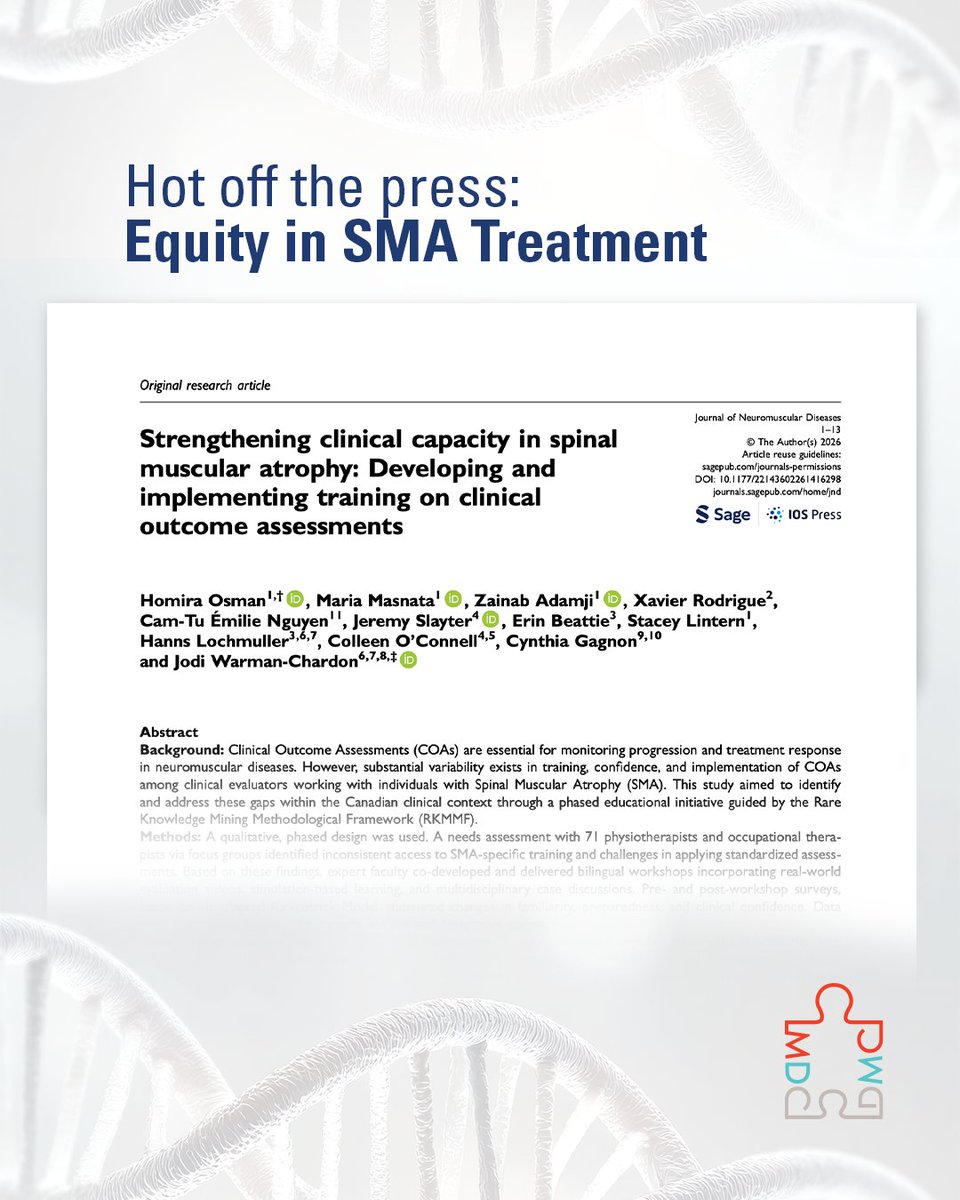
We are excited to share that our new research paper - 'Strengthening clinical capacity in spinal muscular atrophy: Developing and implementing training on clinical outcome assessments' - was published today. It reflects an important step forward for Muscular Dystrophy Canada (MDC) and the neuromuscular community.
Read the full paper here:
https://t.co/Z6ywyxlPam
Why is this paper important, and why does it matter?
For people living with spinal muscular atrophy, access to treatment is not only about whether therapies exist. It also depends on whether trained clinicians are available to carry out specialized motor function assessments. Governments require these assessments to approve, continue, and monitor treatment coverage. When clinics lack trained evaluators, people can face delays or even lose access to care, even when treatments are available.
To address this barrier, MDC took a long-term, capacity-building approach. We designed and delivered hands-on clinical training workshops in Quebec, offered in both English and French. These sessions helped build and standardize clinical expertise, reduced bottlenecks in the system, and supported more equitable access to treatment, especially for people outside major urban centres.
This work also sends a broader message. Access to treatment requires more than funding a drug. It requires investment in training, clinical tools, and ongoing support within the healthcare system. This publication highlights MDC’s role as more than an advocate or funder. It shows how we respond to immediate needs while also working toward lasting system-level change that benefits the entire neuromuscular community.
To learn about all our research initiatives, visit - https://t.co/TlU0Pb92k3
Building clinical capacity of neuromuscular care across Canada is important. This new study outlines the development process of Train(e)d, a national platform by @MD_Canada & @NMD4Canada to expand knowledge of SMA clinical assessments nationally. https://t.co/nn1L9GXfUV
Happy to have another paper recently released in @MuscleAndNerve examining two bulbar performance measures for adults with SMA. MPT performed adequately but was not overly sensitive @ 12 months. S/Z did not show strong validity. https://t.co/YPupxMnRSA
We're happy to have finally released this exploratory single-site study examining core clinical measures in adults with SMA. Only two clusters of information are being tapped by the SMART, suggesting more research is needed. @JournalCJNS@DalMedSchool
https://t.co/OIyTCjStwM
Brian Haynes, PJ Devereux and I present the rationale behind the third key principle of #EBM: evidence alone never is sufficient for decisions, #patient values and preferences always crucial. Or as this #BMJ article put it, evidence doesn’t make decisions, people do.
https://t.co/t1ipeVYdO9
POTW 17: Throwback Thursday - "The Art of Doing Nothing" by Iona Heath presents an argument for slowing down, listening, thinking, and waiting to improve patient care and clinical decision-making in a world constantly speeding up. https://t.co/ENJCLqELyk
Hot off the Press - An updated Canadian consensus toolkit of recommended outcome measures for adults with #SMA. This work fulfills the promise we first made in 2021 to review our original recommendations as new evidence becomes available. #NMD@journal_nd https://t.co/g3NsGLM8X7
POTW17: Bendahan et al. released in @JAMANeuro. The authors completed a thorough independent analysis of a subset of cases of a potentially new syndrome in NB. They concluded that there was no evidence to support a new syndrome or disease. https://t.co/zPcr8F0Jhm
POTW 16: El-Kaim et al., published in @journal_nd outlines a model for predicting 6MWT in Pompe Disease. A great effort to improve measurement strategies among individuals with neuromuscular disease.
https://t.co/soHQrzFWFB
POTW 15: Antisense RNA Therapies for inherited myopathies published in @journal_nd by @oligogirl and others. Great overview of the current state and their potential. https://t.co/kMwmCFyMoO
POTW 14: Measuring HRQoL among patients with ALS. https://t.co/LMXIHl2bex McDool et al. from @sheffielduni published in @GreenJournal did a great job identifying and mapping PROMs to domains of HRQoL. Over 100 tools were used for 42 subdomains.