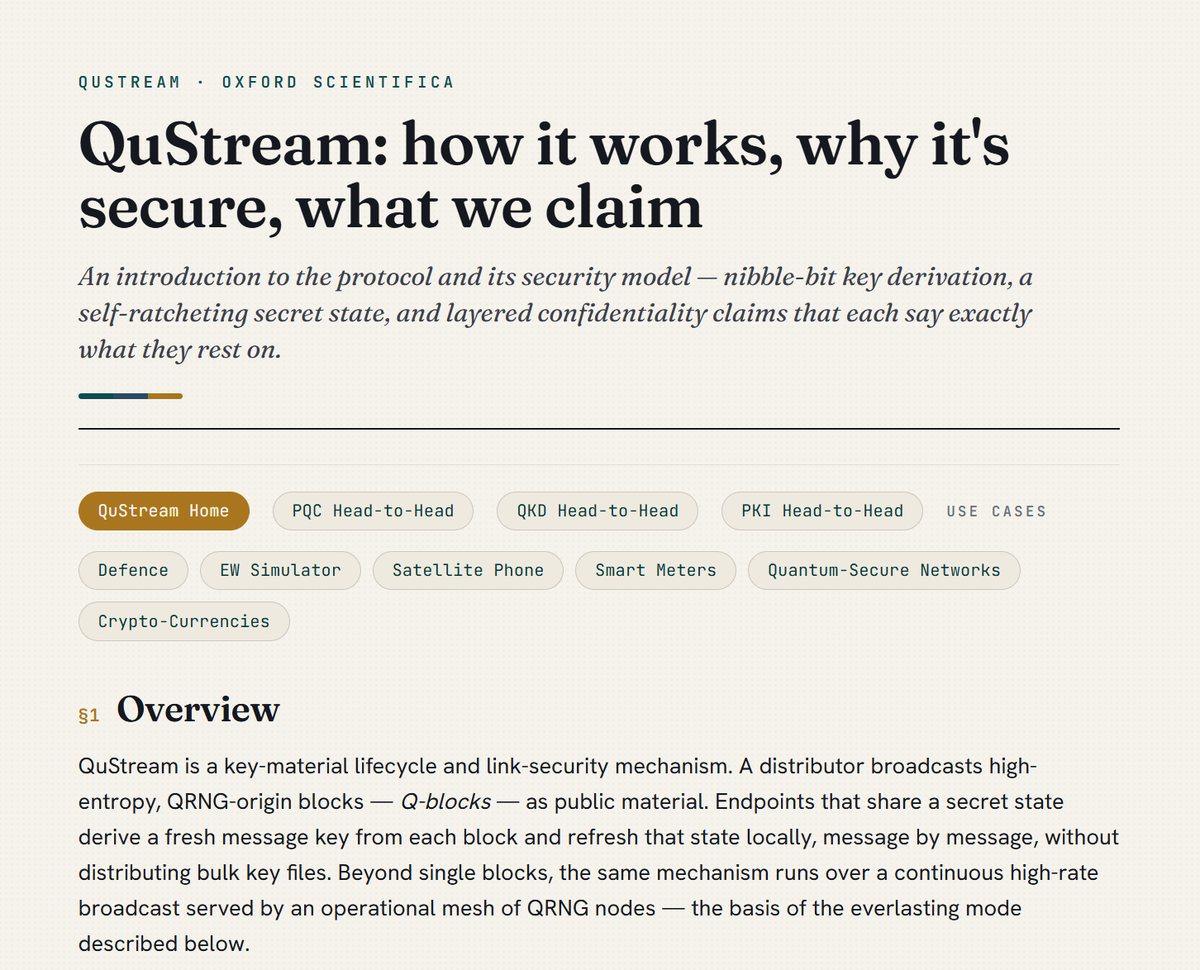
If you ever wanted to DYOR on Qustream @qu_stream but haven't done so yet, this is a good time to look into it. It covers multiple in-depth applications for the technology in great detail. If any of those topics interest you, they are all worth reading through.
https://t.co/n4P9H3mGse
@hefffff solana:AUuCEHQ7sm2i5GmaHrpE961voWcTY8U6mgrkhcV7pump has the Web2 revenue that is going to be pumping in that helps it survive a bear.
https://t.co/t5AKyNVVIU
I asked SuperGrok to look at all of the recent developments around solana:AUuCEHQ7sm2i5GmaHrpE961voWcTY8U6mgrkhcV7pump @qu_stream and estimate the appropriate Market Cap.
Looks like we're in agreement, underpriced significantly for what it is and has validation for.
Prompt and full response provided here:
https://t.co/kUaw3I58VY
@DamianProsa You have to be able to look at the whole picture to see solana:AUuCEHQ7sm2i5GmaHrpE961voWcTY8U6mgrkhcV7pump for what it is and will be. But the potential is huge.
https://t.co/t5AKyNVVIU
I asked SuperGrok to look at all of the recent developments around solana:AUuCEHQ7sm2i5GmaHrpE961voWcTY8U6mgrkhcV7pump @qu_stream and estimate the appropriate Market Cap.
Looks like we're in agreement, underpriced significantly for what it is and has validation for.
Prompt and full response provided here:
https://t.co/kUaw3I58VY
$QST looks like a generational bottom to me
not for long, imo
AI had its party already
quantum security is next, and @qu_stream is one of the few projects with real enterprise-level signal behind it
Nokia. Capgemini. live demos. actual product.
this is the kind of chart people only notice after it reverses
think about it
A Q-Block is not the secret.
It is public quantum-random material.
The secret is the path through it.
QuStream endpoints use shared private state to walk that material and derive fresh keys locally.
Everyone can see the noise.
Only the endpoints know the route.
I feel like solana:AUuCEHQ7sm2i5GmaHrpE961voWcTY8U6mgrkhcV7pump is undervalued currently, and upon inspection so does SuperGrok.
The potential of what they have tech-wise is unreal one it gets adoption at scale, but even now the level of validation supports a higher floor MC.
https://t.co/NVYbQJRT2k
I asked SuperGrok to look at all of the recent developments around solana:AUuCEHQ7sm2i5GmaHrpE961voWcTY8U6mgrkhcV7pump @qu_stream and estimate the appropriate Market Cap.
Looks like we're in agreement, underpriced significantly for what it is and has validation for.
Prompt and full response provided here:
https://t.co/kUaw3I58VY
@CryptoThannos Is your project founder speaking at NATO events to secure their drone communications against enemy signal jamming? QuStream's just did.
$QST @qu_stream
@kingboydarling solana:AUuCEHQ7sm2i5GmaHrpE961voWcTY8U6mgrkhcV7pump is undervalued, in my opinion (and apparently also SuperGrok's), but already making some moves.
https://t.co/t5AKyNVVIU
I asked SuperGrok to look at all of the recent developments around solana:AUuCEHQ7sm2i5GmaHrpE961voWcTY8U6mgrkhcV7pump @qu_stream and estimate the appropriate Market Cap.
Looks like we're in agreement, underpriced significantly for what it is and has validation for.
Prompt and full response provided here:
https://t.co/kUaw3I58VY
@AgencyLaser I feel like solana:AUuCEHQ7sm2i5GmaHrpE961voWcTY8U6mgrkhcV7pump is still severely undervalued, and it seems like SuperGrok agrees with me.
https://t.co/t5AKyNVVIU
I asked SuperGrok to look at all of the recent developments around solana:AUuCEHQ7sm2i5GmaHrpE961voWcTY8U6mgrkhcV7pump @qu_stream and estimate the appropriate Market Cap.
Looks like we're in agreement, underpriced significantly for what it is and has validation for.
Prompt and full response provided here:
https://t.co/kUaw3I58VY
I asked SuperGrok to look at all of the recent developments around solana:AUuCEHQ7sm2i5GmaHrpE961voWcTY8U6mgrkhcV7pump @qu_stream and estimate the appropriate Market Cap.
Looks like we're in agreement, underpriced significantly for what it is and has validation for.
Prompt and full response provided here:
https://t.co/kUaw3I58VY
solana:AUuCEHQ7sm2i5GmaHrpE961voWcTY8U6mgrkhcV7pump is the definition of the alpha play right now, having just presented to NATO (yes, despite only a MC of ~$ 3.2m) yesterday.
What comes next isn't priced in yet, but I for one am planning to ride the wave.
https://t.co/3IUx1dbtF0
@MagicDegenSOL Considering some of the activity on solana:AUuCEHQ7sm2i5GmaHrpE961voWcTY8U6mgrkhcV7pump since the NATO conference presentation yesterday? Well, I'd say it's got something brewing.
https://t.co/pptiofy5cY
Today, Adrian Neal is presenting QSDP (QuStream Defence Protocol) at the NMIOTC NATO conference in Crete.
The data: every major encryption approach run through the same combined attack profile (packet loss, bit errors, burst jamming, reordering applied together). The kind of contested environment Western drones are actually losing C2 in.
QSDP holds command authority across the sweep. ML-KEM, the NIST #PQC standard, delivers 0% because its handshake can't complete under packet loss. AES-GCM degrades to near-zero. ECDH dies. QSDP is the only line that stays up.
The threat model isn't theoretical. Zhitel, Pole-21, and Krasukha are actual Russian EW systems currently operating in Ukraine. Western tactical encryption breaks against them. Post-quantum encryption doesn't help if the handshake never completes.
The audience today: military officers and procurement from NATO maritime command, JFCNF, and member-state defense bodies. They're not in the room because quantum computers might exist sometime between 2029-2035. They're in the room because drone warfare is the present, signal denial is operational reality, and resilient communications during contested operations is something they need answers for this year.
Explore the data yourself: https://t.co/miNlJqoMJc
Project market cap: $ 2.74m.
Following yesterday's NMIOTC content with the adjacent use case.
The architectural property that makes QSDP (QuStream Defense Protocol) hold command authority through Russian EW jamming is the same property that makes QSSP (QuStream Satellite Protocol) keep satellite calls connected through poor signal.
No handshake to break. Single-use keys derived locally instead of negotiated across the link. Calls that connect on the first scrap of signal, hold through dropouts, and deliver where current phones show "no service."
Viasat. Inmarsat. Thuraya. Iridium. Starlink Direct-to-Cell. Pass-through and regenerative satellite networks, made resilient at the software layer only. No new satellites, no hardware refresh.
The defense case is dramatic. The satellite phone case is commercially scalable. Same technology, two operational gaps.
https://t.co/JdBBfw4Jah
@torogems solana:AUuCEHQ7sm2i5GmaHrpE961voWcTY8U6mgrkhcV7pump is the definition of a long-term play, while still being an alpha play currently. Long-story short, encryption that is both more secure and more resilient to jamming presented to NATO today.
https://t.co/pptiofy5cY
Today, Adrian Neal is presenting QSDP (QuStream Defence Protocol) at the NMIOTC NATO conference in Crete.
The data: every major encryption approach run through the same combined attack profile (packet loss, bit errors, burst jamming, reordering applied together). The kind of contested environment Western drones are actually losing C2 in.
QSDP holds command authority across the sweep. ML-KEM, the NIST #PQC standard, delivers 0% because its handshake can't complete under packet loss. AES-GCM degrades to near-zero. ECDH dies. QSDP is the only line that stays up.
The threat model isn't theoretical. Zhitel, Pole-21, and Krasukha are actual Russian EW systems currently operating in Ukraine. Western tactical encryption breaks against them. Post-quantum encryption doesn't help if the handshake never completes.
The audience today: military officers and procurement from NATO maritime command, JFCNF, and member-state defense bodies. They're not in the room because quantum computers might exist sometime between 2029-2035. They're in the room because drone warfare is the present, signal denial is operational reality, and resilient communications during contested operations is something they need answers for this year.
Explore the data yourself: https://t.co/miNlJqoMJc
Project market cap: $ 2.74m.
The project is different than your average one, as it is a legitimate encryption advancement that is fair-launched rather than VC funded. You can do analysis on the information surfaced on the QuStream research site (https://t.co/OHxzHfvu1d) and see that it is not just hype.
The tokenomics are well-explained and surfaced on their more crypto-currency focused site (https://t.co/EYm9iWX1F6) as well as on @qu_stream account (https://t.co/dyAXR98AVU).
But there is a very straightforward team locked token supply that is actively vesting every 2 weeks through 2029 (https://t.co/I5v9dZykw2)
Happy to discuss it further, if you have questions.
Today, Adrian Neal is presenting QSDP (QuStream Defence Protocol) at the NMIOTC NATO conference in Crete.
The data: every major encryption approach run through the same combined attack profile (packet loss, bit errors, burst jamming, reordering applied together). The kind of contested environment Western drones are actually losing C2 in.
QSDP holds command authority across the sweep. ML-KEM, the NIST #PQC standard, delivers 0% because its handshake can't complete under packet loss. AES-GCM degrades to near-zero. ECDH dies. QSDP is the only line that stays up.
The threat model isn't theoretical. Zhitel, Pole-21, and Krasukha are actual Russian EW systems currently operating in Ukraine. Western tactical encryption breaks against them. Post-quantum encryption doesn't help if the handshake never completes.
The audience today: military officers and procurement from NATO maritime command, JFCNF, and member-state defense bodies. They're not in the room because quantum computers might exist sometime between 2029-2035. They're in the room because drone warfare is the present, signal denial is operational reality, and resilient communications during contested operations is something they need answers for this year.
Explore the data yourself: https://t.co/miNlJqoMJc
Project market cap: $ 2.74m.
Today, Adrian Neal is presenting QSDP (QuStream Defence Protocol) at the NMIOTC NATO conference in Crete.
The data: every major encryption approach run through the same combined attack profile (packet loss, bit errors, burst jamming, reordering applied together). The kind of contested environment Western drones are actually losing C2 in.
QSDP holds command authority across the sweep. ML-KEM, the NIST #PQC standard, delivers 0% because its handshake can't complete under packet loss. AES-GCM degrades to near-zero. ECDH dies. QSDP is the only line that stays up.
The threat model isn't theoretical. Zhitel, Pole-21, and Krasukha are actual Russian EW systems currently operating in Ukraine. Western tactical encryption breaks against them. Post-quantum encryption doesn't help if the handshake never completes.
The audience today: military officers and procurement from NATO maritime command, JFCNF, and member-state defense bodies. They're not in the room because quantum computers might exist sometime between 2029-2035. They're in the room because drone warfare is the present, signal denial is operational reality, and resilient communications during contested operations is something they need answers for this year.
Explore the data yourself: https://t.co/miNlJqoMJc
Project market cap: $ 2.74m.
Today, Adrian Neal is presenting QSDP (QuStream Defence Protocol) at the NMIOTC NATO conference in Crete.
The data: every major encryption approach run through the same combined attack profile (packet loss, bit errors, burst jamming, reordering applied together). The kind of contested environment Western drones are actually losing C2 in.
QSDP holds command authority across the sweep. ML-KEM, the NIST #PQC standard, delivers 0% because its handshake can't complete under packet loss. AES-GCM degrades to near-zero. ECDH dies. QSDP is the only line that stays up.
The threat model isn't theoretical. Zhitel, Pole-21, and Krasukha are actual Russian EW systems currently operating in Ukraine. Western tactical encryption breaks against them. Post-quantum encryption doesn't help if the handshake never completes.
The audience today: military officers and procurement from NATO maritime command, JFCNF, and member-state defense bodies. They're not in the room because quantum computers might exist sometime between 2029-2035. They're in the room because drone warfare is the present, signal denial is operational reality, and resilient communications during contested operations is something they need answers for this year.
Explore the data yourself: https://t.co/miNlJqoMJc
Project market cap: $ 2.74m.
@ripper0x The best way to be around in 10+ years is to be the best at something that will always be needed.
Enter @qu_stream $QST.
https://t.co/pptiofy5cY
Today, Adrian Neal is presenting QSDP (QuStream Defence Protocol) at the NMIOTC NATO conference in Crete.
The data: every major encryption approach run through the same combined attack profile (packet loss, bit errors, burst jamming, reordering applied together). The kind of contested environment Western drones are actually losing C2 in.
QSDP holds command authority across the sweep. ML-KEM, the NIST #PQC standard, delivers 0% because its handshake can't complete under packet loss. AES-GCM degrades to near-zero. ECDH dies. QSDP is the only line that stays up.
The threat model isn't theoretical. Zhitel, Pole-21, and Krasukha are actual Russian EW systems currently operating in Ukraine. Western tactical encryption breaks against them. Post-quantum encryption doesn't help if the handshake never completes.
The audience today: military officers and procurement from NATO maritime command, JFCNF, and member-state defense bodies. They're not in the room because quantum computers might exist sometime between 2029-2035. They're in the room because drone warfare is the present, signal denial is operational reality, and resilient communications during contested operations is something they need answers for this year.
Explore the data yourself: https://t.co/miNlJqoMJc
Project market cap: $ 2.74m.