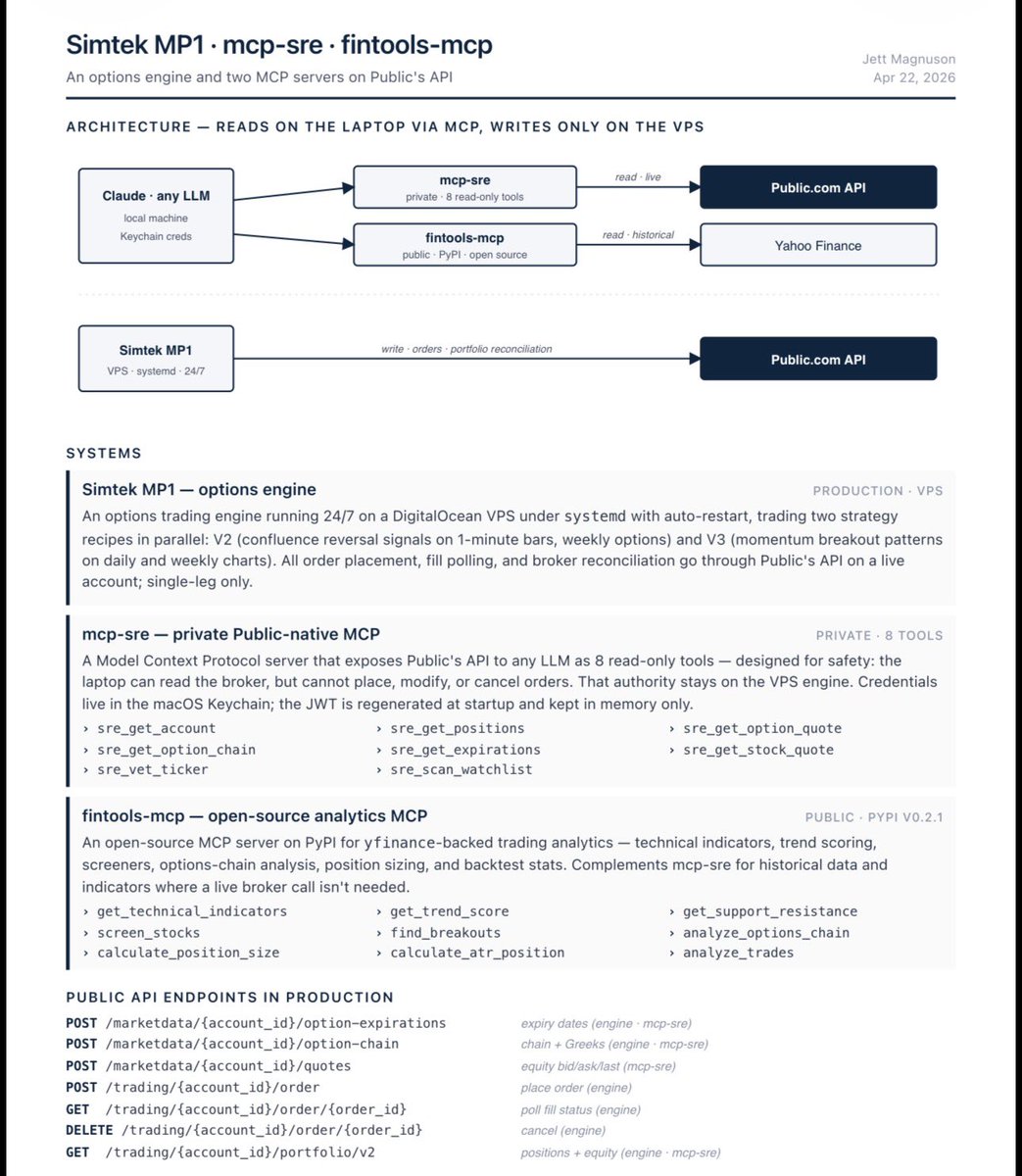
I built SIMTEK MP1: an autonomous, risk gated options execution engine powered by @public API.
My engine reads live chains + Greeks, scores setups, routes orders, reconciles broker state, and enforces risk gates before touching the account.
@gregisenberg The legibility point is the key.
If agents execute against shared company context, their actions need to be machine-readable too: what was attempted, why it was allowed or held, who overrode it, and whether the receipt verifies.
Built this as OSS: https://t.co/16TXGtzWYa
@petergyang I’d start with a source-of-truth ledger, not more autonomy.
My agent stack output gets logged with source, timestamp, confidence, evidence/tests, and result. Then a checker loop compares against the ledger and flags drift.
@pzakin Not mutual, but this is right in the zone I’ve been building in.
I’m running a broker-connected trading engine and building a shadow governor around it: live sensors, report-only decisions, replayable logs, and staged autonomy before agents can touch real actions.
@MarkFromPublic I wrote about this from a day-one shadow run of my own broker-connected governor. The API was working, the logs looked clean, and the agent still would have acted too early if it had authority.
https://t.co/kwGxAvjcMC
@MarkFromPublic Useful frame.
I’d add a third question after “where does the intelligence live?” and “can I preview the workflow?”
How does the system decide when a tool/API response is decision-grade enough to act on?
Connected ≠ decision-grade, especially around broker APIs.
Seeing language I used privately show up elsewhere is a good reminder, access to a blueprint is not the same thing as owning the system.
The real work is in the receipts: code, logs, audits, failure cases, and the boring control layer that keeps autonomy from becoming chaos.
I published a short Substack on a lesson from my agent-governor’s first day in shadow mode:
Connected does not mean decision-grade.
Agents near high-risk systems should earn autonomy through evidence, not config flips.
https://t.co/kwGxAvjcMC
I’m exploring with Nvidia NemoClaw on simteks operating layer so the agent can inspect the system, read approved data, summarize guard health, explain the MCP decisions, and create follow up tasks on top the Kubernetes control-loop layer.
Copying the look of something to seem like you know what you’re doing only works on people who don’t know better yet - and they never stay that way for long. Flattered regardless.
@ohiain@Qullamaggie Built something similar but you talk to it — just say ‘find S&P 500 stocks breaking out above their 21 and 50 EMAs on big volume’ and it surfaces names. Then you can pull the options chain on any of them without leaving the tool. https://t.co/erm2jgpowh
@public This is the part people miss about agentic trading:
the value isn’t just entries.
It’s enforcing the exit rules when your emotions want control.
The future is not “AI picking stocks.”
It’s agentic systems that can inspect live broker state, reason over risk, and execute only inside hard user-defined limits.
That’s exactly what I’m building with SIMTEK MP1.
AAPL trade, real money. @public
Discretionary me probably cuts this Monday.
SIMTEK MP1 didn’t.
The engine entered on a pullback, tracked the position through the drawdown, ran its EOD risk check, and held because the structure hadn’t broken.
Small P&L. Big proof of behavior.