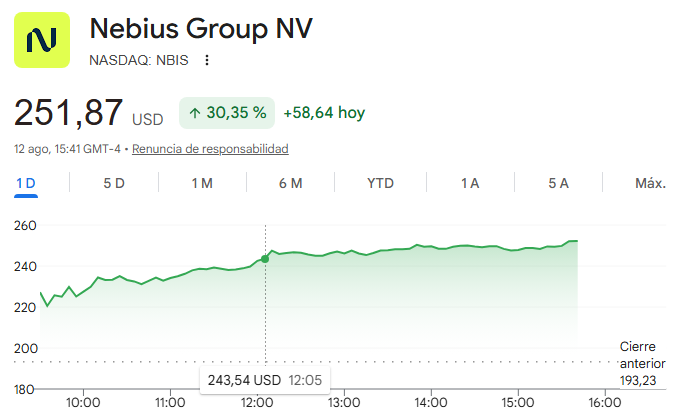
$NBIS +30% 🚀
Simplemente una empresa increíble, con una gran ejecución.
Hay muchas cosas muy interesantes que se han comentado en los resultados y haré un post dedicado.
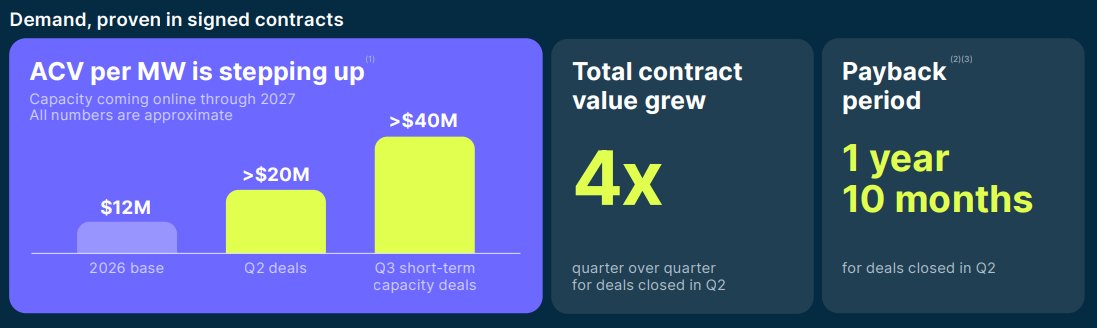
Una de las cosas que más me han gustado de los resultados de $NBIS es este comentario:
"Nuestra primera subasta y los acuerdos de capacidad a corto plazo se están mostrando prometedoras. Vemos una oportunidad de precio en el rango de los 40-50 millones de dólares por MW"
@rata_bursatil_ Muy buenos resultados de $CRWV, sobre todo el margen de EBITDA que está en el 59%.
Ahora solo falta que los resultados $NBIS de mañana sean buenos y con un poco de suerte el sentimiento sobre las neoclouds cambia.
DA Davidson lowered its PT on $NBIS from $250 to $175.
The firm believes the current state of Vineland creates enough execution risk to question the year-end ramp and the company's valuation premium.
I've read the entire report, so here are my overall thoughts on the issue: ⬇️
First, let's look at the analyst arguments.
1) The Vineland concern is about the gap between connected power and actual revenue-generating capacity.
Nebius needs to scale from ~170MW of connected power at the end of 2025 to 800-1,000MW by the end of 2026, while increasing its ARR from $1.9B in March to $7–9B in December. According to DA Davidson, Vineland is a critical piece of that ramp: the site is expected to grow from ~50MW to 328MW.
The firm visited the site and attended the recent public hearing (which was open to the public and livestreamed online, so that's not exactly an edge). Their concern is that permitting has already taken longer than expected, including hearings that had previously been postponed, and, based on the construction progress they observed, they don't believe Vineland currently looks positioned to easily reach 328MW of active power by year-end.
There's an important distinction here: Bloom Energy fuel cells are reportedly arriving at the site, so Nebius may still be able to classify that capacity as “connected” by year-end. Davidson's concern is whether the actual data center infrastructure will be ready to turn that connected power into active, revenue-producing capacity quickly enough to support the $7–9B December run-rate target.
So their thesis isn't simply “Vineland won't have power.” It's that power availability may run ahead of the site's ability to monetize that power.
2) The PT cut is mostly a valuation-premium argument, not just a Vineland estimate cut.
DA Davidson believes $NBIS currently receives a premium because investors view Nebius as the highest-quality neocloud: better execution, a stronger capital structure, a more complete software/infrastructure stack and valuable non-core assets.
That reputation has translated into $NBIS trading at roughly 0.98x EV/backlog, versus 0.8x for CoreWeave, meaning Nebius carries about a 21% premium to $CRWV.
Their argument is basically this:
If Vineland experiences a meaningful delay, it would call into question one of the main reasons investors have been willing to pay that premium: Nebius' perceived superior ability to turn contracted power into connected capacity and ultimately into revenue.
Therefore, Davidson believes that if those execution issues materialize, $NBIS should trade closer to $CRWV's valuation, rather than maintaining its current premium. That's the core reason they cut the PT from $250 to $175.
They also lowered their financial estimates and are now below consensus, particularly for 2027, while pointing to $NBIS' still-negative operating margins as another reason not to give the company the benefit of the doubt indefinitely.
Now, my thoughts.
1) I think Davidson is underestimating the diversification of Nebius’ actual deployment pipeline.
Davidson mentioned that, when asked about Vineland, management reiterated guidance and said it remains on track to meet all of Microsoft’s contractual commitments. The analyst also explicitly leaves open the possibility that other sites, higher monetization, or developments not yet disclosed could offset weakness at Vineland.
That’s where I think they’re underweighting the evidence.
In the report, Davidson includes a table showing what it considers Nebius’ data center pipeline across the U.S., Europe and the Middle East.
The problem is that, based on my research and that of other members of the community, I believe that picture is incomplete. There's credible evidence pointing to several additional locations and expansions that haven't yet been formally announced, including Estonia, Wales, Spain, India, Singapore, further UK expansion, etc. Yes, some of them will only be deployed in 2027, but there’s also evidence that some could be deployed as early as this year.
I understand why Davidson wouldn’t include unconfirmed locations in a formal research model. But if you’re going to make concentration risk one of the central arguments behind a 30% PT cut, then the completeness of the pipeline you’re analyzing matters a lot.
And just as Davidson went looking for evidence that Vineland may be delayed, there's also credible evidence available suggesting that Nebius’ broader deployment footprint is much larger than what appears in their table.
This matters because, if Vineland is indeed experiencing some delay, something even Davidson cannot say with certainty, while management is still reiterating company-wide guidance and Microsoft commitments, one plausible explanation is that Nebius has enough flexibility across the rest of its deployment pipeline to compensate for timing issues at a single site.
This is also consistent with what management has emphasized before: geographic and portfolio diversification is specifically intended to reduce dependence on any one location and mitigate the impact of individual project delays.
Funny enough, Davidson makes essentially the same argument when discussing hyperscalers, writing that they're less exposed to individual site delays because they're diversified across many more locations.
If Davidson had visibility into Nebius’ full pipeline rather than only the publicly confirmed portion, I wonder whether they would view that concentration risk differently.
2) A site visit from the outside doesn't tell you the commissioning timeline.
Davidson repeatedly emphasizes that it visited Vineland and, based on what it saw, doesn't believe the site can “easily” become 328MW of active power by year-end.
That is a relevant observation, and I don’t think it should be dismissed.
But there’s only so much you can infer from looking at a data center construction site from the outside.
I looked closely at the photos included in the report from the "site visit." They don’t appear to have even entered the parking lot, let alone the facility itself.
You can see that construction is ongoing, but you can’t see anything that gives you meaningful visibility into the deployment timeline.
So I think calling this a “site visit” gives the observation more authority than the photos themselves justify.
What ultimately determines when capacity becomes revenue-generating is the commissioning schedule: energization, electrical and mechanical fit-out, equipment installation, phased activation, and the timing of customer workloads.
The report doesn't demonstrate that Davidson has direct visibility into those internal schedules.
So a site visit can support the conclusion that execution risk exists. It cannot, by itself, establish exactly when specific MW will become active and monetized.
And I think Davidson’s own wording reflects that uncertainty. They don’t say Vineland cannot reach 328MW of active power by year-end. They say they don’t believe the site can “easily” be transformed into 328MW of active power by then.
It was never supposed to be easy.
3) There’s a big difference between a delay and a thesis-breaking delay.
I’m not dismissing the possibility that Vineland is delayed. Davidson is mentioning a credible execution risk that we all have been monitoring for quite some time.
But the real question isn’t whether every MW at Vineland becomes active on the exact originally expected timeline.
The real question is whether any delay is significant enough to:
- make Nebius miss its 800–1,000MW connected-power target;
- make it miss the $7–9B December ARR guidance;
- interfere with Microsoft’s contractual commitments;
- or materially change the economics of the capacity being built.
Those are very different outcomes.
Davidson hasn't demonstrated that any of them will actually happen.
In fact, again, its own report says management reiterated guidance and said Nebius remains on track to meet all of Microsoft’s contractual commitments.
So even if we assume Vineland is running behind schedule, that doesn't mean it's material at the company level. And Davidson’s own estimate revisions suggest they’re modeling a relatively small timing impact.
4) The numbers barely changed. The narrative did.
DA Davidson cut its PT by 30%, from $250 to $175.
But look at what they actually did to their revenue estimates:
• 2026 revenue: $3.36B → $3.303B, a reduction of only ~1.7%
• 2027 revenue: $10.604B → $9.874B, a reduction of ~6.9%
So this isn’t really a story about Davidson dramatically changing its expectations for Nebius’ underlying business (that's why I said their own revisions suggest only a small delay).
The overwhelming majority of the PT reduction comes from multiple compression. Their argument is that, if the execution concerns around Vineland materialize, $NBIS should no longer deserve its current premium and should instead trade closer to $CRWV.
Davidson points out that Nebius trades at ~0.98x EV/backlog versus ~0.8x for CoreWeave, and effectively uses convergence toward $CRWV's multiple to justify the new $175 target.
But I think EV/backlog is far too simplistic a metric to determine whether two companies deserve the same valuation.
Backlog tells you how much revenue has been contracted. It tells you much less about the quality and economics of that backlog: margins, contract duration, CapEx required to fulfill it, financing costs, utilization, revenue per MW, customer quality, or ultimately the returns generated on the capital deployed.
Two companies can have the same amount of backlog and that backlog can have very different economic value.
That said, I don't want to make this a discussion about $NBIS vs. $CRWV. It’s fair if one believes their multiples should converge. The point is that Davidson itself has historically argued that Nebius deserves a premium because of characteristics that have nothing to do with simply having more backlog: its stronger capital structure, full-stack offering, management track record and valuable ancillary businesses such as its ClickHouse stake. I'm using their words.
None of those things suddenly disappear because one facility may take slightly longer than expected.
[Not to mention that their PT gives no explicit value to Nebius’ non-core business units.]
If Vineland ultimately causes Nebius to miss guidance, fail to meet contractual commitments or proves that its execution advantage was overstated, then I agree some de-rating would be justified.
But going from “there may be a delay at Vineland” to “Nebius should effectively lose the valuation premium we previously argued it deserved” is a much bigger leap.
Davidson also points to Nebius’ still-negative operating margins and broader uncertainty around the neocloud business model as additional reasons for caution.
Those are legitimate risks, but they’re not new ones.
Nebius also had negative operating margins when Davidson’s PT was $250. The uncertainty around long-term neocloud profitability existed then too.
Overall, the valuation framework seems to fit the typical sell-side analysts’ playbook: use the assumptions that best fit your narrative.
FINAL THOUGHTS
Overall, I think Davidson mentioned a legitimate execution risk at Vineland, but then used several weak arguments to make that risk look much more consequential than the evidence currently supports.
To be clear, I don't really care about the $175 PT itself. An analyst can change a PT very easily by changing the multiple they apply. What I care about is the narrative being built around it.
An outside site visit isn't visibility into the commissioning schedule. Vineland also isn't binary, it doesn't have to be either 50MW or 328MW by year-end, as capacity can come online progressively.
And while Vineland is clearly important for the near-term 2026 ramp, zooming out, the full facility represents only ~8% of Nebius' >4GW YE2026 contracted-power target. It's also not part of the owned-facility portfolio that represents the large majority of Nebius' contracted capacity and, in my view, matters much more to the long-term thesis.
That's exactly why diversification matters. Nebius has consistently built its infrastructure portfolio across sites, geographies and deployment models to reduce dependence on any single project. If Vineland slips by a few weeks or months but other deployments compensate and company-wide guidance remains intact, I don't see that as particularly relevant.
The threshold for me is simple: does Vineland cause Nebius to miss its connected-power guidance, the $7–9B December ARR, or Microsoft's contractual commitments?
So far, we have no evidence of that. Management has actually reiterated all of those commitments Davidson asked about.
And that's ultimately my issue with the report: the risk is real, but I think the conclusion is much stronger than the evidence. The financial estimates barely changed, while the PT fell 30% through multiple compression and previously known bearish arguments suddenly received much more weight.
Fortunately, we should get much more clarity next week with earnings.
To me, this remains exactly what it was before this report: a short-term risk worth monitoring, not a reason for me to change the thesis.
I’ll publish my full preview of next week’s earnings over the weekend.
SOUTH KOREAN MEDIA: APPLE RECENTLY NEGOTIATED WITH CXMT OVER SUPPLY PRICES FOR MOBILE DRAM, INCLUDING LPDDR5X, IN AN EFFORT TO EASE MANUFACTURING COST PRESSURES ON ITS NEXT-GENERATION IPHONE AND SMART DEVICE LINEUP, BUT CXMT REJECTED ITS REQUEST FOR PRICE CUTS
SOUTH KOREAN MEDIA: CXMT INSTEAD INSISTED ON PRICES THAT WERE HIGHER THAN OR COMPARABLE TO THOSE OFFERED BY SAMSUNG ELECTRONICS AND SK HYNIX
$AAPL
@rata_bursatil_ Habrá que esperar a los resultados del Q2 y Q3 para confirmar que todo sigue su camino y el guidance para FY27 es bueno, pero en $188 (preferiblemente $150-$160) es un punto muy atractivo.
@rata_bursatil_ $NBIS, después de lo que dijo Amazon (empieza a haber demanda para 2028), no veo como esta empresa no podría valer +$250B en unos años.
Habrá que ver si mantienen la ejecución, pero si AWS llega a generar $1T al año, $NBIS mínimamente debería de generar $30B - $40B
La gente que ve esto de $AMZN y piensa que estamos en una burbuja no la entiendo.
AWS está creciendo a un ritmo del 37% (el máximo en los últimos 4 años) sobre unos ingresos de $168B anuales.
Básicamente la demanda actual sigue siendo insaciable.
Lo que se ha comentado en la earnings call de $AMZN es lo más bullish para el AI trade en mucho tiempo.
- Empieza a haber demanda para 2028.
- Creen que AWS puede tener ingresos de $1T.
- Siguen aumentando el CAPEX.
- AWS está teniendo su mayor crecimiento en 4 años.
Las cosas como son: este mercado es ABSURDO.
Lo mismo cae un 20% que sube un 30% en un solo día sin que haya cambiado nada a nivel fundamental.
$NBIS +30%
$CRDO +12%
$APLD +22%
$BE +29%




![mvcinvesting's tweet photo. DA Davidson lowered its PT on $NBIS from $250 to $175.
The firm believes the current state of Vineland creates enough execution risk to question the year-end ramp and the company's valuation premium.
I've read the entire report, so here are my overall thoughts on the issue: ⬇️
First, let's look at the analyst arguments.
1) The Vineland concern is about the gap between connected power and actual revenue-generating capacity.
Nebius needs to scale from ~170MW of connected power at the end of 2025 to 800-1,000MW by the end of 2026, while increasing its ARR from $1.9B in March to $7–9B in December. According to DA Davidson, Vineland is a critical piece of that ramp: the site is expected to grow from ~50MW to 328MW.
The firm visited the site and attended the recent public hearing (which was open to the public and livestreamed online, so that's not exactly an edge). Their concern is that permitting has already taken longer than expected, including hearings that had previously been postponed, and, based on the construction progress they observed, they don't believe Vineland currently looks positioned to easily reach 328MW of active power by year-end.
There's an important distinction here: Bloom Energy fuel cells are reportedly arriving at the site, so Nebius may still be able to classify that capacity as “connected” by year-end. Davidson's concern is whether the actual data center infrastructure will be ready to turn that connected power into active, revenue-producing capacity quickly enough to support the $7–9B December run-rate target.
So their thesis isn't simply “Vineland won't have power.” It's that power availability may run ahead of the site's ability to monetize that power.
2) The PT cut is mostly a valuation-premium argument, not just a Vineland estimate cut.
DA Davidson believes $NBIS currently receives a premium because investors view Nebius as the highest-quality neocloud: better execution, a stronger capital structure, a more complete software/infrastructure stack and valuable non-core assets.
That reputation has translated into $NBIS trading at roughly 0.98x EV/backlog, versus 0.8x for CoreWeave, meaning Nebius carries about a 21% premium to $CRWV.
Their argument is basically this:
If Vineland experiences a meaningful delay, it would call into question one of the main reasons investors have been willing to pay that premium: Nebius' perceived superior ability to turn contracted power into connected capacity and ultimately into revenue.
Therefore, Davidson believes that if those execution issues materialize, $NBIS should trade closer to $CRWV's valuation, rather than maintaining its current premium. That's the core reason they cut the PT from $250 to $175.
They also lowered their financial estimates and are now below consensus, particularly for 2027, while pointing to $NBIS' still-negative operating margins as another reason not to give the company the benefit of the doubt indefinitely.
Now, my thoughts.
1) I think Davidson is underestimating the diversification of Nebius’ actual deployment pipeline.
Davidson mentioned that, when asked about Vineland, management reiterated guidance and said it remains on track to meet all of Microsoft’s contractual commitments. The analyst also explicitly leaves open the possibility that other sites, higher monetization, or developments not yet disclosed could offset weakness at Vineland.
That’s where I think they’re underweighting the evidence.
In the report, Davidson includes a table showing what it considers Nebius’ data center pipeline across the U.S., Europe and the Middle East.
The problem is that, based on my research and that of other members of the community, I believe that picture is incomplete. There's credible evidence pointing to several additional locations and expansions that haven't yet been formally announced, including Estonia, Wales, Spain, India, Singapore, further UK expansion, etc. Yes, some of them will only be deployed in 2027, but there’s also evidence that some could be deployed as early as this year.
I understand why Davidson wouldn’t include unconfirmed locations in a formal research model. But if you’re going to make concentration risk one of the central arguments behind a 30% PT cut, then the completeness of the pipeline you’re analyzing matters a lot.
And just as Davidson went looking for evidence that Vineland may be delayed, there's also credible evidence available suggesting that Nebius’ broader deployment footprint is much larger than what appears in their table.
This matters because, if Vineland is indeed experiencing some delay, something even Davidson cannot say with certainty, while management is still reiterating company-wide guidance and Microsoft commitments, one plausible explanation is that Nebius has enough flexibility across the rest of its deployment pipeline to compensate for timing issues at a single site.
This is also consistent with what management has emphasized before: geographic and portfolio diversification is specifically intended to reduce dependence on any one location and mitigate the impact of individual project delays.
Funny enough, Davidson makes essentially the same argument when discussing hyperscalers, writing that they're less exposed to individual site delays because they're diversified across many more locations.
If Davidson had visibility into Nebius’ full pipeline rather than only the publicly confirmed portion, I wonder whether they would view that concentration risk differently.
2) A site visit from the outside doesn't tell you the commissioning timeline.
Davidson repeatedly emphasizes that it visited Vineland and, based on what it saw, doesn't believe the site can “easily” become 328MW of active power by year-end.
That is a relevant observation, and I don’t think it should be dismissed.
But there’s only so much you can infer from looking at a data center construction site from the outside.
I looked closely at the photos included in the report from the "site visit." They don’t appear to have even entered the parking lot, let alone the facility itself.
You can see that construction is ongoing, but you can’t see anything that gives you meaningful visibility into the deployment timeline.
So I think calling this a “site visit” gives the observation more authority than the photos themselves justify.
What ultimately determines when capacity becomes revenue-generating is the commissioning schedule: energization, electrical and mechanical fit-out, equipment installation, phased activation, and the timing of customer workloads.
The report doesn't demonstrate that Davidson has direct visibility into those internal schedules.
So a site visit can support the conclusion that execution risk exists. It cannot, by itself, establish exactly when specific MW will become active and monetized.
And I think Davidson’s own wording reflects that uncertainty. They don’t say Vineland cannot reach 328MW of active power by year-end. They say they don’t believe the site can “easily” be transformed into 328MW of active power by then.
It was never supposed to be easy.
3) There’s a big difference between a delay and a thesis-breaking delay.
I’m not dismissing the possibility that Vineland is delayed. Davidson is mentioning a credible execution risk that we all have been monitoring for quite some time.
But the real question isn’t whether every MW at Vineland becomes active on the exact originally expected timeline.
The real question is whether any delay is significant enough to:
- make Nebius miss its 800–1,000MW connected-power target;
- make it miss the $7–9B December ARR guidance;
- interfere with Microsoft’s contractual commitments;
- or materially change the economics of the capacity being built.
Those are very different outcomes.
Davidson hasn't demonstrated that any of them will actually happen.
In fact, again, its own report says management reiterated guidance and said Nebius remains on track to meet all of Microsoft’s contractual commitments.
So even if we assume Vineland is running behind schedule, that doesn't mean it's material at the company level. And Davidson’s own estimate revisions suggest they’re modeling a relatively small timing impact.
4) The numbers barely changed. The narrative did.
DA Davidson cut its PT by 30%, from $250 to $175.
But look at what they actually did to their revenue estimates:
• 2026 revenue: $3.36B → $3.303B, a reduction of only ~1.7%
• 2027 revenue: $10.604B → $9.874B, a reduction of ~6.9%
So this isn’t really a story about Davidson dramatically changing its expectations for Nebius’ underlying business (that's why I said their own revisions suggest only a small delay).
The overwhelming majority of the PT reduction comes from multiple compression. Their argument is that, if the execution concerns around Vineland materialize, $NBIS should no longer deserve its current premium and should instead trade closer to $CRWV.
Davidson points out that Nebius trades at ~0.98x EV/backlog versus ~0.8x for CoreWeave, and effectively uses convergence toward $CRWV's multiple to justify the new $175 target.
But I think EV/backlog is far too simplistic a metric to determine whether two companies deserve the same valuation.
Backlog tells you how much revenue has been contracted. It tells you much less about the quality and economics of that backlog: margins, contract duration, CapEx required to fulfill it, financing costs, utilization, revenue per MW, customer quality, or ultimately the returns generated on the capital deployed.
Two companies can have the same amount of backlog and that backlog can have very different economic value.
That said, I don't want to make this a discussion about $NBIS vs. $CRWV. It’s fair if one believes their multiples should converge. The point is that Davidson itself has historically argued that Nebius deserves a premium because of characteristics that have nothing to do with simply having more backlog: its stronger capital structure, full-stack offering, management track record and valuable ancillary businesses such as its ClickHouse stake. I'm using their words.
None of those things suddenly disappear because one facility may take slightly longer than expected.
[Not to mention that their PT gives no explicit value to Nebius’ non-core business units.]
If Vineland ultimately causes Nebius to miss guidance, fail to meet contractual commitments or proves that its execution advantage was overstated, then I agree some de-rating would be justified.
But going from “there may be a delay at Vineland” to “Nebius should effectively lose the valuation premium we previously argued it deserved” is a much bigger leap.
Davidson also points to Nebius’ still-negative operating margins and broader uncertainty around the neocloud business model as additional reasons for caution.
Those are legitimate risks, but they’re not new ones.
Nebius also had negative operating margins when Davidson’s PT was $250. The uncertainty around long-term neocloud profitability existed then too.
Overall, the valuation framework seems to fit the typical sell-side analysts’ playbook: use the assumptions that best fit your narrative.
FINAL THOUGHTS
Overall, I think Davidson mentioned a legitimate execution risk at Vineland, but then used several weak arguments to make that risk look much more consequential than the evidence currently supports.
To be clear, I don't really care about the $175 PT itself. An analyst can change a PT very easily by changing the multiple they apply. What I care about is the narrative being built around it.
An outside site visit isn't visibility into the commissioning schedule. Vineland also isn't binary, it doesn't have to be either 50MW or 328MW by year-end, as capacity can come online progressively.
And while Vineland is clearly important for the near-term 2026 ramp, zooming out, the full facility represents only ~8% of Nebius' >4GW YE2026 contracted-power target. It's also not part of the owned-facility portfolio that represents the large majority of Nebius' contracted capacity and, in my view, matters much more to the long-term thesis.
That's exactly why diversification matters. Nebius has consistently built its infrastructure portfolio across sites, geographies and deployment models to reduce dependence on any single project. If Vineland slips by a few weeks or months but other deployments compensate and company-wide guidance remains intact, I don't see that as particularly relevant.
The threshold for me is simple: does Vineland cause Nebius to miss its connected-power guidance, the $7–9B December ARR, or Microsoft's contractual commitments?
So far, we have no evidence of that. Management has actually reiterated all of those commitments Davidson asked about.
And that's ultimately my issue with the report: the risk is real, but I think the conclusion is much stronger than the evidence. The financial estimates barely changed, while the PT fell 30% through multiple compression and previously known bearish arguments suddenly received much more weight.
Fortunately, we should get much more clarity next week with earnings.
To me, this remains exactly what it was before this report: a short-term risk worth monitoring, not a reason for me to change the thesis.
I’ll publish my full preview of next week’s earnings over the weekend.](https://pbs.twimg.com/media/HPI85Q-WEAEmZC4.png)