Australia was handed one of the greatest starting positions of any country in history
Massive mineral wealth. Abundant energy. World-class beaches. Amazing climate. No fault lines... no earthquakes or tsunamis
If you gave a 12-year-old this setup in a civilisation-building game, they'd build a paradise
Instead, we got decades of useless politicians on both sides of the aisle who couldn't run a sausage sizzle at Bunnings without a $4 billion feasibility study and a royal commission
Australia isn't unlucky. It's grossly mismanaged
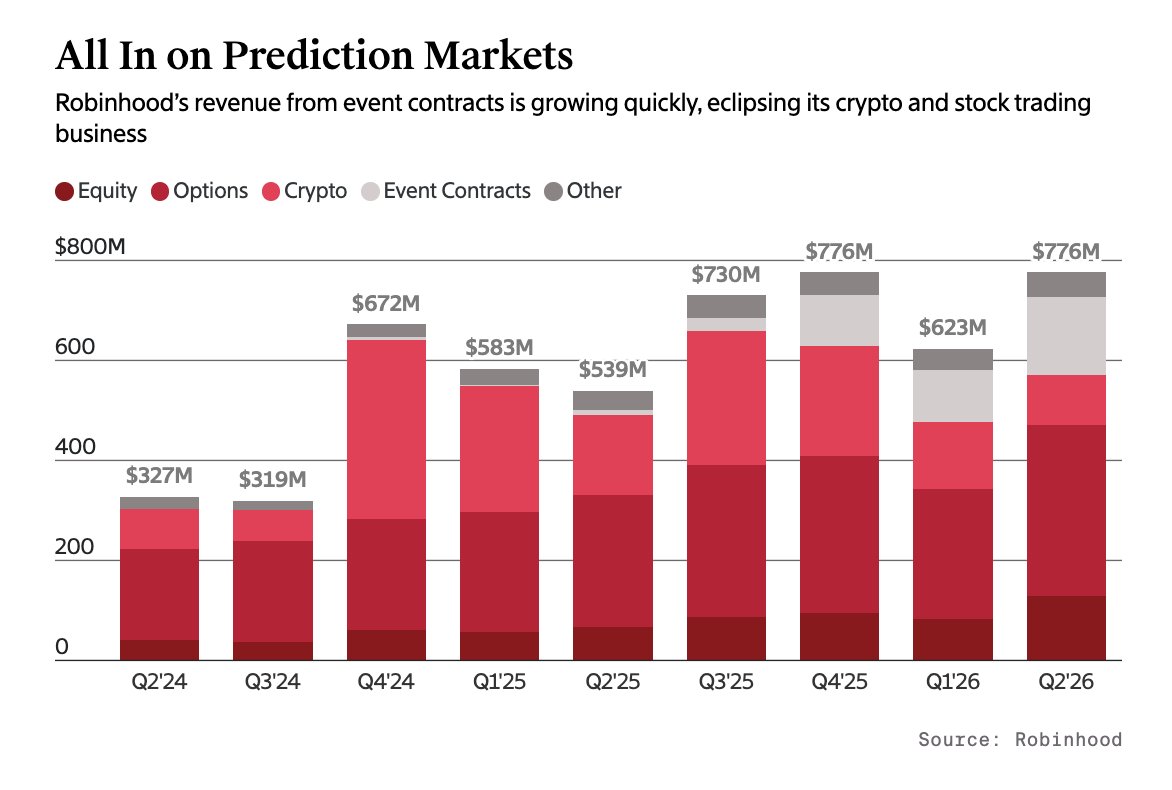
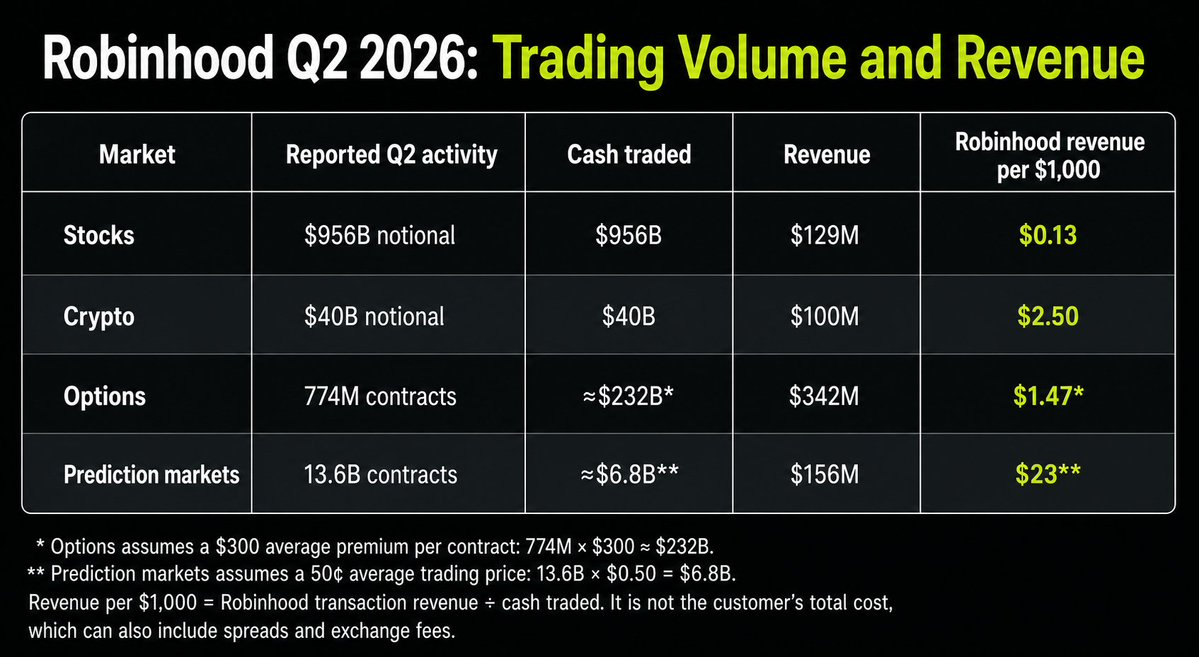
Robinhood now makes more transaction revenue from prediction markets than from either stock or crypto trading... Prediction market take rates are massive, 170x higher than stocks per $1 traded
For every $1,000 traded, Robinhood generates roughly:
Stocks: $0.13
Options: $1.47
Crypto: $2.50
Prediction markets: $23.00
Prediction markets currently monetize about 16× better than options, 9× better than crypto, and 170× better than stocks.
These are assumptions for Options and Prediction markets, but I think they are conservative.
Options assumes an average premium of $300 per contract. Prediction markets assume an average trading price of 50¢ per contract.
@DominicDirupo I never could work out how to onboard a Concierge, EA, PA, or VA.
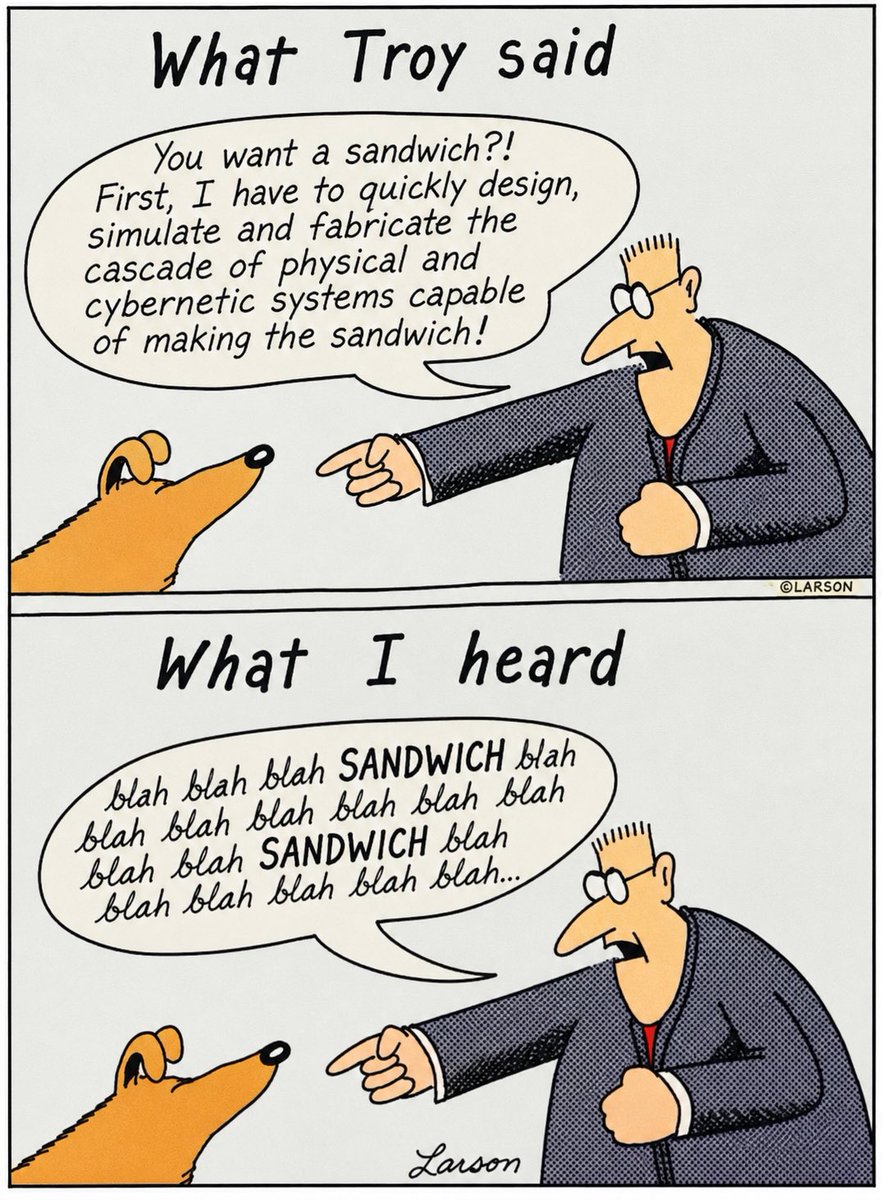
Now, I am expending an enormous number of tokens to get Fable to build me one … nothing like automating failure.
A drug-free sticker that protects and helps lower inflammation around bug bites? Don't forget to pack these on your next family camping trip! https://t.co/HPaWKKAPAP
In 1977, this man told a room of French physicists that reality had been secretly rewritten,
And that he could remember the version before the edit.
The lecture was called "If You Find This World Bad, You Should See Some of the Others."
The man in question?
Philip K Dick.
He delivered it at the Metz science fiction festival in front of an audience that included physicists, philosophers, and journalists who had come expecting a novelist to talk about craft. Instead, the man who wrote *Blade Runner* stood at the podium and calmly explained that the universe is a computed simulation, that the entity running it occasionally rolls back the timeline to try alternate variables, and that most people never notice because their memories get patched to match the new version. Sometimes the patch fails. When it fails, you are left holding a memory of a world that no longer exists.
Half the room thought he was having a breakdown. A quieter half sat forward.
What he was describing, without the vocabulary we have now, was the Mandela Effect twenty years before anyone had a name for it.
He was describing save states and branching timelines before video games gave us the metaphor. He was describing simulation theory a full quarter century before Nick Bostrom made it academically respectable in 2003, when Bostrom argued that any civilization capable of running ancestor simulations would eventually run so many of them that the odds of *you* being the original biological version approach zero.
Dick claimed he had personally experienced the failed patch.
In February 1974, a pharmacy delivery girl arrived at his California apartment wearing a small golden fish pendant called the ichthys, the symbol early Christians used to identify each other under Roman persecution. Sunlight caught the metal.
Dick said something in his mind cracked open. He described a pink beam of information flooding his consciousness, carrying with it medical diagnoses for his infant son that no doctor had made yet. The hospital confirmed those diagnoses days later. He began speaking fragments of Koine Greek, a language he had never studied. He became convinced he was simultaneously living as a persecuted Christian named Thomas in first-century Rome — the same consciousness threaded through two separate slices of time.
He spent the final eight years of his life writing an 8,000-page private journal called the *Exegesis*, trying to reverse-engineer what had happened to him.
Most of it has never been decoded by anyone but him.
What makes the Metz lecture impossible to write off is what physics did afterward.
Everett’s 1957 many-worlds theory suggested each quantum event branches reality. Wheeler’s “it from bit” argued the universe arises from information. More recently, Melvin Vopson claims information has mass and that the cosmos acts like it’s compressing data to save resources. His “second law of infodynamics” says information entropy in closed systems decreases over time (the opposite of matter) and what you’d expect from a simulation optimizing itself.
Experiments probing the discreteness of spacetime at the Planck scale keep producing results that look less like a smooth continuum and more like pixels.
None of this proves Dick was right.
Insrtead, it proves the frame he was speaking from stopped being fringe.
After the lecture, physicists came up to him not for a book signing, but to share their excitement and ask how a novelist without formal training in quantum theory had arrived at ideas they were still exploring at the edges of their own field. He welcomed the question, even if he couldn’t offer a tidy explanation. He told them he had been shown. He said the insight seemed to arrive from beyond the system, from something he sometimes called VALIS ( a Vast Active Living Intelligence System) and other times simply the programmer.
Dick died in 1982 believing he had glimpsed something the rest of us are structurally prevented from seeing.
He invited no worship and sought no followers. He simply left a record for those who came next, ready to notice the same seams in the fabric of the world.
The uncomfortable question isn't whether he was insane.
It's why so many of the things a "madman" said in 1977 keep quietly showing up in peer-reviewed papers forty years later.
@alexeckermann@Telstra Have you tried in-store?
We didn’t know we had points and walked out of the Southland (Melbourne) Telstra store with:
- much cheaper phone plans
- a Tapos robot vacc
- and, a desktop iPhone dock
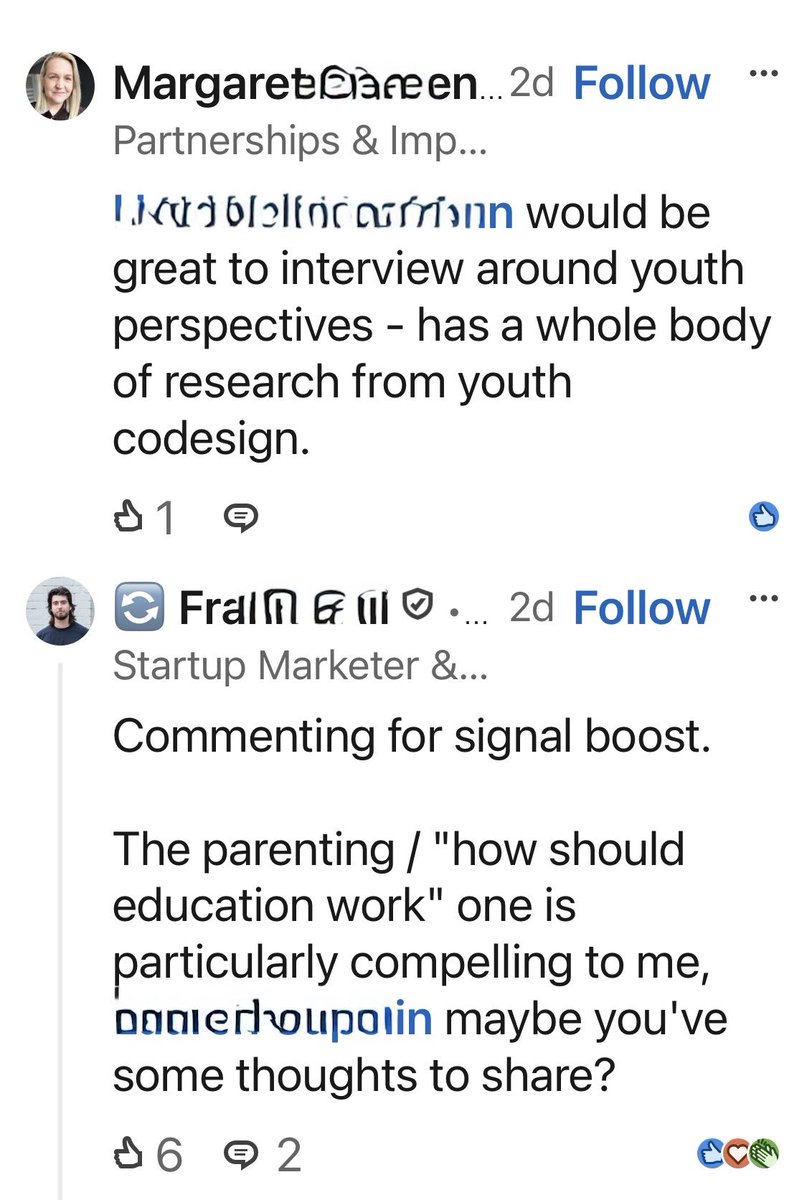
Can you spot the AI?
One @LinkedIn post.
Three thoughtful comments.
Here’s the part that will leave you guessing.
Two were written by people.
One was generated by AI.
Which one is it — can you guess?
🤔
NEW: 2 Manchester Airport coworkers reportedly became "best friends" before discovering they were brother & sister separated by adoption for more than 30 years.
The IMAX screen at Lincoln Center in NYC is literally worth traveling cross country to see. No joke.
To put it in context, here is the size compared to standard screens and the IMAX Christopher Nolan himself attends in LA: