Just do it guys! Let's break the Auto industry's lobby and government's arrogance. We buyers have the ultimate power! Let's make it a trend. Let's stop buying the Cars!
Harass indigenous Agri, Koli and native Marathi speaking population for decades, discriminate and term then ghatis, dirty Marathi, try to ban their lifestyle, food markets, force restriction on what they eat & when they unite and retaliate, play the victim card. Typical Jaionist
Excellent! This is how it should be.
They don’t even an ethanol roadmap for 10 years for Petrol cars and want 40% GST + Insane registration cost and Insurance. Buying an EV or Diesel in hurry isn’t a solution because eventually their number will come too in one way or the other.
Paise ped pe thodi ugte hein.
If Sejal Pawar can mock a dead man's genitals and still her medical licence isn't revoked, then it's hard to deny that women can get away with behaviour that would be treated much more seriously if the genders were reversed.
Brilliant idea! Next up: Apple randomly reboots your Mac if you're building competing tech, Gmail silently edits your email if you mention rival platforms, and Tesla Autopilot swerves if it detects you're working on self-driving cars.
All in the name of safety, of course. Because malicious actors controlling the world’s operating systems, inboxes and cars would be extremely dangerous!
Yes, Britain famously transferred wealth to India. When British arrived in India its share of the world economy was 4%. When they left in 1947, they had taken it to 23%, roughly equal to all of Europe combined.
On a serious note.
The Indian railways were financed entirely by bonds sold on the London Stock Exchange. British investors were guaranteed a return of 5% per annum by the colonial government. A guaranteed return, in an era when no other safe investment in Britain offered anything close. And who guaranteed those returns? Indian taxpayers. Indians paid for the construction. Indians paid the guaranteed profits to British shareholders. Indians paid for the equipment, which was manufactured exclusively in Britain and shipped to India at inflated prices. One mile of Indian railway cost twice what the same mile cost to build in Canada or Australia, because the guaranteed return meant there was no incentive to control costs. The more it cost, the more British investors and suppliers earned.
And what were these railways designed to do? Move raw materials from India’s interior to ports. Cotton from the Deccan to Bombay. Jute from Bengal to Calcutta. Coal from Bihar to wherever the Empire needed it. Tea from Assam to London’s drawing rooms. The routes connected mines and plantations to harbors. Not cities to cities. Not people to opportunities. Raw materials to ships. The Indian public’s transportation needs were, as Shashi Tharoor put it, entirely incidental.
Oh, and the railways also moved troops. Very efficiently. So that when Indians protested being looted, the British could deploy soldiers to shoot them. That was the other “infrastructure investment.”
But wait, there is more. Before the railways, India had the world’s finest textile industry. The British smashed the looms, broke the weavers’ thumbs (this is not metaphor, this is documented history), imposed tariffs on Indian cloth, and shipped raw cotton to Manchester to be manufactured into garments that were then sold back to Indians. India went from being the world’s largest textile exporter to an importer of British cloth within a generation.
The Bengal Famine of 1943 killed an estimated 3 million people. Churchill diverted food supplies from Bengal to already well-supplied British troops and European stockpiles. When informed of the famine, his response, on the record, was to ask why Gandhi had not died yet. This is the “infrastructure investor” Musk is defending.
India contributed 2.5 million soldiers to fight in two World Wars on Britain’s behalf.
So let us summarize the colonial “investment” in India. They took a 23% global economy and left it at 4%. They destroyed the world’s finest textile industry. They built railways with Indian money, for Indian resources, generating British profits. They engineered famines that killed millions. They drained an estimated $45 trillion in today’s value over 200 years.
That’s some unprofitable adventure.
Fcuk ventilated seats & 360 deg camera, I want my car me to tell me the composition of petrol (ethanol & petrol percentage) & adulteration (if any) the moment I fill in the fuel.
A must have feature in India.
Right now, the best advice I can give you as an automotive journalist is to stop buying new cars and bikes, until this #ethanol mess is sorted out. OEMs are too scared to say anything to the government, so this will be one way of pressurising them as well.
@aravind Hi Aravind, CERT-In along with CBSE & Ministry of Education (GoI) were notified before the disclosure these vulnerabilities publicly. CERT just sends me a boilerplate "thank you" reply every time and it's frustrating to say the least.
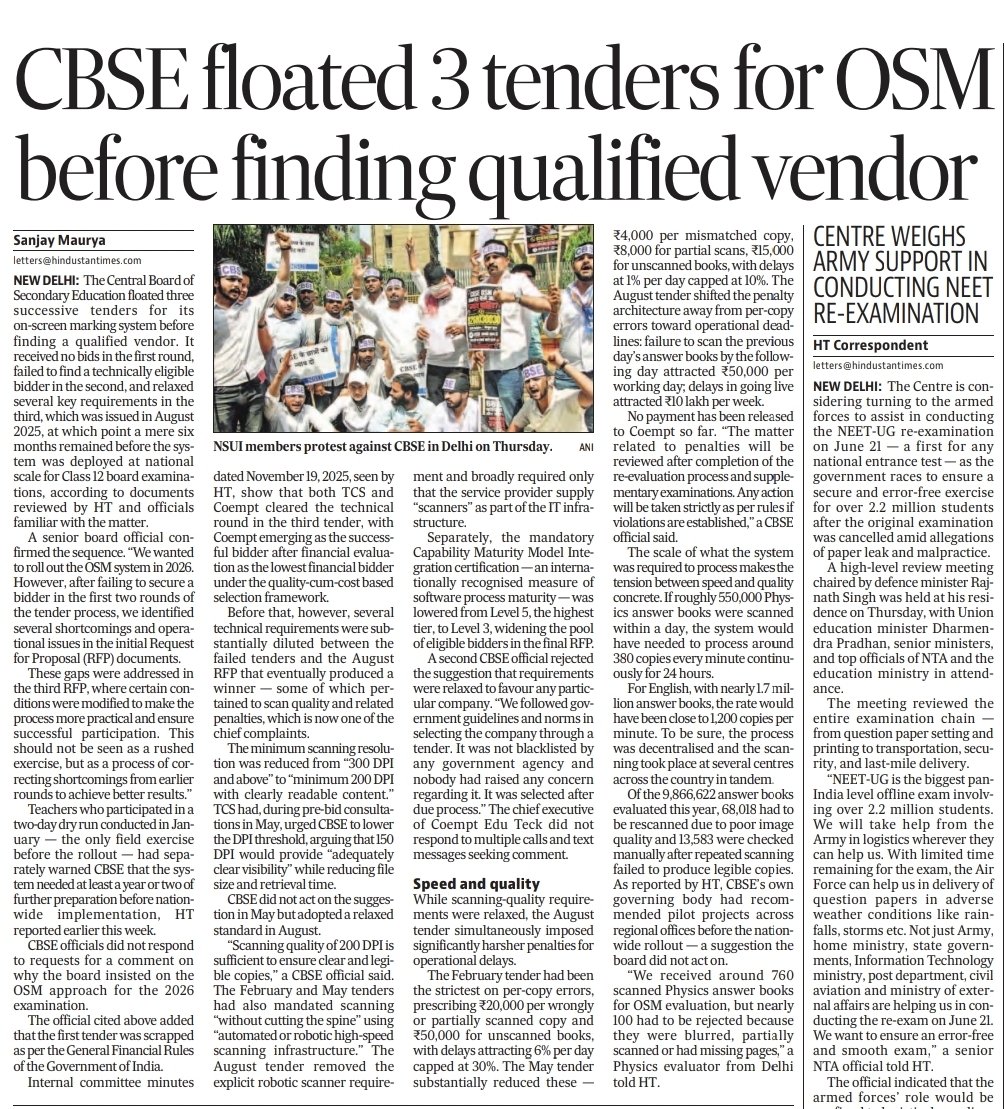
Read this story. Carefully.
CBSE called for OSM tenders thrice. Zero bids the first time. No qualified bidder the second time. And finally, the technical bar was lowered until COEMPT could clear it.
Scanning resolution cut. Robotic scanner requirement dropped. CMMI certification lowered from Level 5 to Level 3. Penalties for errors in answer sheets removed.
TCS, India’s biggest IT services company, qualified in the third round too. TCS lost. COEMPT - a company with a spectacular track record of failure - won.
And what are CBSE students complaining about today? Badly scanned answer sheets. Missing pages. A broken evaluation portal.
Teachers had warned CBSE that the OSM system needed at least a year or two for further preparation before nationwide implementation, yet it was rushed through.
So I ask again - who wanted COEMPT to win? Who lowered the bar, step by step, until this company could clear it?
Pradhan ji and CBSE say “due process was followed.” That is not an answer, that is not accountability. The question is whether the contract was honestly awarded to the best company which could do the job correctly.
The futures of 18.5 lakh children were handed to a company that could only qualify after the rules were bent for it.
To the BJP Ministers attacking me for asking questions - I have, from day one, demanded an independent judicial probe. Expand it from CBSE to every contract awarded to COEMPT. Our youth deserve the truth.
And Modi ji, your silence on the CBSE debacle and inaction against the Education Minister tells the country what you actually care about - not the futures of lakhs of students, only the survival of your own government.
Dharmendra Pradhan's son
is studying in America, so did Nirmala's and Jyotiraditya.
Piyush Goyal's son is studying in Singapore, Anurag Thakur's son is studying in Canada.
S. Jaishankar's son is studying in the UK & even Smriti Irani (who hardly studied) sent son to study there.
Nishikant Dubey's son studied in Scotland
So why would these people bother about NEET paper leak
or CBSE scam or communal distortion of history by NCERT?
Or care about your children getting pushed around in trains and buses or even committing suicide?
Government of Hypocrites from Top to Bottom!!
"India is overcrowded" is the most successful gaslighting campaign Indian babus ever ran on their own citizens. They underbuilt the country for forty years and convinced 1.4B Indians to blame themselves for it.
Every overcrowded space you've ever queued in is a supply failure the state engineered, not a demographic accident. Five lifts in a hospital, one working. Seven railway counters, one ticketer. Toll plazas, water boards, municipal offices: built once in 1972, patched once in 1996, abandoned ever since. The only exception is airports, and even those lounges are gigafried at peak.
Why did this happen? 4 reasons, none of them are "too many people."
1. Cost of capital. Rupee down 60% against the dollar in two decades. Inflation 5-7% on paper, 8-10% in reality. Risk-free rates above 7%. No rational allocator underwrites a hospital with a 30-year payback under those conditions. Capital flows into software and consumer brands; anything with a 3-5 year ROI window. Parks, ports, metros, dams, schools need multi-decade underwriting that India's macro structurally cannot support.
2. The regulatory stack is engineered to prevent construction. 50+ clearances across municipal, state, and central bodies for any large project, each with its IAS gatekeeper extracting rent. Real builders give up. The only construction happening at scale is therefore illegal, which is exactly why slums mushroom while sanctioned housing projects sit at 15% completion for a decade.
3. The corruption tax. Budget 15-20% of project cost in bakshish before pouring a single slab. Stacked on top of GST, stamp duty, capital gains, property tax, labour cess. Software shops escape it; they ship from a laptop. Anyone touching cement, steel, or land pays the surcharge in cash, off the books, with zero recourse and zero deductibility.
4. State capacity has collapsed into pure friction. GST portal crashes on filing deadlines. MCA21 is a relic. Every regulator (SEBI, RBI, IRDAI, FSSAI, BIS) optimises for CYA, never throughput. Babus paid 1990s salaries to administer 2026 complexity respond rationally by doing nothing.
India's perpetual undercapacity is a capital allocation story the political class would rather you never learn. The 1.4B is a feature. The people running the country are the bug. Until cost of capital drops, the regulatory fat gets gutted, and the corruption surcharge gets squeezed out, the lifts and the counters and the hospitals will stay exactly as broken as they were when your grandfather first complained about them in 1987.
If you go back 12+ yrs ago, the Davos / WEF / trans-Atlantic elites thought they had won & would rule the world forever.
They now control none of the top three world powers (including Russia), and the big two don't give a damn about the optics of not having women or blacks
1/
Prime Minister: We must conserve fuel
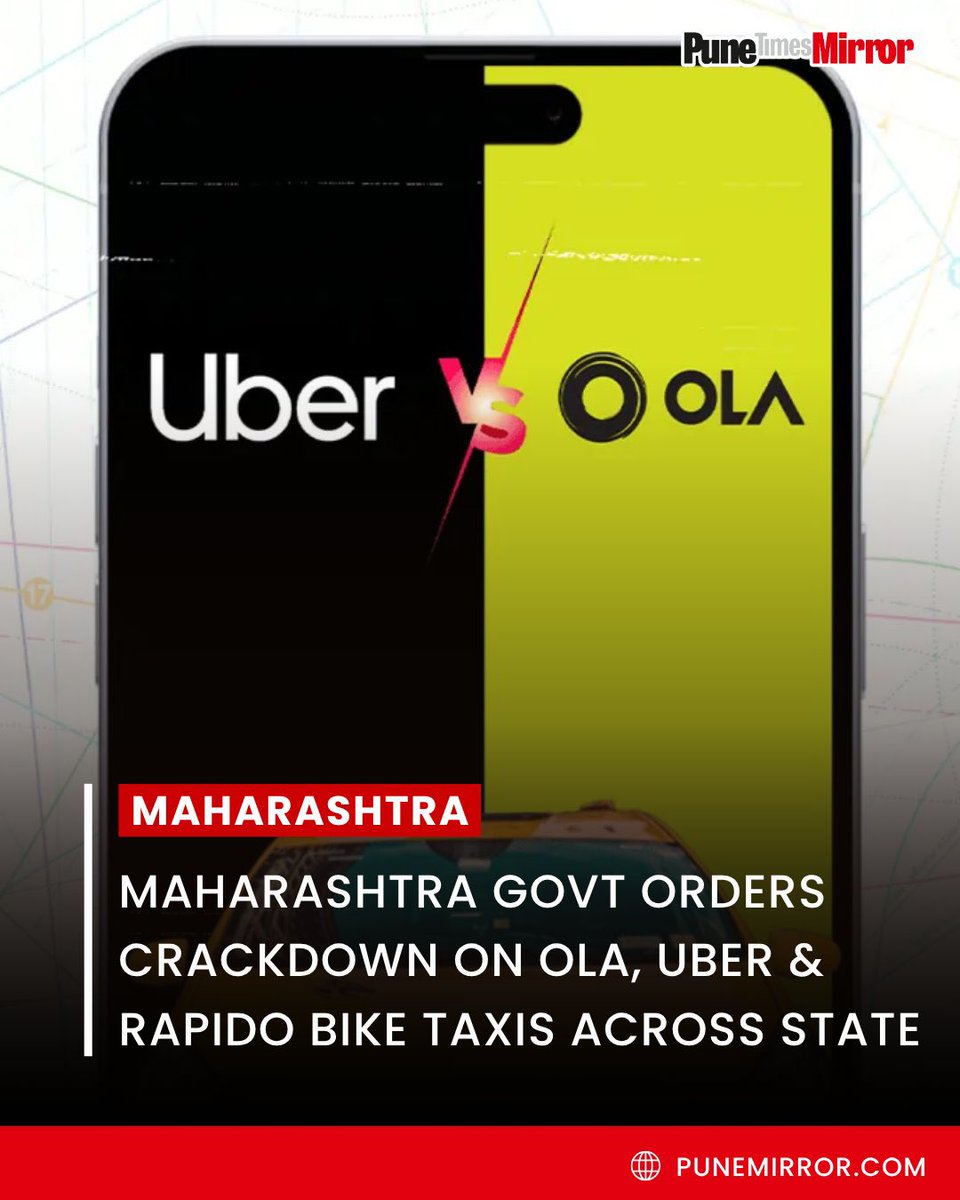
Maharashtra Minister: Ban one of the most fuel-efficient vehicles as a Taxi.
I’m shocked that Ministers in a State Government are brazenly humiliating the goals of the PM.
Jai Maharashtra,
Two days ago, Prime Minister Narendra Modi appealed to Indians to adopt austerity. Reduce gold purchases, avoid unnecessary foreign travel, consume less petrol and diesel, shift to electric vehicles, and embrace work-from-home practices. Why? Because gold and crude oil are imported, and they drain precious foreign exchange reserves. And with the Iran conflict escalating, global crude prices have surged sharply.
Fair enough. But the Prime Minister and senior leaders continue to travel across the country with massive convoys, roadshows, helicopters, flower showers, and extravagant political campaigns. Will the prime minister admit that ‘such political excesses were our mistake, and all of us including me, will not repeat it’? Why should the common man suffer for your mistakes? Is austerity meant only for the citizen and never for the political class?
Crude oil today is hovering around 90–100 dollars per barrel. But this is not the first time the world has seen such prices. During the 2008 financial crisis, during the Arab Spring of 2011–12, and the 2013–14 phase (when the BJP itself aggressively attacked the UPA over fuel prices) and again during the OPEC production cuts in 2022–23, crude prices had similarly touched these levels. During 3-4 such periods Dr. Manmohan Singh was the Prime Minister. Narendra Modi himself held the position once. Dr. Manmohan Singh did not ask citizens to stop travelling abroad. Narendra Modi himself did not make such appeals earlier either. So why now? When global crude prices had fallen to nearly 60–65 dollars per barrel, Indian citizens were still paying extremely high prices for petrol and diesel because of heavy taxation. The government earned lakhs of crores through fuel taxes. Where did that money go?
The Prime Minister once mocked the “freebie culture.” Yet elections - from Maharashtra to Bihar to West Bengal - are increasingly fought and won through precisely such populist giveaways. In Maharashtra, the ‘Ladki Bahin’ scheme has put tremendous strain on state finances. Instead of genuinely empowering women through jobs, education, and safety, governments distribute temporary cash benefits while inflation silently takes back much of that money. If the economic situation is indeed serious, will the Prime Minister openly ask all political parties to stop competitive populism?
The PM now asks citizens to reduce fuel consumption. Fine. But why did this wisdom not emerge during massive election campaigns involving thousands of vehicles, endless roadshows, and the transport of lakhs of supporters across states like West Bengal, Assam, Tamil Nadu, and Kerala? That itself would have burnt crores of liters of petrol and diesel. This didn’t occur to you when massive money power was wielded to gain votes there? Citizens are also being advised to avoid foreign travel. But how many Indians can afford international travel today? Even the middle class that can afford it is living under constant job insecurity. Students wish to study abroad because India has not invested deeply enough in higher education over the last decade, nor created enough confidence in domestic institutions. All you seem to be interested in is imposition of Hindi.
Meanwhile, foreign institutional investors have been steadily pulling money out of Indian markets. Estimates suggest that nearly ₹1.5 lakh crore has exited over the past few months. The Prime Minister and his Chief Ministers travel to colder climates to cement investment deals. But if they are making those deals with Indian companies, why even go to Switzerland for it? The Prime Minister himself is embarking on another multi-country foreign tour beginning May 15. First cancel these travels and then preach austerity.