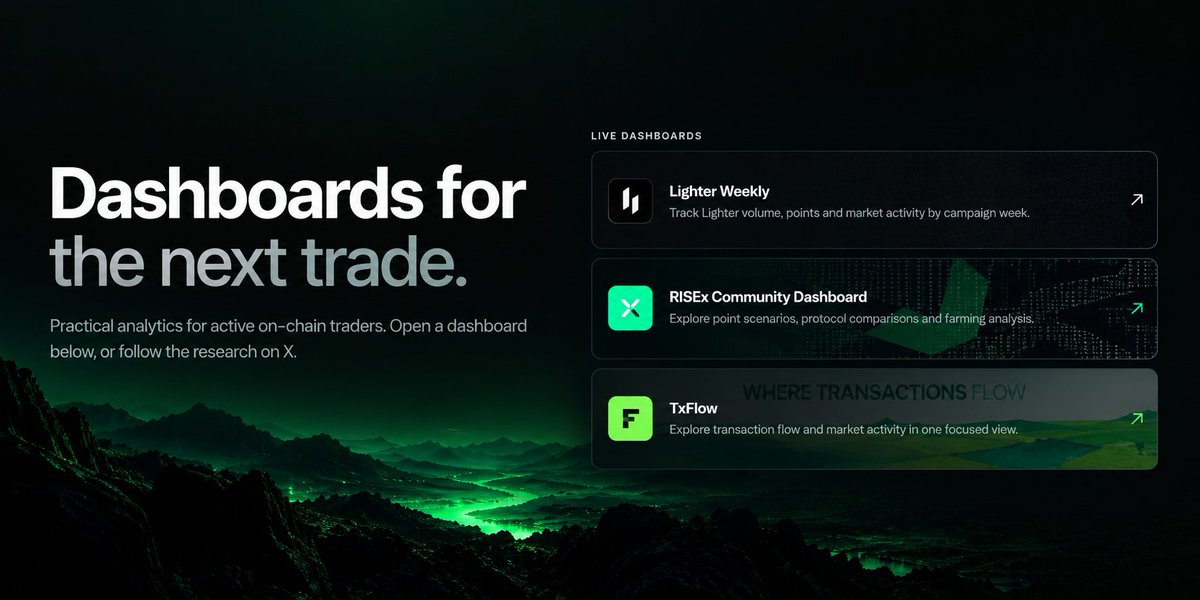
Farming Lighter, RISEx or TxFlow?
These free tools might be useful for you.
Over the past few months, I've been building tools for the 3 Perp DEXs I'm farming the most:
– @Lighter_xyz
– @risextrade
– @TxFlow_L1
The idea behind them is pretty simple: understand how much farming actually costs and what those points could eventually be worth.
Depending on the dashboard, you can:
– Track your trading activity, fees and points.
– Estimate your cost per point.
– Build your own scenarios using different FDVs and airdrop allocations.
– See how your potential rewards compare with your farming costs.
Nothing is guaranteed, of course.
The valuations are just assumptions you can adjust yourself.
I'm not a developer. I've basically taken ideas I had in my head, used ChatGPT and free tools, and slowly turned them into dashboards I actually use for my own farming.
They were scattered across different links, so I've finally put everything in one place.
You'll find it in my X bio. It's the only link on my profile, so it's easy to find.
Everything is free. No subscriptions or paywalls.
I don't make a living from this, and I'm not looking to monetize it.
I just enjoy building things that help me improve my strategies, and sharing them with others.
If you find any of these tools useful, feel free to use them and share them with other farmers.
That's already more than enough for me.
I’ve been looking at the new @Trigr_xyz integration with @ProprXYZ, and I think it raises an interesting question:
Could someone who isn’t an experienced trader use a systematic strategy to attempt a prop firm challenge?
With Trigr, you can build a strategy from a written description or explore existing ones, then test them against Propr’s challenge rules before buying a challenge.
You can also try an agent in paper trading before connecting it to an account.
I find that interesting because it gives people a way to explore a more structured approach without having to make every trading decision themselves.
That said, there’s still a big gap between creating a strategy and finding one that actually works.
A backtest can look good and still fail in live conditions. And while an agent can follow risk rules, it won’t guarantee a funded account or prevent you from losing the challenge fee.
I’d be curious to see how these strategies perform over time, especially in different market conditions.
Has anyone here tried automated strategies for prop firm challenges?
You can join here: https://t.co/lakujzP8ES
Your Trigr agent can now take on a @ProprXYZ challenge.
Build it from your own rules, test it against the real challenge rules, and see how it would have done before you pay.
Start with the odds on your side.
Thinking about starting to farm @risextrade?
You can use my referral to get a 12.5% points boost:
https://t.co/2fHUybiyLw
I've also built a free RISEx Farming Analyzer to help you track your fees, points and real cost per point.
You'll find it in my bio.
Protect capital first. Farm second.
RISEx Week 17: Is farming getting cheaper again?
After several weeks of increasing costs, my latest results show a small improvement.
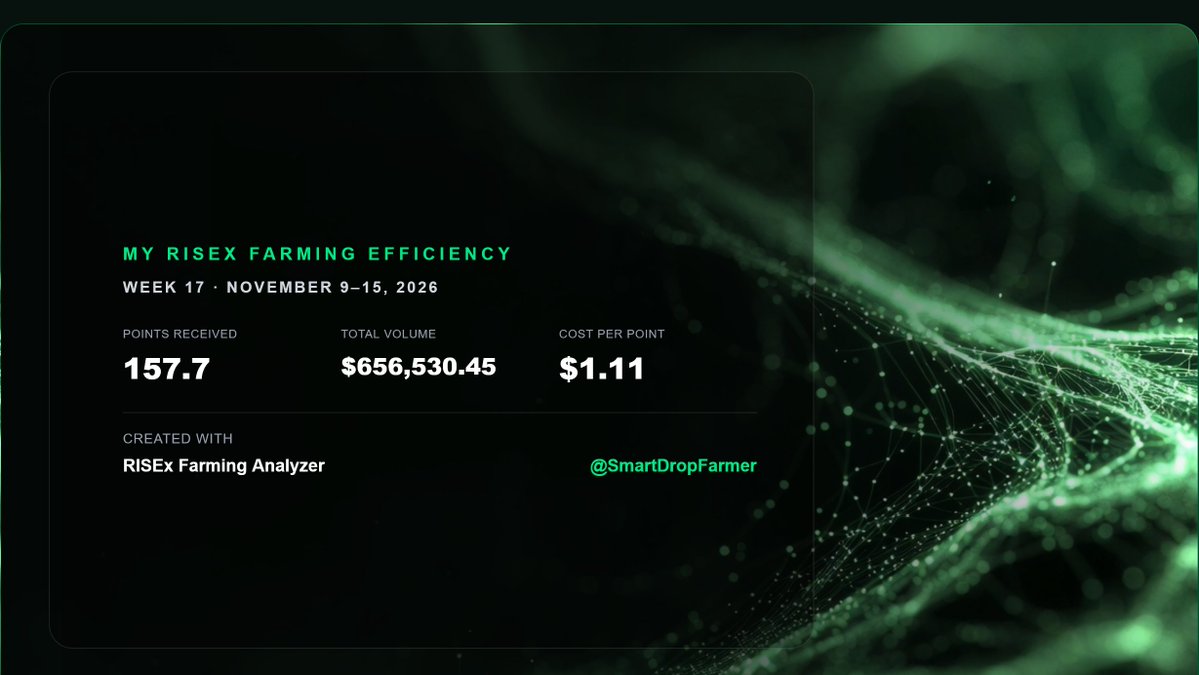
My numbers on @risextrade:
→ 157.7 RISE Points
→ $656.5K trading volume
→ $1.11 per point
Compared to last week:
- W16: 150.87 points | $1.16/point
- W17: 157.7 points | $1.11/point
More points, less volume and a lower cost per point.
And I have a theory about why this might be happening.
The market has been brutal lately.
Liquidations, falling prices, exhausted traders and farmers who are simply getting tired of grinding.
My suspicion is that some liquidated traders aren't coming back immediately, while others are reducing their activity.
If that's happening, competition for points could temporarily ease.
Of course, that's my interpretation, not something I've confirmed with on-chain data.
And personally, I think these are the moments worth paying attention to.
When everyone is excited about an airdrop, farming becomes crowded and expensive.
When markets are painful and people lose interest, opportunities can appear again.
I'm not interested in blindly burning fees.
But as long as I can keep acquiring RISE Points around $1, I still see a very attractive R:R based on my own valuation scenarios.
The key is staying efficient, protecting capital and being willing to farm when others are losing patience.
Sometimes the best farming opportunities appear when nobody feels like farming anymore.
TxFlow Season 1 - Epoch 5: Still farming, but changing my approach.
Another Tuesday, another Points distribution.
I've been reducing my trading volume over the past few weeks, mainly because of market volatility and uncertainty.
My weekly results:
- Volume: ~$200,000
- Points earned: 471
- Fees paid: $94.87
- Cost per Point: $0.2014
That's an improvement from last week's $0.2517, although still above my best week at $0.1520.
I still see @TxFlow_L1 as an interesting farming opportunity, especially if some traders are stepping away from the market.
But I don't want to play the role of a professional futures trader just to accumulate Points.
My plan for the coming weeks:
- Focus on delta-neutral strategies.
- Maintain larger, longer-lasting Open Interest.
- Use more conservative margin levels to withstand volatility.
- Avoid unnecessary trading and fees.
This week, market volatility still forced me to close some positions.
Going forward, I'd rather maintain positions that don't require constant monitoring, while keeping liquidation and funding risks under control.
My goal isn't to maximize volume. It's to accumulate Points at the lowest reasonable cost without taking unnecessary risks.
I still suspect sustained OI could matter more than raw volume, but that's something I'll keep testing.
Want to start farming TxFlow Points or estimate what your current Points could be worth?
My free TxFlow Dashboard:
https://t.co/0SiNBU9VtQ
Calculate your cost per Point and explore different FDV, TGE and future season scenarios.
Start trading on TxFlow (my referral):
https://t.co/UTFarmFsxM
As always, feel free to share your results or any feedback on the dashboard!
This is exactly what I don’t want to see from a crypto project.
@predictdotfun was shaping up to be one of the most promising prediction markets on BNB Chain, with a highly anticipated airdrop.
Then users were given a choice:
- Claim 35% at TGE and give up the remaining 65%
- Receive 100% over 12 months
And now the TGE has been postponed again, with no confirmed launch date.
The team hasn’t said this delay is due to market conditions.
But if the plan is to keep waiting for a better market, I think that sends the wrong message.
From the outside, it feels like they don’t trust the token or the community enough to let the market decide.
And every last-minute change makes it harder for that same community to have confidence in the launch.
Unless there’s significant buying support from backers or elsewhere, I struggle to see why $PREDICT would perform well after TGE.
For me, this was a very passive farm. I’ll take the airdrop, sell and move on.
WHILE EVERYONE IS LOSING INTEREST IN DEFI, SOME PROTOCOLS ARE STILL BUILDING.
And @MeteoraAG is one of those I believe deserves particular attention.
Not just because of its token, but because of the tools it provides to make our capital more productive.
I've been using Meteora for a long time, and its latest announcements at Breakpoint genuinely caught my attention.
Here's what's changing and what's coming next.
1. DLX - TRADING AND LIQUIDITY ARE BECOMING ONE
Probably my favorite announcement.
Meteora is introducing a different way to approach trading through liquidity positions.
- Buy tokens and deploy them directly into LP positions.
- Set Dynamic Limit Orders at your desired entry or exit prices.
- Route orders through available liquidity pools.
- Potentially earn fees or execution incentives while your capital waits.
- Monitor liquidity and price levels through the DLMM orderbook.
This is what I find particularly interesting.
Imagine wanting to buy a token at a specific price.
Instead of simply placing a traditional limit order and waiting, you can structure your position through liquidity.
If the market reaches your range, your liquidity can progressively convert into the asset you want to accumulate, potentially generating trading fees along the way.
You're essentially combining a trading strategy with liquidity provision.
Of course, execution isn't identical to a traditional limit order, and fees aren't guaranteed.
DLX is already available through Meteora Edge.
2. DLMM PRO - MORE TOOLS FOR LIQUIDITY PROVIDERS
Meteora is taking its concentrated liquidity infrastructure further.
Currently in beta:
- LP-created pools.
- NFT positions with up to 45 price ranges.
- Native limit orders.
- Customizable fee structures.
- Price increments as small as 0.01%.
- Open SDK for developers.
More flexibility for LPs and more possibilities for protocols launching tokens.
3. PROJECT HYPERNOVA - LOOKING TOWARD 2027
Meteora also presented its longer-term ecosystem expansion plans.
Two main areas:
> Founder Track
- Better tools and support for token launches.
- Hackathons and developer initiatives.
- Improved documentation.
- Exploration of new tokenization opportunities.
> Creator Track / @met_lparmy
- Improvements to MET Referral Staking.
- More community initiatives.
- Support for educators and content creators.
These are roadmap plans rather than features already available.
4. WHY I'M PAYING ATTENTION
Markets go through cycles.
When prices fall and interest disappears, it's easy to overlook protocols that are actually improving their products.
But this is precisely when I like researching them.
Meteora is trying to make liquidity provision more accessible, flexible and integrated into trading.
And that could matter for two reasons:
- As a user: More ways to manage capital, accumulate assets and potentially generate fees.
- As an investor: If these improvements attract additional trading volume and generate more protocol fees, they could strengthen the long-term investment case for $MET.
Of course, protocol success doesn't automatically translate into token appreciation.
For that to happen, there needs to be a meaningful mechanism connecting protocol activity with token value.
That's something worth monitoring rather than assuming.
> MY TAKE
I've always believed that some of the best DeFi opportunities aren't necessarily the protocols offering the highest APR.
They're the ones building infrastructure that changes how we use our capital.
And with DLX, DLMM Pro and Hypernova, Meteora is showing that it still has plenty of ideas to explore.
While others lose interest, I'm keeping a close eye on the protocols that continue building.
DLX is already available on Meteora Edge, where you can explore the new trading and liquidity experience, including Dynamic Limit Orders.
Find the link in the first comment
Anyone already testing it?
I’ve been looking into Zero, @LayerZero_Core’s new blockchain, which is scheduled to launch on November 30.
But with the market looking like this, I have a question:
Are you actually interested in exploring a new ecosystem right now?
Zero is LayerZero’s own L1, designed to use ZK proofs and parallel execution to scale. It’s also launching alongside ATLAS, infrastructure designed to power trading across different markets.
The technology sounds interesting, but launching a new network in these conditions feels risky. Plenty of projects will appear, and realistically, many of them won’t make it.
Still, I think it’s worth looking for the ones that stand out. I’m already researching:
- NFT collections
- DeFi protocols
- Games
- Trading apps and other early projects
Would you like me to share what I find and how I’m positioning myself, or are you staying away from new ecosystems for now?
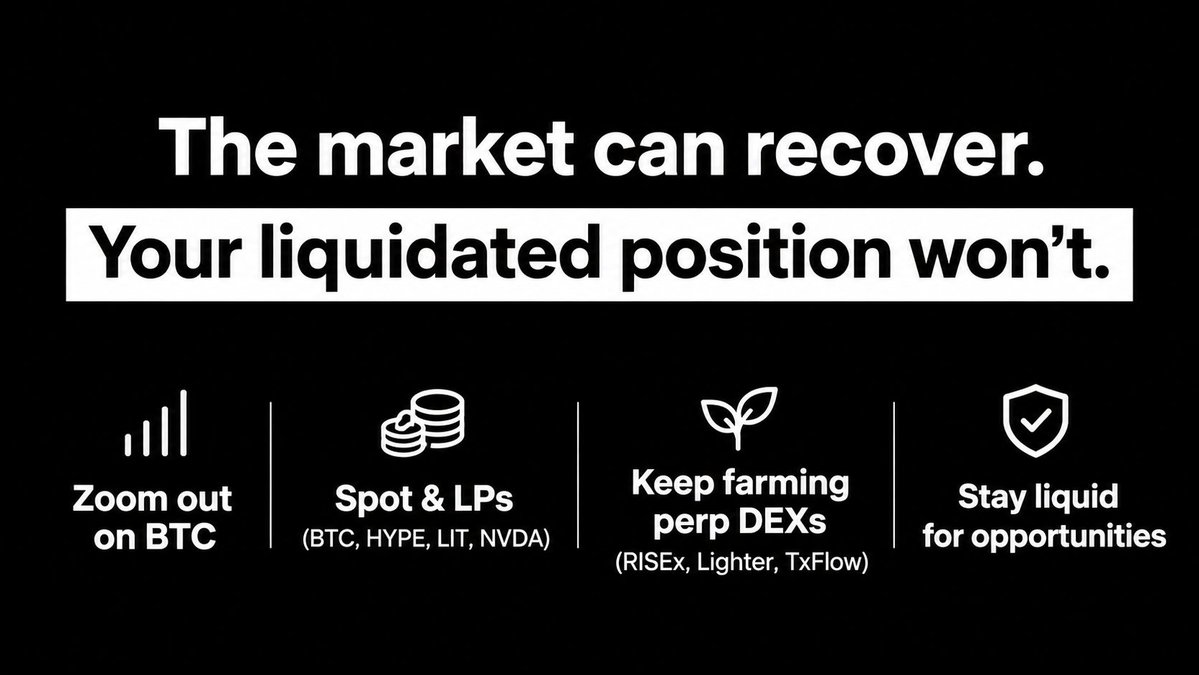
THE MARKET CAN RECOVER. YOUR LIQUIDATED POSITION WON'T.
BTC has taken a serious hit, and sentiment feels worse than at previous lows.
But let's zoom out:
- A few months ago: BTC around $58K.
- Recently: $85K.
- Now: back near $65K.
And somehow, sentiment feels worse than ever.
I'm still bullish as long as $58K holds. But I'm changing my strategy.
1. I'M MOVING AWAY FROM FUTURES
I'm reducing directional leveraged trades.
Why?
- If BTC drops 20% in spot, I still own my BTC.
- If I get liquidated, that money is gone.
- Even if BTC reaches new ATHs, my liquidated position won't recover.
I don't want to be right about the market and still lose everything.
2. WHAT I'M DOING INSTEAD
I'm focusing on spot accumulation and liquidity pools.
My main exposure:
- BTC: My strongest long-term conviction.
- HYPE: My bet on the future of perpetual DEXs.
- LIT: Exposure to Lighter, a potential Hyperliquid competitor.
- NVDA: My bet on long-term AI infrastructure.
I'm also providing liquidity in selected pools involving HYPE, LIT and NVDA-related assets.
If prices fall below my LP ranges, I'm comfortable accumulating assets I want to hold.
Of course, LPs still involve IL, smart contract and liquidity risks.
3. WHY THESE ASSETS?
My thesis is simple:
- Bitcoin remains my strongest crypto conviction.
- Profitable perpetual DEXs with sustainable tokenomics could become major winners as adoption and regulation evolve.
- AI infrastructure will remain an important long-term narrative.
None of these assets is guaranteed to recover.
But I'd rather own assets I believe in than risk liquidation trying to catch the bottom.
4. NOBODY KNOWS THE BOTTOM
Everyone wants the perfect entry.
Almost nobody gets it consistently.
I'd rather accumulate gradually than gamble with leverage.
Could BTC revisit $58K or break below it? Absolutely.
That would make me reassess my thesis.
Until then, I'm cautiously bullish.
5. I'M STILL FARMING PERPETUAL DEXs
And I think this is an interesting time to continue.
- Traders are getting liquidated.
- Sentiment is terrible.
- Farmers are exhausted.
- Many are giving up.
That's exactly when I want to keep accumulating points.
My main protocols:
- RISEx
- Lighter
- TxFlow
But I'm farming with a different approach:
- Delta-neutral strategies.
- Stablecoins as collateral.
- Limited directional exposure.
- Monitoring fees and cost per point.
- Avoiding excessive diversification.
Farming isn't free or risk-free.
But if these points eventually convert into tokens during a stronger market in 2027, today's farming could prove valuable.
That's my bet, not a guarantee.
6. KEEPING LIQUIDITY FOR REAL CAPITULATION
I'm also keeping stablecoins available across my perp DEX positions.
If BTC approaches $60K and everyone starts calling for $40K, I may reduce my farming exposure.
Why?
Because buying more BTC during extreme fear could offer a better risk/reward than accumulating additional points.
I won't catch the exact bottom.
But I want liquidity available when opportunities appear.
MY STRATEGY RIGHT NOW
- Less directional leverage.
- More BTC, HYPE and LIT through spot and selected LPs.
- Continue farming RISEx, Lighter and TxFlow with delta-neutral strategies.
- Keep liquidity available for a potential BTC capitulation.
I'm still bullish on crypto and perpetual DEXs.
I just want to survive long enough to benefit from the next cycle.
Surviving the market is part of winning it.
Yesterday was Friday, another @Lighter_xyz points distribution on Robinhood Chain.
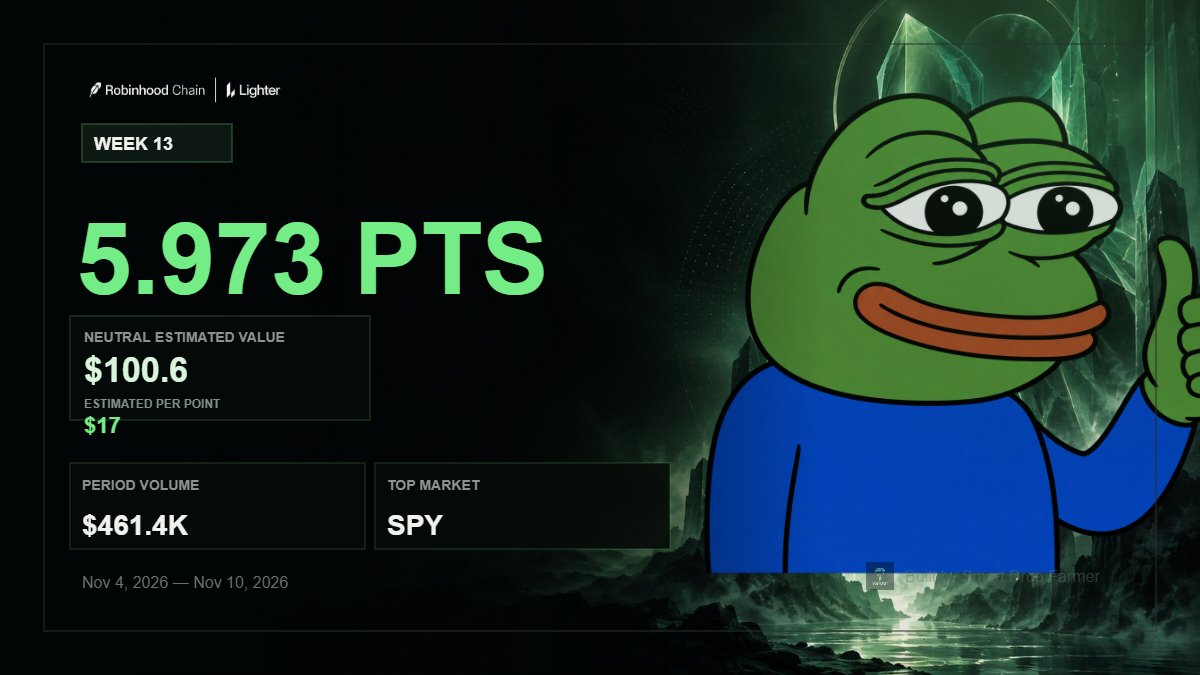
Week 13 results:
→ 5.973 points
→ $461K trading volume
→ SPY as my main market
Quite a drop compared to previous weeks.
W9: $845K → 10.87 pts
W11: $1.13M → 12.10 pts
W12: $840K → 10.14 pts
W13: $461K → 5.97 pts
But there's a reason behind it.
With the market being so turbulent lately, I've reduced my trading activity quite a bit.
My average Open Interest has also dropped from around $50K to $25–30K.
And interestingly, the points have fallen almost proportionally.
This reinforces my theory that OI could be playing an important role in points distribution, although eligible volume probably matters too.
But there's something else I've noticed.
I've seen more and more users complaining about how difficult it's becoming to earn points.
And even traders paying for Premium accounts don't seem particularly happy with their distributions.
So it doesn't look like switching to a paid account automatically solves the problem.
> The bad news?
Earning points seems to be getting harder, competition is increasing, and we still don't know when the campaign will end.
> The good news?
Standard accounts still offer zero trading fees.
And for someone like me, using Lighter alongside @risextrade for delta-neutral arbitrage, that's a huge advantage.
I can continue looking for trading opportunities without forcing unnecessary volume just to chase points.
> My takeaway
Fewer points this week, but also less capital exposed and less trading activity.
I'm increasingly treating the points as an extra reward on top of my arbitrage strategy, rather than the main reason to trade.
And as long as I can keep my costs low, I'm happy to continue farming.