Research Radar | Multi-Cytokines at the Bedside: When One Cytokine Isn’t Enough
Can six cytokines, measured at the point of care, help identify sepsis immunoparalysis earlier?
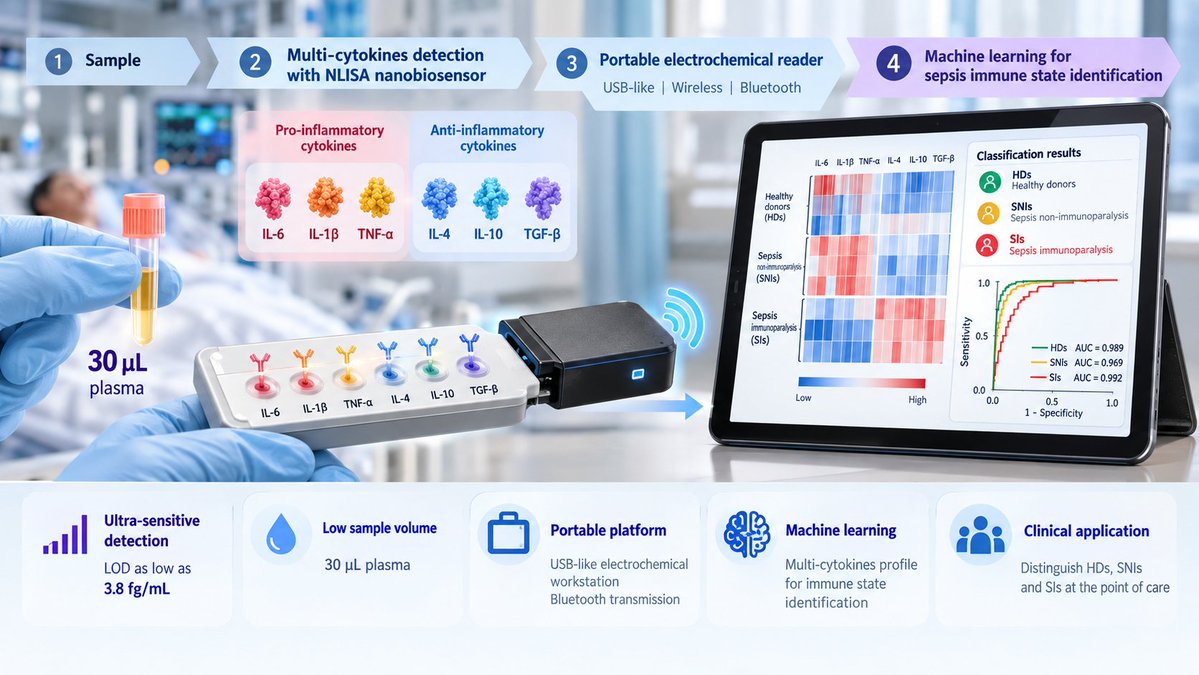
Sepsis immunoparalysis (SIs) remains difficult to identify rapidly in emergency and intensive care settings. To address this, Chineses researchers from Chongqing Medical University and its affiliated hospitals, together with the Affiliated Hospital of Southwest Medical University developed a portable nanobiosensor based on Nanozyme-Linked Immunosorbent Assay (NLISA) for point-of-care testing of six cytokines: IL-6, IL-1β, TNF-α, IL-4, IL-10, and TGF-β. The system requires only 30 μL of plasma and achieved detection limits as low as 3.8 fg/mL.
The portable platform uses a USB-like wireless electrochemical workstation to convert biological signals into electrical signals, with results transmitted via Bluetooth to a smartphone or tablet and available for further data processing.
The study found that Multi-Cytokines analysis provided better discrimination than single cytokines and conventional clinical indicators such as CRP, PCT, serum albumin, and total lymphocyte count. To further improve differentiation among SIs, sepsis non-immunoparalysis (SNIs), and healthy donors (HDs), the researchers applied machine learning to Multi-Cytokines concentration data.
In the machine-learning analysis, 300 clinical samples were divided into a training cohort of 210 and an independent validation cohort of 90, with different cytokine combinations evaluated using multiple algorithms. These machine-learning models showed strong discrimination across the three groups.
The study highlights a practical direction for sepsis POCT: combining portable Multi-Cytokines detection with machine learning to support the early identification of SIs and enable more flexible diagnostic strategies in different clinical settings.
Reference: Yu, R., Wu, J., Chen, A., Xue, J., Guo, S., Chen, S., Dong, S., Li, L., Gui, X., Wang, L., Tian, G., Liu, G., Qiu, J., Chen, W., A portable nanobiosensor with machine learning: enabling multi-cytokines point-of-care testing and early identification of sepsis immunoparalysis, J. Nanobiotechnol., 24, 845, 2026.
#Sepsis #PointOfCareTesting #POCT #MachineLearning #Biosensors #LaboratoryMedicine #Cytokines #DigitalDiagnostics
Diagnostics Update | Unilabs Expands Digital Pathology and AI Across Europe
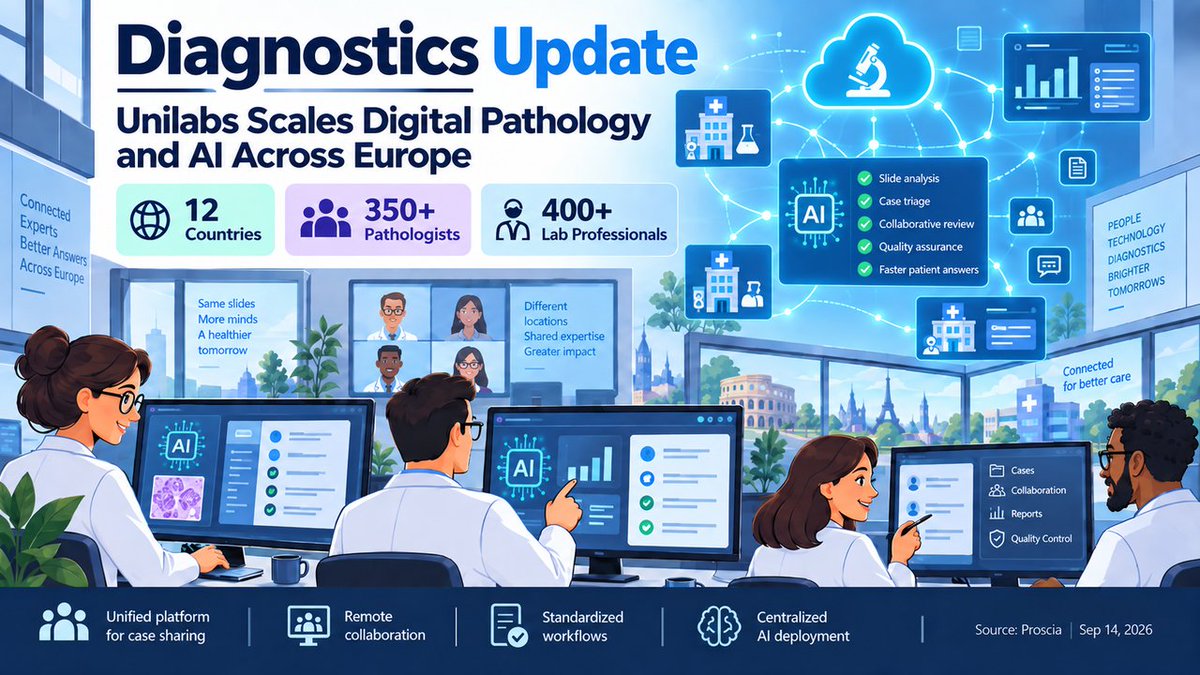
Unilabs is scaling a unified digital pathology platform across its European network, connecting 350+ pathologists and 400+ laboratory professionals across 12 countries.
The platform supports case sharing, remote collaboration, workflow standardization, workload distribution, and centralized deployment of AI applications. Several countries are already using it for routine diagnostic workflows, with further expansion planned through 2026.
The move reflects a broader shift in laboratory medicine: from isolated AI tools toward integrated, multi-site digital infrastructure that embeds AI into real-world clinical workflows.
Source: Proscia, September 14, 2026
https://t.co/Vtf0emJFnv
#DigitalPathology #LaboratoryMedicine #AI #DigitalHealth #PrecisionMedicine
Research Radar | CRISPR on a Smartphone: When Visual Reading Isn’t Enough
What happens when a CRISPR test is positive—but the signal is too faint for the human eye to call confidently?
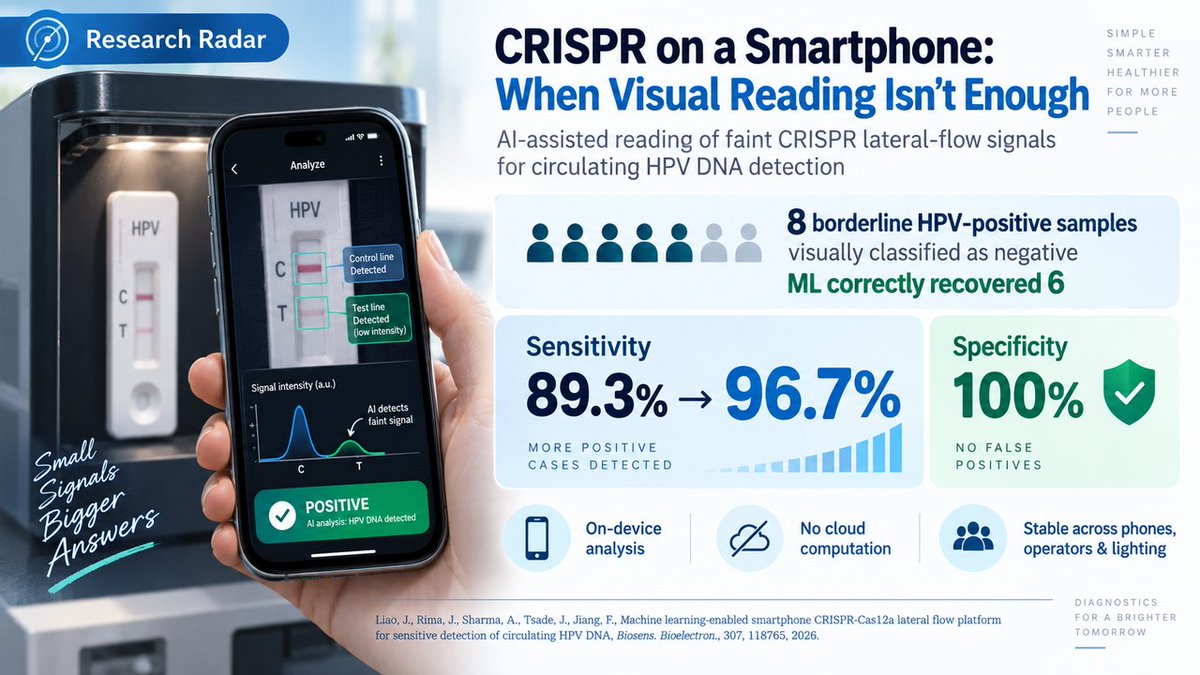
In a development cohort of 150 plasma samples, eight HPV-positive samples produced borderline CRISPR lateral-flow bands that were visually classified as negative. A smartphone-based machine-learning model correctly recovered six of them, improving sensitivity from 89.3% to 96.7%, while maintaining 100% specificity.
The system combines CRISPR-Cas12a detection with lateral flow assay (LFA) readout, standardized smartphone imaging, and interpretable machine learning to detect circulating HPV DNA in plasma.Instead of relying on band intensity alone, the model integrates multiple quantitative image features to distinguish weak positive signals from true negatives.
Importantly, the analysis runs entirely on-device, without cloud-based computation, and remained stable across different smartphones, operators, and lighting conditions.
The value here is not simply adding AI to CRISPR. It is turning a visually interpreted molecular test into a more quantitative, reproducible, and deployable point-of-care diagnostic workflow.
Reference: Liao, J., Rima, J., Sharma, A., Tsade, J., Jiang, F., Machine learning-enabled smartphone CRISPR-Cas12a lateral flow platform for sensitive detection of circulating HPV DNA, Biosens. Bioelectron., 307, 118765, 2026.
Diagnostics Update | AI Governance in Laboratory Medicine
AI is moving deeper into laboratory medicine — and the regulatory conversation is moving with it.
Recent statements from ADLM and ASCP highlight a shared concern: when AI or software analyzes laboratory data and contributes to patient-specific results, how should its performance, quality and accountability be governed?
ADLM has called for updates to CLIA that better address AI-specific risks, including validation, ongoing performance monitoring and integration into laboratory quality systems.
ASCP, meanwhile, has challenged the idea that software-based analysis of laboratory data could operate outside CLIA oversight simply because the analysis is performed by an algorithm rather than laboratory personnel.
Together, these discussions point to an important shift:
The question is no longer only whether AI can be used in the laboratory, but how it should be validated, monitored and governed once it becomes part of the diagnostic workflow.
Sources: Association for Diagnostics & Laboratory Medicine (ADLM), Sept. 2026 ; American Society for Clinical Pathology (ASCP), Sept. 2026.
#LaboratoryMedicine #ArtificialIntelligence #AI #Diagnostics #ClinicalLaboratory #DigitalHealth
Diagnostics Update | AMR Surveillance
AMR surveillance is moving closer to the routine laboratory workflow.
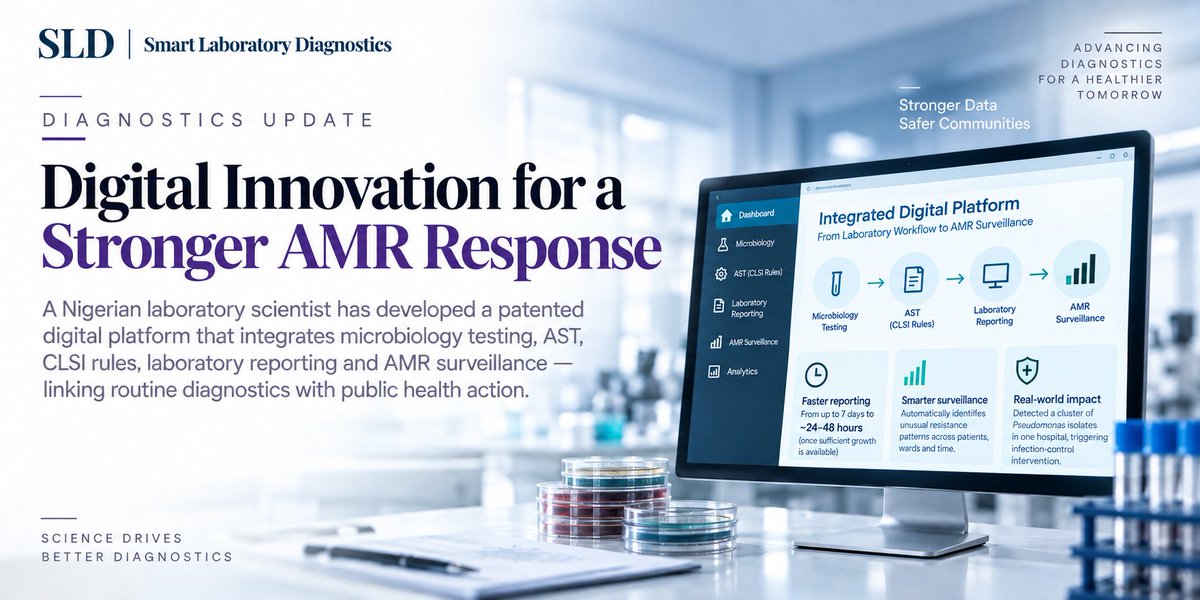
A patented digital platform developed in Nigeria integrates microbiology testing, antimicrobial susceptibility testing, CLSI-based rules, laboratory reporting and resistance surveillance into a single workflow. In early implementation, reporting time was reduced to about 24–48 hours once sufficient growth was available, while the system also identified unusual resistance patterns across patients, wards and time periods.
In one hospital deployment, the platform detected an unusual cluster of Pseudomonas isolates within about a week, prompting infection-control action. The case shows how routine laboratory data can move beyond individual reporting to support continuous AMR surveillance, antimicrobial stewardship and earlier outbreak detection.
🔗 Source: Vanguard News https://t.co/z68EeQEih5
#AMR #LaboratoryMedicine #Microbiology #AntimicrobialResistance #LaboratoryInformatics #PublicHealthSurveillance
Diagnostics Update | The Next Step in AI Pathology
AI pathology is entering a new phase. Instead of only classifying static images, emerging systems are beginning to learn how pathologists actually work—where they look, when they zoom, and how they gather evidence across a whole-slide image.
A new Nature Biomedical Engineering study demonstrates this shift with Pathology-CoT, using expert viewing behaviour to train an AI pathology agent.
The broader trend is clear: digital pathology is moving from image recognition toward interactive, behaviour-aware diagnostic agents that are more closely aligned with real clinical workflows.
Source:https://t.co/smZI1WOraY
#AIPathology #DigitalPathology #LaboratoryDiagnostics #MedicalAI
Research Radar | Vibe Coding in Laboratory Medicine: When “It Works” Isn’t Enough
Generative AI is making it possible for laboratory professionals to build scripts and clinical tools through simple prompts—even without formal programming training.
But a recent Clinical Chemistry and Laboratory Medicine opinion paper warns of an important “illusion of competence.” AI-generated code may look professional and work in a few test cases, while still hiding logic errors, unhandled edge cases, security vulnerabilities, or missing clinical safeguards.
The authors use CBC autoverification as a telling example. A safe system must account for instrument flags, QC results, delta checks, critical values, patient-specific information, and hundreds of interdependent rules. Missing even one condition can allow errors to pass silently through the laboratory workflow.
And the risks go beyond code accuracy. Vibe coding can also raise concerns around patient-data privacy, software supply chains, validation, traceability, and regulatory compliance.
Still, the message is not “don’t use AI.” The authors see real value in vibe coding for rapid prototyping and proof-of-concept development. The key distinction is simple:
A prototype is not a clinical product.
Before AI-generated software enters patient-care workflows, it needs professional software development, formal validation, risk management, and multidisciplinary oversight.
#LaboratoryMedicine #VibeCoding #GenerativeAI #ClinicalLaboratory #PatientSafety #DigitalHealth
Diagnostics Update | AI Regulation
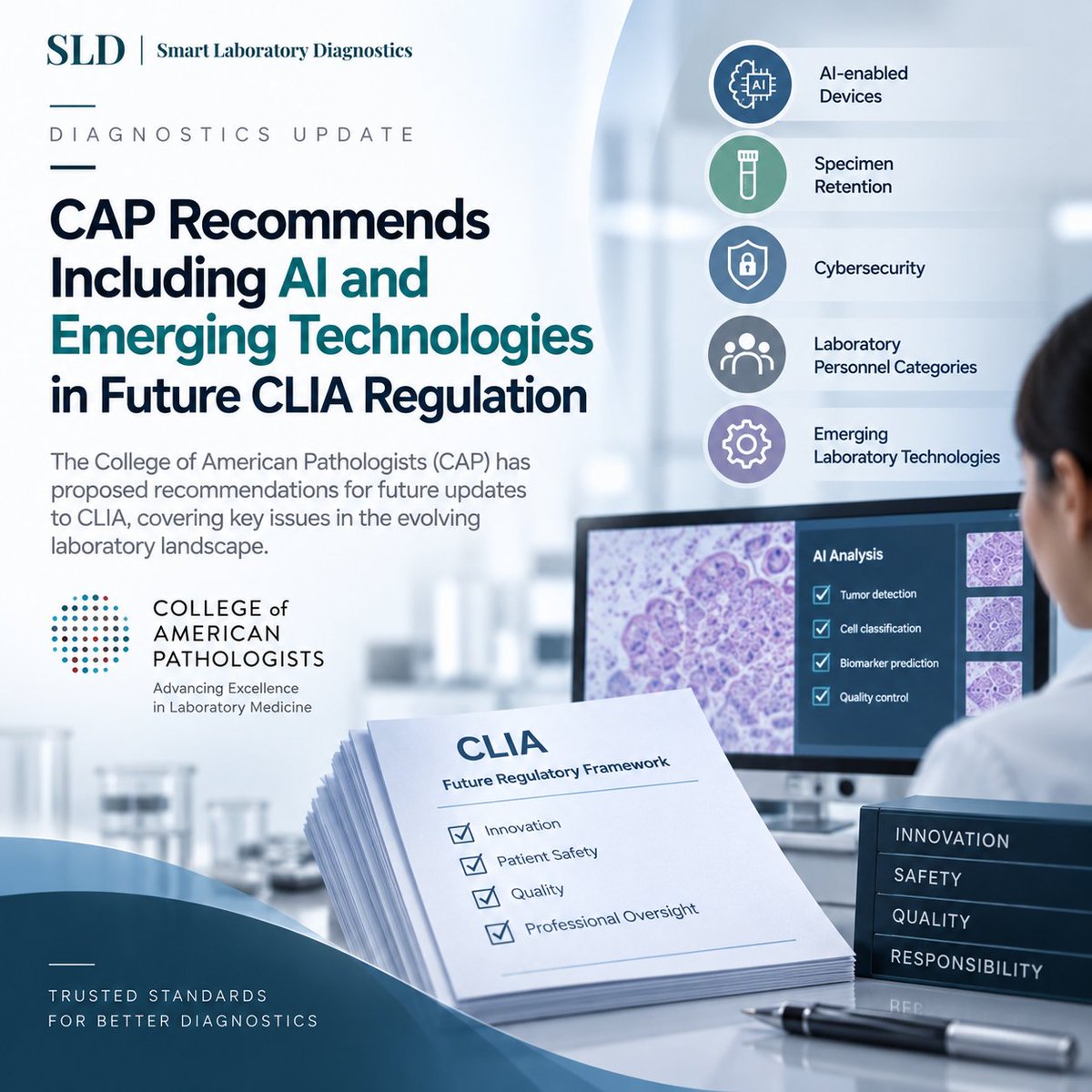
As AI and emerging technologies move deeper into clinical laboratories, regulation is beginning to catch up.
The College of American Pathologists (CAP) has submitted recommendations for future updates to CLIA, covering AI-enabled devices, cybersecurity, specimen retention and emerging laboratory technologies. CAP emphasizes that AI should assist—not replace—professional diagnostic interpretation, with pathologists retaining responsibility for patient care decisions.
The message is clear: future laboratory regulation will need to balance innovation, quality and patient safety.
🔗 Source: CAP https://t.co/D517iDW7CV
#ArtificialIntelligence #LaboratoryMedicine #CLIA #DigitalPathology #LaboratoryQuality #Diagnostics
Diagnostics Update | ctDNA-Guided Therapy
The FDA has approved camizestrant plus a CDK4/6 inhibitor for ESR1-mutant advanced breast cancer, with ctDNA testing helping identify resistance before radiographic progression.
The approval highlights the growing role of liquid biopsy and companion diagnostics in guiding precision cancer treatment.
🔗 Source: Targeted Oncology https://t.co/JDrNvLon9g
#ctDNA #LiquidBiopsy #MolecularDiagnostics #PrecisionOncology #CompanionDiagnostics
Can AI simulate different immunotherapy strategies before treatment decisions are made?
Developed by Lei Zhou, Yingjie Tan and colleagues at the Third Xiangya Hospital, Central South University, GI-ImmunoWorld draws on multimodal data from 2,847 patients to model changes in the tumor immune environment, predict immunotherapy response and explore treatment timing, combinations and sequencing. https://t.co/V7aJhxFgvg
#AI #Immunotherapy #CancerResearch #SLD
SLD is an academic platform dedicated to advancing communication in intelligent laboratory diagnostics.
At SLD, our vision is to foster academic exchange in the field by connecting experts across disciplines to share knowledge, ideas, and perspectives
#SLD#LaboratoryMed