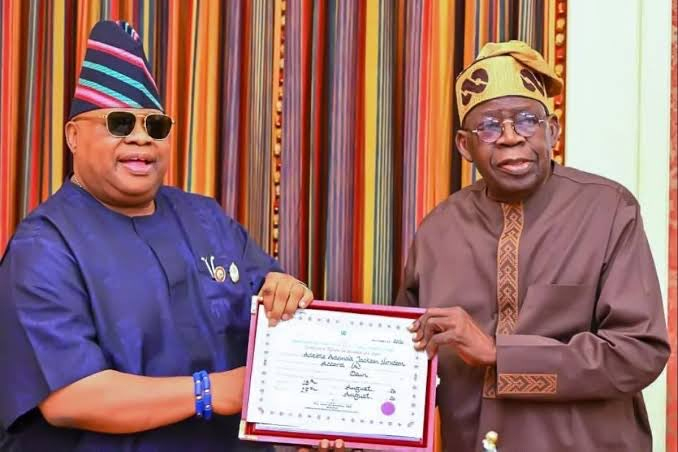
The APC Campaign Council: Nigerians Deserve a New Direction
I have taken note of the recently constituted APC Presidential Campaign Council, whose composition offers Nigerians a clear picture of the choice before us in the 2027 general election.
The council brings together many of the same political actors who have supported, defended or participated in the present administration. Their coming together raises a fundamental question: what exactly are they asking Nigerians to vote for in 2027, a new beginning, or the continuation of the same system that has brought severe hardship to our people?
The truth is, I see the 2027 election as a struggle between the oppressed Nigerian masses and those who have benefited from, defended and sustained the system responsible for their hardship.
It is concerning to all well-meaning Nigerians whose across the country, their families are struggling with the rising cost of food and basic necessities. Young Nigerians face unemployment and diminishing opportunities. Farmers and businesses are struggling to survive, while millions continue to live with insecurity. Our education, healthcare and other essential public services remain under enormous pressure.
This ruling campaign structure presents another scenario between the oppressors and the oppressed. We must use it come 2027 election to reject continued oppression and demand accountable, people-centred governance. If Osun people can do it, so can all other parts of the country.
I particularly appeal to my brother, Senator Abdul’aziz Yari, who has accepted to serve as Director-General of the APC Presidential Campaign Council, to reflect deeply and reconsider accepting this responsibility.
As a former governor of Zamfara State and a prominent leader from the North-West, I believe Senator Yari has a clear understanding of the devastating consequences of insecurity, poverty, unemployment, displacement and the destruction of livelihoods in the region and the country at large.
I therefore will be surprised if in his good conscience, will lead a campaign whose principal objective is to secure the continuation of a government under which many of the people he once governed, and other innocent Nigerians remain trapped in these challenges?
There is also a serious institutional question concerning the inclusion of the Executive Chairman of the Nigeria Revenue Service, Dr Zacch Adedeji, and the Director-General of the Budget Office of the Federation, Dr Tanimu Yakubu Kurfi, in the campaign’s fundraising and finance structures.
The leadership of critical public institutions demands neutrality, integrity and public confidence. It is therefore legitimate to ask whether the responsibilities of senior officials entrusted with managing public revenue and national finances can appropriately coexist with senior partisan campaign roles.
The government and the APC should explain how such arrangements are consistent with institutional neutrality and public trust.
Ultimately, no campaign council is more powerful than the Nigerian people. - RMK
Tomorrow, you'll refer to TY Danjuma's great grandchildren as OLD MONEY.
You'll worship the ground they step on, and even apply to be their schedule managers.
Meanwhile, what was the salary of an Ex- Service Chief?
How did he grow to aquire such level of wealth?
No questions, just outright worship.
Nigeria Cannot Become a Killing Field
What is happening to our country?
In recent days, deadly attacks have struck Benue, Plateau and Niger States, three contiguous states in Nigeria’s North-Central region.
In Mangu, Plateau State, at least 23 people were officially reported killed in the Jwak Maitumbi attack, while residents put the toll above 30. More than 45 houses were reportedly destroyed. In Borgu, Niger State, recent attacks reportedly killed over 40 people and abducted more than 100, though the figures remain contested.
This comes amid continuing violence in Benue, where communities face repeated killings, abductions and the destruction of homes and livelihoods.
Nigeria is not officially at war, yet citizens are being attacked in their villages, abducted after prayers, driven from their homes and stripped of their farms.
What is happening in Benue, Plateau and Niger is similar to what is happening elsewhere in the country, with some attacks even going unreported. The violence across these states must no longer be treated as isolated incidents. It is a national security emergency requiring urgent and coordinated action.
I urge governments at all levels to wake up to their responsibility and take urgent and decisive action to end this madness once and for all.
Government must protect vulnerable communities, improve intelligence and rapid-response capabilities, rescue abducted Nigerians, and arrest and prosecute those responsible.
We cannot keep counting bodies after every attack. We must prevent these attacks before they happen.
Protecting lives and property is the most basic duty of government. Nigerians deserve nothing less.
Nigeria must not become a killing field. -PO
I have consistently continued to respectfully appeal to those in office today to prioritise reconstruction and maintenance of existing roads and other infrastructure over commencing new ones.
I left someone in Onitsha on Saturday night to take the first bus to Lagos on Sunday morning. Until I left Lagos at 8 pm yesterday, he had not arrived in Lagos. He only arrived in Lagos at about 2 pm today. A journey that usually takes a maximum of 8 hours now takes nearly two days.
This is not just about bad roads. It is about lost man-hours, stranded passengers sleeping on highways, wasted fuel, damaged vehicles, delayed goods, and businesses losing millions of naira.
Nigerians do not need new projects just for the headlines. We need functional roads that make life and economic activity possible.
A government must understand that infrastructure is not necessarily about the size of the project; it is about the number of lives and livelihoods it improves.
A new Nigeria is POSSIBLE, and Nigeria will be OK. -PO
If you actually ruminate the indices considered in this assessment, you’ll agree with me it is largely underestimated.
-• Household purchasing power
-• Inflation
-• Job creation
-• Living standard (Sanitation, water supply, electricity, cooking ‘fuel’).
-• Healthcare access (affordable functional health facilities).
-• Housing quality (structural safety of dwellings).
You want to tell me 37% (103million Nigerians) can comfortably afford these right now?? Lmao!
World bank is being diplomatic tbh.
You buy palm oil from the market, and you'll discover its been adultrated with artificial colour.
The chicken sold to you by your aboki vendors died of questionable sickness while some were slaughtered prematurely... In addition to all that, you'll buy those wings and see them pure red in colour.
Many still buy and eat, and when they start having kidney failure, they'll call village people.
In all these, we have a NATIONAL AGENCY FOR FOOD AND DRUG ADMINISTRATION CONTROL (NAFDAC) that's not interested in taking these toxins and poisins outta circulation.
Above all, we have a government that is only interested in its reelection.
Pathetic!!!
One interesting thing most people don't know, is that some of the efforts to get Bola Ahmed Tinubu to disclose his academic credentials before now, started with Gani Fawehinmi.
So, in 2001, Chief Gani Fawehinmi submitted a petition to the Nigeria Police Force alleging that Bola Ahmed Tinubu, then the Governor of Lagos State, had made false declarations and submitted forged documents to the Independent National Electoral Commission (INEC) in his nomination forms.
Gani Fawehinmi requested Musiliu Smith, who was the Inspector General of Police then, to investigate the allegations.
But Musiliu Smith and the Nigeria Police refused to investigate Bola Ahmed Tinubu, arguing that he was a sitting governor protected by constitutional immunity.
Most people would have stopped there.
But Gani Fawehinmi did not.
Following the police's refusal to act, Chief Gani Fawehinmi dragged the Inspector General of Police to court, seeking an Order of Mandamus to compel the police to perform their statutory duty by investigating the alleged crime.
Now you may ask, "What is an Order of Mandamus?"
I will tell you.
An Order of Mandamus is a command from a court that forces a government official or public body to do a job they are legally required to do, but have refused to perform. End.
When the case came before Justice Egbo-Egbo of the Lagos Federal High Court, the Nigeria Police argued that Gani Fawehinmi lacked the legal right (locus standi) to institute the action because he was not directly injured by the Governor's alleged false declaration.
The Federal High Court accepted the argument of the Nigeria Police and dismissed the case.
But Gani Fawehinmi refused to give up.
He proceeded to the Court of Appeal.
At the Court of Appeal, the judges took a more liberal position.
They held that Gani Fawehinmi indeed had the legal right to institute the case.
However, the Court of Appeal still held that because the police's power to investigate is discretionary, a court could not use an Order of Mandamus to compel them to investigate a sitting governor.
Again, Gani Fawehinmi was not satisfied.
So he took the battle to the Supreme Court.
That was where the case took a dramatic turn.
The Supreme Court carefully considered his arguments and drew a very important legal distinction between investigation and prosecution.
The court reasoned that although Section 308 of the 1999 Constitution grants the President, Vice President, Governors and Deputy Governors absolute immunity from civil and criminal proceedings while in office, that immunity does not prevent the police from investigating them.
The Supreme Court further explained why such investigations are necessary.
It held that evidence gathered against public office holders while they are still in office can be preserved and immediately used to prosecute them the very moment their constitutional immunity expires.
Lastly, the court held that the police have a mandatory statutory duty under the Police Act to investigate alleged crimes.
Because that duty is a public duty, the court ruled that an Order of Mandamus can be issued to compel the police to perform it whenever they fail or refuse to do so.
That was how Gani Fawehinmi won the case.
However, the unfortunate thing is that even though Gani Fawehinmi won the legal argument regarding the police's constitutional power to investigate a sitting governor, the police still chose not to act on the judgment or press criminal charges.
From May 10, 2002, when the Supreme Court delivered its judgment, to today, July 1, 2026, it has been exactly 24 years, 1 month, and 21 days.
Yet Nigerians are still asking President Tinubu for his credentials.
Without success.
I went into a sachet water production plant, and i cried when i saw the environment, the floor and the water tank, i shed tears.
We don't have an active food protection agency in Nigeria!
SOMETHING IS HAPPENING TO THE FOOD WE EAT AND NIGERIA NEEDS TO START ASKING SERIOUS QUESTIONS
When was the last time you personally saw a major, sustained food-safety inspection in your local market?
I ask because Nigerians are beginning to notice changes in the food we buy, and instead of dismissing every observation as nostalgia, perhaps we should start asking questions.
Vegetables that people remember releasing deep-green pigments during washing or cooking sometimes don't behave the same way.
Some varieties of yam no longer cause the itching people traditionally associated with handling certain yams.
Potatoes don't always leave the same stains on the hands.
Some ginger sold today seems to have nowhere near the aroma or pungency people remember.
And then there is beans.
Ask older Nigerians how long beans used to take to cook, then compare it with some beans bought today. In certain cases, the difference can be remarkable.
But here is where we must separate legitimate concern from speculation.
None of these observations, by themselves, proves that chemicals are being added to our food. Crop variety, maturity, soil conditions, breeding, storage, transportation and post-harvest handling can significantly change colour, texture, aroma and cooking characteristics.
That is precisely why regulators should be investigating rather than leaving Nigerians to speculate.
NAFDAC's own mandate includes regulating food and chemicals, preventing substandard and unwholesome products from reaching consumers, and combating adulterated products. Its current strategic plan even sets a target of 800 surveillance operations annually.
So Nigerians deserve to see the evidence of that surveillance where food actually changes hands.
What pesticide residues are being detected in our vegetables?
What chemicals are traders using to preserve produce?
Are substances being used to accelerate ripening, soften food or extend shelf life?
Are beans being chemically treated anywhere along the supply chain?
How frequently are random samples of beans, yam, vegetables, ginger and other staples taken from Nigerian markets and subjected to laboratory analysis?
These are questions for NAFDAC, the Federal Ministry of Health, agricultural regulators, research institutes and state authorities.
And this isn't paranoia. Nigeria already has laws prohibiting counterfeit, adulterated and unwholesome processed foods, while NAFDAC's own food-safety framework requires controls against food-safety hazards.
We shouldn't have to wait until people start falling sick before asking what is entering our food chain.
If the food has changed because agriculture has changed, explain it.
If new varieties are responsible, tell us.
If storage practices are responsible, educate us.
And if dangerous chemicals are being used anywhere between the farm and our plates, FIND THEM.
Food safety should not be something Nigerians have to investigate with their noses, palms and cooking pots.
And nobody in that country is asking questions how a man can randomly gift another person 500 million Naira?
This is a £250,000 gift.
What exactly is your source of income and your current financial status that you casually give away such money as birthday gift? What is going on that is being packaged as birthday gift?
But of course, to empty-brained money-worshipping sycophants, asking this kind of question must mean you have “envy”, and not that you genuinely wonder what kind of jungle society allows such huge amount of money to exchange hands and nobody is alarmed.
Because if the figures are accurate and the news is true, then we are doomed as a country if people can casually move £250,000 in the name of a birthday and nobody (in the positions to check) has enough brains to ask any questions.
Nigeria is a painful tragic joke.
This is where you’ll see THAT generation flex their muscles, you called a rich, older person by their first name ??
There was a mass killing in Plateau days ago.. *crickets*
Your president just signed an electoral bill allowing candidates to present forged documents. “crickets”
Lmfaoooo it is on these mundane and stupid little things that you people like to remember culture and values. When they ask you not to elect an ex(?) drug baron and very corrupt people now, you will not remember values and culture.
There is no difference between those who sell fake drugs, those who sell hard drugs like cocaine, and Boko Haram.
At least Boko Haram are honest when they say they want to kill you.
The same punishment should be given to Boko Haram as to fake drugs and drug pushers.
All of them are killers.
A man can be a gatekeeper in January and buy a Rolls-Royce in December.
No one will ask questions.
The church will appoint him chairman of the harvest committee.
A podcast will invite him to talk about his journey to wealth.
Police will escort him.
Politicians will sell him a nomination form.
The streets will celebrate him.
It should not be so.