✨If you ignore the dragon, it will eat you. If you defy the dragon it will overpower you. But if you ride the dragon, you will take advantage of its strength and power.✨
https://t.co/KJcydts9y1
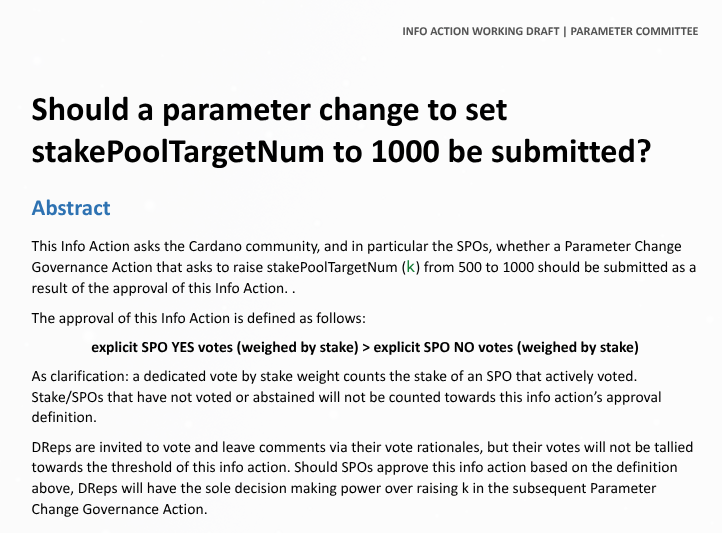
The parameter committee has spent months/years debating on how to accurately gauge SPO sentiment about raising stakePoolTargetNum from 500->1000.
As part of this, myself and another member of the parameter committee meticulously drafted all the arguments for and arguments against and linked them in separate documents so that voters could have a balanced view of both arguments. We linked these inside of a neutral-language Info Action body for SPOs to consider.
Because Info Actions have no ratification threshold and stakePoolTargetNum isn't a parameter that SPOs vote on through governance, the parameter committee collectively agreed to use a specific threshold of explicit YES > explicit NO for this Info Action. This is already above and beyond what the protocol and the Constitution require and we went out of our way to give SPOs a voice on this.
Unfortunately, a community member who is opposed to the parameter change hijacked our draft and the years of effort that went into it, changed the threshold to suit his desired outcome, and submitted it without consulting anybody.
Even if the we can reasonably disagree about what the threshold should be for this vote (remember it is not required at all), taking other people's work, twisting it, and submitting in a manner to suit your own narrative is extremely disappointing to see.
I'm very disheartened by this after having spent years of my own, uncompensated effort building to this point only to see a community member undermine it like this.
If you want to see the real draft that the parameter committee put together, you can read it here. Also the case for and case against are linked as well, so you can see both sides of the discussion fairly.
I can't speak on behalf of the others, but I will be interpreting the outcome of the vote based on the criteria that the parameter committee collectively agreed on, regardless of what this Info Action says.
https://t.co/GhKcbNtITh
From October 1, @MidgardLabsHQ will begin leading Plutus engineering. The transition preserves continuity among engineers who currently maintain and extend the codebase.
Midgard Labs has spent years auditing and developing Plutus contracts across Cardano and contributing code, libraries, and standards across the Plutus ecosystem.
Built by many. Owned by all. 🧵
Cardano node: 11.1.2 Release: https://t.co/LFMKeaOsXf
▷ SPOs are asked to prioritize this release and complete the upgrade at the earliest practical opportunity.
In my “Blockchain & Society” class, I love using real examples to help students understand how decentralized ledgers works. This semester, I was able to take things up a notch by using Claude Code to build a custom Cardano Blockchain Explorer as part of our class activity.
My course is generally taken by students who have little to no experience with blockchains or crypto. Many are preparing for careers in technology and information consulting, where they will analyze different systems, assess their organizational value and limitations, and communicate recommendations to clients and decision-makers.
In past years, I have done an exercise where I put a blockchain explorer up on the screen and walk students through how transactions move through the chain. But this time, I wanted them to learn about blockchain transactions by sending real assets over the Cardano network themselves.
For that I had planned out a worksheet and a workflow where each student would receive some ADA, send transactions to each other, and then send some to a common address that I could use as a tracking point for the whole class.
My intention was to use the Claimpaign platform to distribute the ADA, but I didn’t get it set up in time for students to use it in class. As I was getting ready to teach, I realized I would need a different way to get ADA into their wallets. Luckily, I knew that the VESPR wallet lets me use Face ID on my iPhone in place of the signing password, which means I can send a transaction about as fast as I can look at my phone.
So when class began, I explained the activity, passed out the worksheet, and had students install either VESPR or Eternl on their phone or computer. Then I went down each row and manually sent every student 4 ADA to seed their wallet. Thanks to the Face ID option, this did not take me very long to accomplish. As students got set up with their ADA, they started working with a partner on the worksheet, and once everybody had traded with each other, they sent their ADA on to the classroom wallet.
I had originally intended to look at all of this in an ordinary Cardano blockchain explorer, but I was having fun designing the activity, so I asked Claude to build me a custom explorer that would show the transactions and let me reveal the transaction flows my students had engaged in, step by step. (Hat tip to @SmaugPool for the UX inspiration from @pool_pm.)
The whole class worked out fantastically. After students had traded with each other and sent ADA to the classroom wallet, I used the custom explorer to collect the on-chain data via Koios and display it in a way that showed the transactions lined up one next to another. We had a discussion on how the transactions worked and how their structure showed the inputs and outputs we had been discussing in class, not just for Cardano but for Bitcoin as well.
We also talked about how their wallet software was their way of controlling their private keys for the blockchain network, just like the activity from the first week of class where I had them set up PGP key pairs so they could send secure email and get a feel for key-pair cryptography. We discussed the security implications of a mobile software wallet like VESPR compared with cold-storage methods, as well as situations where convenience might be prioritized over stronger safeguards.
Overall, I am extremely happy with how the activity went, and I am thoroughly impressed with the way Claude was able to extend my ability to teach this lesson. While I didn’t strictly need a custom blockchain explorer to show my students the activity they had engaged in on chain, it let me show what was happening exactly the way I wanted so that I could reinforce the lessons I had been teaching in class.
There is a lot of discussion right now about how AI tools are being used by instructors and students. While there are certainly real downsides to becoming over-reliant on AI to build new products and do analysis, there are also ways it makes things better. It is undeniable that most of my students will be graduating into jobs where they will be using AI systems every day. I am actively working to shift my teaching to help them learn how to manage their interactions with these systems. Rather than requiring as many written assignments that could simply be produced by AI, I am doing a lot more hands-on in-class activities like this and asking students to give oral presentations. I have found that the preparation required to explain a concept to your peers is what makes you understand it fully.
I have put the activity in a GitHub repository so that anyone who teaches a blockchain course can use these materials and modify them for their own needs. I hope you find it useful!
https://t.co/1B0T7ZQau6
Good Morning
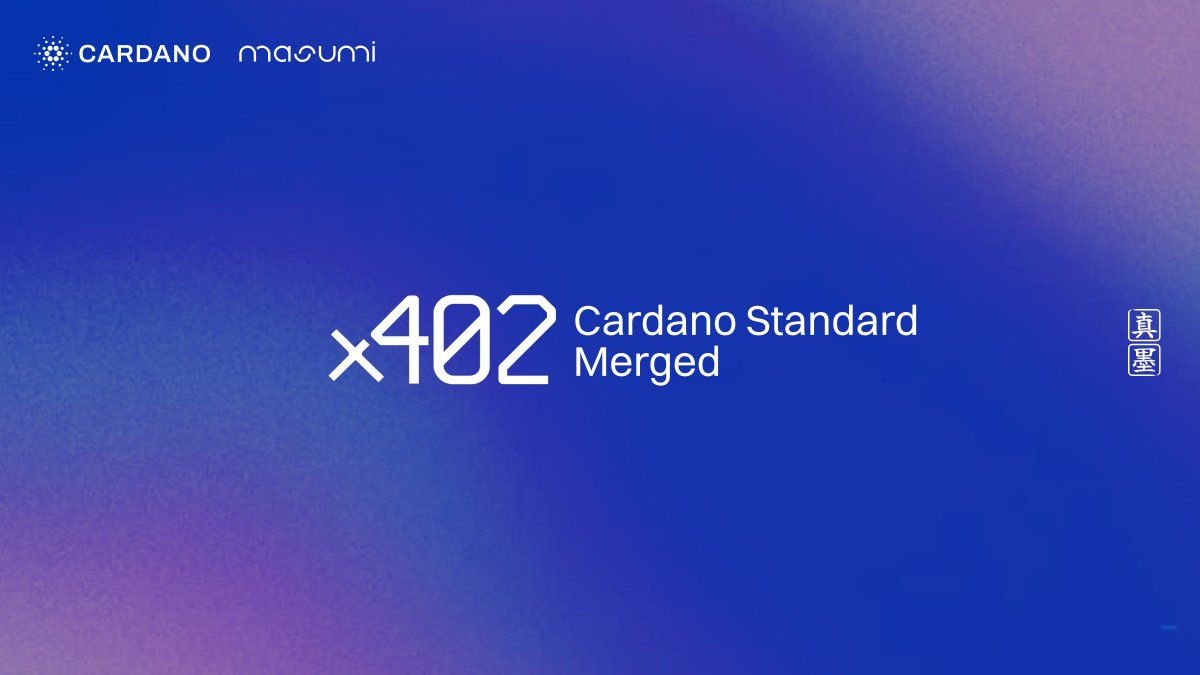
Cardano (with Masumi) has now been merged as a working implementation into the official x402 repository.
Previously only the specification was in there but now Cardano is also available via the official x402 packages in various programming languages.
https://t.co/qW6FGsDo2c
Have an issue with Daedalus? Use our new ariadne support portal, either via the Support Request option in the Help menu or opening a ticket at: https://t.co/8K0ZhugEN0
If you are a Cardano stake pool operator and don't want to participate in governance, please follow the below guide to switch your pools to auto-abstain.
Without this, your non-vote will automatically count as an implicit NO.
https://t.co/klhAXhIPMb
2 SPO votes are closing in about 5 hours:
▷ Reduce minPoolCost to 75 ada and increase Plutus Memory Limits (Part 2)
▷ Update Constitutional Committee 2026
Unless you're delegated to ALWAYS ABSTAIN DRep, no vote means NO.
So if you wanted to vote YES, it's your last chance.
@LiberalMark@Cerkoryn@earncoinpool@Hornan7 Interesting, thanks. This gives a different perspective of the coupling.
A little risky though as they are completely unrelated and this prevents only one of them to pass.
I voted anyway.
I think the real problem is that X's password reset email code is only 6 digits. If a hacker has been making 10 password reset request per account and trying the same code each time, that gives a 1 in 100000 chances of successfully resetting a password, or 1 every 100k X account.