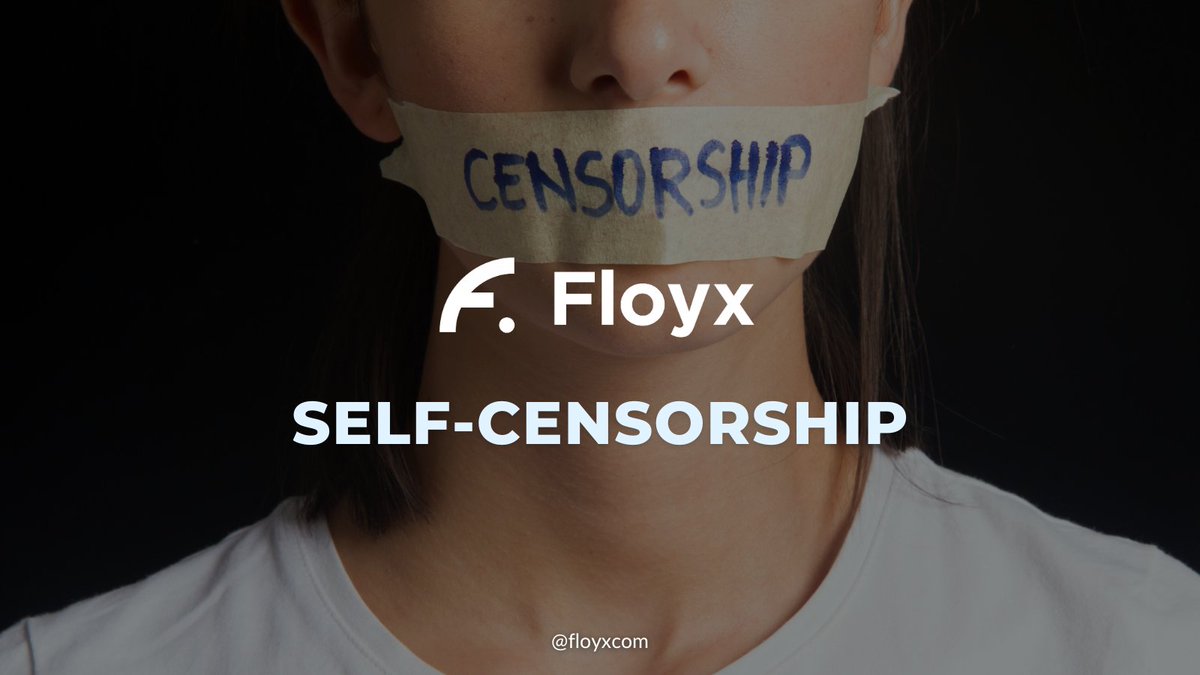
📚 Self-censorship
In many cases, #censorship is not imposed by #governments or social media #platforms, but rather by individuals themselves. People may censor themselves out of fear of reprisal, or they may simply be more comfortable consuming information that confirms their existing beliefs.
This can lead to a narrowing of the public discourse and a lack of exposure to diverse viewpoints. It can also make it more difficult to hold power to account.
#Web3SocialMedia #SocialFi #Floyx #Blockchain
📚 Algorithmic censorship
The algorithms that power #SocialMedia platforms can also play a role in #censorship. These algorithms are designed to show users content that they are likely to engage with, which can lead to the suppression of different viewpoints and the creation of echo chambers.
For example, an algorithm might be designed to show users more content from people who share their political views, while hiding content from people who hold opposing views. This can lead to a situation where users are only exposed to information that confirms their existing beliefs, making it difficult for them to see the world from different perspectives.
#Web3SocialMedia #SocialFi #Floyx #Blockchain
📚 The impact of censorship
#Censorship has a number of negative consequences, both for individuals and for society as a whole. It can limit #freedom of expression, restrict access to information, and contribute to the spread of misinformation. It can also stifle #innovation and #creativity, and it can make it more difficult to hold power to account.
In a world that is increasingly interconnected and information-rich, censorship is a serious threat to the free flow of ideas and the open exchange of information. It is important to be aware of the different forms of censorship that exist, and to work to protect our right to free expression and access to information. 🫡
#Web3SocialMedia #SocialFi #Floyx #Blockchain
📚 Why Floyx has great potential in the future:
✅ The #decentralized social media and #socialfi market is growing rapidly. In 2022, the global decentralized social media market was valued at $1.5 billion. This market is expected to grow to $10 billion by 2027. #Floyx is well-positioned to capitalize on this growth.
✅ Users are becoming increasingly concerned about their #privacy and #security on social media. Floyx's decentralized nature makes it a more secure and private option than traditional social media platforms.
✅ Floyx's #reward system is a unique and attractive feature that could help to attract and retain users.
#Web3SocialMedia #Blockchain #FreedomOfSpeech
🧐 When do countries plan to Implement CBDCs?
The plans of countries regarding the implementation of #CBDCs (central bank digital currencies) vary. Some countries, such as China, have already implemented CBDCs, while others, such as the United States, are only considering their introduction.
Countries that have already implemented CBDCs:
✅ China: The Chinese digital renminbi (e-CNY) was introduced in a pilot program in 2020. In 2022, it was made available to the public in several cities in China.
✅ Bahamas: The Bahamas Digital Dollar (B$D) was introduced in 2020.
✅ Grenada: The Grenada Digital Currency (DXCD) was introduced in 2021.
✅ Vanuatu: The Vanuatu Digital Currency (VatuD) was introduced in 2022.
Countries that are considering the introduction of CBDCs:
❓ United States: The Federal Reserve is conducting research on CBDCs. In 2022, it published a report in which it outlined the potential benefits and drawbacks of introducing CBDCs.
❓ European Union: The European Central Bank is conducting research on CBDCs. In 2022, it published a report in which it outlined a plan for introducing CBDCs in Europe.
❓ United Kingdom: The Bank of England is conducting research on CBDCs. In 2022, it published a report in which it outlined the potential benefits and drawbacks of introducing CBDCs.
#Web3SocialMedia #Floyx #SocialFi #Blockchain





![floyxcom's tweet photo. 🚨 An update on the current progress of the new #Floyx product design [November 24, 2023].
#Web3SocialMedia #SocialFi #Decentralized #Blockchain https://t.co/WjulhXbx6A](https://pbs.twimg.com/media/F_smUVSWEAE2myM.jpg)