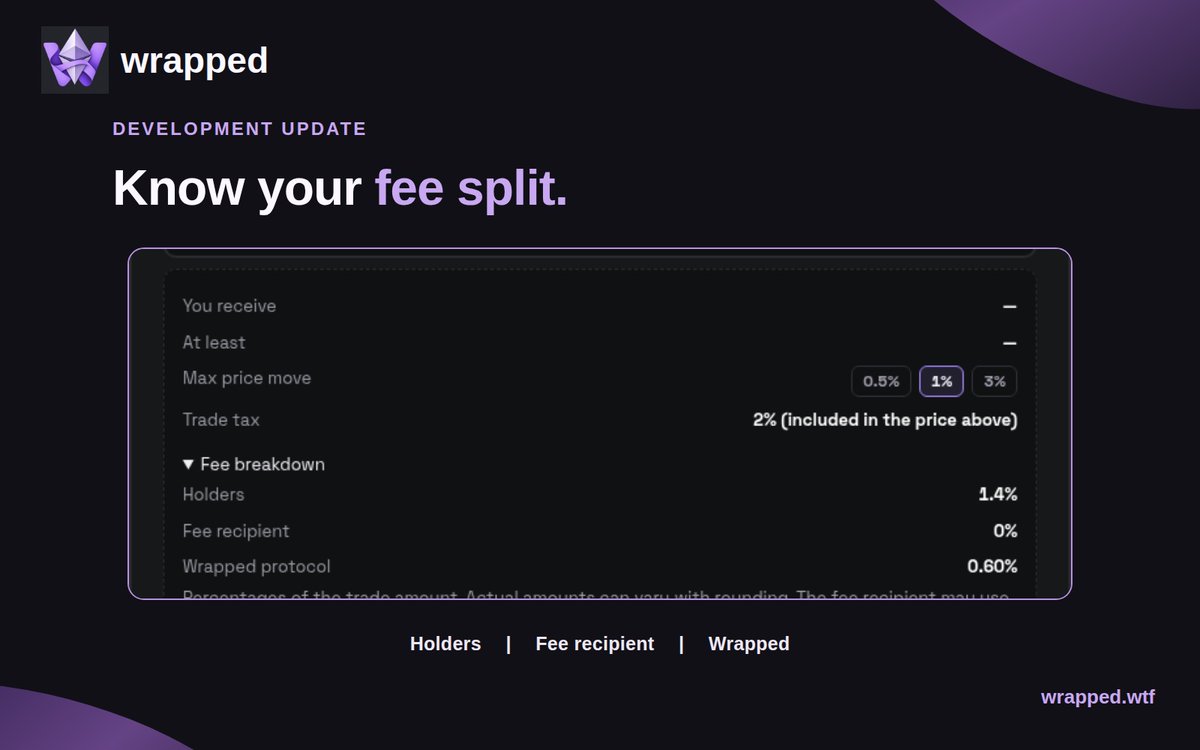
We added a fee breakdown beside the swap.
Expand it to see the holder allocation, fee recipient share and Wrapped protocol share for the selected wrapper.
https://t.co/ZXwla99JYl
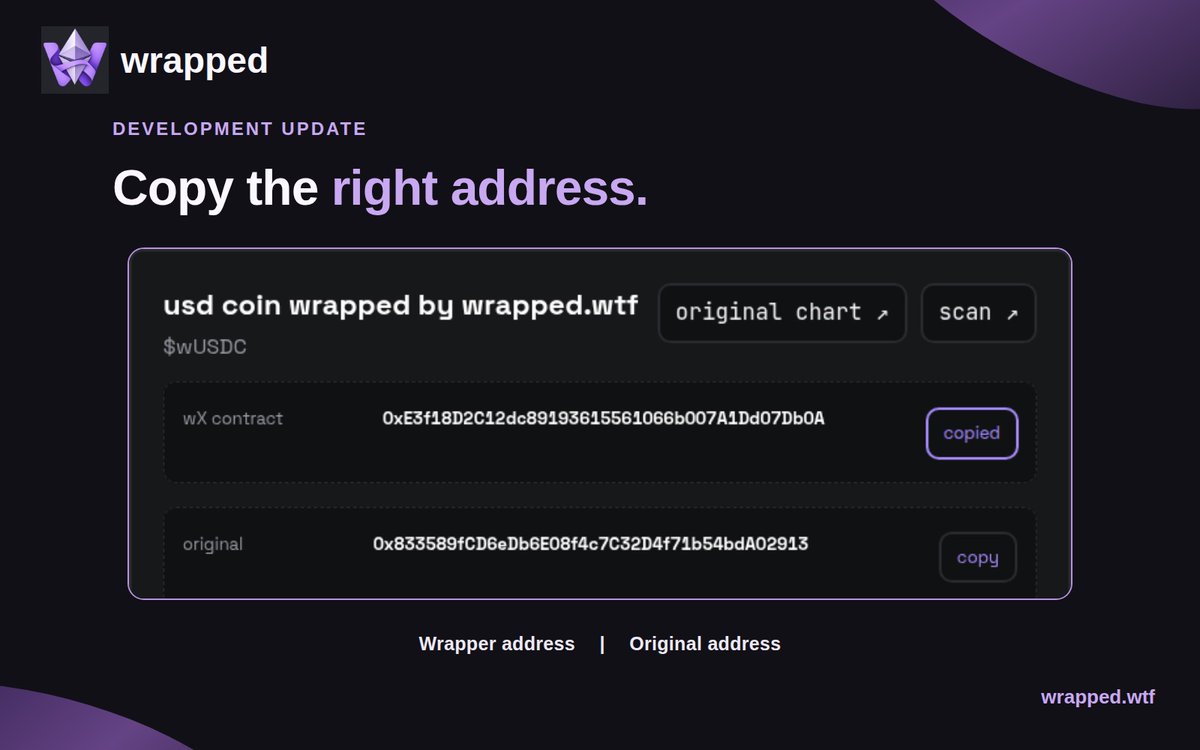
We made wrapper and original token addresses easier to copy.
Both addresses now have a copy button and confirmation on the token page.
https://t.co/ZXwla99JYl
@harrypauldavies Hi Henry I got a gem for you.
@wrapped__eth
Shared a video below but you can find more info on the website https://t.co/DvP2bYzdox
Its a first mover and for a product as lucrative as this, I see it pulling a lot of big attention soon.
We have launched a small CAKE wrapper pilot on BSC.
The contracts are deployed, the website uses the new maintenance route, and real native BNB buys and sells have been confirmed. DEX Screener has also indexed the pool and displayed its price.
The pilot combines a funded wrapper market with a 10% maintenance trigger, a fee reserve, and daily spending limits. The initial deployment, funding, and test trades used 0.00264 BNB within the approved 0.005 BNB cap.
This is one deliberately small $WRAPPED pilot. Budget-limited idle maintenance is now enabled, with fresh observation history required before recovery can rebalance. Liquidity is limited, and adjustments remain subject to reference, inventory, and spending checks.
https://t.co/CVns5XG0mM
We implemented a trading route that checks the price gap after a wrapper buy or sell settles.
When the gap exceeds the configured threshold and the reference, inventory, and maintenance budget allow it, the same transaction can attempt a rebalance.
The important boundary is settlement: a rejected maintenance attempt does not need to undo an otherwise valid user trade.
This route is connected to the website for the single CAKE pilot on BSC, including native BNB buys and sells. The pilot threshold is 10%.
Bundling upkeep still costs gas. Original-market moves without wrapper trades also need a separate keeper or operator action.
We have confirmed DEX Screener discovery for an experimental Wrapped market on Ethereum.
We deployed the trial, funded it, and executed real trades. The funded wrapper pool was then recognised by DEX Screener, giving the market an observable price through the scanner.
For $WRAPPED, this is a concrete step toward making wrapper markets easier to inspect outside our own application.
Discovery is one milestone. It does not mean automatic price maintenance is live on Ethereum, and it does not make the wrapper inherit the original token market cap.
This was a small live experiment, not an Ethereum-wide rollout.
We improved how Wrapped Explorer loads transaction history across supported chains.
Reliable history matters when you are checking whether a wrapper was created, a trade happened, or your activity has been recorded. We moved history reads behind a protected gateway and corrected caches that could preserve incomplete RPC results.
That gives Explorer a more dependable source for loading protocol activity, rather than treating a partial response as the full picture.
The reader and cache fixes are deployed. This is an improvement to finding and reviewing activity, separate from the staging indexer we are also testing.
https://t.co/an15Jjer6W
A wallet holds 1% of a wrapper’s total supply. Its share of a funded holder epoch depends on the combined balances of the eligible wallets selected for that snapshot.
If those wallets hold 40% of total supply, that wallet represents 2.5% of their combined balance, assuming it qualifies.
Our publisher uses that eligible balance total to calculate allocations. Check the snapshot when working out your share.
Suppose a wrapper collects 0.2 WETH in fees. After the ecosystem’s 30% share, 0.14 WETH reaches the creator allocation.
If the creator policy assigns 25% of that allocation to holders, their budget receives 0.035 WETH. The remaining 0.105 WETH goes to the payout wallet, assuming a zero buyback allocation.
This illustrative example shows how a holder percentage applies within the creator’s share.
https://t.co/lLYXbqASDG
A token community wants to keep its trading bot online. Its wrapper creator could direct the payout allocation to a wallet used for hosting costs.
Our fee policy gives that wallet a share of collected wrapper fees. The team can then publish its hosting bill alongside the fee receipts, so members can see how much the activity covered.
What recurring expense would your community fund first?
$WRAPPED 🤝 $BRETT
A wrapped version of BRETT has been created on the Wrapped protocol 💜.
wBRETT is on Base with a fixed 1% wrapper fee.
Explore the wrapper:
https://t.co/5dzuVkAM31
A community running regular events could use its wrapper payout wallet to build a public record of how trading activity helps cover costs.
Over several months, members could follow collected fees through to venue payments or tournament prizes.
That is a use we want $WRAPPED to support: communities choosing a purpose for their creator allocation and showing people what the money paid for.
We have integrated @helloSQD into Wrapped 💜
It indexes wrapper activity into a shared database, laying the foundation for deeper history, clearer analytics, and connected website and Telegram feeds.
$WRAPPED 🤝 $POPO
A wrapped version of POPO has been created on the Wrapped protocol 💜.
wPOPO is on Ethereum with a fixed 1% wrapper fee.
Explore the wrapper:
https://t.co/8g7ZQaCS5o
A holder finds an allocation in an earlier funded epoch after a newer one has been published.
Our policy stores epochs separately. The holder can submit the proof for that earlier allocation while it remains unclaimed, and a successful claim draws from its reserved funding.
When checking rewards, review the earlier epochs associated with your wallet as well as the latest distribution.
https://t.co/lLYXbqASDG
Depositing 1,000 original tokens into a wrapper with a 2% fee produces 980 receipts. Redeeming all 980 at the same rate returns 960.4 originals.
This example assumes standard token transfers and excludes gas. Both actions apply the configured fee.
For someone testing $WRAPPED with tokens they already hold, calculating the complete deposit-and-redemption path helps them choose an amount for their first transaction.
https://t.co/7atar7ohFi