Drivers make hundreds of decisions on a single trip.
When to turn.
When to slow down.
When to switch lanes.
When to trust the route.
Most of these decisions happen instantly.
But even small delays in judgment can make a difference.
Because driving today isn’t just physical.
It’s mental.
You’re constantly processing directions, traffic changes, reroutes, and notifications, all while staying focused on the road.
And over time, that adds up.
More mental load.
More second-guessing.
More pressure on the driver.
For something people do every day, it shouldn’t feel this demanding.
Navigation should simplify decisions… not add more of them.
That’s part of what we’re building with SnapRoad.
Not just guiding drivers…
but reducing how much they have to think about while driving.
#DriveSmarter #FutureOfMobility
Drivers make hundreds of decisions on a single trip.
When to turn.
When to slow down.
When to switch lanes.
When to trust the route.
Most of these decisions happen instantly.
But even small delays in judgment can make a difference.
Because driving today isn’t just physical.
It’s mental.
You’re constantly processing directions, traffic changes, reroutes, and notifications, all while staying focused on the road.
And over time, that adds up.
More mental load.
More second-guessing.
More pressure on the driver.
For something people do every day, it shouldn’t feel this demanding.
Navigation should simplify decisions… not add more of them.
That’s part of what we’re building with SnapRoad.
Not just guiding drivers…
but reducing how much they have to think about while driving.
#DriveSmarter #FutureOfMobility
At highway speed, just 5 seconds of distraction means driving the length of a football field… without looking.
Think about that.
Five seconds.
That’s all it takes.
Checking directions.
Looking at a notification.
Trying to understand a route change.
It doesn’t feel dangerous in the moment.
But on the road, distance adds up faster than we realize.
And weekends like this only increase that risk.
More people driving.
Longer trips.
More movement overall.
Most drivers aren’t being careless.
They’re just managing too much at once.
And that’s where the problem is.
Driving today isn’t just about the road.
It’s about how much attention the system demands from you.
That’s something we’ve been thinking deeply about with SnapRoad.
Not just helping you navigate…
but reducing how much attention navigation actually takes.
Because on the road, even a few seconds matter.
#DriveSmarter #RoadSafety #FutureOfMobility
At highway speed, just 5 seconds of distraction means driving the length of a football field… without looking.
Think about that.
Five seconds.
That’s all it takes.
Checking directions.
Looking at a notification.
Trying to understand a route change.
It doesn’t feel dangerous in the moment.
But on the road, distance adds up faster than we realize.
And weekends like this only increase that risk.
More people driving.
Longer trips.
More movement overall.
Most drivers aren’t being careless.
They’re just managing too much at once.
And that’s where the problem is.
Driving today isn’t just about the road.
It’s about how much attention the system demands from you.
That’s something we’ve been thinking deeply about with SnapRoad.
Not just helping you navigate…
but reducing how much attention navigation actually takes.
Because on the road, even a few seconds matter.
#DriveSmarter #RoadSafety #FutureOfMobility
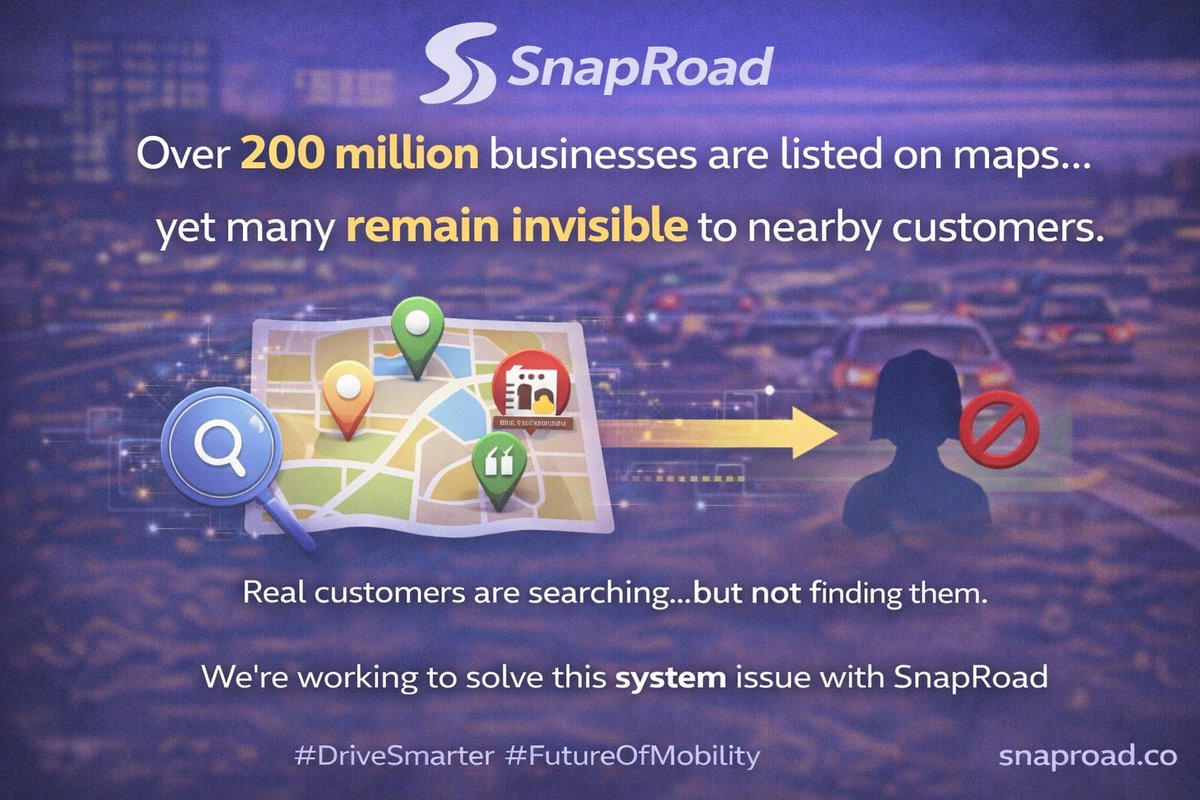
Over 200 million businesses are listed on maps…
yet many remain invisible to nearby customers.
On the surface, it looks like everything is working.
You search.
You see options.
You choose a place.
But behind that experience, there’s a gap.
Because being listed isn’t the same as being discovered.
And discovery isn’t just about showing up…
it’s about showing up at the right time,
in the right context,
with the right level of trust.
For drivers, it can feel like limited choice.
For businesses, it’s a bigger problem.
Real customers are searching…
but not finding them.
And when that happens consistently,
it stops being a visibility issue.
It becomes a system issue.
That’s what we’ve been focused on with SnapRoad.
Not just putting businesses on the map…
but helping them connect with the right people, at the right moment.
#DriveSmarter #FutureOfMobility
Over 2 billion people use map apps every month…
yet drivers still get nothing back.
Think about that scale for a moment.
Billions of trips.
Billions of routes.
Billions of data points generated every single day.
The system is constantly learning, improving, and becoming more powerful.
But for the person behind the wheel…
the experience hasn’t changed much.
You still spend your own money.
You still deal with traffic.
You still follow routes that don’t always feel right.
And all the value being created flows in one direction.
That’s the part that doesn’t make sense anymore.
Because at this scale, navigation is no longer just a tool.
It’s infrastructure.
And infrastructure should work for the people who depend on it every day.
That’s the perspective we’ve been building around with SnapRoad.
Not just improving maps…
but rethinking how value flows through the entire system.
#DriveSmarter #FutureOfMobility
Over 2 billion people use map apps every month…
yet drivers still get nothing back.
Think about that scale for a moment.
Billions of trips.
Billions of routes.
Billions of data points generated every single day.
The system is constantly learning, improving, and becoming more powerful.
But for the person behind the wheel…
the experience hasn’t changed much.
You still spend your own money.
You still deal with traffic.
You still follow routes that don’t always feel right.
And all the value being created flows in one direction.
That’s the part that doesn’t make sense anymore.
Because at this scale, navigation is no longer just a tool.
It’s infrastructure.
And infrastructure should work for the people who depend on it every day.
That’s the perspective we’ve been building around with SnapRoad.
Not just improving maps…
but rethinking how value flows through the entire system.
#DriveSmarter #FutureOfMobility
Drivers can spend up to 17 hours a year just looking for parking.
That’s almost an entire day… gone.
Driving around the same block.
Checking one spot, then another.
Hoping something opens up.
Getting closer, then missing it.
It’s one of those things people just accept.
Part of driving.
But when you think about it, it’s time that shouldn’t be wasted.
You’ve already reached your destination…
but you’re still not there.
And the system doesn’t really help much.
It gets you to the location.
Then leaves you to figure out the rest.
For something people deal with almost every day,
that gap feels bigger than it should be.
That’s part of what we’re thinking about with SnapRoad.
Not just getting you somewhere…
but helping you actually arrive.
#DriveSmarter #FutureOfMobility
Drivers can spend up to 17 hours a year just looking for parking.
That’s almost an entire day… gone.
Driving around the same block.
Checking one spot, then another.
Hoping something opens up.
Getting closer, then missing it.
It’s one of those things people just accept.
Part of driving.
But when you think about it, it’s time that shouldn’t be wasted.
You’ve already reached your destination…
but you’re still not there.
And the system doesn’t really help much.
It gets you to the location.
Then leaves you to figure out the rest.
For something people deal with almost every day,
that gap feels bigger than it should be.
That’s part of what we’re thinking about with SnapRoad.
Not just getting you somewhere…
but helping you actually arrive.
#DriveSmarter #FutureOfMobility
The average driver makes hundreds of micro-decisions on a single trip.
When to turn.
When to slow down.
When to switch lanes.
When to trust the route.
When to double-check directions.
Most of these decisions happen without thinking.
But they add up.
Driving today isn’t just physical.
It’s mental.
And the more information a driver has to process
routes, reroutes, traffic updates, notifications,
the heavier that mental load becomes.
What was once simple navigation has turned into constant decision-making.
And over time, that affects focus, confidence, and overall driving experience.
For something people do every day, it shouldn’t feel that complex.
It should feel clear.
Predictable.
Effortless.
That’s part of what we’re thinking about with SnapRoad.
Not just how to guide drivers…
but how to reduce the number of decisions they have to make along the way.
#DriveSmarter #FutureOfMobility
The average driver makes hundreds of micro-decisions on a single trip.
When to turn.
When to slow down.
When to switch lanes.
When to trust the route.
When to double-check directions.
Most of these decisions happen without thinking.
But they add up.
Driving today isn’t just physical.
It’s mental.
And the more information a driver has to process
routes, reroutes, traffic updates, notifications,
the heavier that mental load becomes.
What was once simple navigation has turned into constant decision-making.
And over time, that affects focus, confidence, and overall driving experience.
For something people do every day, it shouldn’t feel that complex.
It should feel clear.
Predictable.
Effortless.
That’s part of what we’re thinking about with SnapRoad.
Not just how to guide drivers…
but how to reduce the number of decisions they have to make along the way.
#DriveSmarter #FutureOfMobility
At 60 mph, you travel 88 feet every second.
That’s the distance covered in just one moment of distraction.
Now think about how often drivers glance at their screens.
Checking directions.
Looking at the next turn.
Trying to understand a route change.
It doesn’t feel like much.
But on the road, even a second carries weight.
And weekends like this only increase that exposure.
More people driving.
Longer trips.
Late-night routes.
More movement overall.
Most drivers aren’t being careless.
They’re just trying to get where they need to go safely…
while managing more information than they should have to.
That’s why the experience matters.
Navigation shouldn’t compete for your attention.
It should reduce the need for it.
That’s part of what we’re focused on with SnapRoad,
building something that feels clearer, safer, and more aligned with how people actually drive today.
Because on the road, every second counts.
#DriveSmarter #RoadSafety #FutureOfMobility
The biggest update to map platforms in over 10 years just happened.
AI-powered navigation.
Smarter recommendations.
More personalized results.
On paper, everything looks better.
But for most drivers… the experience still feels the same.
You still follow routes that don’t always make sense.
You still deal with traffic that feels avoidable.
You still spend more time and money on the road than you should.
The technology is evolving.
But the outcome for the driver hasn’t changed much.
And that’s where the real question starts.
Is navigation just about becoming more intelligent…
or should it become more useful for the people actually using it?
Because at some point, better technology should translate into a better experience.
More clarity.
More control.
More value for the driver.
That’s the direction we’ve been focused on with SnapRoad.
Not just improving how maps look or respond…
but rethinking how they actually work for the people behind the wheel.
#DriveSmarter #FutureOfMobility
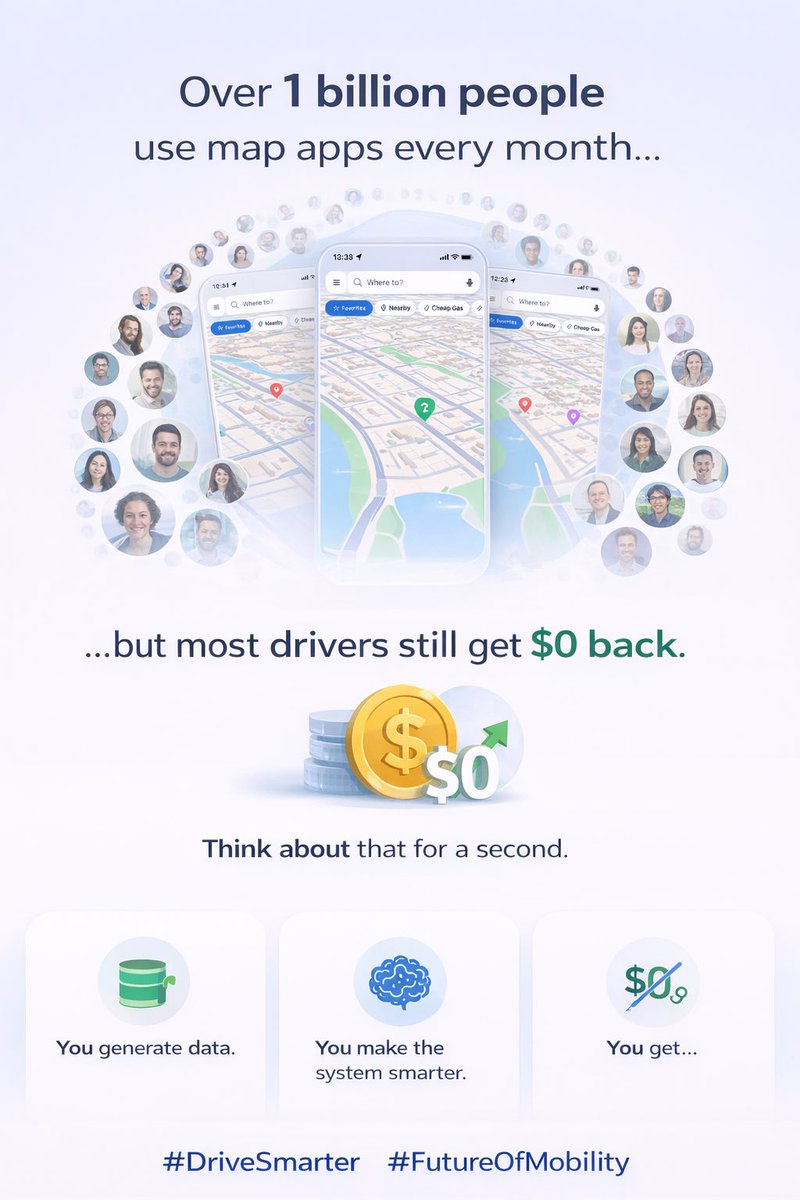
Over 1 billion people use map apps every month…
but most drivers still get $0 back.
Think about that for a second.
Every trip you take,
every route you follow,
every place you visit…
you’re generating data.
Valuable data.
The system learns from it.
Improves from it.
Grows because of it.
But for the person actually driving?
Nothing really changes.
You still pay for gas.
You still sit in traffic.
You still follow routes that don’t always make sense.
And at the end of the day,
you’ve contributed to a system that never really gives anything back.
That’s the part people are starting to question.
Because if over a billion people are using something every month…
shouldn’t it work better for them?
That’s exactly what we’ve been thinking about.
And we’re getting closer to showing what that looks like when drivers are actually part of the value.
#DriveSmarter #FutureOfMobility
Over 1 billion people use map apps every month…
but most drivers still get $0 back.
Think about that for a second.
Every trip you take,
every route you follow,
every place you visit…
you’re generating data.
Valuable data.
The system learns from it.
Improves from it.
Grows because of it.
But for the person actually driving?
Nothing really changes.
You still pay for gas.
You still sit in traffic.
You still follow routes that don’t always make sense.
And at the end of the day,
you’ve contributed to a system that never really gives anything back.
That’s the part people are starting to question.
Because if over a billion people are using something every month…
shouldn’t it work better for them?
That’s exactly what we’ve been thinking about.
And we’re getting closer to showing what that looks like when drivers are actually part of the value.
#DriveSmarter #FutureOfMobility
Your driving data is worth billions.
And yet… most drivers get nothing back.
Every time you’re on the road, you’re generating value.
Your location.
Your routes.
Your habits.
Your patterns.
All of it feeds into a system that becomes more accurate, more efficient, and more valuable over time.
But that value doesn’t flow back to the person creating it.
It just becomes part of the infrastructure.
Something you rely on… without ever benefiting from it.
For something that millions of people use every single day, that imbalance is hard to ignore.
Driving isn’t just movement anymore.
It’s data.
It’s behavior.
It’s value being created in real time.
The question is no longer whether that value exists.
It’s who it should belong to.
We’ve been thinking deeply about that.
And we’re getting very close to showing what that looks like when it’s done differently.
#DriveSmarter #FutureOfMobility
Your driving data is worth billions.
And yet… most drivers get nothing back.
Every time you’re on the road, you’re generating value.
Your location.
Your routes.
Your habits.
Your patterns.
All of it feeds into a system that becomes more accurate, more efficient, and more valuable over time.
But that value doesn’t flow back to the person creating it.
It just becomes part of the infrastructure.
Something you rely on… without ever benefiting from it.
For something that millions of people use every single day, that imbalance is hard to ignore.
Driving isn’t just movement anymore.
It’s data.
It’s behavior.
It’s value being created in real time.
The question is no longer whether that value exists.
It’s who it should belong to.
We’ve been thinking deeply about that.
And we’re getting very close to showing what that looks like when it’s done differently.
#DriveSmarter #FutureOfMobility
Over 50% of serious road accidents happen between Friday and Sunday.
And it makes sense when you think about it.
More people are on the road.
Longer trips.
Late-night drives.
Family visits.
Weekends away.
Friday marks the shift.
From routine driving…
to real-life movement.
People are no longer just commuting.
They’re going out, traveling, reconnecting, and spending time with the people that matter.
But with that increase in movement comes increased risk.
And most drivers aren’t doing anything wrong.
They’re just navigating busy roads, changing routes, and trying to get to where they need to be safely.
That’s why the systems we rely on every day matter more than we think.
Driving should feel clear.
Predictable.
Less stressful.
Not something that demands more attention than necessary.
That’s part of what we’re focused on with SnapRoad.
Building a navigation experience that feels safer, more aware, and more aligned with how people actually move
especially on days like this.
#DriveSmarter #RoadSafety #FutureOfMobility