I told my AI agent: "Buy my nornal coffee at 9am everyday and delivered to the venue."
It handled everything.
Top-up ✅
Cashback earned ✅
Order placed ✅
Delivery arranged ✅
North America's first real-world AI payment. 🇨🇦
#AIAgents#Snaplii
🏛️ Patrick reading about ancient manuscripts while we're out here building the infrastructure for AI to spend money in the real world
different timelines, both valid
I've been enjoying Victoria Whitworth's new work, The Book of Kells: Unlocking the Enigma.
I've actually never seen the Book of Kells in person, somewhat to my embarrassment. I've been doing some reading about the origins of Christianity this year, however, and I figured I should know something about the most famous Irish manuscript. (Perhaps the most famous manuscript, full stop.)
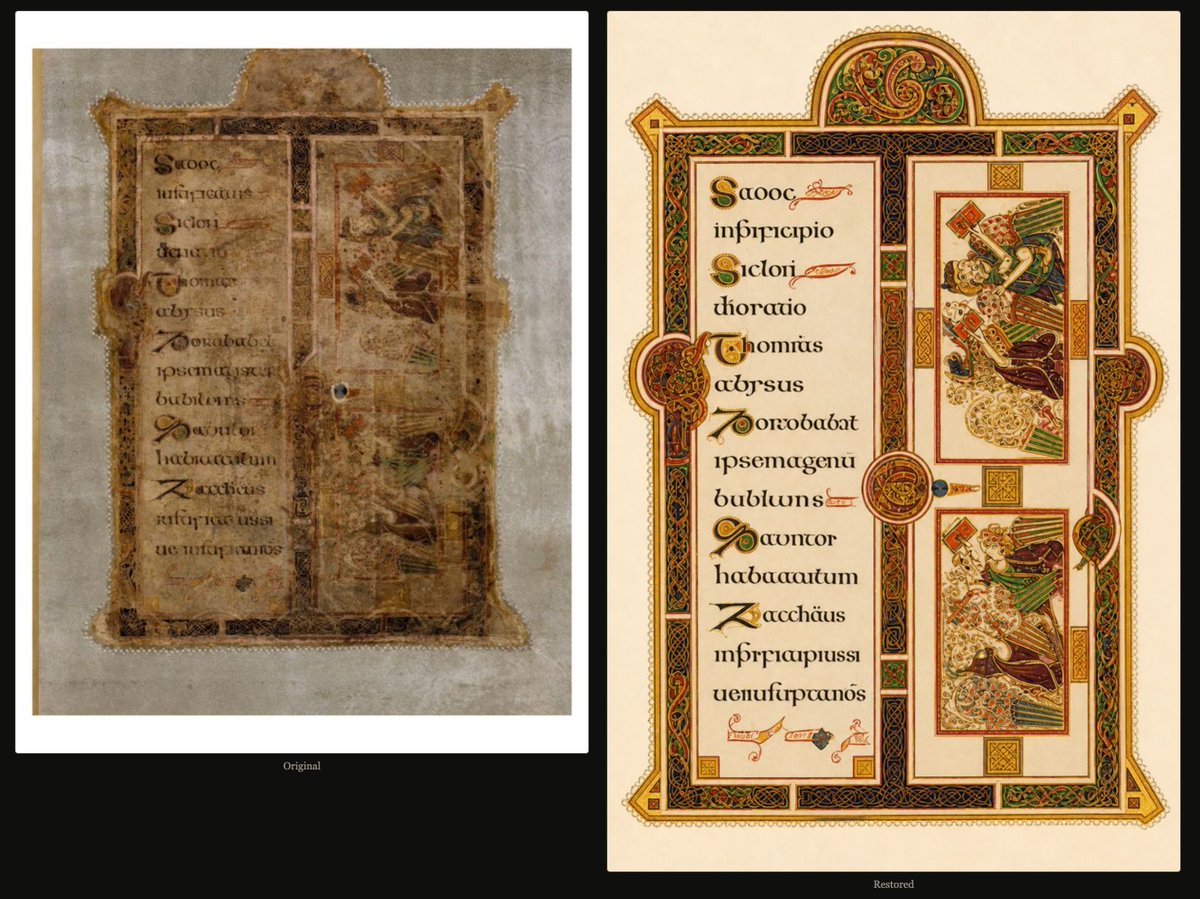
Reading the book, I was struck by how much the contents have suffered over the past ~1200 years (enduring everything from water damage to reckless malfeasance in attempted nineteenth century restoration), and I wondered whether AI could help give a sense for how the work might originally have appeared.
I downloaded the Internet Archive's PDF and asked my friendly neighborhood agent to use gpt-image-2 to render each page the way it imagines it might have originally appeared. Remarkably, this all worked with a single prompt, with the agent spinning up 48 workers, since each page took a minute or two. (I'm sure that someone wiser than me could prompt the model better, ensuring somewhat more historical accuracy in color restoration and so forth. There is no gold leaf in the Book of Kells!) This part of the project went from conception to completion before I'd finished my morning coffee.
I then wanted some easy way to view the results online, so I asked Stripe Projects (https://t.co/1tSgGbSLxM) to host the result on Vercel. That also worked in basically a single prompt: https://t.co/5ED9TM7lJB.
I also figured that people might want an easy way to download the full PDF of updated images, but it's a large (~200MB) file, so I decided that I should charge $0.10 to cover bandwidth costs using @MPP. I asked my agent to set this up, and it basically worked smoothly, though I had to tell it what MPP is (I guess it's not yet in the pretrain) and also manually set up the Cloudflare account that actually hosts the PDF and configure the API key. (Vercel seemingly has a 100MB limit.) The purchases now show up in my Stripe account alongside all other activity.
The site now has a ready-made agent prompt for anyone who wants to download the whole thing. I'm guessing that we'll see a lot more UIs like this in the future.
I remain pretty intrigued by the intersection of agents, micropayments, and stablecoins. I don't know much about managing crypto wallets from the CLI, but now AI can do that for me, while Stripe seamlessly handles turning it all back into fiat.
So what is the moral of the story?
• Whitworth's book is very good, and you should buy it.
• The Internet Archive continues to be wonderful and a civilizational treasure.
• While there are rough edges, setting up third-party services via the CLI now basically works. I'm pretty sure I wouldn't have bothered with any of this if I couldn't have outsourced almost all of the work to AI.
• The image models have gotten very good.
• There will probably continue to be all kinds of interesting applications of AI to history. (The Vesuvius Challenge of course being a shining pioneer.)
• These days, I often find myself building single-use sites for things I'm learning or for books I'm reading. I think this is a cool new category of software.
@tobi DuckLake is slept on. Pairing it with an agent that can actually act on that data — payments, purchases, real decisions — is where it gets interesting.
Most teams building AI agents obsess over the model.
But the real unlock? What the agent can actually *do* in the real world.
Payments are infrastructure. We built that layer. 💳
#AIAgents#Snaplii
Yep and the ones that have survived long (like Google, Amazon, Microsoft etc) have been constantly launching new products
They're not single product companies
If Amazon was still only selling books, Microsoft was still only selling Windows, and Google was still only running a search engine, they'd be dead by now
They're still alive because they keep switching to the new thing, which now of course for everyone is AI!
🤖 Your AI agent can now pay for things in the real world.
500+ brands. Automatic cashback. Your card never exposed.
This is what agent-native payments look like. #AIAgents#Snaplii
Every payment rail has an expiry date.
Gift cards outlasted checks. Mobile wallets outlasted swipe. AI agents are next — and they need infrastructure built for them, not retrofitted from 2015. 💳
Snaplii was built for this moment.
Real-time payments aren't the future anymore — they're the baseline.
While the industry catches up, Snaplii has been quietly delivering instant, secure AI payments across 500+ brands in Canada. 🇨🇦
#AIAgents#Snaplii
🇨🇦 Canadian builders are quietly doing big things
from a Chrome extension to working with Perplexity and Wise — that's a real arc
we're rooting for every team like this up here
Halifax-based @BuildWithFloqer went from a simple Chrome extension to helping Perplexity and Wise gather and review client data.
https://t.co/a9gVcdBnWG
@n8n_io Skill drift is real — versioned agent configs with scheduled validation checks help a lot. Same principle applies to payment flows in agents: stale logic = silent failures.