@CryptoKaleo@MEADGod Excellent … one of the most serious Kol’s , on Robinhood not being there ., would’ve been an absolute injustice! 🔥🚀 Enjoy this MONUMENTAL occasion — history is being made!
To think you nearly missed it 🤔🐈
Imagine being sidelined on Robinhood
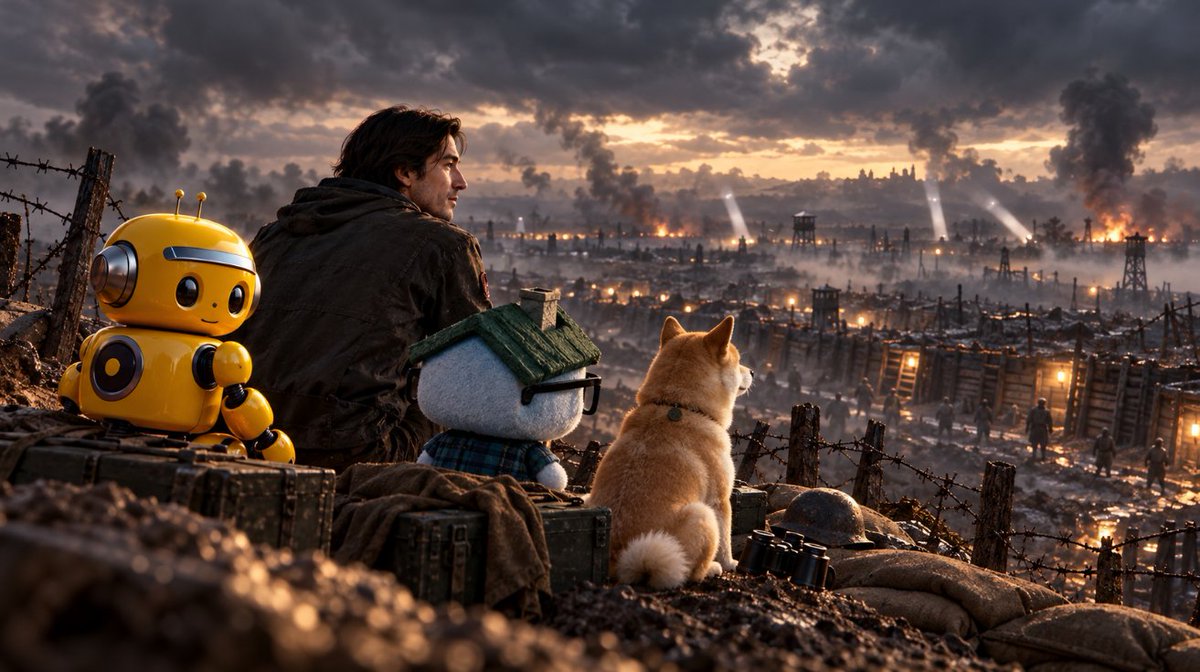
We've been in the trenches nonstop with @theunipcs@vladtenev & @meadgod for weeks and will remain there for many months to come
"Robinhood is THE chain of this cycle" 🎒
The Captain Who Quit Rugby Because a Teammate Died in His Arms
Chris Burger was twenty-eight years old when he went down in a loose scrum at Bloemfontein, playing for Western Province under the captaincy of Morné du Plessis. He never got up. A neck injury, sustained either in the tackle or in the ruck that followed, took his life, and it took something from du Plessis too — something he never fully got back.
Du Plessis was, by that point, the most successful captain the Springboks had produced in a generation. Between 1975 and 1980 he led South Africa to victory in thirteen of fifteen Tests, a win rate few captains anywhere have matched. He had beaten France home and away. He had outlasted the All Blacks in a brutal four-Test series that swung on a single point in the finale. He had run out against a World XV and against the British Lions, and in 1980 he captained his country to a series win over Lions sides that rarely lost. He stood 1.95 metres tall, moved like a man who had once bowled fast for Western Province before Barry Richards hit him for two sixes and convinced him rugby was the safer trade, and he carried a name that already belonged to South African sport before he ever pulled on a jersey. His father had captained the Springboks against the All Blacks. His mother had captained the national women's hockey team. No other Springbok captain in history has been able to say both parents led their country.
Here is where the story gets complicated. Craven had built Du Plessis up as the iron man of South African rugby — outspoken, occasionally reckless, once escorted off a field by police after a hit that enraged an entire stadium. This was not a soft man. And yet, months after Burger's death, with a tour to New Zealand approaching and Danie Craven himself pleading with him to stay on, du Plessis walked away from the game at its peak. Craven believed, until the end, that South Africa would have won that series in New Zealand had du Plessis led the side. Du Plessis chose something else. He chose to grieve, and then he chose to build.
He did not simply retire. He turned the loss into a permanent structure. In 1980 he established what became the Chris Burger Fund, and he stayed its chairman for thirty-eight years, long after the headlines faded, long after most retired captains had moved on to easier legacies. The fund grew into a lifeline for South African rugby players catastrophically injured on the field, a twenty-four-hour helpline built from the wreckage of one Saturday afternoon in Bloemfontein. It exists today under a longer name, carrying Burger's alongside another player's, still doing the same quiet work.
That instinct — to convert personal loss into permanent protection for others — did not stop there. With Tim Noakes, du Plessis co-founded the Sports Science Institute of South Africa, built specifically to study how the body breaks under this sport and how it might be saved. Fifteen years after he hung up his boots, he was back in a Springbok camp, this time as team manager, watching Francois Pienaar lift the World Cup on home soil in 1995, a tournament that meant more to a fractured country than any trophy has any right to mean.
The rugby world remembers the captaincy record, the family dynasty, the tackle on Naas Botha that nearly started a riot at Loftus. But the truest measure of Morné du Plessis is what he did after he stopped playing — a man who had every reason to walk away from the game entirely, and instead spent decades making sure the next Chris Burger had somewhere to call.
A 19-year-old Japanese student built a trading bot with Claude Code in 2 days.
Used his iPad as a second monitor.
First night: $6,732 profit.
Starting capital: $68.
Total profit so far: $750,000.
Here's how it works:
The bot scans over 50 markets simultaneously.
Syncs live BTC data from Binance every second.
Spots price errors before humans even notice.
The edge is pure speed + pattern recognition.
While traders stare at charts trying to predict the next move, his bot is already executing on mispricing across dozens of markets.
No guessing.
No emotions.
No hesitation.
Just Claude Code logic finding gaps that close in seconds.
He built the entire system in 48 hours:
→ Claude Code handles the trading logic
→ Binance API feeds real-time BTC data
→ iPad displays multi-market monitoring
→ Executes trades when arbitrage windows open
The system runs 24/7.
Every price dislocation = profit opportunity.
Most people are still trading manually, refreshing charts, second-guessing entries.
Meanwhile this 19-year-old engineering student turned $68 into $750K by letting Claude Code do what humans can't: process 50 markets instantly and execute without fear.
Why are people still trading manually?
💡 I'm giving away the exact Claude Code setup for free.
24 hours only.
To get it:
1️⃣ Comment "Fable"
2️⃣ Like and Repost
3️⃣ Follow @choyamymuna
I'll DM you the complete setup.