Gemini 4 argon is extremely good at doing investigations, evaluating and explaining, it talks in a clear and straightforward to the point manner, just don’t use it to write code
i’ve been using opus 5.5 to write bend as a formal verified core then convert typescript for a while, the workflow is excellent, once a law is proved it become an asset and your confidence grow. write pure logic in bend + state machine for everything https://t.co/20Iqkshl1a
New on our Frontier Red Team blog: using Claude to formally verify software at large scale.
Formal verification can prove that code is free of certain bugs, but historically it has only been feasible for small codebases (or required a lot of expert time).
With AI models, however, this is beginning to change. In collaboration with @theoremlabs, we used Claude to prove security properties in over one hundred real-world open-source libraries over the span of a few weeks.
Read our research in full here: https://t.co/zUyx8CjBEk
tsrs is a fast new TypeScript compiler port 🔥
This deep-dive blog post by @max_schwenk explains how he created the compiler and what makes it so fast.
Contains excellent infographic animations.
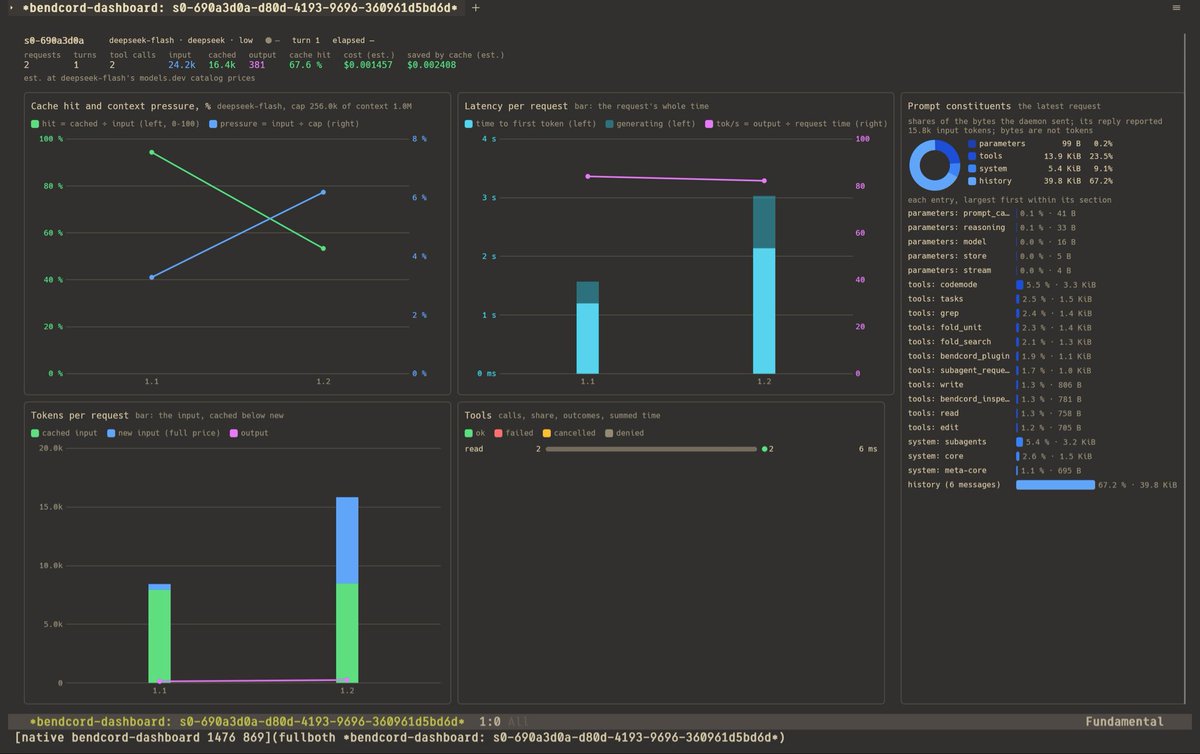
This is how a real session using the context fold idea looks like, very efficient compare to using context compression. It is like constantly doing mini compression on the fly.
Fold, don't compress.
Agents wait for the context window to fill, then summarize everything and lose the originals.
Instead: when a piece of work is done, fold it into its result. The original goes to disk, where the model can still read it. No summary, no extra model call.
stop spliting long function def into multiple lines because it exceed 80 characters, write it in one line, it is easier for agent to grep and compare, if it's too long that it indicate a refactor is needed. New code style is need for agents.
Now nsh is on the Emacs interface for my agent, it can write an in-app interactive artifact on the fly which is embedded in the transcript. There are a lot of potentials…
Emacs is really a good place to work on, every agent UI on terminal is great, but the only thing it lacks is a good editor for inputing, maybe that's why people are using neovim + terminal agent. I want to use Emacs, that's why I'm buidling my own EmacsUI for my agent.
every agent calls bash tool it re-read the context again and that’s inefficient to let agent call multiple bash tool if it can finish the task by writing one script. I disable bash tool and let it use codemode in my new agent, and the result is much better
Codemode doesn't need a sandbox for arbitrary JavaScript, only a language that can do nothing but call the tools you hand it.
Why I kept opencode's evaluator, dropped QuickJS-wasm, and am rewriting the scheduler in Bend:
https://t.co/J3MNTwfgmh
Emacs is a Lisp interpreter disguised as a text editor. Almost everything in it can be controlled through code, so an agent can operate it by writing Emacs Lisp. I think people are sleeping on the possibilities.
@pradeepXkapoor i’m using claude models in my own agent just because I can use the context fold idea instead of compression, basically i’m getting way more usage from the same subscription
https://t.co/0yCLSdVWKy
this time it is written in pure emacs lisp, back to where I should start right from the begining. but I learn a lot, fable just gives me a clear reason why my previous atteamps failed, and it's right.
My own emacs config orchestrator framework, rewritten in 4th time: https://t.co/hl40r6mzmt
I gave fable 5.1 my previous implementations, it just one shot this library, and i accept it. after all it's my own idea, first written in Gleam+TS, then in elle-lisp+rust, then in bend+ts