The apocalyptic novels of Paul Christensen:
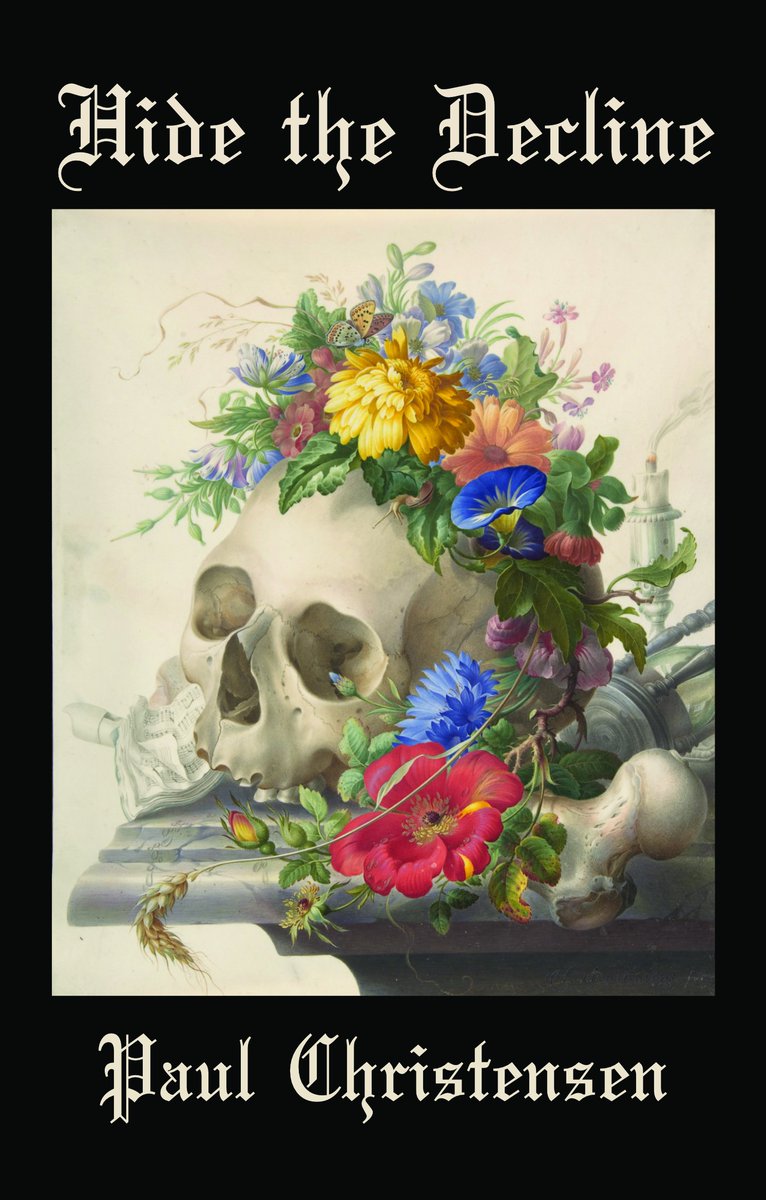
HIDE THE DECLINE
https://t.co/lKDBCvQ1fe
The period from the September 11 attacks to the Covid-19 lockdowns and beyond, as seen through the eyes of a right-wing filmmaker and an anarchist musician.
THE THRESHER
https://t.co/6HyLkMJTTc
A portrait of the underground music scene of the 1990s, ‘The Thresher’ explores the conflict between individualism, nationalism and globalism, and the role of art in an increasingly sterile and conformist modern world.
THE WOLVES TRILOGY (single volume edition)
https://t.co/0DIYOLBw5v
Part satire, part tragedy, Paul Christensen’s tale of an anti-globalist revolt and its aftermath anticipated many political developments of the past decade.
"The best work of dystopian fiction that I have read for many years."
- Black Front Press
‘Christensen’s ability to put his finger on the pulse of everything that is wrong with humanity is a force to be reckoned with.’
- Counter-Currents
‘This is the first book I would lend to anyone who is questioning the system’s narratives. Anyone on the brink of awakening…’
- Juleigh Howard-Hobson, author of ‘I Do Not Belong To The Baader-Meinhof Group & Other Poems’
@Slide2theleft_@ponyfaceddog All the homeschooling parents I know encourage their kids to read the classics.
It's the ones who go to school that are forced to read garbage like this by their braindead teachers:"
The idea of a Western 'canon' is ridiculous, especially in an age riven by factionalism.
Recommended reading lists are well and good, but a monolithic 'canon' implying some kind of 'authority from above' is pure fantasy.
I believe most of the people pushing this idea have non-European ancestry.
Partly because the prose style and characters are more unique, but mainly because it offers a more incisive (albeit dreamlike) metaphor of Western decline than Tolkien's one.
(I do like Tolkien, incidentally, and LOTR was the first literature I seriously engaged with other than Tintin comics).
The Soviet campaign against ‘rootless cosmopolitans’ intensified in 1949.
Framed as an anti-Western patriotic drive, it had originally been aimed at artists and scientists accused of ‘kneeling before the West’, but from 1949 its primary targets were Soviet Jews.
This was partly due to Israel’s creation the previous year.
The USSR had initially supported the Zionist project, but soured on it when Israel aligned with the West.
Stalin was alarmed at the enthusiasm with which Jewish crowds greeted the Israeli ambassador Golda Meir in Moscow.
The USSR’s turn against the ethnic group which had largely created it was particularly ironic, given that Soviet acquisition of the atomic bomb that same year (1949) had been facilitated by Jewish spies like the Rosenbergs.
Once again, the golem legend springs to mind.
Gustav Meyrink, ‘The Golem’ (1915)
This book evokes a distant and shadowy world, when the streets of Prague still had German names.
A world where the Jewish ghetto, whose houses ‘confer together in mysterious, noiseless agitation’, harboured different tribes of Jews who ‘harbour a secret loathing and revulsion for each other, but know how to conceal it from the outside world.’
Meyrink, a gentile, captures this twilight world unforgettably.
(Robert Irwin falsely claims in the preface that Meyrink was Jewish on his mother’s side, but this is untrue).
Aaron Wassertrum, the junk dealer, ‘with his round fish’s eyes and gaping hare-lip,’ lives like a squalid animal, but in reality is immensely wealthy, and has bought off the police.
His son, who changed his name to the more gentile-sounding Wassory, is an eye doctor who runs an evil scheme to mutilate the eyes of perfectly healthy patients.
He becomes a wealthy and respected ‘humanitarian’, until he is unmasked by the penniless student Charousek, who exposes him like some kind of proto-/pol/.
There is a mysterious network of tunnels under the ghetto, which will hardly be surprising to modern conspiracy theorists.
Metaphysically, the Golem is a ‘sudden, spasmodic discharge’ of the ghetto’s spiritually poisonous air…yet he ‘who manages to bind the Golem and to refine him will be reconciled with himself.’
The three female characters represent the ‘three faces of Eve’.
Miriam is the higher, or divine feminine.
Rosina the whore with her ‘waxy, rocking horse face’ and ‘white bloated flesh’ represents the lower, or animal form.
The countess Angelina is the genuine woman, who is a mixture of both.
Reincarnation is real:
‘Your soul is composed of many ‘selves’, just as a colony of ants is composed of many single ants.’
‘Though the soul is not a unity, it is destined to become one, and that is what we call ‘immortality’.’
The prison chapters are based on Meyrink’s own experiences of being falsely imprisoned, and probably influenced Franz Kafka’s book ‘The Trial.’
I think the writers who are remembered in 100 years will be the ones who addressed the difficult issue of technology and its impact, and the political issue of the individual vs. the mass.
Tolkien, while a tremendously atmospheric writer, is too simplistic in this regard.
Frank Herbert and Ernst Jünger are likely to last longer.
https://t.co/Fa9dhlBDWD
Ernst Jünger, ‘Eumeswil’ (1977)
This novel is Jünger’s main fictional explication of his concept of the ANARCH, written in his eighties (he would live and write for another two decades).
Instead of seeking to overthrow power, the ANARCH cultivates inner detachment from it.
‘For the ANARCH, little is changed when he strips off a uniform that he wore partly as fool’s motley, partly as camouflage.
‘This distinguishes him from the ANARCHIST, who, objectively unfree, starts raging until he is thrust into a more rigorous straitjacket.’
The anarch ‘recognises lawfulness, but not law; he despises rules.’
His enemy is the NPC (the narrator calls them ‘eunuchs’), whose most heartfelt goal is to castrate the free man.
Eunuchs are responsible for ‘laws demanding that you run to the district attorney while your mother is being raped.’
In the end, the narrator disappears into the Forest (the imaginal world), while his normie brother consigns his writings to an archive that no one will read.
Jünger is sceptical about nationalism as a viable alternative to globalism:
‘When the empire falls apart, as after Alexander’s death, the old tribes try to isolate themselves again, each citing its own distinctive character.
‘Yet this is precisely what they have lost by passing through the empire, like grain ground through a mill.
‘All they retain is their names, akin to the Greek cities of the Roman era.
‘Yet Alexandria blossoms.’
In other words, this book predicted the Diadochi-like world of 21st century multipolarism.
Perhaps Jünger is right that new strategies against cultural Mordor-hegemony should be sought.
Even if nationalist governments came to power in Europe, all it would do is increase the might of America and Russia, those Macedonian upstarts who swallowed their progenitor.
‘Eumeswil’ also predicted smartphone-like devices called ‘phonophores’, but sadly its ‘luminars’ (memory banks that can call up any period in history) don’t look like being developed anytime soon.
Vaughn Monroe’s 1949 version of GHOSTRIDERS IN THE SKY (written by a park ranger the previous year) was a huge hit, outselling Bing Crosby’s version of the same song.
The tune was partially inspired by an Apache Indian legend about the spirits of the dead dwelling in the sky as ghostly riders, and it also evokes European myths of the Wild Hunt.
It was unusual material for a Billboard number one hit in 1949, and would later on influence the Doors’ song RIDERS ON THE STORM.
@subsix848 The only good Rolling Stones album is this one.
Their other stuff is generic rock and roll, which (for instance) AC/DC do way better, if you're into that sort of thing...
In 1946, one of the most original works in English literature appeared: Mervyn Peake’s gothic masterpiece TITUS GROAN.
Along with its sequel, GORMENGHAST, it is the story of how an ancient, ritual-bound society is brought down by an interloper called Steerpike, whose nature (whether intentionally or not on the author’s part) strongly resembles that of a certain ethnic group.
TITUS GROAN is no mere reactionary work, however, as the protagonist of the books, Titus, while hating Steerpike, is nevertheless himself a rebel against the hidebound traditions of the castle.
Thus Peake’s literary affinities, despite his extraordinarily slow-paced prose, actually lie with ‘radical right’ modernists like Ezra Pound.
@tolkienthoughts LOTR is a kids/YA book.
It's very good for what it is, but at the centre of the 'canon' (for those who believe in 'canons') is a bit of a stretch.
George Orwell’s 1947 essay LEAR, TOLSTOY AND THE FOOL takes on the literary world’s most famous Shakespeare disrespecter, Leo Tolstoy (although George Bernard Shaw and J.R.R. Tolkien are also known for their attacks on the ‘Swan of Avon’).
Tolstoy claimed that Shakespeare wasn’t even an average writer, and that his enduring fame was a result of ‘epidemic suggestion’, like the emperor’s new clothes, rather than genuine merit.
Orwell shows that Tolstoy’s attack contains selective quoting and misrepresentation, and reveals more about himself than about his target.
Tolstoy’s real objection, Orwell argues, is Shakespeare’s zest for life and anarchic inventiveness, the opposite of Tolstoy’s ascetic worldview which sought to NARROW human consciousness.
It is notable that Tolstoy singles out KING LEAR for special examination, because his own renunciation of worldly goods closely resembles that of Lear.
@philosophymeme0 Marx and Rand strike me as Fs rather than Ts.
They took their feelings and made them into a system. Nietzsche was more self-examining.