Modern farms generate more data than ever before. Yield maps, planting records, equipment data, and soil information can all contribute valuable insights throughout the growing season. The challenge is bringing those pieces together in a way that supports better-informed decisions.
When high-resolution soil mapping data is integrated with digital farm platforms, it can provide additional context for understanding field variability and identifying opportunities for more targeted management. By viewing soil data alongside other field records, growers and agronomists can explore relationships that may not be obvious when each dataset is viewed independently.
At SoilOptix®, our high-resolution soil maps are designed to work within the digital tools many growers and agronomists already use, helping make soil information more accessible and actionable across the operation.
Because the value of data isn't just in collecting it, it's in connecting it too. Read our latest blog to learn how integrating soil data with digital farm platforms can help support more informed agronomic decisions.
https://t.co/pSrvDCyC0I
#GreenFarmingFriday! 🌱
A great reminder that better soil decisions start with better soil data. This study shows that proximal gamma-ray spectroscopy can help predict key soil properties like clay, pH, and total nitrogen, especially in the topsoil where crop roots and seedbeds matter most.
That is exactly where soil mapping adds value, because it turns field variability into actionable insights. For #SoilOptix, this is the kind of insight that supports more precise inputs, smarter prescriptions, and a better understanding of what is happening beneath the surface.
Read the full study here: https://t.co/H7z0ujYYDm
Assumptions limit your potential. Better maps unlock it. With detailed soil mapping that reveals what's really happening in every corner of your field, #SoilOptix helps growers and agronomists move from guessing to investigating. More details. Better conversations. Smarter decisions.
Learn more at https://t.co/ER13r2xGw7
A common question we hear from growers isn’t how to collect data, it’s what to do with it next. This is where conversations with your agronomist become so important.
Many agronomists use high-resolution soil maps to create practical recommendations that balance field conditions, crop goals, input efficiency, and current economics, stating that “prescriptions can only be as precise as the data it's based on”.
This is why many agronomists prefer our high-resolution soil maps with 335 data points per acre, which allows them to easily spot patterns and hidden variability that traditional sampling methods can miss.
Together, #SoilOptix data and agronomic expertise help ensure you’re making the most informed decisions possible, and getting the most out of every acre.
#AskYourAgronomist
SoilOptix® operations look a little different depending on where you are in the world.
Service providers and growers are constantly adapting the technology to fit their operations by integrating sensors into existing equipment, and building custom setups that make data collection more efficient for their fields.
In Thailand, Wondermilk integrated the SoilOptix® sensor directly onto a forage harvester, creating a streamlined approach to collecting high-resolution soil data alongside daily field operations.
Where will we see #SoilOptix next?
Not all variability is visible from the cab.
A field can look uniform at a glance, but underneath, nutrient levels, texture, and soil composition can change dramatically across short distances.
This hidden variability can quietly impact everything from input efficiency to yield potential.
Traditional sampling methods often generalize those changes across larger zones. #SoilOptix takes a different approach, combining gamma-radiation scanning with strategically placed soil samples to generate high-resolution maps at up to 335 data points per acre.
The result? A clearer picture of what’s actually happening across the field, including macro and micronutrients, sand, silt, clay, pH, organic matter, and more.
Because when you can see variability where it actually exists, you can make more informed decisions about where inputs are truly needed.
Soil variability could be costing more than you think.
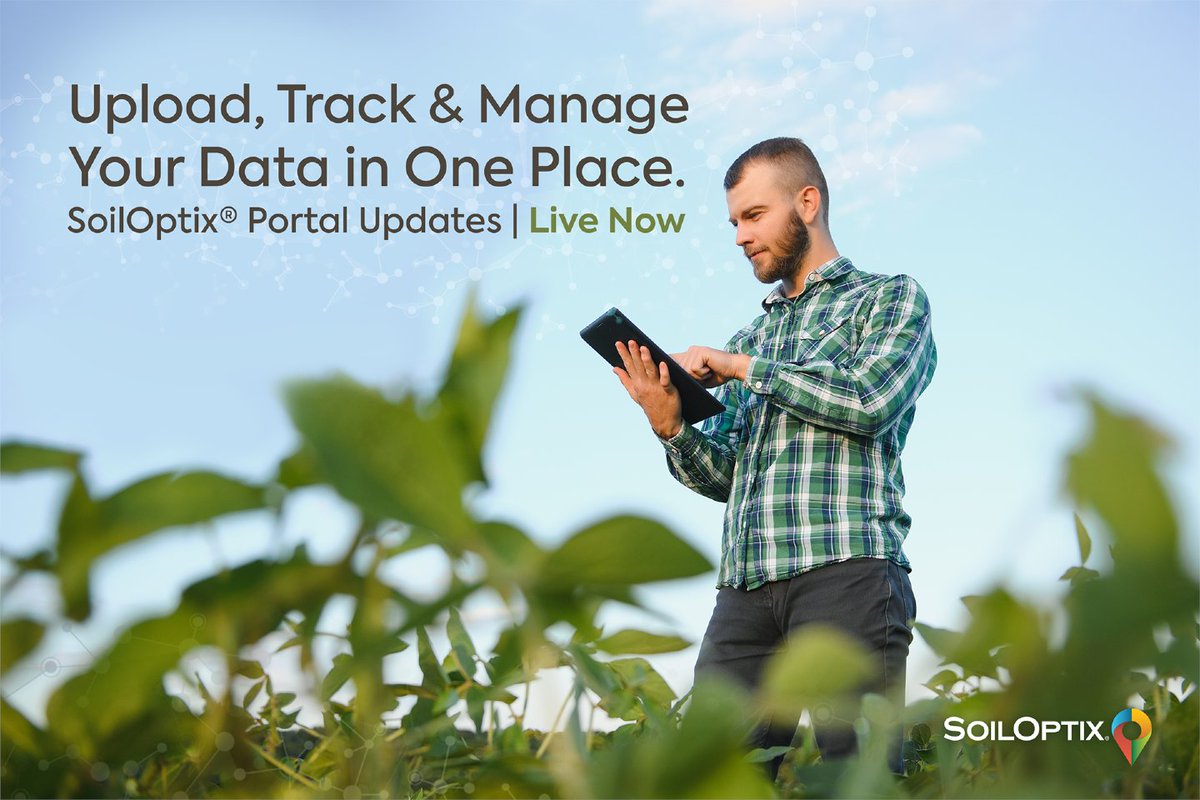
The new updates for the #SoilOptix portal are officially live!
Starting today, users can now upload data directly within the Portal, control who on your team has access to specific information, and communicate with our team directly from individual fields through the new Messaging System, creating a clearer historical record and more streamlined workflow.
You’ll also be able to track where data sits in the processing pipeline with improved status visibility and quicker identification of fields that may need your attention.
These updates are designed to simplify daily operations and create a more seamless experience for providers across all regions.
One of the most interesting parts of the #SoilOptix network is seeing how providers adapt their collection vehicles to fit local field conditions.
In Denmark, our provider Danish Agro added tracks to their UTV to better handle wet winter terrain and extend their collection season in difficult conditions.
Where will we see SoilOptix® next?
What looks uniform on the surface often tells a different story below.
See what your soil is really telling you.
Visit https://t.co/SH2D1899ze to find a #SoilOptix provider near you.
#GreenFarming Friday! 🌱🌎
Soil mapping is an important part of how growers think about sustainability. This fact sheet points to a few of the same ideas #SoilOptix is built around, using field-level soil information to better understand variability, identify soil health opportunities, and support more targeted management decisions.
It’s a good reminder that when soil differences are clearer, it becomes easier to manage each area with more intention. #SoilOptix fits into that conversation by helping turn those soil patterns into something more practical to work with.
Read the full article here: https://t.co/oJCBhipl8K
#SoilHealth #SoilScience #SoilHealthMatters
We’re excited to share what’s ahead for the #SoilOptix Portal.
This upcoming update represents a step forward in system performance and user experience, all designed to improve day-to-day workflows and create a more streamlined experience for providers across every region.
At its core, SoilOptix® is about turning high-resolution soil data into practical, actionable insight. These improvements are built to make that process even more seamless, from data management to decision-making in the field.
We’re excited to share what’s ahead for the #SoilOptix Portal.
This upcoming update represents a step forward in system performance and user experience, all designed to improve day-to-day workflows and create a more streamlined experience for providers across every region.
At its core, SoilOptix® is about turning high-resolution soil data into practical, actionable insight. These improvements are built to make that process even more seamless, from data management to decision-making in the field.
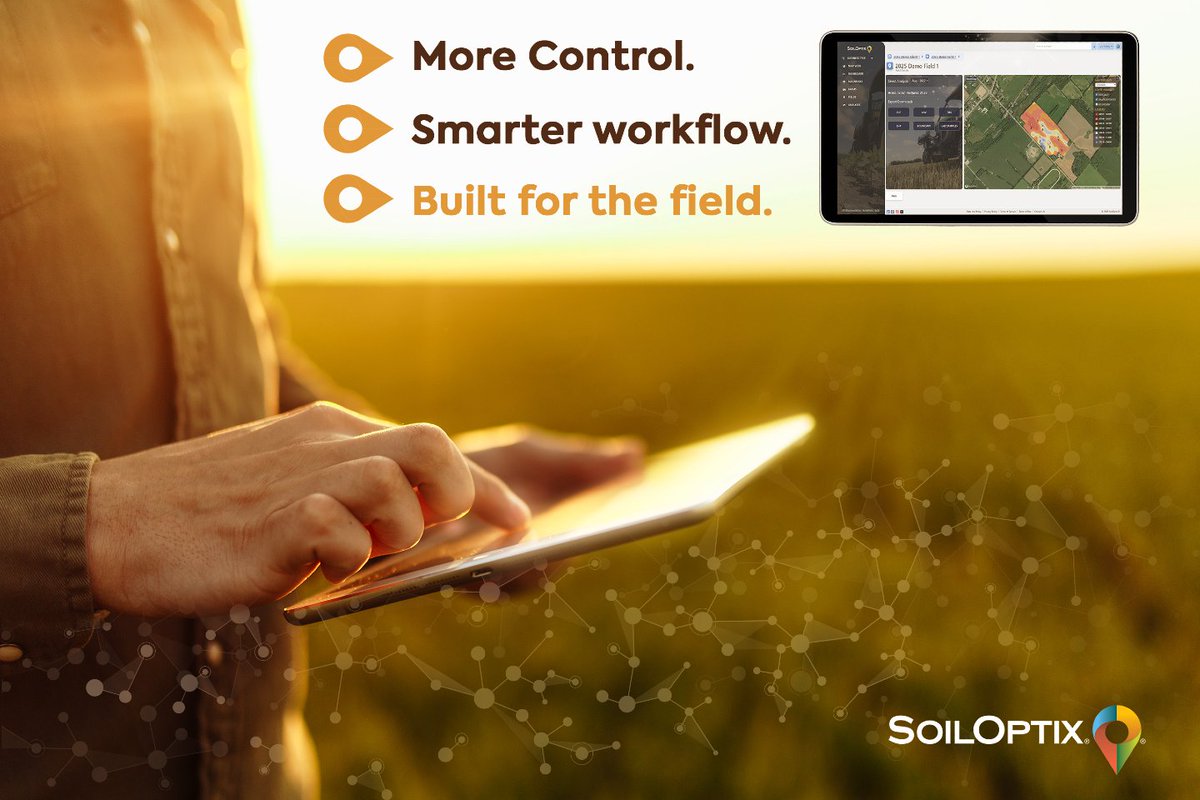
We’re excited to share new updates to the #SoilOptix Portal.
Rolling out May 4th, these updates are bringing more control over your data, a smarter, more streamlined workflow, and a system built for the realities of the field.
All designed to help you stay connected, informed, and ready to act.
We're very proud to be celebrating 10 years with @cropcare Consulting!
From a single sensor to a multi-sensor fleet, they’ve played a key role in bringing high-resolution soil data to growers across Western Canada.
Proud to have them as our trusted service provider in the region.
Ready for spring? Our high-definition mapping provides 335 data points per acre across more than 25 layers of essential soil data.
With our level of data resolution, you can be confident you’re applying the right rate of fertilizer in the right place.
Find a provider near you and make confident, data-driven decisions this growing season: https://t.co/wt1xeg2fja
We’re excited to announce updates to the SoilOptix® Portal!
On May 4th, you’ll be able to:
• Create, manage, view and UPLOAD data into the Portal for analysis.
• Communicate with us just like email, directly in the Portal from the specific field and dataset in question, giving you complete historical visibility for every field, via our new Messaging System.
• Instantly see where your data is in the processing pipeline and quickly identify any fields that need your attention with Status Updates.
All designed to give you more clarity and control!
We hope you're able to take a moment to slow down, spend time with family, and enjoy some good food this weekend.
Happy Easter from the #SoilOptix family to yours!
What you do early in the season shapes everything that follows.
Getting a clear read on your fields in the spring gives you a stronger starting point before key decisions are made. And even if things are already in motion, there’s still flexibility. Using the #SoilOptix gamma sensor, scanning can take place after crop emergence, as long as field conditions allow it.
Ask your agronomist what’s possible this spring.
#GreenFarming Friday! 🌱🌍
Digital Soil Mapping remains a key component of precision agriculture. This new review discusses how DSM is used to generate high-resolution soil maps from targeted sampling, capturing field variability that traditional methods may overlook.
These detailed maps of texture, nutrients, organic matter, and more can support site-specific management, suggesting opportunities for fertilizer, lime, and seeding decisions tailored to each field’s soil variability.
By identifying potential yield-limiting soil conditions before planting, growers could optimize inputs and better utilize every acre's potential.
📖 Read the full review here: https://t.co/iLuXl21ePA
#SoilHealth #SoilScience #SoilHealthMatters
Many nutrient plans are still built on broad averages, despite the significant soil variability within every field.
This breakdown looks at how higher-resolution soil data changes the way fertilizer and seeding decisions get made. When you can actually map variability across the field, prescriptions become more precise, inputs are used more intentionally, and performance becomes easier to explain.
If you’re already using variable rate, this is really about what’s driving those decisions in the first place.
Read the full breakdown: https://t.co/kr4djr2GAt