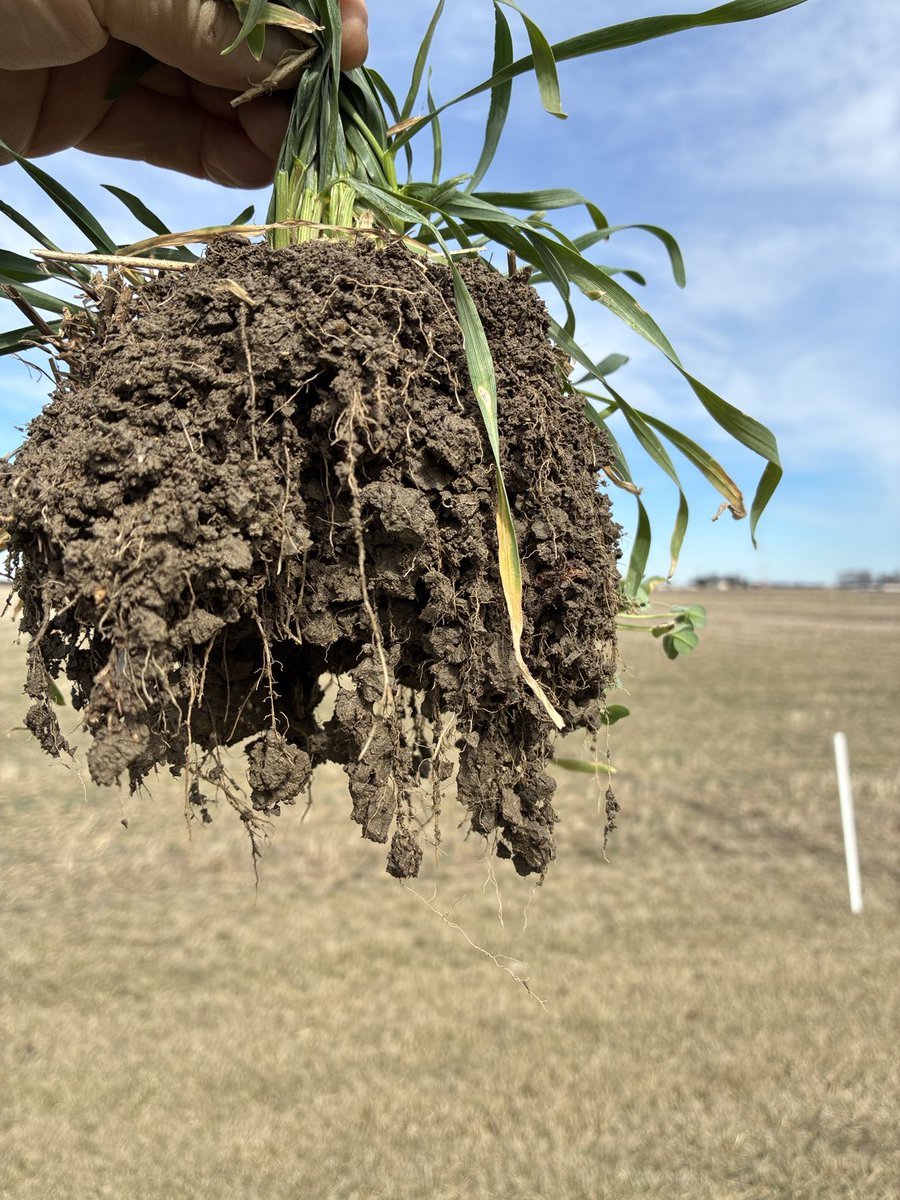
This is what well aggregated clay soil can look like. Zero tillage, living roots, diverse rotations, integration of ruminants with rotational grazing. The Devil is in the Detail. March 14, 2026 the last day of winter here in my corner of 🇨🇦
Cover crops aren’t just a soil practice—they’re a systems strategy: more living roots, flexibility, and a real option to pivot when feed prices spike or grain prices drop. Make them pay double dividends with grazing: https://t.co/wcmUHbUkt2 @UnderstandingAg
When we think of a generational farm we often think of multiple generations from the same family working the land over the course of centuries. Brian Dougherty and Sara Faivre are seeking to start a generational farm that is generational in it's founding.
Check out the @AcresUSA Eco Ag Conference in Madison, WI. I'll be discussing Building Profit and Resilience With a Systems Approach to Biological Farming. Looking forward to representing @UnderstandingAg and joining a great lineup of speakers. https://t.co/ztLW0zSmL9
Just Get pH Right?
Does getting soil pH “right” lead to more nutrient availability?
Yes, but also no. Life in the soil is not one dimensional.
When considering pH, we should also be considering Eh (soil redox potential).
There are management decisions that can influence both pH and Eh, and these two metrics should be thought of together.
Redox Potential (Reduction and Oxidation)
Reduction= gain of electrons (H+)
Oxidation= loss of electrons or gain of Oxygen
To make it easier to understand, I think about a plant oxidizing the atmosphere (adding oxygen) and the roots reducing (adding H+) to the soil.
Reference the Pourbaix diagram I’ve attached to see how pH and Eh relate. There are more of these charts you can find to see where different nutrients may become available to the crop. You can find this by looking for Olivier Husson’s work.
It makes sense why pH is considered and Eh is not. pH can actually be measured on a soil test. But even pH is not static even though we treat it like it is. Either way, there are management choices that will impact both.
Here are some examples of an overly oxidized, reduced, and a more balanced system.
Overly Oxidized:
-frequent tillage
-dry soil conditions, low residue cover
-low OM/low WEOC
-nitrate based fertility
-low biological activity
All results in high Eh and slightly alkaline conditions plus nutrient tie-ups
Overly Reduced:
-heavy clay w/ poor drainage
-high OM and/ or manure inputs
-compacted, anaerobic subsoil
-waterlogged for extended periods of time
All results in low Eh and more acidic conditions plus anaerobic microbial activity. Blueish gray looking soil that might smell rotten.
A more balanced system:
-living roots as much as possible
-minimal tillage
-mixed nitrogen sources
-good biological activity
-ground cover
-aggregated soil
All results in moderate Eh and slightly acidic to neutral pH. Leads to nutrient cycling and resilience.
There's still time to apply for Nuffield USA 2026 agricultural scholarships. Travel the world and connect with an amazing network while studying a topic of your choice Learn more and apply here:https://t.co/rmp18Ox0PT
There's still time to register for the September 23rd workshop in Charles City IA where we will explore a different way to farm that builds profit and resilience while improving your land for the next generation. RSVP here: https://t.co/1DTo1ay1LI
Join Understanding Ag Consultant Brian Dougherty in Charles City, IA, on September 23 for a hands-on workshop exploring soil regeneration, nutrient management, and profitable crop-livestock integration. https://t.co/trJIkLy6iP
@SoilLorax Planted too shallow would be my guess. Tilled fluffy soil can settle after it's been planted and the resulting seed depth is less than it initially appears. You can still dig it up and find the seed and check.
Check out this @UnderstandingAg workshop focused on dealing with the root causes of ecological dysfunction and financial stress on farms. Great opportunity to network and see positive change in action @joiafoodfarm RSVP here: https://t.co/1DTo1ay1LI
@StripTillFarmr Look up the definition of cide. 'Far more safe' = this pesticide might kill you slower than the old ones. These can be useful tools, but let's not pretend they're 'safe'. Soil, plant, animal, and human health cannot be disconnected.
@kohima_io The conclusion is that people paying 1966 grazing rates who still haven't figured out how to make money are not going to adopt those technologies.
Hot, humid, and thriving: Keys to cattle comfort in summer
When the summer sun blazes, are your cattle thriving or just surviving? In this timely blog, UA's Allen Williams, Ph.D. shares practical, proven strategies to help your herd beat the heat. https://t.co/QrwZG4HXYP
On this edition of the Strip-Till Farmer #podcast, brought to you by Environmental Tillage Systems (@SoilWarrior), Understanding Ag consultant Brian Dougherty gets to the root of compaction.
https://t.co/SDM7qiYlk8