Why I love Trading and why it is a Fight
Yes Money is a reason - as for many things we do in life.
Who says money isn't "everything" - why you sell your time for it then? Another topic...
For me trading is like fighting. It's like having an opponent that has 1000+ fights and seems unbeatable. The moment I step in the Ring - open the charts and start a session - makes me feel alive.
It shows who I am. It's a mirror. There is no hiding, and many are watching. I might get beaten up. Maybe I die.
The fear, the greed, the pressure, the pain - everything is on an extreme level.
When I was doing Muay Thai I didn't have the best technique. I didn't even train one year before go fighting, but I have heart. When I enter the ring, I decide that there are only 2 outcomes.
Either I go knockout - or I win. Nothing inbetween.
I never backed down. No stepping back. People in my gym knew me for always pushing forward. I put as much pressure on my opponent as possible, not caring about getting hit, not caring about looking good. I just wanted to destroy. I love the violence - in a regulated way, when both accept.
Being in the market has a lot of similarities. The first fight I had was in front of my family and round about 50 spectators - uncomfortable but manageable. I can compare that to trade with very small risk.
Losing wouldn't be nice but it's not that bad.
The next fights had more spectators, the opponents got harder and I knew it won't be easy. I was ready to win, but accepted the fact I might go down fast. Getting knocked out in front of 100+ people isn't that nice - but still I am the one in the ring. I am the one who's taking the risk.
It's like sizing up. I might be ready to lose and take the risk, but the pain here hits different. It's another level.
But it makes me feel alive. And if I want to make it, I can't avoid that.
Winning here makes a difference. I get real money, not only for buying groceries or going to dinner with my wife. No it's more. Maybe a monthly salary in some hours.
So. To make it in trading, same like in fighting, I must accept to get beaten up. If I enter the ring there's no way out. Yeah I can give up - but let's be honest thats embarrassing. No option.
In trading, when I give up, cut early, don't execute what was planned or tilt - nobody sees it. I am alone. The shame is only on me. (obviously not always, cause I do live trading in front of other people but I want to stick to that example.)
That makes it even harder. When I cut early and see the trade playing out... Wow how weak am I?
When I hold the position, follow the plan, using the size as planned and fully accept to get banged - that should make me proud. It does.
A Stop Loss? Is not nice, but is okay.
I lost many fights. In ring. In life. I can take the pain. At one point it's natural. If you never got knocked out, you never pushed it above your limits.
The society I grew up in taught me violence is bad, pain is bad, everything that hurts is bad.
How wrong they are...
I love trading. When I get into the flow state, it often reminds me of fighting. It's like being an outlaw. F*ck the system vibes.
Every time you tell somebody you are a trader they are in doubt. Even showing the before and after - yeah thats luck.
They aren't fighters. Their mentality is weak. They fear punches. If they get attacked, they don't fight back... They don't even run. They just freeze.
I get comfortable. I begin to handle the emotions better and better. I get more "cold".
My character grows in front of the charts. The development is real.
Why do you trade? Why do you like it?
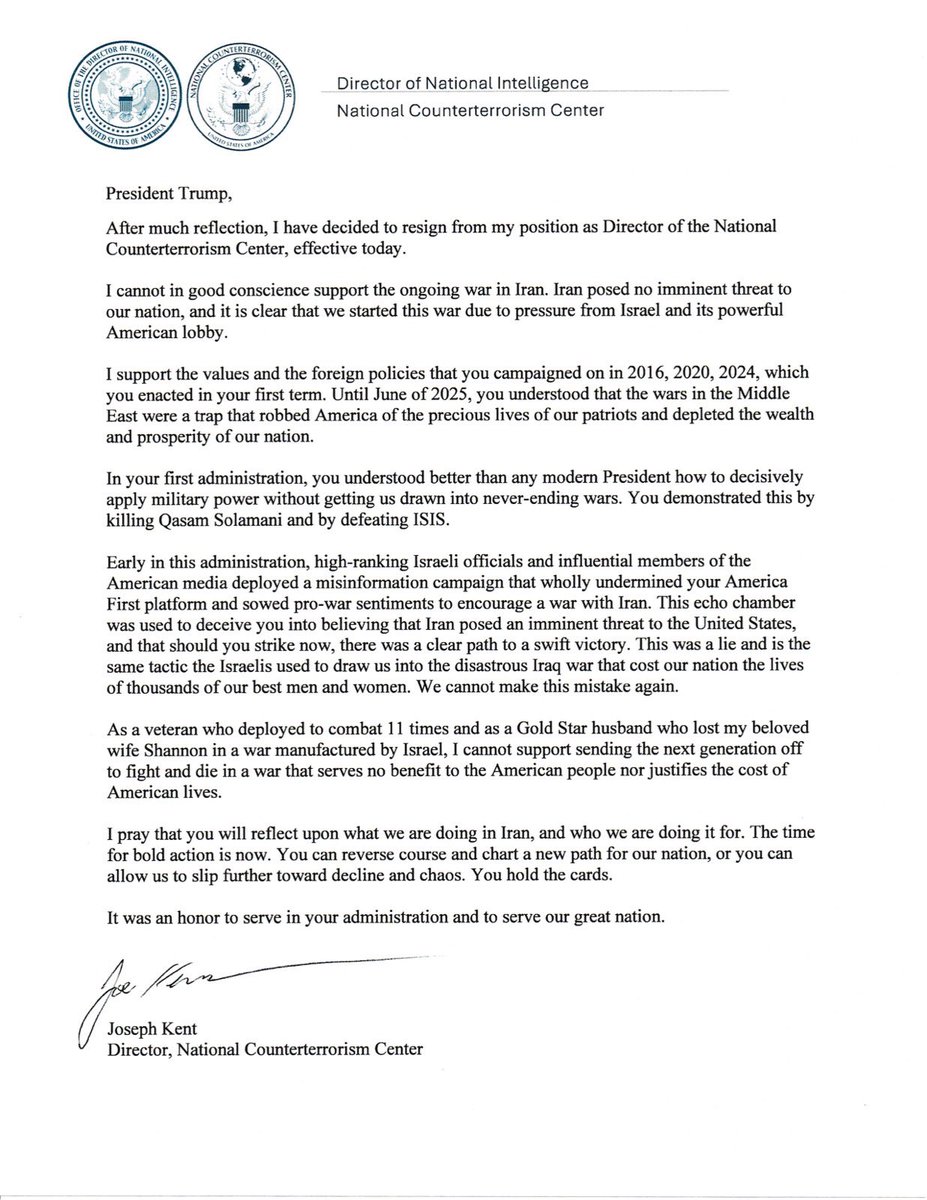
After much reflection, I have decided to resign from my position as Director of the National Counterterrorism Center, effective today.
I cannot in good conscience support the ongoing war in Iran. Iran posed no imminent threat to our nation, and it is clear that we started this war due to pressure from Israel and its powerful American lobby.
It has been an honor serving under @POTUS and @DNIGabbard and leading the professionals at NCTC.
May God bless America.
I haven’t traded crypto in a couple months as I’ve been focused on indices and forex. I took levels charted months ago blindly. Lesson learned. Taking trades with no context or confirmations gets you into trouble. Thankfully my risk management kept me safe but losing money is still losing money.
The Nineteenth man.
Who is the nineteenth man?
When I first started trading I heard the statistic that 95% of those who try fail. That means that on average in every random sample of 20 people who started trading, only 1 of them will succeed.
I imagine myself in this random sample. In a group with 20 random other people in the world who started this at the same time as me. Within this group only one of us makes it.
That is going to be me.
Therefore everyday I imagine the nineteenth man, hot on my heels. What is he doing? What can I be doing that he isn't? How do I guarantee that he doesn't not overtake me and leave me instead in his place?
In my group of 20 I imagine 10 perhaps will be half hearted, those who will say they tried but in reality got bored or lost all their money and gave up after a few months. That leaves us with 10 who do more. They read, they learn, they take notes. But even amongst them when they start to realise the scale of the task at hand or other 'commitments' and 'responsibilities' get in the way perhaps after 12 - 18 months or so, 5 of them then too chuck in the towel.
That leaves us with 5. The 5 people here are now people who really are trying and they show commitment. So what happens to them? Perhaps they try their best but one fails to discipline themselves and then caves to the comforts of normality. Another can't manage risk and blows account after account eventually giving up in a rage or despair. The a third has unforeseen life circumstances hit, a loved one falls ill or they break up with a partner and there focus is now taken else where sadly leaving this behind as a dream that never quite came to fruition.
That just leaves me and the nineteenth man. The one still standing. What is he doing? Does he wake as a early as me and work as late? Is he truly as devoted to this as I am? He could well be. So how do I succeed, what is my edge...
Discipline, focus and small habits.
Trying to be 1% better in all that I do.
Can I be 1% more focused. 1% more efficient. Get 1% more done. Put in that extra mile.
Because if I don't I will end up myself the nineteenth man.
- BOS
- Check if hidden liquidity level left behind
- Check if fibs align with your level. Define your entry & SL
- Look for confluence on majors
That's your setup
If your setup doesn't fulfills these, most likely won't work out or you'll see a messy reaction aka wick you out
Moneytaur study blueprint 🗺️
The process I used to go from not knowing what an order block is to pulling cash from the crypto markets in under 6 months using @Moneytaur_ concepts.
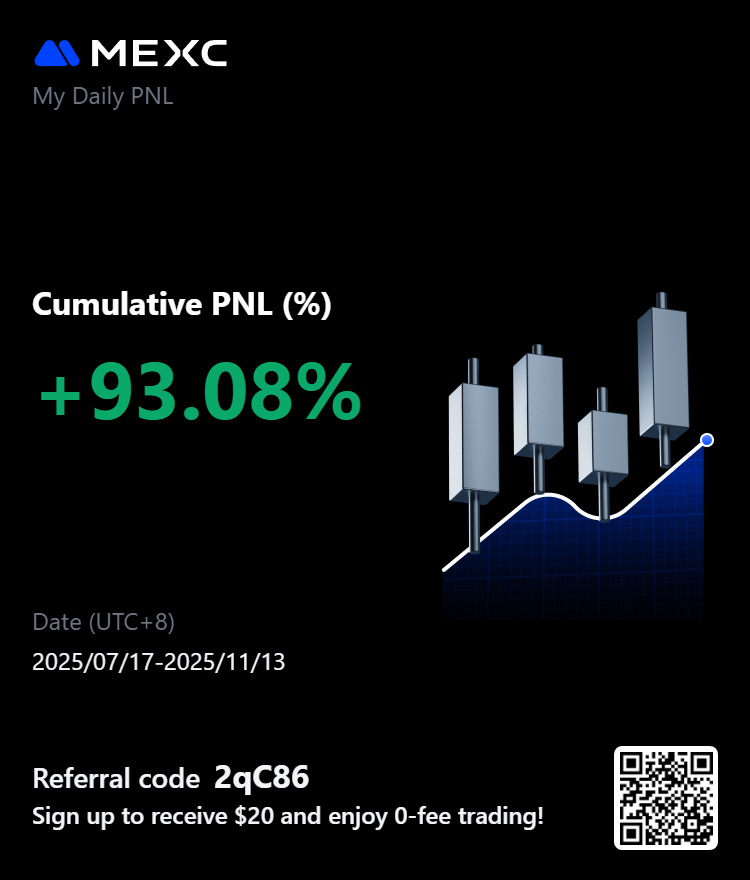
Proof of performance, past 120 days👇
Start date: 09/03/2025 https://t.co/YFgNq5yJ9N
Requirements:
- A PC/laptop
- Wifi
- A basic understanding of trading. ( What candlesticks are, how to actually place trades , etc )
- A free mind
- Time or the ability to free up time.
Starting:
- Structure and routine
- Stick to that routine + Pre mortem plan.
- Notion / Obsidian setup.
The first thing you need to create is a clear routine moulded around how you intend to approach this very large and complex task. This will not be linear and you will naturally adapt it as you progress but especially in the beginning some resemblance of structure each day is vital.
This is an individual process but it is important to understand from the beginning that this will require a majority of your free time assuming you work a full time Job or study as a student. For me in the beginning this looked like:
- Wake up at 6:30.
- Shower
- Study/work for 1h 45m before leaving for work.
- 09:00 -> 17:00 work
- 17:30 Exercise / Train
- Eat
- 19:00 resume study/work
- 22:30 Start to wind down and get ready to sleep.
It changed several times over the months and especially now I am full time but this is irrelevant, the only thing that matters is sticking with what you choose.
Whatever your own routine may look like, it is important to understand it will inevitably require sacrifice.
---
The next thing once you have established a draft framework of your routine is ensuring you will actually stick to that routine. Something I implemented which I found particularly beneficial was the concept of a Pre-Mortem plan. This involves creating several scenarios of a future in which you have failed and working backwards from each of these to find where it went wrong. Here is a video which explains it fully: https://t.co/QGPyfrgrPK
When I did this I came up with 3 scenarios as well as prevention and cure for each. In the 6 months that followed each scenario presented at some point but I was able to catch them early due to having done this.
The last thing is to not over complicate this, don't hyper focus on systems and loose momentum optimizing each detail. Just ensure you do the fucking work.
I was a little guilty of the above at times, trying to craft the perfect routine. In reality the person who just gets up, drinks too much coffee and works his ass off out performs the workflow perfectionist who visualizes and repeats affirmations, any day of the week.
---
Next you need somewhere to store your notes, journal your trades and build your knowledge.
For me this was Obsidian but I have also used Notion before and it is an equally viable option. Whichever one of these you choose be warned you will inevitably want to bang your head against a wall trying to use them for the first few days, but they will both click pretty quick and are 100% better options the word document or paper alternative.
Here is my full obsidian setup tutorial: https://t.co/7sdsOTQEyE
Here is a link to @studentoffew 's notion Journal: https://t.co/nfFCqFnpsX
Here is how I create "Meta-Notes" using obsidian: https://t.co/WKmYwwWmJu
The process:
- How I did it.
- How I would do it if doing it again.
Now I did things the "hard way" and manually worked my way back through each of MT's tweets starting in 2021, reading every one and logging those that I felt where relevant. You can see in my first post: https://t.co/YFgNq5yJ9N the very first system I used to do this. I quickly adapted though after about a week and focused less on just logging each relevant tweet but trying to find and focusing on those which contained the most information. There where a lot of charts I looked at then skipped over because especially at the start of his timeline they contained little useful information and my time was better spent finding those where there was something to decode. Now this does not mean skip out on "work" just use your time efficiently.
--
If however if I was to start from the beginning again with the goal of levelling up technical understanding as quickly as possible I would take a different approach. To start with I would familiarise myself with all relevant SMC concepts, I have linked the best free recourses for this below 👇
@CryptoChase02 beginner friendly index: https://t.co/j0IDFJzlN1
@barnc0re's "The Moneytaur Way" series: https://t.co/SoHcnsNJcg
@materagian's Trading bootcamp playlist: https://t.co/jdtTOWHEEg
Following this I would then work through all of Taur's subscription posts working backwards, recreating his charts and taking notes on his logic. The subscription feed has the highest value density and least noise.
Video example of my notes from his subscription posts 👇:
---
Okay so now once you have a basic understanding of concepts and can re-recreate them on charts of your own it is time to put this in to practice. The next step is vigorous backtesting, you can use the trading view tool but I think trade Zella offers a more use friendly option if you pay for the subscription. Especially as it allows you to change timeframes without skipping ahead to candle close time of the timeframe you change too ( like Trading view does )
*my only note would be that their LTF/Micro TF data feed with be different to brokerage charts you will use on Trading view, to start with though you should not be going low enough that this is an issue.
When you backtest in this context, treat it like real trading. That means journal and logging like you would if real cash was on the line. Take time, do not rush and focus on quality.
Stick to BTC, ETH, Major FX pairs or indices as these assets are less reliant on confluence, backtesting a shitcoin is near useless as whether levels work or not will be highly dependent on Majors PA. Go on HTF, scroll back a couple years and try not too look at chart while doing so and then begin. Start with HTF analysis and work down to 2H or wherever you feel comfortable, chart it fully and then identify setups. Make rough notes / plans and then press play, execute the setups as they hit, log and journal trade management as well as observations and key notes. It is very important to not cheat when you do this, do not skip back and adjust your stoploss because it hit by 0.1%, do not skip back and adjust plan because you missed a block and your TP got frontrun. Instead these are the things you journal, embrace these mistakes because they are the cheapest mistakes you are going to make.
Grind this, do it for hours, put some music on and enjoy. To start with focus on HTF's, as you get better and start netting $ on paper you can drop the timeframes and increase the difficulty. HTF = Normal, MTF = Medium, LTF = Hard. Even if you do not intend to day trade, learning how to read the lower TF's that force you to think faster, harder and prepare you for lower win rates / loss streaks can greatly improve your ability on higher TF's.
While you are doing this as you start to have concepts click you now want to build up your real trading experience, take a sum of money that you care about but will be okay loosing and dedicate this to live trading. Start taking real trades and expect net losses in the beginning. This is where you will make you 2nd cheapest mistakes. This is also where you can begin to learn about your psychology. You may encounter some elements already in backtesting but the real market is where true colours really start to show.
Mental issues are inevitable and part of the game, get used to them and start working to identify and fix them. Reading and applying books like Trading in the Zone and Mental Game of Trading are important and will help a lot but there is no easy fix, for some stuff you I believe you just have to get used to it and it goes away with experience. Losses suck at the beginning but after you loose 100 times you starting getting pretty numb to it, same goes for the winners.
To accelerate the learning process, build connections and get advice there is also always the option of private groups, while I never personally chose this route and committed to learning everything through my own endeavours there is no denying that having nearly all the information you need structured and compiled in one place is valuable and can save time. Beyond this having access to real time thoughts and opinions of profitable traders can accelerate performance, however it carries the risk of being a double edged sword if not used properly, if relying on it like a crutch and using it as a substitute for real work you will not succeed. With that said if you take it for what it is, a learning opportunity then I believe it can be very beneficial. I am not a member of, nor affiliated with any paid group.
There are now many options available within the community, all run by different people with different styles, tailored to different needs. If I was to make a recommendation though, as a non-member, it would be @Albert_618 & Co's 618'ers simply due to the diversity in styles of the traders running it and results I have seen from members I know personally.
It is important that as you start to trade with real capital you reduce noise in your social feeds or eliminate it all together. You do not need 5 different opinions, you also do not need 2 people telling you the same thing in their own way so you feel re-assured. What you do need is to develop your independent thinking as a trader and be comfortable making different decisions to others, even traders ahead of yourself if it fits with your system or understanding of market. Taur here is perhaps an exception as this is who you are learning from but down the line a real test of your own ability and independence will be being able to stick with your own plan even when it differs from his. Don't get me wrong, counter trading him is retarded but you must learn to adapt his gift to your own style. This will make sense at some point.
The next stage is taking your understanding of specific concepts to higher level as you simultaneously snowball experience. Look back through your journal and review where you lost money and made money, do not over extrapolate from a small sample but start to take notes and observe if trends in performance emerge. This is the beginning of the transition to self reliance, you now understand the strategy but must learn for yourself when and where it works.
Here you can also learn more nuanced secondary concepts such as VSA, orderflow etc and add these to your game where appropriate. Do NOT get lost in the sauce though and remember mastery of basics is key. IMO a big focus should be understanding correlation thoroughly but especially on HTF's this is the most important thing and what triggers the majority of large swings where most of your cash will be made and losses recovered.
Some people will disagree with me here but IMO you should also not be *focusing* on Odd TF's. These are secondary at best and most people overweight their significance leading to avoidable losses while wondering why price did not care about their 327minute Breaker Block which they think is the key to the market. Study Taurs feed and take note of how he mostly uses: 3M, 1M, 3W, 2W, 1W, 5D, 4D, 3D, 2D, 1D, 12H, 8H, 6H, 4H, 2H, 1H, 30m, 15m + micro time frames.
The only thing left is time and repetition, you must show up each day and really do this, for months. Maybe you start to see result's, you catch your first key swing and where able to trade where others froze. Congratulations. Learn from these winners and repeat the actions. Find what assets work best for you, find your style, refine and grow.
---
The last thing I will include is a short list of tools or links that can be helpful.
- Trading view tutorial: https://t.co/YduNlFTYXw
- Dictionary: https://t.co/668NUwodj2
- Market news Calendar: https://t.co/YE22AWAdKt
---
Thank you too all those who have read this, I hope this has been helpful for the beginners who want to start but are just not sure how. 🫶
Don't just bookmark this and move on, start 🙃